Quantity Price Breaks for Shopify Subscriptions
Set quantity price breaks on Shopify subscriptions without giving away margin. Compare tiers, Build-a-Box, cart rules, and AOV versus profit.
Set quantity price breaks on Shopify subscriptions without giving away margin. Compare tiers, Build-a-Box, cart rules, and AOV versus profit.
The most popular advice on volume pricing is simple: cut the unit price, watch the basket grow, and call it a win. That advice fails the moment you look at what is left after product cost, pick-and-pack, payment fees, spoilage, and cash sitting in a cupboard. A bigger cart can raise average order value while each order earns less than a single full-price bag.
Quantity price breaks are useful only when the extra units still leave more contribution than the order they replace. If the shopper would have bought one unit anyway, a deep cut is a gift, not a growth tactic. I would refuse any deeper tier that needs a discount the margin cannot carry, or a pack the customer will not finish before it ages out.
The test is contribution per order. Unit price and basket size are inputs. They are not the score.
Table of Contents
- Quantity Price Break Types That Hold Up
- Make Breaks Usable for Real Households
- Test Each Break Against Real Costs
- Set the Break on Shopify and Subscriptions
- Read Results and Keep Only Profitable Breaks
Quantity Price Break Types That Hold Up
A quantity price break is a lower unit price that applies only after a cart, bundle, or prepaid plan crosses a set quantity. Take a $28 specialty coffee bag. At two bags the offer is 10 percent off. At three bags it is 20 percent off.
Checkout math splits the two common rules. All-units reprices every bag once three are in the cart, so revenue falls from $84 to $67.20. Incremental pricing leaves the first two bags at $28 and discounts only bag three and beyond, at $22.40, so that same cart stays at $78.40. The shopper still sees a deal. You keep $11.20 more on the order.
Most write-ups stop at that contrast and treat the discount as an automatic saving. A Springer chapter on quantity discounts is more useful. In one modeled case, incremental discounts increased order quantity by 2.1% but reduced total inventory-management cost by only 1.9%, while holding costs rose. A higher threshold can hurt even when the per-unit price looks better, especially on perishable or trend-sensitive goods. Carrying cost, financing, spoilage, and uncertain demand all sit on your side of the ledger.
| Break type | How the price changes | Worked example | Use it when |
|---|---|---|---|
| All-units | Every unit drops once the quantity is reached | Three $28 bags fall from $84 to $67.20 | The offer must be simple on a Subscribe and Save widget |
| Incremental | Only units above the threshold get the lower price | Bags one and two stay $28, bag three is $22.40, cart is $78.40 | The first units must keep full margin |
| Renewal ramp | The discount deepens after a set number of paid orders | 10% on order 1, 15% from order 4 | You want retention without a large first basket |
| Build-a-Box bands | The discount follows items in the box | 4 items 5% off, 6 items 12% off, 8 items 18% off | Shoppers mix flavors or SKUs on a replenishment cadence |
| Prepaid multi-delivery | A modest cut in exchange for several deliveries paid now | 3 monthly deliveries prepaid at 10% off the monthly total | Cash collected up front matters more than a deep per-unit cut |
| Mixed-SKU count | Different products count toward one threshold | Any 3 SKUs unlock 10% | Customers will not store six units of a single product |
Which row belongs on the product page
All-units fits a simple Subscribe and Save widget because the shopper can check one price. Incremental fits when the first units must hold full margin and you can explain the bands without a calculator. A renewal ramp of 10 percent on order one and 15 percent from order four buys retention without a huge first basket. Build-a-Box bands at four, six, and eight items reward a fuller mix. A prepaid three-month pack trades a modest discount for cash collected up front. Mixed-SKU counts let a shopper access the break across flavors instead of six of one product.
If you are still choosing the shape of the ladder, testing tiered pricing on Shopify is a practical walkthrough of how those models behave in a live cart. Pair that with a subscription pricing strategy that sets the discount against reorder frequency, not against a one-time impulse.
If shelf life, storage, or cash on hand cannot support the threshold, do not publish that row.
Make Breaks Usable for Real Households
A steep bulk tier looks generous on a pricing slide and useless to the shopper who closes the tab. Larger packs can cut the unit price sharply. Cash in the account, cupboard space, and the effort of comparing offers still keep many households on the small size.
That pattern shows up in supplements, coffee, skincare, and pet food. People want a recurring saving. They do not want six months of product on day one. Evidence using NielsenIQ data indicates that low-income households could save about 5% on groceries by buying in bulk at the rate of higher-income households, and that cognitive costs discourage bulk buying, while unit-price-display mandates in nine U.S. states may make the saving easier to see, according to Mallick Hossain's bulk-buying analysis.
Put both prices on one line
Show unit price and amount due today on the same line. A $22.40 bag that requires $67.20 at checkout is a different decision from a $22.40 bag on a monthly plan. Hiding the cash outlay behind a percentage forces mental arithmetic, and mental arithmetic is where budget-conscious buyers leave.
Offer a small first break before any six-unit pack. Two units, or a four-item box, is enough to teach the ladder. Let mixed SKUs count toward one threshold so a coffee drinker can mix origins instead of stacking one roast. Use a prepaid or scheduled plan so the saving does not require the whole quantity in the house today.
Watch who never reaches the line
Track conversion at each minimum, not only the baskets that clear it. A higher threshold can lift order value and lose shoppers who were ready to subscribe at one unit. Separate a genuine incremental saving, where only the extra units are cheaper, from an all-units cut that pushes people to buy more than they will finish.
A cheaper unit that needs cash the shopper does not have is not a saving.
Test Each Break Against Real Costs
Treat every candidate break as a profit test. A larger order is not automatically better. Work one quantity interval at a time on the same $28 coffee bag: $9 unit cost, $4 pick-and-pack per order, payment and handling near 3 percent of the selling price, plus a spoilage or holding allowance if extra bags sit.
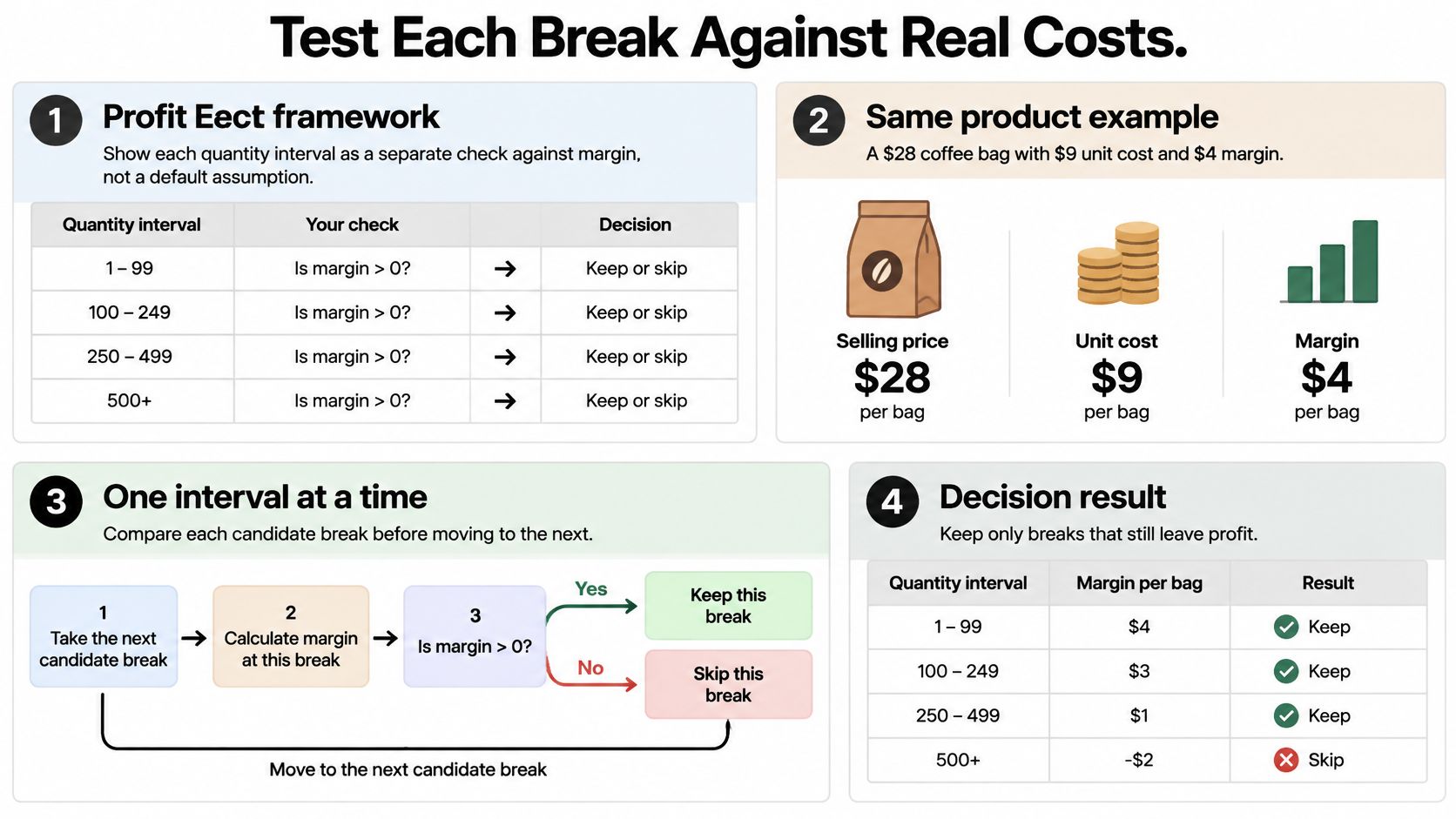
A practical method, laid out in an inventory model with price breaks, is to treat each tier like a constrained order-quantity decision. Buyer holding cost, seller setup cost, order quantity, and the number of breaks are the variables that decide whether coordination helps. Accept a break only when the extra margin and any real pick or ship saving beat working-capital and demand risk.
Five checks before you publish a tier
- Estimate how many orders will land in that interval, and split out buyers who would have purchased a single bag at full price. Those orders are cannibalized, not new.
- Apply the price rule correctly. All-units changes the price of every unit. Incremental changes only the units past the threshold.
- Subtract unit cost, fulfillment, payment fees, expected spoilage, and extra cash tied up until the subscriber uses the pack.
- Compare contribution dollars for the one-bag order, the order at the break, and the order one unit below the break. The best quantity often sits on only one side of the line.
- Accept the break only when that extra contribution beats the working-capital and demand risk. If it does not, leave the row off the widget.
A floor before any model
A $28 bag already carries $13.84 of unit cost, pick-and-pack, and payment handling on a one-bag order ($9 + $4 + $0.84). Any discount deeper than about 51 percent loses money on every bag before spoilage. I would start by refusing anything near that floor.
| Order | Unit cost |
|---|---|
| One bag at full price | $9.00 |
| Two bags, all-units 10% off | $18.00 |
| Three bags, all-units 20% off | $27.00 |
| Three bags, incremental 20% off bag 3 | $27.00 |
Unit cost is the same at three bags. Contribution is not. The all-units three-bag order brings in $67.20. After $27 of coffee, $4 of pick-and-pack, and about $2.02 of payment fees, contribution is $34.18, or $11.39 a bag. One bag at full price contributes $14.16. The bigger order earns more dollars in total and less on each bag. The incremental three-bag cart at $78.40 keeps more of that gap because only the third bag is cut.
Two failures show up again and again. Average order value can rise while profit falls. A six-unit discount fails when use time exceeds shelf life. The same logic belongs in bundle product pricing: price the mix the customer will finish, not the mix that maximizes units.
Practical rule: Keep a tier only when contribution dollars on that order beat the one-unit plan after spoilage and cash tied up.
Set the Break on Shopify and Subscriptions
Ship the break on one hero product before you touch the rest of the catalog. A storewide ladder hides which row is earning money.
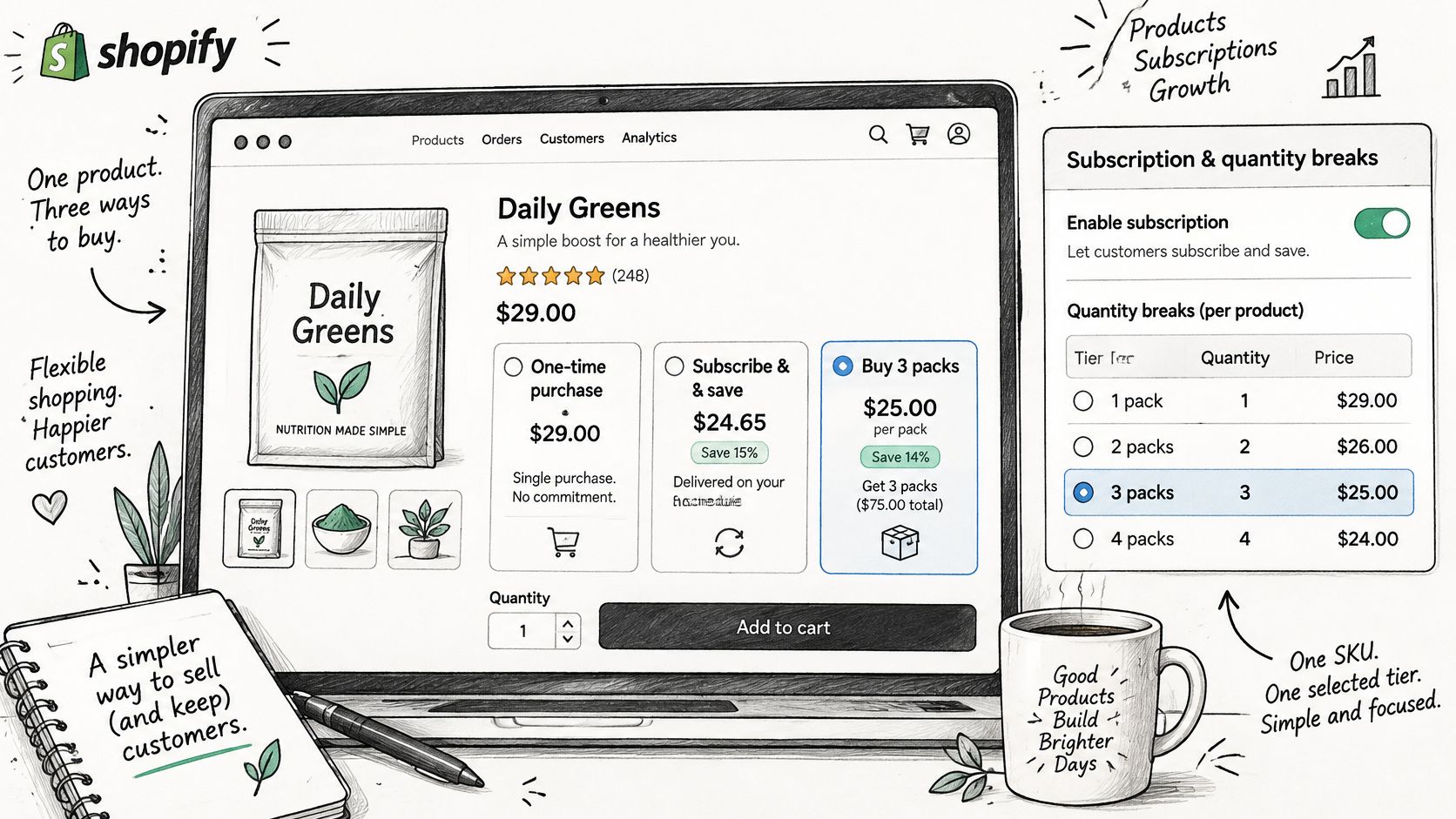
A setup you can place this week
- Choose one SKU and one row from the break table. Coffee at two and three bags is enough. Do not add a fourth rung on day one.
- Add three selling options side by side: a one-time purchase, a monthly Subscribe and Save plan, and a prepaid plan covering three deliveries. Shoppers should see the cash difference before they pick a cadence.
- Attach the quantities, 10 percent at two units and 20 percent at three, and state on the widget whether the cut is all-units or incremental. Silence here creates support tickets when checkout does not match the page.
- On a Build-a-Box, discount by item count: 5 percent at four items, 12 percent at six, and 18 percent at eight. Let flavors mix toward the same count.
- Test the cart. Adding a unit must cross the threshold live. A subscription line and a one-time line must not double-count. Dropping under the threshold must restore the higher price.
- Check renewal so the tier stays, or deepens after a set number of paid orders. Confirm that pause, skip, or swap in the customer portal keeps the discount on the plan instead of resetting it.
- Read the widget on a phone. Unit price and amount due today both need to be visible without a pinch-zoom.
Native automatic discounts and a Functions-based app do not behave the same way at the threshold. Choosing between Shopify discount tools is worth ten minutes before you lock the widget, because a display-only price that disagrees with checkout is how you lose the order you just earned.
Place test orders one unit under and one unit over every threshold, on both the one-time and subscription options, before any ad spend. If the price snaps back when quantity drops, the rule is safe to show.
Read Results and Keep Only Profitable Breaks
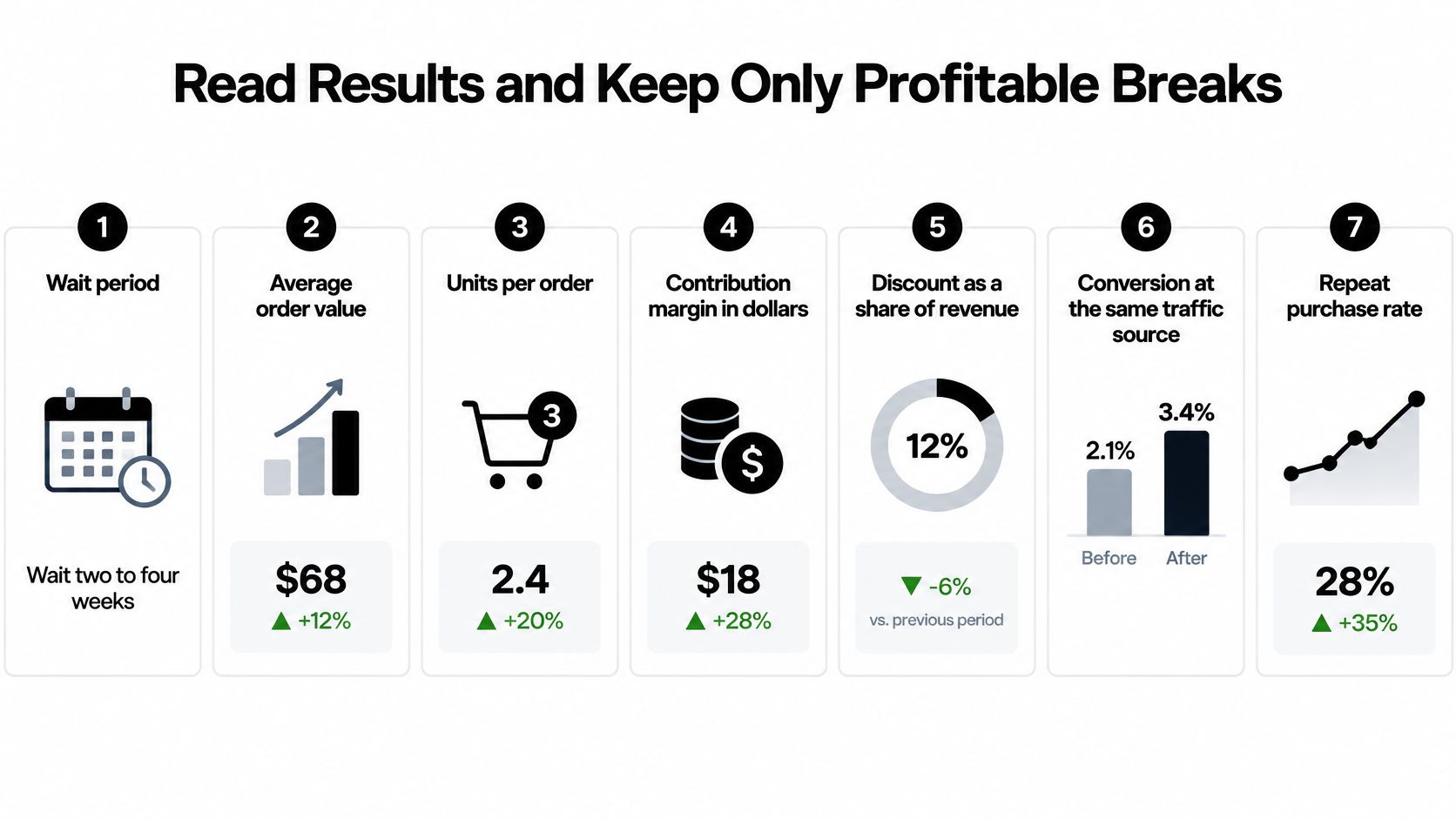
Wait two to four weeks before you judge a new tier. Then read six numbers together, not one vanity metric.
| Metric | Question it answers | Stop or narrow the tier if |
|---|---|---|
| Average order value | Did basket dollars rise? | AOV rises while contribution dollars fall |
| Units per order | Did the threshold move quantity? | Units jump and revenue stays flat |
| Contribution margin in dollars | Is the order still profitable after discount, cost, and fulfillment? | Margin per order is below the one-unit plan |
| Discount share of revenue | How deep is the cut against what buyers pay? | Depth is so deep that the break only moves units, not revenue |
| Conversion by threshold | Who abandons before the break? | The higher minimum cuts new-buyer conversion |
| Repeat, skip, and cancel rate | Does the pack match real consumption? | Skips or churn rise because the pack outlasts use or shelf life |
Units can rise while revenue stands still
A 2016 field experiment is the warning, not the target. King Digital Entertainment, in a PNAS study, tested quantity discounts for virtual goods with more than 14 million consumers. Progressively deeper discounts increased the quantity purchased per user by 6.7%, 11.2%, and 44.9%. The deepest treatment reduced prices by as much as 70% for large purchases. Average prices paid fell by approximately similar proportions, so total revenue changed very little. Short-run price elasticity was close to one: a 1% decrease in price produced roughly a 1% increase in quantity.
That is what a break often does. It shifts existing buyers toward larger baskets without expanding the customer base. Judge it on contribution and retention, not on units. On a subscription, add repeat rate, skip rate, and cancel reason. A six-bag prepaid that will not fit in the cupboard shows up later as skips, not as a week-one AOV win. Compare the break cohort with shoppers who stayed on a one-unit subscribe plan.
Narrow or remove a tier when contribution dollars per order fall, even if AOV is up. Pull MRR, LTV, and AOV from the same admin view so the test is not rebuilt in a side spreadsheet. A clear split between reporting vs analytics keeps the kill decision on contribution, not on a chart that only shows baskets.
A 14-day test on one SKU
Launch one break only. Publish the row that already cleared the contribution test and matches a replenishment interval the customer can finish before the product ages out. Run it for 14 days on one hero SKU in supplements, coffee, skincare, or pet.
Kill or narrow the tier if contribution dollars per order drop, new-buyer conversion drops, or skips spike. Keep widget copy honest. Turn on portal pause, skip, swap, and frequency change so a too-large pack becomes a self-serve fix instead of a cancel. RecurX is one place to run this test, since tiers, portal changes, and AOV and retention metrics can sit in one Shopify admin view. Only after the first break holds profit should the same worksheet run on a second SKU.
RecurX lets Shopify brands sell Subscribe and Save, prepaid plans, and Build-a-Box with quantity tiers enforced at checkout, plus a customer portal for pause, skip, and swap. If you are ready to price a break by contribution instead of by basket size, set the first tier on one hero product inside RecurX.
quantity price breaks · Shopify subscriptions · volume discounts · Build-a-Box · AOV
Keep reading
- Best Upsell App for Shopify: Top 10 Picks 2026Compare the 10 best upsell app for Shopify options by pricing, placements, subscriptions and loyalty support to find the right fit for your store.
- Reduce Involuntary Churn on Shopify: 5 Recovery StepsReduce involuntary churn on Shopify with decline routing, card-update flows, retry timing, and measurement that avoids inflated recovery numbers.
- Reporting vs Analytics: When to Use Each in SubscriptionsReporting vs analytics for subscription stores: what each answers, which metrics belong in reports, and when to analyze churn, cohorts and LTV.
Start growing recurring revenue on Shopify
RecurX has a 14-day free trial and zero transaction fees on every plan. Install in minutes.
Start your free trial →