Reduce Involuntary Churn on Shopify: 5 Recovery Steps
Reduce involuntary churn on Shopify with decline routing, card-update flows, retry timing, and measurement that avoids inflated recovery numbers.
Reduce involuntary churn on Shopify with decline routing, card-update flows, retry timing, and measurement that avoids inflated recovery numbers.
Your churn report says subscribers are leaving, so you rewrite the cancellation flow and add a discount. A week later the number hasn't moved, because a share of those subscribers never chose to leave at all. Their cards failed, the retries missed, and the subscription lapsed unnoticed. If you want to reduce involuntary churn, you need to separate that payment problem from genuine cancellations, route each failure by its cause, and fix the charges customers block because they don't recognise them.
Table of Contents
- Where Involuntary Churn Hides in Your Numbers
- Build the Recovery Loop by Decline Type
- Fix the Customer Side of Failed Payments
- Measure Recovery Without Overstating Results
- Test Retry Timing and Set Safe Guardrails
- Run a 30-Day Recovery Audit This Week
Where Involuntary Churn Hides in Your Numbers
A renewal failure and a cancellation by choice can look identical in a headline churn figure. Separate them before changing retention tactics. Involuntary churn comes from an expired card, insufficient funds, a bank decline, or an authentication failure. The subscriber may still want the delivery, but the payment did not go through.
A Recurly-based summary of failed-payment statistics reports median involuntary churn of 0.86% of subscribers per month across industries and 0.67% for SaaS. It also estimates that failed payments account for roughly 20% to 40% of total churn in many subscription businesses. At a steady monthly rate of 0.86%, about 9.8% of the starting base would be lost over 12 months if no failures were recovered. For a store with 1,000 subscribers paying $40 a month, 0.86% is about 9 subscribers, or $344 in monthly revenue, lost before any customer chooses to cancel.
Churn benchmarks to compare against
| Benchmark | Value | What it means for you |
|---|---|---|
| Median involuntary churn, all industries | 0.86% per month | Reference point for payment-related subscriber losses |
| Median involuntary churn, SaaS | 0.67% per month | A software-subscription comparison, not a Shopify-store target |
| Voluntary churn | Compare your own rate over the same 90 days | Set it beside involuntary churn to see how much loss comes from payment failures versus cancellations |
| Base lost over 12 months at 0.86% | About 9.8% | Illustrates the effect of a monthly rate if failures are never recovered |
| Share of total churn from failed payments | 20% to 40% | An estimate of the payment-related share in many subscription businesses |
Pull four figures for the same 90-day period. Keep cancellation reasons and payment outcomes separate; subscription reporting and analytics can help distinguish a count of lost subscriptions from the causes behind them. For blocked or disputed renewals, track disputes separately and set a process to manage excessive chargebacks.
- Failed renewals per month: Count renewal attempts that did not collect on the first try.
- Payment-related share: Count cancellations tagged as payment-related as a share of all cancellations.
- Recovered renewals: Count failed renewals that later collected and stayed active.
- Churn by decline reason: Separate expired cards, insufficient funds, issuer declines, and authentication failures.
Use that breakdown to choose the fix. A replaced card calls for an update path; a customer who does not recognize the charge needs clearer billing communication. Retrying the same confusing charge harder can turn a payment failure into a deliberate cancellation.
Build the Recovery Loop by Decline Type
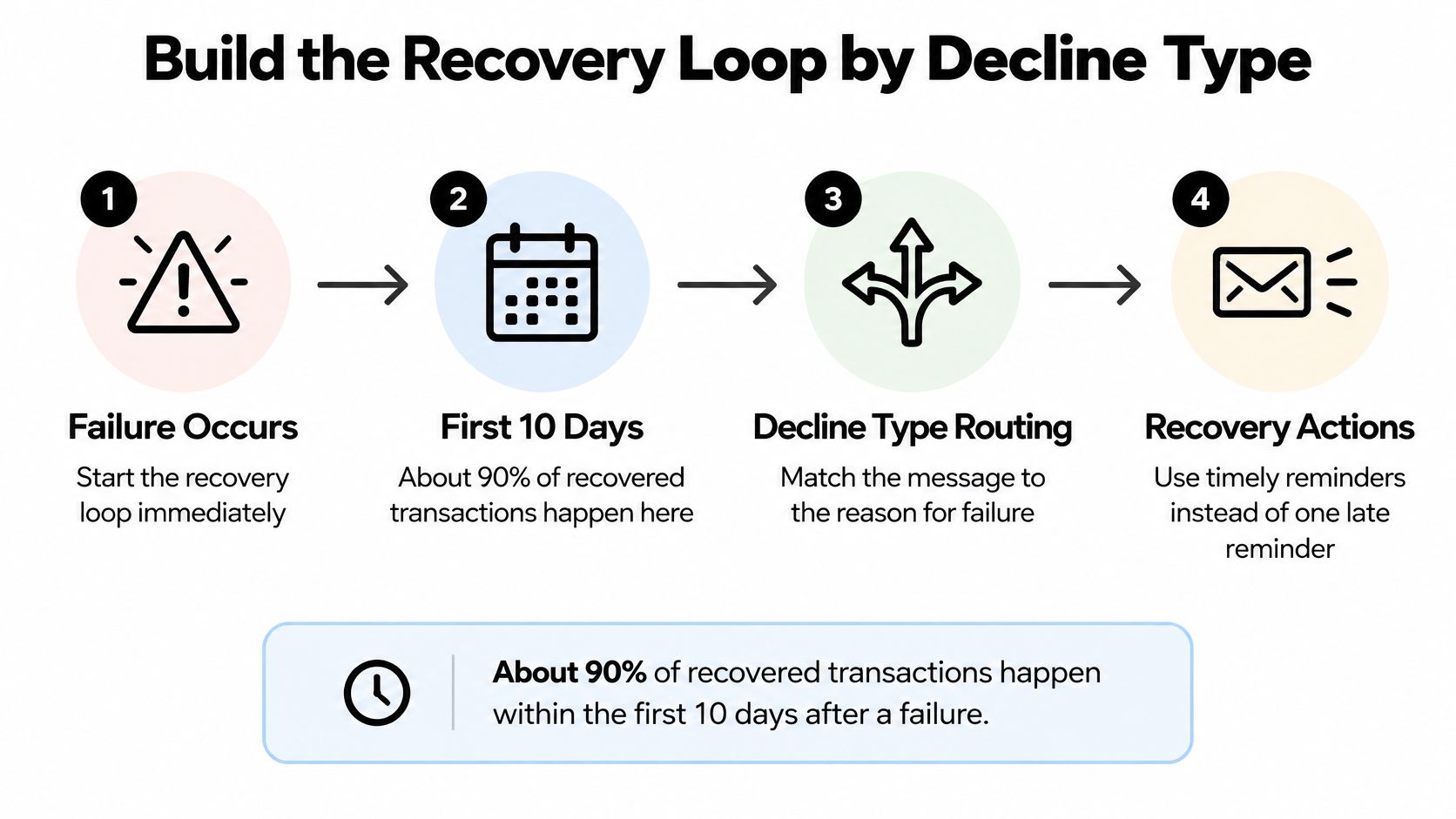
Timing decides most of this work. Research summarised from Recurly in a Spark Money study of subscription billing infrastructure indicates about 90% of recovered subscription transactions occur within the first 10 days after the initial payment failure. One reminder on day nine wastes that window. You need classification, retries, and messages running from day zero, while the subscriber still expects the order.
The infographic below maps that concentrated sequence from first failure to recovery action.
Set expectations before you build. The same summary estimates optimised dunning recovers approximately 25% to 35% of failed payments in business-to-consumer software subscriptions, while highly tuned business-to-business programs can reach 70% to 85%, and the three most common decline messages can achieve recovery rates above 45% when retries are appropriately timed. Don't treat those figures as promises for a Shopify store selling coffee or pet food. Geography, payment method, tenure, and issuer behaviour change the result. They're useful as a range to judge whether your own loop is obviously underperforming.
Step 1 Classify every failed renewal
Tag each failure by decline code and payment method the moment it happens. Use six practical buckets: expired or replaced card, insufficient funds, generic issuer decline, hard decline, customer-side fraud block, and authentication required. A closed account needs a new card. Insufficient funds needs time. Mixing them gives you a single retry schedule that's wrong for both.
The common slip is reporting one failed-payment total. That hides whether you're losing people to stale credentials, which automation can fix, or to hard declines, which need customer action. I'd start with classification even before rewriting message copy, because every later decision depends on it.
Step 2 Refresh credentials before you ask the customer
Turn on account updater or credential-refresh mechanisms where your payment setup supports them. When a bank reissues a card, refreshed credentials can let the next renewal collect without the customer doing anything. That's the cheapest recovery you'll get, because there's no email to ignore and no form to abandon.
Don't then email everyone in that bucket asking for an update. If the credential already refreshed and the retry succeeded, a card-update message creates confusion and support contacts. Suppress dunning as soon as a refreshed credential collects, and only send the update path to customers whose cards didn't refresh.
Step 3 Route retries by reason
Route each bucket on its own pattern instead of repeating a fixed interval. The table below gives a starting pattern you can test and tighten. Notice that some paths have no automatic retry at all, and that's deliberate.
| Decline type | Recovery action | Retry pattern | First message |
|---|---|---|---|
| Expired or replaced card | Account updater, then one-click card-update link | No retry needed once the card updates | Email with update link on the failure day |
| Insufficient funds | Retry across the days the balance is likely to recover | Spread over about 7 to 10 days | Gentle reminder, no alarm wording |
| Generic issuer decline | Decline-aware retry with a capped attempt count | 2 to 3 attempts within 10 days | Ask the customer to contact their bank or update the method |
| Hard decline (closed account, stolen card) | Stop automatic retries | None | Direct request for a new payment method, no discount offer |
| Customer-side fraud block | Confirm the descriptor and billing date before retrying | Retry only after the customer confirms | Pre-renewal reminder and a support contact |
| Authentication required | Send a verification link | One retry after the customer approves | Short link to complete verification |
Retrying a hard decline doesn't create a valid card. It adds issuer friction and can make later legitimate attempts look worse. Retrying insufficient funds too early, several times on the same day, has the same problem in milder form. Spread those attempts across the days when a balance is more likely to have recovered, and stop when the bucket says stop.
The short video below walks through how a decline-aware sequence looks in practice, so you can compare it with a fixed retry schedule.
Step 4 Escalate messages with a one-click update path
Send progressively stronger messages through email, SMS, or WhatsApp, and put a one-click payment-update link in every one. The first message should land on the failure day, name the product and next step plainly, and avoid making the customer log in and hunt for billing settings. Later messages can state the date the subscription will cancel if payment isn't updated.
Match tone to reason. For insufficient funds, use gentle wording that doesn't accuse the customer of having no money. For a hard decline, ask directly for a new payment method and don't attach a discount. A discount trains a customer with a closed account to wait, and it gives away margin on a problem that price didn't cause.
A customer who has to reset a password, find the portal, then find billing settings is a customer you've asked to do three jobs to pay you. One secure link does the job in one tap.
The slip here is identical alarm wording for every decline. "Your payment failed, act now" is disproportionate for a temporary balance issue and too vague for authentication. Each message should tell the customer the one action that fixes their specific bucket.
Step 5 Measure whether recovered customers stay
Track recovery rate, time to recovery, retry count, post-recovery survival, and recovered gross margin by cohort. A payment collected on day two that cancels on day four isn't the same win as a subscriber who renews three more times. Counting cash alone flatters aggressive retry schedules.
Context from a Shopify guide to subscription recovery shows why bucket-level measurement matters. In an analysis of 76 million subscriptions, about 9% of renewal charges were initially declined, but 53% of failed monthly-plan payments were ultimately recovered. A separate 2024 dataset in that guide reported approximately 70% recovery of detected involuntary churn, with 42% recovered through dunning messages alone.
After one full billing cycle, run a blunt check. Does each decline code land in the right path, and is any hard decline still being retried? If you can't answer yes to the first and no to the second, fix routing before you test copy or add another channel.
Fix the Customer Side of Failed Payments
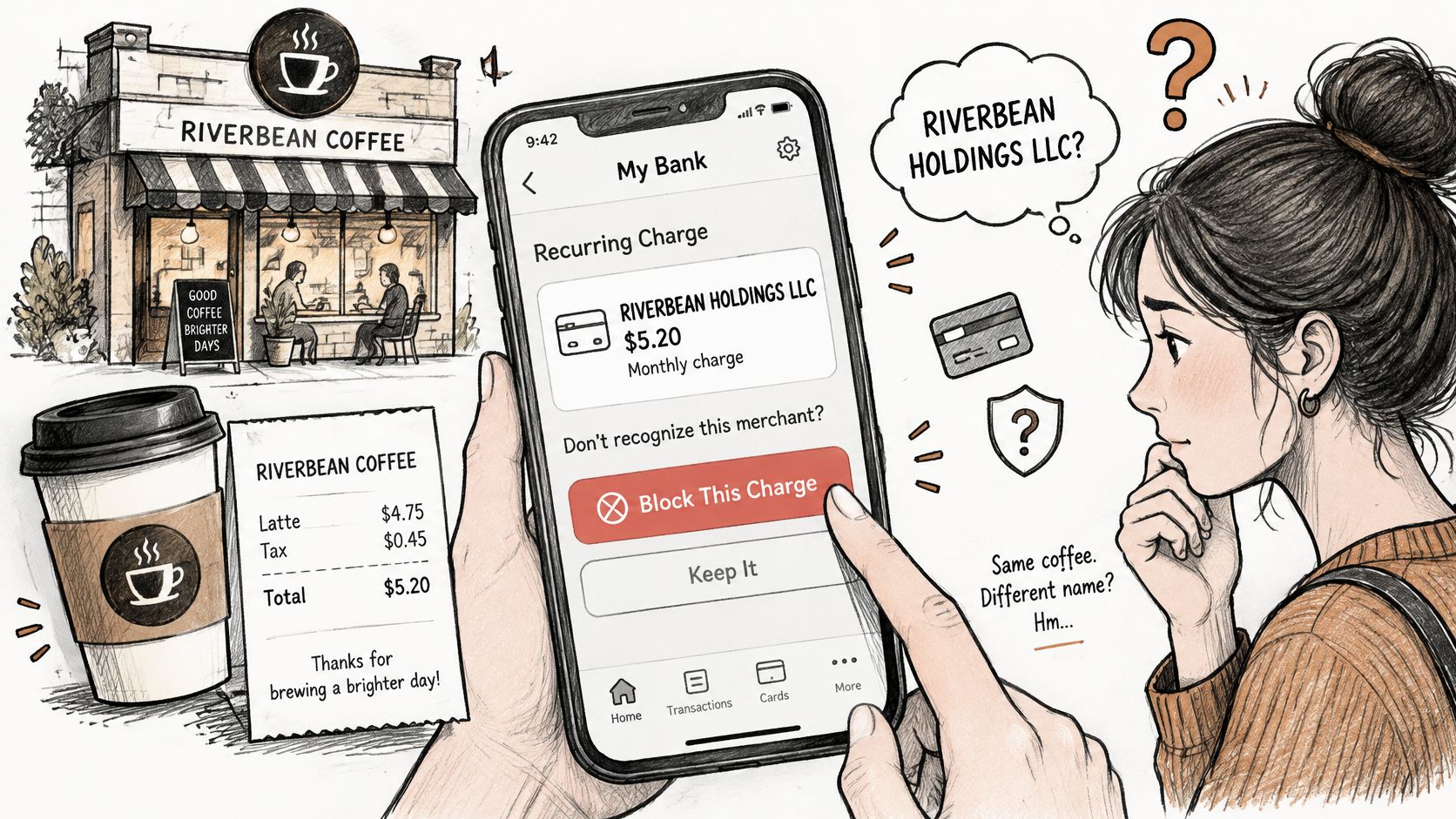
Say a coffee brand bills under its legal entity name, something like a holding company the customer has never seen. The charge appears in a banking app, the customer doesn't connect it to the coffee that arrived last week, and they block it as suspicious. Your retry engine then tries again. From the customer's side, an unrecognised company is now repeatedly attempting to take money.
That's not a rare edge case. In the Mastercard and FT Strategies subscription economy report, 25% of consumers had blocked a payment because they believed it might be fraudulent, and 29% had disputed a recurring payment for the same reason. Retrying harder in that situation doesn't recover revenue. It creates disputes, complaints, and a customer who now actively distrusts you.
The image below shows the moment that decides it, a customer staring at a charge they can't place.
Controls you own before the renewal runs
Start with recognition. Make your statement descriptor match the storefront name customers bought from, not your registered entity. State the billing date and amount in the renewal email, and send a pre-renewal reminder three to seven days before the charge so the bank line item matches a recent message. Keep the one-click card-update link visible in that reminder too, so an expiring card gets fixed before it fails.
Then give customers a way out that isn't a block. A portal where they can pause, skip, swap products, change frequency, or update the payment method catches people who would otherwise use their banking app as a cancellation button. Good examples of customer portals for subscriptions show how much of this belongs on the merchant's own domain through a native Shopify customer-account setup. Confirm which of those options your store supports before you promise them in an email.
- Test timing on one line first: Send the reminder to a single product line before rolling it across the catalogue.
- Put the link first in SMS: Lead with the update link, not a paragraph of explanation.
- Review disputes by category: Check your own dispute rate by product category before assuming supplements, skincare, or pet lines need extra work.
Prevention beats recovery here. A recognised charge never enters your dunning sequence at all.
Measure Recovery Without Overstating Results
Public recovery numbers conflict because they don't measure the same thing. A FlexPay paper on why fraud teams must address failed payments notes one source reporting recurring-payment failures above 20% for authorization requests among cardholders whose in-person transactions were declined only 1% of the time, while another analysis says 10% to 15% of payment-related failures remain unrecovered. Those aren't comparable. One may count attempts, another failed transactions, another cancellation events.
Pick one denominator and keep it
Decide whether your recovery rate divides by failed renewal attempts, customers with at least one failure, cancellation events, or total churn. Each produces a different percentage from the same month. For operating decisions, I'd use customers with at least one failed renewal, because you're trying to save subscribers, not attempts.
Now run a worked example. Say you had 400 failed renewals in March and 180 recovered within 10 days. That's 45% gross recovery. But 70 of those customers had already updated their card on their own before your sequence could claim credit. The incremental figure is 110 of 400, or 27.5%, and that's the number to report internally.
Reporting rule: Report the incremental rate, not the gross rate. Customers who would have paid anyway aren't proof your retries work.
Build the cohort view
Fix the denominator, then build a 30, 60, and 90-day cohort of recovered customers. Where volume allows, compare automated recovery with a holdout group that gets your previous process, so you can see the lift your sequence caused. Segment everything by geography, payment method, product category, and subscription value, because a blended rate hides a failing segment behind a healthy one.
Report recovery rate alongside time to recovery, dispute rate, involuntary churn rate, retained gross margin, and post-recovery renewal. That last set is what stops you celebrating a recovered payment that produced a chargeback a week later. The best program isn't the one with the highest immediate authorization rate. It's the one that keeps profitable subscribers renewing without friction or disputes.
Test Retry Timing and Set Safe Guardrails
Don't rebuild the whole sequence and call the result a test. Hold out a group on your current process, then change one variable at a time. Start from a sane baseline: an immediate notification with a secure card-update link, followed by retries spread across the period when funds are most likely to arrive, with insufficient-funds timing kept separate from invalid-card and suspected-fraud declines.
Use external baselines only as direction. A Payway guide to failed payment recovery strategies places median failed-payment recovery near 47.6%, with top-performing programs at roughly 70% to 85%, and links dynamic retry logic to a 7.8% absolute purchase-recovery improvement and a 36% relative improvement versus static schedules. Vendor samples and definitions differ, so your holdout matters more than anyone's benchmark.
Variables to test and the guardrail for each
| Variable | Test options | Guardrail metric |
|---|---|---|
| Retry timing | Days 1, 3, 7 versus days 1, 4, 10 | Complaint rate |
| Number of attempts | 3 attempts versus 5 attempts | Refund rate and chargebacks |
| Message channel | Email only versus email plus SMS | Opt-out rate and consent complaints |
| Decline-specific routing | Separate insufficient-funds timing versus one generic schedule | 30-day retention of recovered customers |
| Payment-update UX | Update link in email versus in SMS | Update completion rate and support contacts |
Guardrails that stop a test
Set these before the test starts, not after a metric moves. A test that lifts recovery while doubling complaints isn't a win you can keep.
- Maximum retry count: Cap attempts per failure and enforce the cap automatically.
- Suppression rules: Stop all retries and messages after an explicit cancellation or a fraud signal.
- Consent and localisation: Confirm SMS and WhatsApp consent and language for each market you message.
- Cohort monitoring: Watch complaint rate, refund rate, chargebacks, support contacts, and 30, 60, and 90-day retention.
Judge every test on net recovered contribution margin, not gross recovered revenue. Subtract product cost, shipping, refunds, and dispute fees from what you collected. If the margin doesn't improve against the holdout, the timing change doesn't ship, however good the authorization rate looks.
Run a 30-Day Recovery Audit This Week
Four weeks is enough to find where failed renewals are getting lost and establish a clean baseline. Keep the audit focused: measure first, then change one part of the recovery process at a time.
Week 1, split the number. Pull 90 days of cancellations and separate voluntary from involuntary churn. Record failed renewals, payment-related cancellations, recovered renewals, and churn by decline reason. Leave settings unchanged so you have a baseline for comparison.
Week 2, fix recognition and updates. Classify failed renewals by decline code, enable one-click card updates, and add a pre-renewal reminder for your highest-volume product. Check that the descriptor and billing date match the storefront name and the reminder email. Customers who don't recognize a charge may treat repeated retries as suspicious, so make the payment easy to identify before increasing attempts.
Week 3, route and cap. Apply the routing patterns for each decline type, set a retry cap, and stop automatic retries on hard declines. Keep a holdout group on the current process, then change one variable for everyone else.
Week 4, read the cohort before making another change. Review 30-day results for recovered customers alongside complaints, refunds, chargebacks, and support contacts. If recovered customers cancel faster than the usual base, the sequence may be collecting payments from people who intended to leave.
Choose the single bottleneck the audit reveals and fix it first. Changing the whole sequence at once makes it difficult to identify what worked.
To estimate potential recovery from your own figures, use the failed payment recovery calculator. RecurX also offers decline-aware retries, email, SMS and WhatsApp dunning, one-click card-update links, and churn-by-reason cohort views in Shopify. Whatever tools you use, classify failures first, route them second, then message and test timing.
If failed renewals are affecting subscribers who did not intend to leave, RecurX provides payment recovery and churn-by-reason analytics within Shopify. Start with your last 90 days of failures, identify the decline types, and track whether each change recovers payments without raising complaints or cancellations.
reduce involuntary churn · failed payment recovery · Shopify subscriptions · subscription dunning · card update flow
Keep reading
- Best Upsell App for Shopify: Top 10 Picks 2026Compare the 10 best upsell app for Shopify options by pricing, placements, subscriptions and loyalty support to find the right fit for your store.
- Quantity Price Breaks for Shopify SubscriptionsSet quantity price breaks on Shopify subscriptions without giving away margin. Compare tiers, Build-a-Box, cart rules, and AOV versus profit.
- Reporting vs Analytics: When to Use Each in SubscriptionsReporting vs analytics for subscription stores: what each answers, which metrics belong in reports, and when to analyze churn, cohorts and LTV.
Start growing recurring revenue on Shopify
RecurX has a 14-day free trial and zero transaction fees on every plan. Install in minutes.
Start your free trial →