Shopify Subscription Refund Policy: A Merchant Guide
Build a clear Shopify subscription refund policy that protects revenue and customer trust. Covers legal basics, trial refunds, proration rules, and best
Build a clear Shopify subscription refund policy that protects revenue and customer trust. Covers legal basics, trial refunds, proration rules, and best
Your customer's email lands three days after a subscription box ships. They say they meant to cancel, they want a refund, and they're not trying to be difficult. They're asking for the exact kind of exception that turns a clean policy into a messy support thread, because the question isn't whether the policy sounds fair, it's whether your team can close the loop without leaking money.
A Shopify subscription refund policy only works when it matches the way the business bills, ships, retries, cancels, and documents decisions. If refund language says one thing while the subscription stays active, the customer thinks the issue is over and the next renewal surprises them. That's where churn, duplicate reimbursements, and chargeback fights start.
Table of Contents
- The Refund Call That Changed How This Brand Operates
- How Shopify Thinks About Refunds on Its Own Billing
- The Refund Scenarios Every Subscription Merchant Will Face
- Why Refunding a Shipment Can Still Generate a Renewal
- How Subscription Features Shape the Refund Conversation
- Policy Language You Can Actually Ship
- When Refunds Turn Into Chargebacks and What Changes
- Turning the Policy into Daily Habits
The Refund Call That Changed How This Brand Operates
The call starts the same way every time. A customer gets a recurring supplement shipment, opens it late, then writes in because they believed they had already canceled. The support rep checks the renewal date, the cancellation timestamp, the policy version shown at checkout, and the email trail before anyone offers money back.
That order of operations matters more than polished refund language. If the cancellation happened after renewal, the team is dealing with a billed order, not a simple apology request. If the cancellation happened before the charge and the customer still got billed, the evidence has to show whether the failure was operational or just a bad assumption.
Policy language is not the finish line
Most merchants write a refund policy as if the sentence itself protects the margin. It doesn't. A policy only works when the billing record, portal behavior, and support workflow all point to the same outcome.
Practical rule: never answer a refund email until you know whether the customer is asking for money back, future billing to stop, or both.
That distinction sounds obvious until a coffee subscriber says “refund” when they really mean “skip the next box,” or a skincare buyer asks for a goodwill credit after a late shipment. If your team treats every request as the same, you end up paying for the wrong fix.
The useful mindset is simple. Refund handling is an operating discipline, not a legal checkbox. The business needs a policy that matches its own billing logic, then a process that records what happened when the customer asked.
How Shopify Thinks About Refunds on Its Own Billing
A merchant cancels a Shopify plan after an invoice arrives, then asks why the charge was not reversed. Shopify's own billing rules explain the confusion: subscription-plan charges are generally non-refundable, and canceling a plan does not ordinarily create a refund entitlement. Proper cancellation stops future billing, while money already invoiced usually remains charged. See Shopify's refund policy for subscriptions for the distinction between cancellation, fees, and reimbursement.
The review windows that actually exist
Shopify may review certain charges during defined consideration periods. These windows are review opportunities, not automatic refund rights. A monthly-plan charge may be reviewed when requested within 7 days of the invoice date. The first invoice after a trial and annual-plan charges may be reviewed within 30 days. SEPA Direct Debit charges may be reviewed within 14 days, while merchants in Brazil have a 90-day review window, as listed in the same Shopify refund policy cited above.
| Charge type | Review window |
|---|---|
| Monthly plan charge | 7 days |
| First invoice after a trial | 30 days |
| Annual plan charge | 30 days |
| SEPA Direct Debit charge | 14 days |
| Brazil merchant charge | 90 days |
Why this matters to your customers
These rules govern Shopify's platform billing, not the subscriptions sold through your store. Your refund policy is separate, and your team must identify which billing event caused the complaint before offering relief. A customer disputing a Shopify invoice needs a different answer from a customer seeking a refund for a shipment or asking to stop the next renewal.
Your billing interface should show the billed party, invoice date, plan type, cancellation status, and requested outcome. Record whether the customer wants a refund, a credit, or future billing canceled. That information prevents a shipment refund from being mistaken for subscription cancellation, one of the operational gaps that creates avoidable renewals and chargebacks.
The Refund Scenarios Every Subscription Merchant Will Face
Most refund requests fall into the same few buckets, and each one needs a different answer. If you treat them all the same, you'll either refund too much or annoy customers who had a fair expectation. The smart move is to map the request to the billing event first, then decide what kind of relief fits.
Trial-to-paid, mid-cycle, and prorated requests
A trial-to-paid conversion dispute usually means the customer forgot the trial ended. If the charge falls inside the kind of review window Shopify allows for its own billing, the merchant still needs to decide whether the customer was clearly warned and whether the renewal notices were obvious.
Mid-cycle cancellation is a different beast. The customer doesn't want to argue the charge existed, they want the unused portion recognized. That's where you decide whether your policy offers a refund, a credit, or no reimbursement at all.
Prorated downgrades deserve special care. If you let customers move down a tier or change frequency, spell out whether you calculate the change immediately or at the next billing date. A vague policy makes every downgrade sound negotiable.
Post-shipment requests and failed-payment recovery
Refund requests after shipment are where operations and loyalty collide. Some customers got a defective item, some wanted to pause instead of refund, and some are using the refund request as a softer cancellation. For a plain-language overview of the buyer psychology behind remorse after purchase, Exerta's piece on buyer remorse is worth keeping nearby.
A refund on a delivered order is not the same thing as a future-billing stop. If your team blends those together, you create repeat tickets later.
Failed-payment recovery is its own category. If a card fails and the customer is being retried, the question is often whether they want to stay on the plan. The right response is usually to fix the payment method first, then decide if a courtesy credit makes sense. A refund without that context solves nothing.
For merchants who need a cleaner policy surface, RecurX's refund settings can be a useful reference point for how a subscription app frames these choices. The important part isn't the tool, it's the rule: refund, credit, skip, and cancellation are separate outcomes.
Why Refunding a Shipment Can Still Generate a Renewal
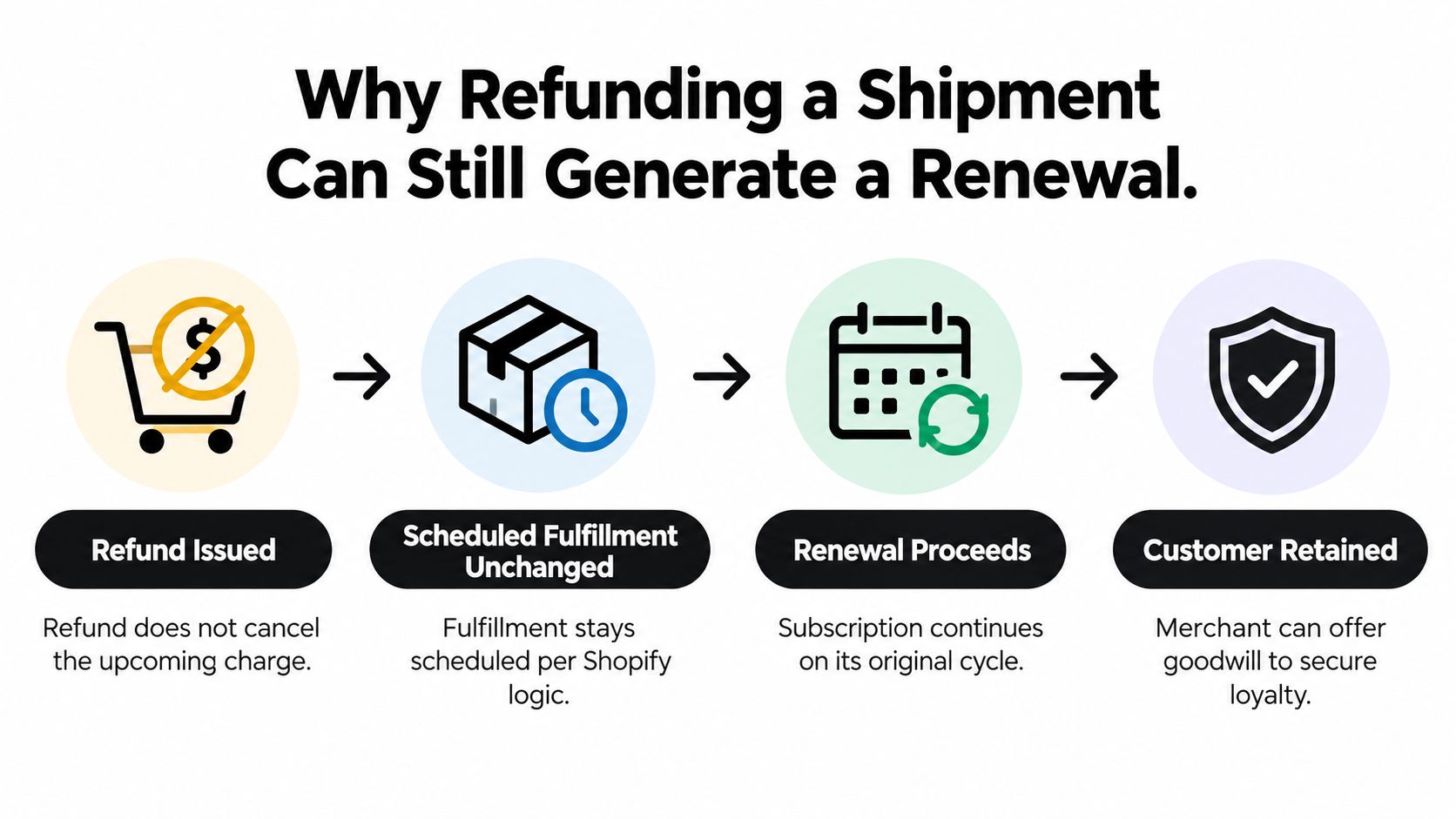
This is the edge case merchants miss, and it's the one that drains the most time. Shopify supports refunds for individual scheduled subscription fulfillments through the admin or the refundCreate mutation, but a fulfillment refund does not automatically cancel the renewal linked to that subscription. If you only refund the shipment, the subscription can keep marching on its original cycle. Shopify's subscription fulfillment documentation
Bundles make this worse
The problem shows up fast in bundled subscription orders. A skincare box might include four items, one arrives damaged, and the rep refunds the item that triggered the complaint. If the bundle stays active and nobody cancels, skips, or edits the schedule, the next box still ships. The customer thinks the relationship ended. The system disagrees.
Coffee and supplement subscriptions create the same trap. A customer may ask to pause because they have enough product, but the rep processes the case as a shipment refund because that's the easiest button to click. The next renewal then feels like a surprise charge, which is exactly how preventable disputes begin.
Shipping protection doesn't solve the subscription problem
People often reach for shipping protection or carrier insurance when they're really dealing with a renewal issue. That's a category error. If you want a practical contrast between parcel loss and subscription state, check shipping protection with Aeros Couriers and notice how different the problem really is.
Bottom line: refund, cancel, skip, and payment-recovery are four different actions. A refund should never be the only one you take when the customer wants the relationship to change.
Generous refund language can still increase churn and support cost if the underlying subscription stays live. The merchant feels accommodating, then eats the next round of confusion anyway. Fix the subscription state first, then decide whether goodwill money is still appropriate.
How Subscription Features Shape the Refund Conversation
The way you build subscriptions determines how many refund requests you get and what kind of answers you can give. Dunning, renewal timing, portal controls, and pricing structure all change what customers believe happened. Refund policy is downstream of that design.
Dunning and payment recovery reduce fake refund pressure
If the payment stack includes decline-aware retries, card-update links, and clear retry windows, a lot of “refund” requests stop being refund requests at all. Customers often don't want a reimbursement, they want the order to go through without more friction. A strong recovery flow gives them that path before they email support.
That matters because failed-payment churn is often really a communication problem. If the customer never saw the retry notice or couldn't update the card quickly, support gets blamed for a billing problem. A better portal cuts that noise before it starts.
Anchor dates and plan structure change the math
Anchor-date billing also shapes how you talk about mid-cycle changes. If every subscriber renews on the same day, proration and goodwill credits are easier to explain. If renewals happen per signup date, each refund conversation becomes more individualized and more prone to argument.
Memberships and pay-as-you-go plans need different language too. A membership usually promises ongoing access, so the refund question is about access duration and service use. A consumable subscription is about units shipped, which makes partial refunds and skipped orders more common.
A merchant can reduce support load by giving customers a portal on the merchant's domain with clear pause, swap, and skip actions. RecurX follows that native Shopify approach, but the bigger point is universal, if customers can self-serve the right change, they don't mislabel everything as a refund.
Policy Language You Can Actually Ship
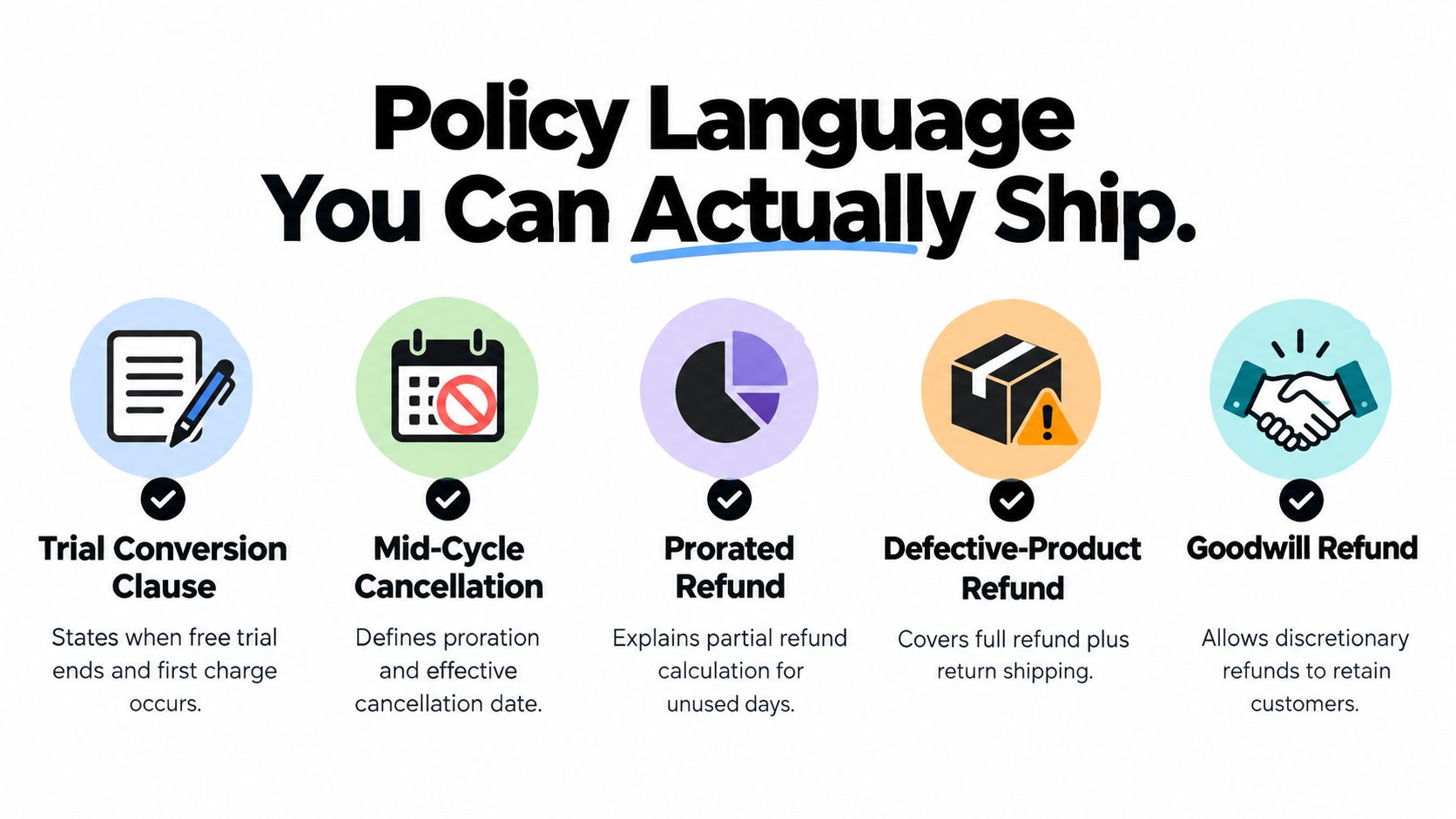
Most policies fail because they sound fair but don't say enough. You need language that a support agent can apply without improvising. The policy should define what happens when a trial converts, a shipment is defective, a customer wants to cancel mid-cycle, or the payment fails and recovery is still in motion.
Clauses worth copying and adapting
- Trial conversion clause: State exactly when the trial ends, when the first charge posts, and whether reminders go out before billing.
- Mid-cycle cancellation clause: Say whether cancellation stops the next renewal only or triggers any proration.
- Prorated refund clause: Explain how you calculate partial refunds for unused days, if you offer them at all.
- Defective-product refund clause: Cover full refunds, return shipping, and what happens when only part of a bundle is damaged.
- Goodwill refund clause: Reserve room for discretionary refunds when retention matters more than a rigid denial.
Those clauses need to appear where the customer sees them. Put them on the product page, in checkout, in the customer portal, and in the confirmation email. If the policy only lives in a footer, you've got a legal page, not an operational control.
Don't forget edge cases
Bundles, Build-a-Box configurations, prepaid plans, gift subscriptions, quick checkout links, and QR code orders all need explicit treatment. Those are the cases that generate the ugliest disagreements because the customer remembers one version of the flow and the system enforces another.
A timestamped policy version helps more than most merchants expect. When support can see exactly which terms were visible at purchase, the refund decision becomes easier to defend. The policy doesn't need to be long, it needs to be precise.
When Refunds Turn Into Chargebacks and What Changes
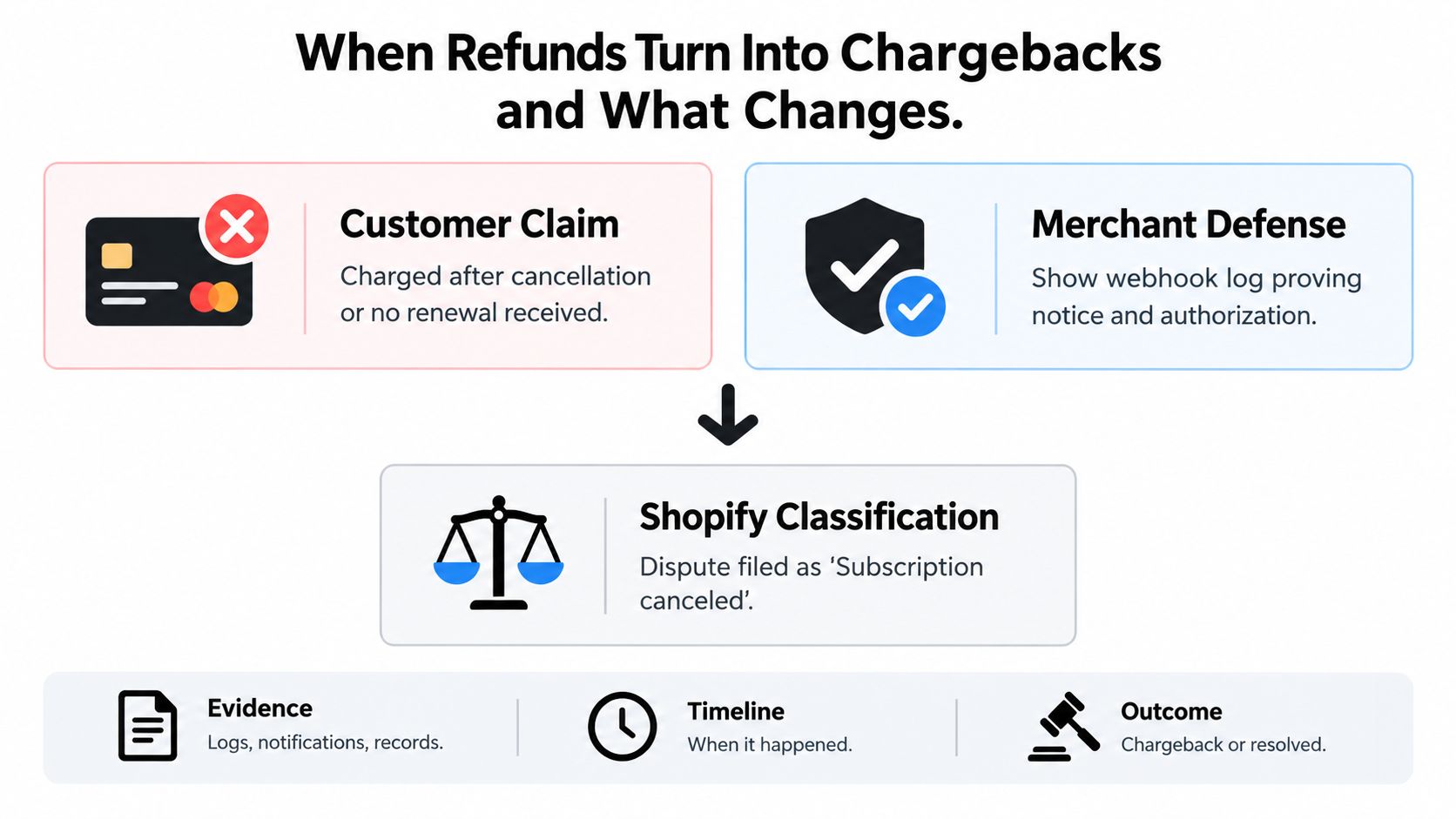
A customer requests a refund for a shipment, the renewal remains active, and the next charge arrives before anyone checks the subscription state. That sequence turns a service complaint into a bank dispute. Shopify classifies a dispute as Subscription canceled when a customer says they were charged after canceling or expected a reminder before a recurring charge. The merchant then needs a cancellation timestamp, subscription state, policy version, billing authorization, renewal notices, fulfillment or usage records, and customer communications. Shopify's chargeback reason guidance notes that evidence may have a 7 to 21-day response window, while card-network review can take up to 75 days.
Evidence beats sentiment
The strongest response is a complete timeline, not the most apologetic message. The checkout policy, cancellation log, renewal notice, fulfillment record, and support conversation should describe the same customer state. If those records conflict, the dispute becomes difficult to defend.
A refund request can become a chargeback when the merchant acknowledges the complaint but fails to stop the next billing event. Align retry notices and card-update flows with payment-recovery solutions before the dispute escalates. For a tactical examination of response decisions, Securify's guide to fighting Shopify disputes provides a practical reference.
Don't create double loss
Once a chargeback is open, Shopify says a refund cannot be issued through Shopify because the bank has already withdrawn or reserved the funds. Reimbursing the customer outside that process can create a duplicate payout. A refund decision must therefore account for both the customer's requested outcome and the payment state.
Preserve the evidence before moving money. Confirm whether the chargeback is open, whether the subscription is canceled, and whether a refund has already been initiated. Support can remain courteous, but the subscription record and payment trail must agree before anyone issues a second payment.
Turning the Policy into Daily Habits
A policy only matters if the operating system underneath it is disciplined. That means immutable webhook logs, clear customer-portal actions, and a data model that connects each renewal to authorization, notice, cancellation, fulfillment, and refund status. If any one of those links is missing, you've made a future dispute harder to win.
Build for audit, not just for checkout
Use native Shopify architecture wherever you can, with Polaris UI, App Bridge, JWT session tokens, and HMAC-validated webhooks. That isn't architecture theater. It's how you make sure the records you're relying on are the records an auditor can trust.
Your support team also needs editable cancellation instructions in the portal, not buried policy text. If a customer can't find how to pause, skip, swap, or cancel, they'll email. If they email and get no clear path, they'll dispute.
Make the policy live in the workflow
The best refund policy is the one your team can execute without discussion on every ticket. That means the billing event, the renewal notice, the refund decision, and the subscription state all need to be visible in one place. RecurX's guidance on reducing subscription churn is a good example of how operational clarity and retention work together.
Operational rule: every refund should leave behind a traceable outcome, not just a satisfied inbox.
A Shopify subscription refund policy is really a connected system of documents, controls, and logs. When those pieces line up, customers get faster answers, support gets fewer repeat tickets, and the business stops paying for confusion it could have prevented.
If you want the refund policy to do more than sound fair, use RecurX to connect the portal, billing, and renewal state behind it. Visit RecurX and build a subscription flow that makes refunds, cancellations, skips, and recoveries show up as the right action instead of the nearest one.
shopify subscription refund policy · shopify subscriptions · refund policy · subscription billing · ecommerce retention
Keep reading
- Best Upsell App for Shopify: Top 10 Picks 2026Compare the 10 best upsell app for Shopify options by pricing, placements, subscriptions and loyalty support to find the right fit for your store.
- Quantity Price Breaks for Shopify SubscriptionsSet quantity price breaks on Shopify subscriptions without giving away margin. Compare tiers, Build-a-Box, cart rules, and AOV versus profit.
- Reduce Involuntary Churn on Shopify: 5 Recovery StepsReduce involuntary churn on Shopify with decline routing, card-update flows, retry timing, and measurement that avoids inflated recovery numbers.
Start growing recurring revenue on Shopify
RecurX has a 14-day free trial and zero transaction fees on every plan. Install in minutes.
Start your free trial →