Subscription Churn Rate: How to Reduce It for Shopify
Learn what subscription churn rate means, how to calculate it, and proven strategies Shopify merchants can use to reduce voluntary and involuntary churn.
Learn what subscription churn rate means, how to calculate it, and proven strategies Shopify merchants can use to reduce voluntary and involuntary churn.
You opened your Shopify store this morning, checked yesterday's subscription renewals, and noticed your active subscriber count dropped again. You didn't change your pricing. You didn't change your product. Your dashboard shows a subscription churn rate, but it doesn't tell you who left, why they left, or what you should fix first. That's the gap this guide closes, starting with why that single number deserves more attention than your next acquisition campaign.
Table of Contents
- Why Your Subscription Churn Rate Matters
- What Subscription Churn Rate Actually Measures
- How to Calculate Churn Rate Correctly
- Common Causes of Churn in Subscription Businesses
- Churn Benchmarks and What Good Looks Like
- Strategies to Reduce Voluntary and Involuntary Churn
- Building a Churn Measurement Framework
Why Your Subscription Churn Rate Matters
A merchant I'll call Maya runs a coffee subscription on Shopify. She adds new subscribers every week through ads and email, so her revenue looks stable at a glance. When she looks closer, she sees she's replacing customers almost as fast as she gains them. Each new subscriber costs her ad spend and a welcome discount, while the customers leaving were already paying full price on a predictable schedule.
That's why your subscription churn rate functions as a diagnostic tool, not a grade on your business. It tells you what share of your starting subscriber base you're losing in a period. If that share is rising, something in your product, billing, or customer experience needs attention, whether or not total revenue has dropped yet.
Why a Small Leak Beats a Big Funnel
Churn compounds. A subscriber who stays an extra few months doesn't just add one more order. That customer adds repeat revenue without new acquisition cost, learns your product well enough to buy add-ons, and becomes more likely to refer a friend. A subscriber who leaves early takes all of that future value with them.
This compounding effect is why retention often matters more than acquisition once you've built an initial base. Adding more subscribers into a program that's losing people quickly is like filling a bucket with a hole in it. You'll work harder every month just to stay level.
Practical rule: If you're spending to acquire subscribers faster than you're fixing why existing ones leave, you're renting growth instead of building it.
Churn also determines how confidently you can plan. Subscription revenue is valuable because it's forecastable. You can order inventory, schedule staff, and set a marketing budget around revenue you expect to recur.
What Stable Churn Lets You Do
- Forecast revenue with less guesswork: You know roughly how many subscribers will renew next month, so cash flow stops feeling like a surprise.
- Spend on acquisition with a clear payback window: You can judge whether a subscriber stays long enough to cover what you paid to get them.
- Spot problems before they show up in sales: A spike in cancellations after a price change or a shipping delay points you to the cause while it's still fixable.
None of this requires a perfect rate. Some churn is normal in every subscription business, because customers move, budgets change, and tastes shift. What matters is knowing whether your rate reflects those normal reasons or a fixable problem you're currently paying for every month.
What Subscription Churn Rate Actually Measures
Most merchants treat churn rate as one number. It's a family of related numbers, and collapsing them into a single headline figure is where bad decisions start. A customer who clicks cancel because they've stockpiled too much product is not the same problem as a customer whose card expired while they were happily using your product every day.
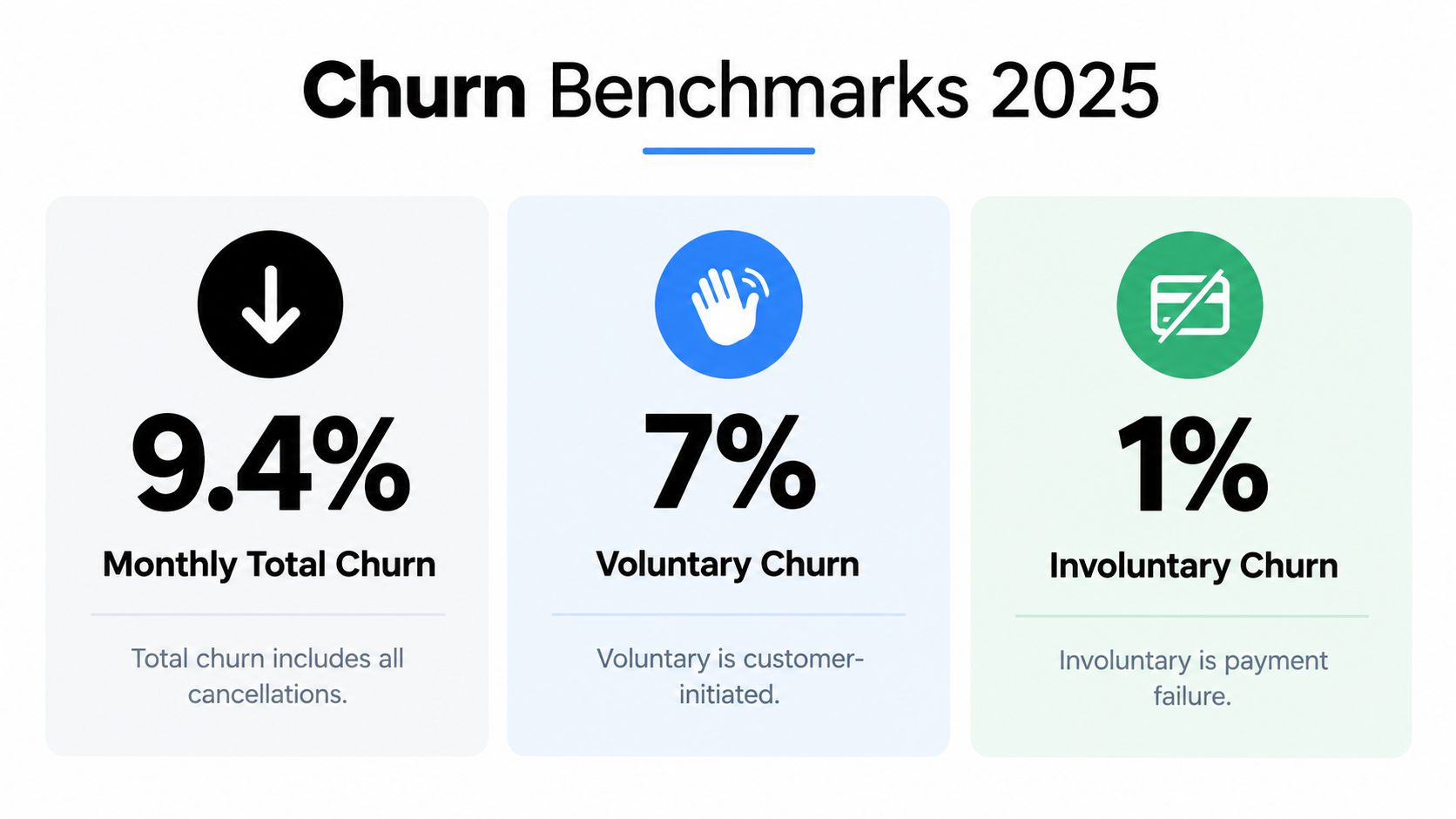
The 2025 analysis spanning more than 1,000 companies puts monthly total churn near 9.4%, with voluntary churn at approximately 7% and involuntary churn generally near 1%. Those three figures look similar on a dashboard. They describe completely different customer behavior.
The Four Numbers Hiding Inside One Rate
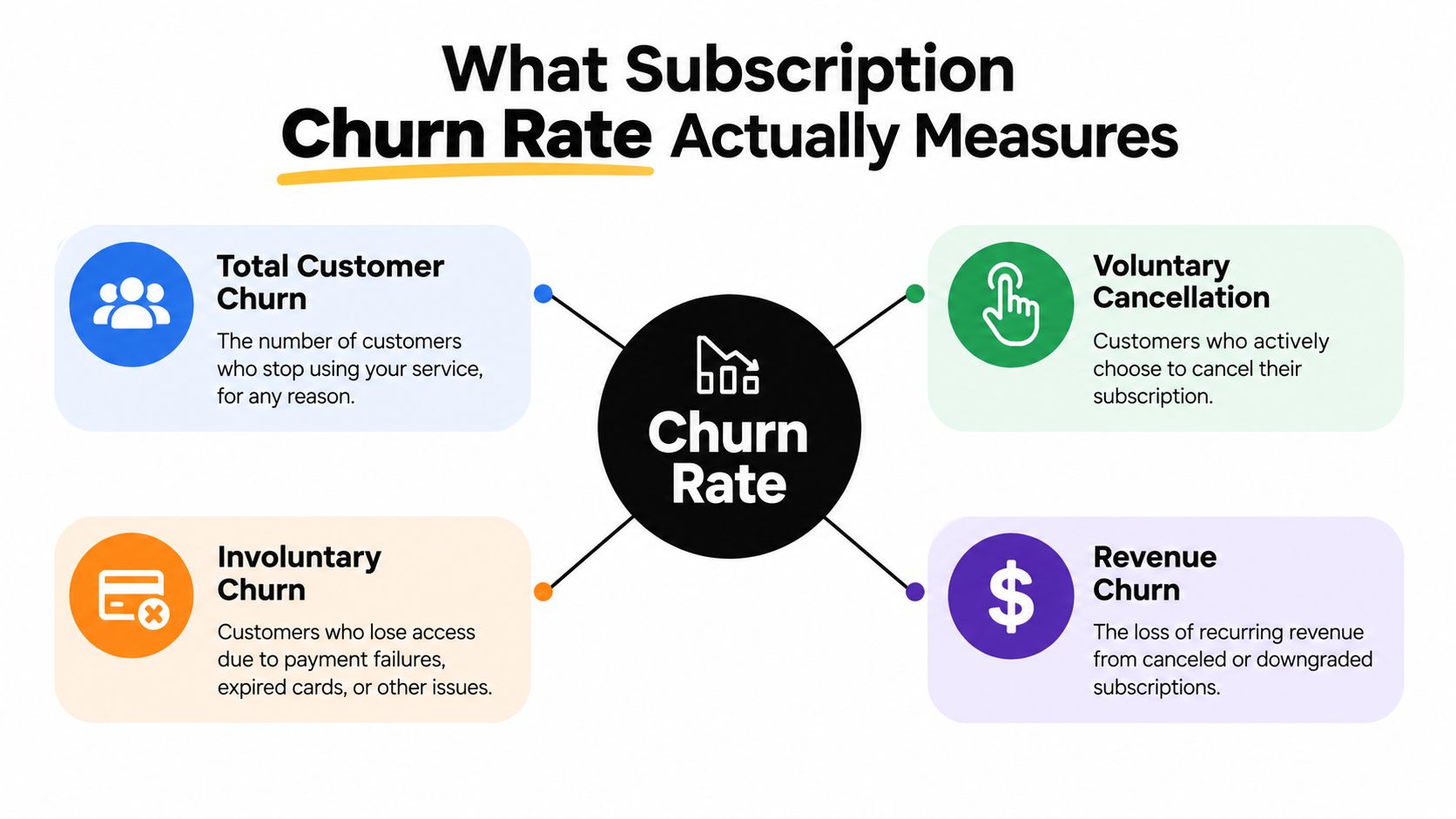
Total customer churn counts every subscriber you lost in a period, for any reason. It's useful as a headline, but it can't tell you what to fix.
Voluntary churn is deliberate. The customer opened your portal or contacted support and chose to cancel. Something about fit, price, timing, or experience drove that decision, and that's information you can act on.
Involuntary churn happens when payment fails and the subscription expires without the customer choosing to leave. Expired cards, insufficient funds, and outdated billing details are the usual culprits. The customer may not even know they've churned until a shipment doesn't arrive.
Revenue churn measures money lost instead of people lost. Losing one subscriber on a large quarterly bundle hurts more than losing one subscriber on your smallest plan, even though both count as a single cancellation in a customer-based rate.
Why the Denominator Changes the Story
Every churn rate divides subscribers lost by a starting count. That starting count is the denominator, and choosing it carelessly distorts your result. If you divide by subscribers at the end of the month, a strong acquisition month makes your churn look artificially low, because new joiners inflate the base even though they weren't at risk of leaving for the full period.
You also can't compare a monthly rate directly with an annual rate. Twelve months of compounding losses produce a number that looks far worse than any single month, even when nothing about your retention changed. Merchants who compare their monthly figure against an annual benchmark either panic unnecessarily or relax when they shouldn't.
A blended rate can look steady while new subscribers quietly leave faster each month, because loyal long-term customers average out the damage.
That's why cohort retention matters alongside any headline rate. A cohort is a group of subscribers who started in the same period. Tracking each group separately shows you whether recent joiners behave differently from earlier ones, which is exactly the pattern a single blended number hides.
How to Calculate Churn Rate Correctly
The standard formula is simple. Divide subscribers lost during a period by subscribers active at the start of that period, then multiply by 100 to get a percentage. Simple is a good starting point, but the simple version alone will mislead you about what's happening in your program.
A Worked Example From a Typical Store
Say you start March with 500 active subscribers. During March, 30 customers cancel on purpose and 10 subscriptions expire after failed payments you couldn't recover. You also gain 60 new subscribers and 20 paused customers reactivate, so you end March with 540 active subscribers.
The basic calculation uses 40 lost subscribers divided by your starting 500. That gives you an 8% monthly churn rate. But splitting it tells you more. Your voluntary churn is 30 divided by 500, and your involuntary churn is 10 divided by 500. One points to a product or flexibility question. The other points straight at your payment recovery process.
Notice what your ending count hides. You grew from 500 to 540, so the month looks healthy. Yet you still lost 40 people you already had, and growth masked that loss completely.
You can run these versions side by side with a churn rate calculator built for subscription stores, which also surfaces average customer lifetime and recurring revenue at risk. The tool matters less than the habit of separating the components below.
| Metric | Definition | Why It Matters |
|---|---|---|
| Beginning active subscribers | Active subscriptions on day one of the period | This is your denominator, so it anchors every rate you calculate |
| Voluntary cancellations | Customers who actively chose to cancel | Signals product, price, timing, or experience problems |
| Involuntary expirations | Subscriptions ended after unrecovered payment failure | Signals billing and payment recovery problems |
| Pauses | Customers who suspended instead of cancelling | Shows demand for flexibility, not necessarily lost demand |
| Reactivations | Paused or cancelled customers who returned | Shows how much apparent churn was only temporary |
| Ending active subscribers | Active subscriptions on the last day of the period | Lets you reconcile growth against losses instead of guessing |
Subscriber Churn Versus Revenue Churn
Run the same calculation with money instead of people and you get revenue churn. If the 40 subscribers you lost were mostly on your smallest plan, your revenue churn will be lower than your subscriber churn, which is reassuring. If they were mostly high-value bundle customers with a large average order value, your revenue churn will be higher, and that's an urgent problem even if the headcount loss looks modest.
Track both every month. When they move together, churn is spread evenly across your plans. When revenue churn pulls ahead, you're losing your most valuable customers first, and that finding should jump to the top of your retention list.
Common Causes of Churn in Subscription Businesses
Causes sort cleanly into two buckets once you know what to look for. The bucket matters more than the individual reason, because each bucket demands a completely different response from you and your team.
Involuntary Causes Your Customer Never Chose
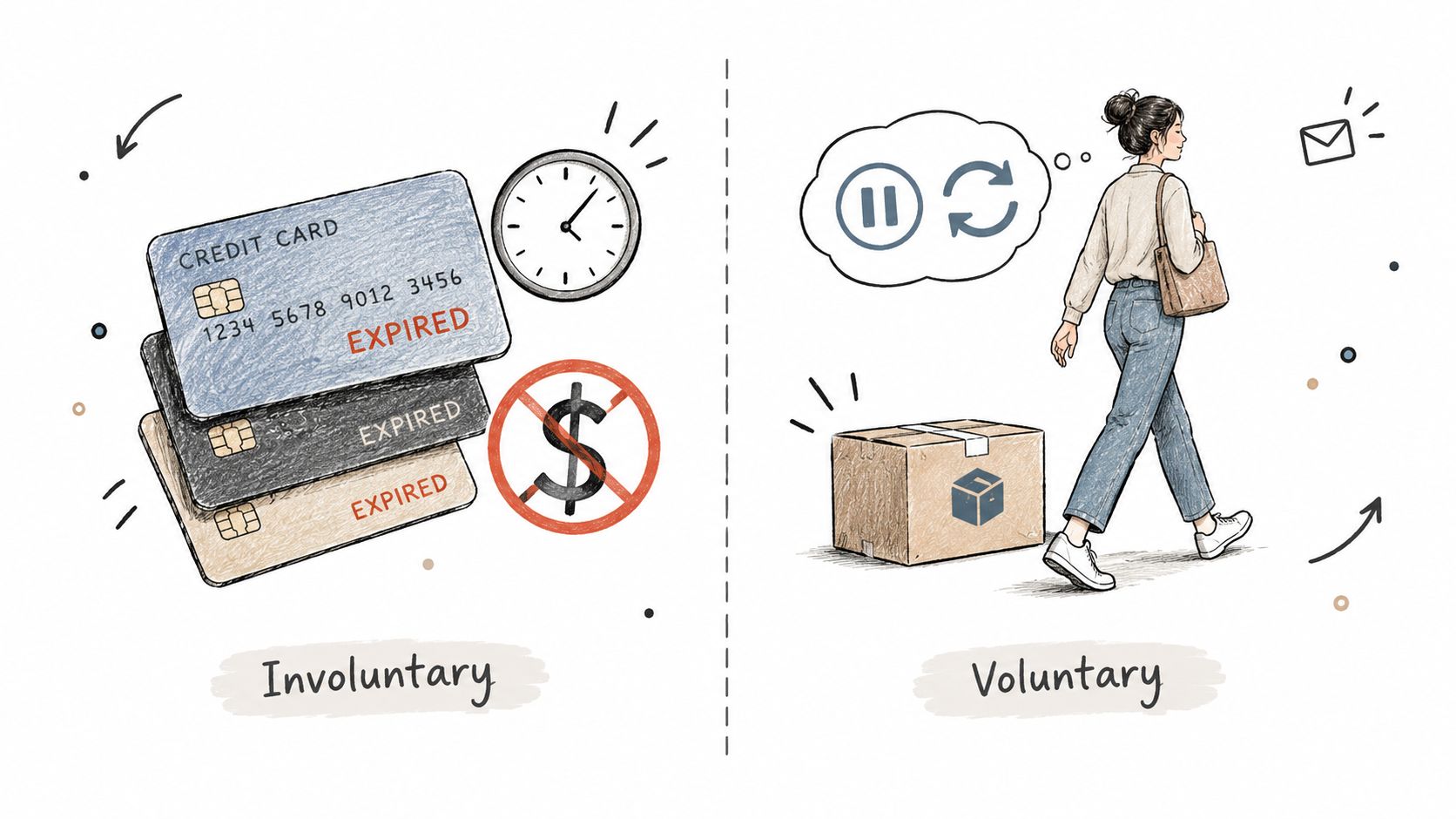
Payment failure is the silent category. A skincare subscriber gets a replacement bank card, forgets to update her details, and her renewal declines. She never decided your serum stopped working. She probably assumes the next bottle is on its way.
Insufficient funds work the same way. A renewal that lands two days before payday fails, even though the customer can afford the product and wants it. Outdated billing information after a move produces the same result. In each case, the relationship is intact and only the transaction broke.
Voluntary Causes That Look Like Rejection
Voluntary cancellations feel personal, but many of them aren't about your product at all. A coffee subscriber who loves your beans may still cancel after three unopened bags pile up on the counter. The product succeeded. The delivery cadence failed.
- Inventory accumulation: Replenishment arrives faster than the customer uses it, so every new shipment becomes a reminder to cancel.
- Seasonal demand shifts: A customer needs your product heavily in winter and barely at all in summer, and a fixed schedule can't follow that pattern.
- Travel and life changes: A pet owner boarding her dog for a month doesn't need food deliveries arriving at an empty house.
- Temporary budget pressure: A subscriber tightening spending for two months cancels entirely if cancelling is the only lever you've given them.
- Product fatigue: The same scent, flavor, or formula every cycle eventually feels stale, even when quality hasn't changed.
Read those causes again and notice the pattern. Most describe a timing or control problem, not a quality problem. A high cancellation rate often signals poor lifecycle design, meaning your program doesn't flex with how customers live.
That distinction changes your diagnosis. A merchant who sees rising cancellations and assumes the product is failing might reformulate something customers already like. A merchant who reads cancellation reasons first might discover the product is fine and the schedule is the entire problem.
Churn Benchmarks and What Good Looks Like
Benchmarks answer one question well. Is your rate in a range that should worry you, or is it broadly in line with other subscription businesses? They can't tell you what your specific store should achieve, because your category, price point, and delivery frequency all shift what's realistic.
The breakdown shown below, drawn from the 2025 figures covered earlier, is best read as a reference point for splitting your own numbers rather than as a target to hit exactly. A replenishment product customers consume daily behaves differently from a quarterly curated box, and comparing the two against one headline figure tells you very little.
Why Your Blended Rate Is the Least Useful Version
Consider a hypothetical store with moderate overall churn that looks acceptable against any benchmark. Split that store's subscribers by age and a different picture can emerge. Long-tenured subscribers might be staying at a healthy pace while brand-new subscribers leave very quickly in their first cycle or two.
Those two situations need opposite responses. Weak retention among veteran subscribers suggests your product or value is wearing thin over time. Weak retention among new subscribers suggests an onboarding problem, where customers don't learn how to use the product, don't understand how to manage deliveries, or bought expecting something different from what arrived.
Reading tip: Compare your rate against your own earlier cohorts before you compare it against anyone else's business.
Category context matters just as much. Products with natural consumption rhythms, like pet food or supplements, give customers a built-in reason to renew on schedule. Discovery-style subscriptions ask customers to stay curious, which is a harder promise to sustain. Neither model is broken. They produce different healthy ranges.
Price point shapes expectations too. A low-cost subscription can survive on convenience alone, because the decision to keep it feels small. A premium subscription gets re-evaluated at every renewal, so each shipment has to re-earn its place. When you review published subscription churn benchmarks for Shopify stores, read them through that lens. Your goal is a rate that's improving within your own model, trending in the right direction for the right customer groups, not a number copied from a business unlike yours.
Strategies to Reduce Voluntary and Involuntary Churn
The instinctive response to churn is a discount. A customer reaches the cancel button, you offer money off, and some of them stay. That approach treats every cancellation as a price objection, and the evidence on consumer behavior points somewhere else entirely. Many subscribers don't want a cheaper subscription. They want control over the one they have.
The 2025 Mastercard subscription economy report found that 31% of consumers frequently cancel and resubscribe, while 57% of businesses ranked pausing among their top three retention tactics. Separate 2025 consumer research cited in that report found 55% of subscribers wanted easy pausing or cancellation, but only 37% currently had that option.
Read those figures together and a clear picture forms. A large share of churn isn't a goodbye. It's a customer asking for a break through the only door you've left open, then sometimes coming back on their own later.
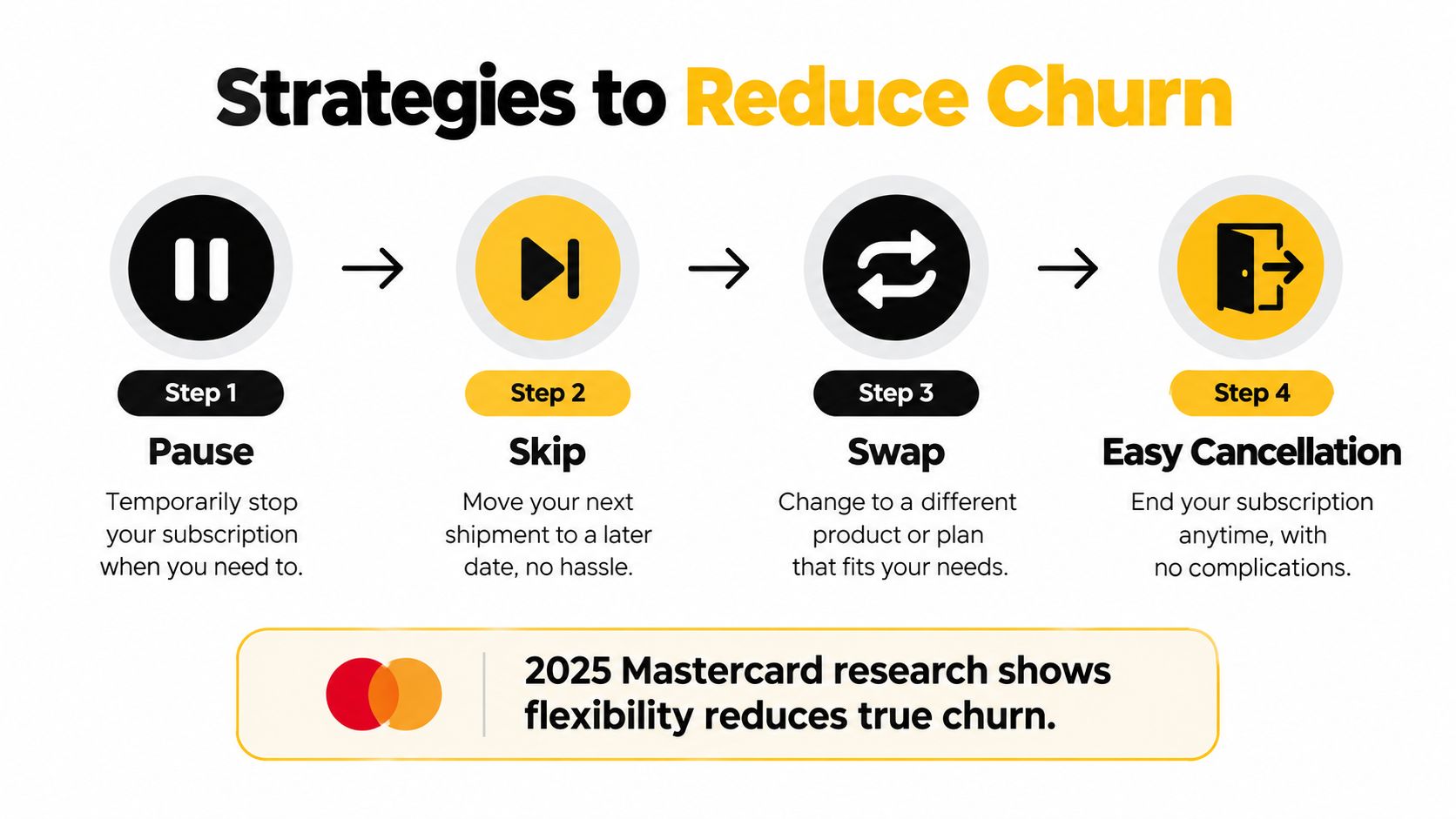
Flexibility Tools That Convert Exits Into Pauses
Pause suits the traveling pet owner and the subscriber under temporary budget pressure. The relationship survives, the billing stops, and restarting takes one click instead of a full resubscription.
Skip solves the stockpiled coffee problem without ending anything. Swap handles product fatigue by letting a customer trade a scent or flavor they've tired of for something new, keeping the subscription while refreshing the experience. Anchor-date billing, which lets customers align charges to a preferred day like payday, prevents a category of failures that look like churn but start as bad timing.
Easy cancellation belongs on this list too, which surprises many merchants. A customer who leaves without a fight remembers the experience as fair, and a fair exit keeps the door open for resubscription. Trapping people with hidden cancel buttons protects one renewal and costs you every future one.
The short walkthrough below shows how these controls look from the customer's side of the screen.
Recovering Payments Before They Become Churn
Involuntary churn needs automation, not persuasion. A dunning sequence is a planned series of retries and reminders after a payment fails. Retrying on a smart schedule catches customers whose funds arrive a few days later, while a one-click card-update link sent by email or text lets the expired-card customer fix the problem in seconds.
Platforms such as RecurX build these pieces into Shopify directly, combining decline-aware retry windows and card-update links for payment failures with a self-serve customer portal where subscribers pause, skip, and swap on their own. Whatever toolset you use, the mapping is what counts. Payment tools fix payment churn. Portal controls fix flexibility churn. Loyalty rewards, such as points per renewal or milestone bonuses, address the slower drift of customers who feel unappreciated over time.
Keep one exception in mind. When cancellation reasons consistently name product quality or price, flexibility won't save you, and discounting only delays the exit while training customers to wait for offers. Read your cancellation reasons monthly so you can tell a control problem from a genuine product problem before you spend money solving the wrong one.
Building a Churn Measurement Framework
A framework turns everything above into a monthly routine you can finish in one sitting. Start with the six components from the calculation table, recorded the same way every month, so your numbers stay comparable over time. Consistency matters more than sophistication here.
Layer three views on top of those basics. Split churn by reason so you know which bucket is growing. Split it by cohort age so you can see whether new or veteran subscribers drive changes. Split it by plan type so a problem isolated to one offer doesn't trigger changes across your whole program.
Then track what happens after someone almost leaves. Record gross cancellations, how many you saved, your pause-to-reactivation rate, and average time paused. Check net active revenue at 30 and 90 days after any retention change, because a save that cancels again next cycle isn't really a save.
Reading churn by cohort takes some practice, and a structured guide to subscription cohort analysis can help you set up those views without a data team. Once they're running, set simple thresholds for yourself. Investigate when a specific reason, cohort, or plan moves sharply. Accept the background level of churn that comes from moves, budgets, and changing tastes, because chasing zero churn leads to desperate discounting that damages healthy revenue.
The merchants who manage churn well share one habit. They treat each cancellation as data about a specific cause, match the fix to that cause, and check whether the right number moved. Your subscription churn rate becomes useful the moment it stops being one number and starts being that conversation.
If splitting voluntary from involuntary churn in your current setup means exporting spreadsheets and guessing at reasons, RecurX can handle that work inside Shopify, with churn tracked by reason and cohort, self-serve pause and skip controls for your customers, and automated payment recovery running in the background. Install it on your store, pull up your first separated churn report, and fix the bucket that's costing you subscribers.
subscription churn rate · churn rate · Shopify subscriptions · reduce churn · involuntary churn
Keep reading
- How to Offer Payment Plans to Customers in 2026Learn how to offer payment plans to customers with this practical guide covering plan structures, billing setup, eligibility, pricing, and recovery tactics.
- subscription-referral-program-shopify
- Buy a Subscription the Smart Way: A Complete How-To GuideLearn how to buy a subscription with confidence. Discover what to check before paying, how recurring billing and cancellation really work, and how
Start growing recurring revenue on Shopify
RecurX has a 14-day free trial and zero transaction fees on every plan. Install in minutes.
Start your free trial →