How to Offer Payment Plans to Customers in 2026
Learn how to offer payment plans to customers with this practical guide covering plan structures, billing setup, eligibility, pricing, and recovery tactics.
Learn how to offer payment plans to customers with this practical guide covering plan structures, billing setup, eligibility, pricing, and recovery tactics.
Your Shopify store already has the ingredients for a payment-plan launch: customers asking about smaller payments, a subscription app on the shortlist, and a checkout where another payment option seems easy to add. The harder questions arrive afterward. Who pays the financing fee? What happens when a customer returns part of an order? Does canceling a subscription also cancel an outstanding installment balance?
To offer payment plans to customers profitably, treat the launch as a billing and unit-economics decision, not a conversion toggle. Choose the obligation you're creating, model the costs through repayment and returns, and give support a workable exception process before sending traffic to the offer.
Table of Contents
- Choosing the Right Payment Plan Structure for Your Store
- Defining Who Qualifies and When Plans Should Appear
- Pricing Plans So They Actually Add Margin
- Wiring Plans Into Checkout and the Product Page
- Building a Decline-Aware Payment Recovery Workflow
- Communicating With Customers and Reducing Repayment Risk
- Launch Checklist and Common Questions
Choosing the Right Payment Plan Structure for Your Store
Choose the obligation before the billing schedule
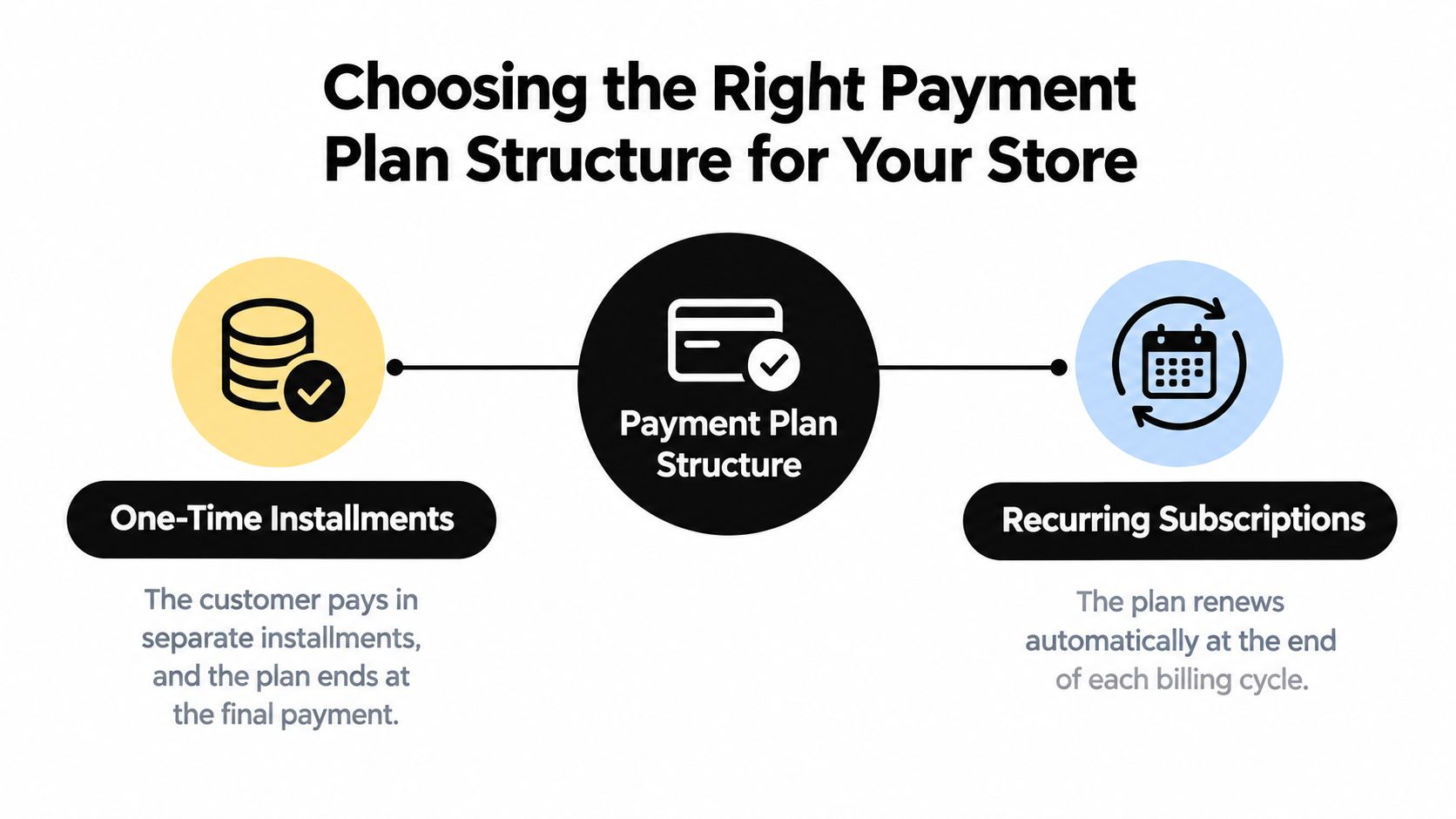
One-time installments divide a finite purchase into scheduled payments. The obligation ends after the final payment. This structure makes sense when the customer wants a particular product or bundle, rather than an ongoing relationship.
Recurring subscriptions renew until canceled under the agreed terms. For coffee, supplements, skincare, and pet products, the central question is replenishment: does the customer want another shipment, and when? Don't present an automatically renewing subscription as though it were a smaller payment on a completed purchase.
A deferred single payment is different again. The customer buys now and pays the full balance later. It delays payment without dividing the balance, so calling it an installment plan would misrepresent the arrangement.
The distinction should be obvious before customers select an option.
For a replenishment business, start with the delivery relationship, then choose the billing structure:
- Pay-as-you-go: Charge as each subscription order becomes due. Match the charge to a clearly understood shipment.
- Prepaid: Collect payment upfront for an agreed delivery entitlement. Specify the delivery schedule and what happens to unused deliveries.
- Membership: Charge for continuing access or benefits. Explain whether physical products are included or purchased separately.
- Finite installments: Spread a defined purchase balance across payments without implying that each charge creates another shipment.
A subscription application and a BNPL provider solve different problems. Don't assume that a tool that schedules recurring orders also underwrites credit, advances settlement, or assumes repayment losses. Confirm those responsibilities in the provider agreement.
Practical rule: Write the customer's obligation in a plain sentence before configuring the plan. If your team can't explain when it ends, your customer won't know either.
Match billing cadence to consumption and fulfillment
For a hypothetical coffee subscription, monthly billing might fit the customer's consumption better than yearly prepayment. A gift subscription could justify an upfront prepaid arrangement, while a membership could use a separate annual renewal. These are design choices, not reasons to expose every available interval.
Choose order-date billing when each customer should follow their own purchase anniversary. Consider anchor-date billing when operations need a shared production or dispatch cycle. With an anchor date, explain the first charge and shipment explicitly, especially when someone signs up close to the cutoff.
Keep billing frequency and delivery frequency separate in your configuration notes. Customers can pay upfront while receiving goods over time, but the portal and confirmation must show both schedules. Otherwise, support has to explain why a paid customer hasn't received everything yet.
Free trials require another deliberate choice. Define what's free, what the customer authorizes, when the first paid charge occurs, and whether anything ships during the trial. Don't label a plan prepaid while leaving customers uncertain about when you collect the upfront payment.
Design changes before customers request them
A pause, skip, downgrade, and cancellation shouldn't all trigger the same action. A skipped delivery might move the next charge, while a prepaid pause might move fulfillment without creating a refund. A downgrade needs an effective date and a clear treatment of already-paid benefits.
Document the expected result for each action:
- Pause or skip: Identify which shipment and charge move, and when service resumes.
- Swap or change frequency: Recalculate the next order without changing an existing purchase obligation.
- Cancel: Distinguish stopping future renewals from resolving goods already supplied or balances already incurred.
Keep pay-in-full available alongside finite financing where appropriate. For a subscription-led store, present the replenishment plan as the primary recurring option rather than surrounding it with several nearly identical schedules. Start with the simplest structure your fulfillment and support teams can explain consistently.
Defining Who Qualifies and When Plans Should Appear
Plan eligibility should reflect the economics of the basket, not just whether the provider can approve the shopper. A low-margin refill and a higher-value starter bundle don't necessarily deserve the same financing offer.
Availability alone also doesn't prove demand. The New York Fed's June 2023 survey found that 64% of respondents had been offered BNPL, while 19% had used it during the preceding year, as summarized in the Federal Reserve's analysis of BNPL use and motivations.
Build an eligibility matrix
Use a policy your merchandising and finance teams can inspect, rather than scattered theme conditions.
| Decision factor | Consider showing plans | Consider withholding plans |
|---|---|---|
| Basket contribution | Enough margin to absorb incremental costs | Little room after fulfillment and fees |
| Product category | Clearly defined purchase and return treatment | Complicated fulfillment or refund exposure |
| Customer history | Reliable prior transactions | Unresolved disputes or payment problems |
| Existing subscription | A distinct purchase outside normal replenishment | An offer that obscures existing commitments |
Customer history should inform the decision, not become a claim about affordability. A repeat purchaser may understand your products but still have obligations you can't see.
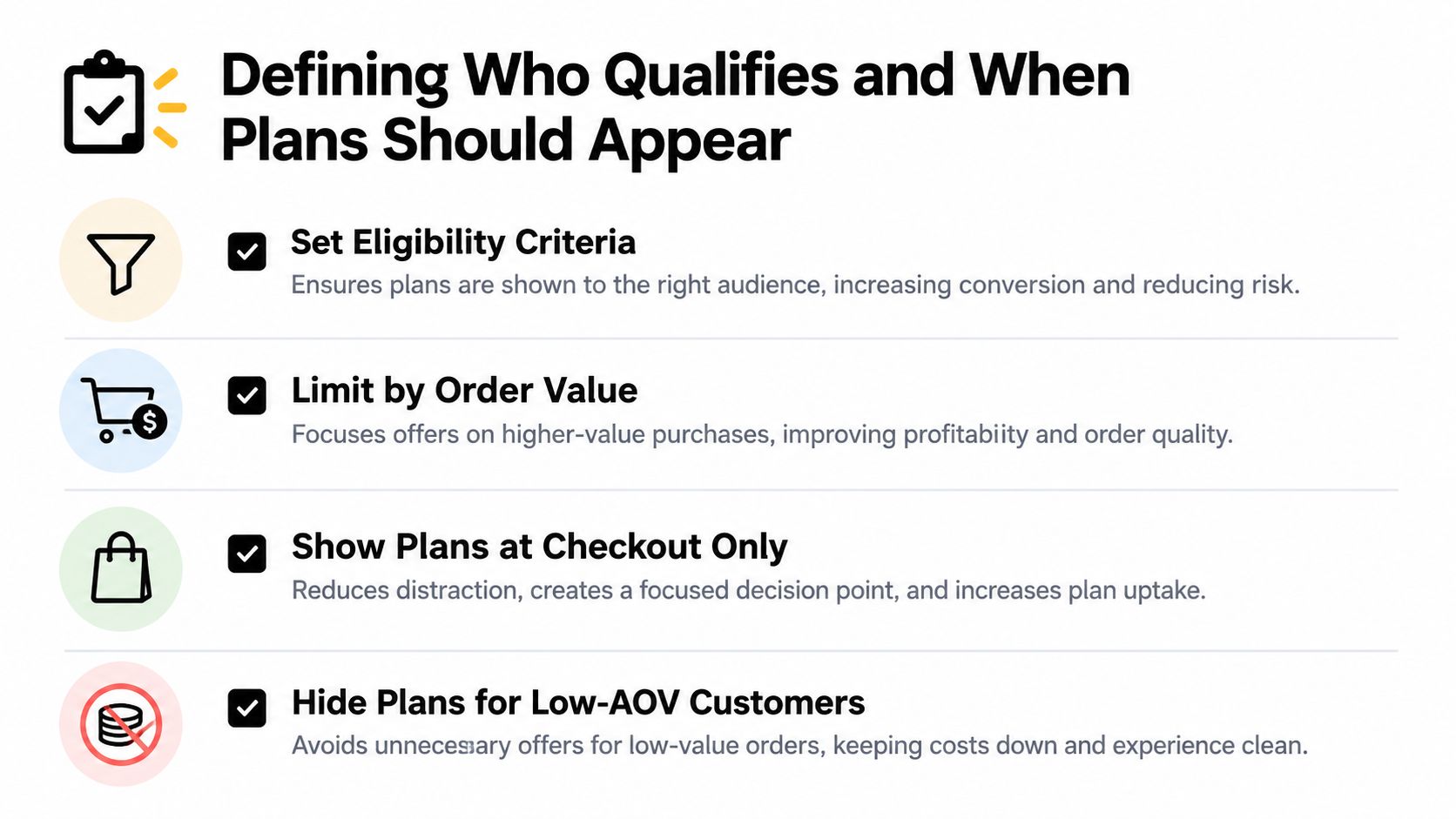
Use this checklist to translate the policy into storefront conditions.
Separate eligibility from placement
Checkout-only exposure is a useful pilot configuration, not a universal rule. Product-page messaging can help customers evaluate an eligible purchase earlier, provided it doesn't promise terms that disappear after cart changes.
- Set the threshold from margin: Don't copy a competitor's minimum basket value.
- Recheck the cart: Discounts, mixed products, and subscription selections can change eligibility.
- Segment deliberately: Existing subscribers may need a familiar renewal choice rather than another financing prompt.
Begin with a narrow product group and retain a comparable unexposed cohort. Expand only after finance and support can explain both the profitable orders and the exceptions.
Pricing Plans So They Actually Add Margin
A payment plan earns its place when it increases contribution profit per visitor, not merely completed checkouts. Otherwise, you may be paying more to collect revenue from customers who would have used a cheaper method.
Typical BNPL merchant fees range from 1.5% to 7%, compared with approximately 1% to 3% for conventional card acceptance, according to the Kansas City Fed's merchant and consumer payment-plan analysis. Your signed agreement, including refund treatment and settlement terms, should drive the actual model.
Cost and Margin Comparison for Payment Methods
| Payment method | Typical fee | Conversion impact | Key metric to track |
|---|---|---|---|
| Conventional card | Card-processing charges | Use as the baseline | Contribution profit per visitor |
| BNPL | Financing charges, generally above cards | May reduce upfront price friction | Incremental profit after financing |
| Recurring subscription | Processing plus applicable app costs | Creates an ongoing purchase choice | Cohort contribution after churn |
| Prepaid subscription | Processing plus applicable app costs | Requires an upfront commitment | Contribution after remaining fulfillment |
Include the costs that arrive after checkout
Calculate contribution from collected revenue after discounts, product cost, fulfillment, payment costs, refunds, disputes, and incremental support. For prepaid plans, reserve for deliveries you still owe rather than treating cash received as fully earned margin.
A larger order isn't automatically a better order if you paid more to finance it and will spend more resolving its return.
Keep pricing architecture separate from financing. A subscription pricing strategy should establish the value of recurring purchases before you layer on payment flexibility. For a different high-consideration purchase context, ECI Jewelers' guide to ring financing for couples offers a useful consumer-facing resource to review when planning financing explanations.
Compare exposed and control cohorts using consistent acquisition and product groupings. Track conversion, average order value, repeat purchases, refunds, and contribution together. Retire the offer if customers mainly switch from cheaper payment methods without producing enough incremental profit.
Wiring Plans Into Checkout and the Product Page
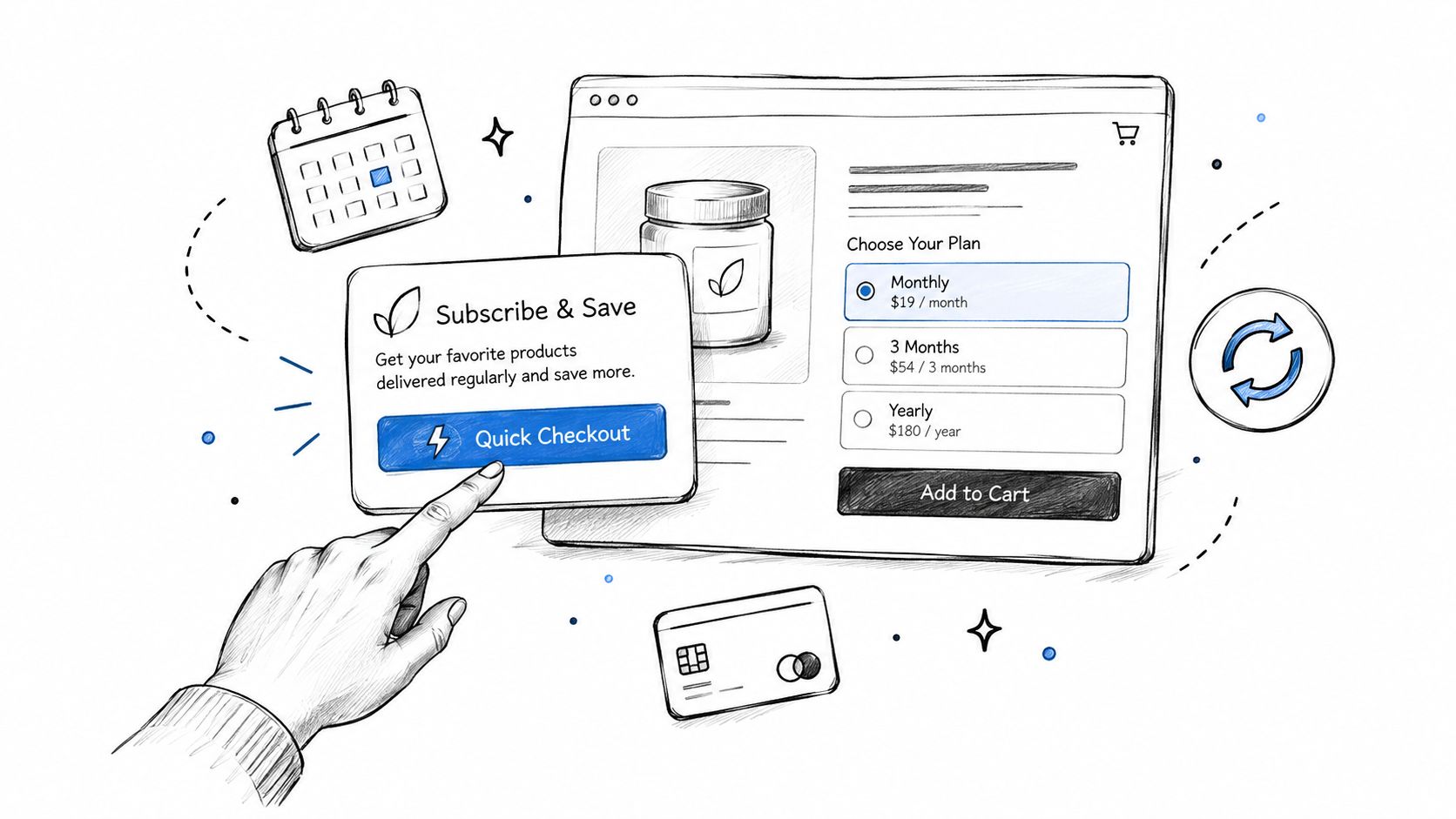
Show the purchase choice where customers make it. On the product page, place the plan selector close to the price and purchase button, rather than burying renewal terms in an accordion.
The storefront should distinguish the immediate charge from the ongoing commitment.
Make selection and confirmation agree
Use theme-matched typography and accessible contrast so the widget looks like part of the store. That's a design requirement, not a guarantee of higher conversion. Avoid an overlay that makes customers wonder whether they've left your checkout.
Check the complete path using the Shopify subscription checkout guidance, then test your actual combinations of variants, discounts, shipping, and purchase options.
- Product page: Show what customers receive and which purchase arrangement they're selecting.
- Cart and checkout: Preserve the selected plan and its relevant terms after cart changes.
- Confirmation: Record the arrangement the customer accepted, not just the product name.
The embedded video provides an additional visual reference.
Test campaign entry points and self-service
Quick-checkout links and QR codes can take customers from a social post, package insert, or campaign directly into a selected purchase. Configure the intended variant and plan, then test the destination as a logged-out shopper. A shortcut shouldn't bypass the information needed to understand the commitment.
For Klaviyo or Mailchimp campaigns, confirm that the email promise matches the checkout state. Don't advertise a prepaid arrangement and land the shopper in an automatically renewing selection.
Give customers an account-based portal on the merchant's domain for supported changes. Test permissions, confirmation messages, and the resulting order state after a pause, swap, or frequency change. Support should see the same next charge and shipment information the customer sees.
Building a Decline-Aware Payment Recovery Workflow
A failed payment is an exception to classify, not permission to keep charging blindly. Insufficient funds, an expired card, suspected fraud, and a hard decline need different responses.
Use the processor's decline information to determine whether a retry, payment update, or manual review is appropriate. Tagada's Tagada on dunning for ecommerce is useful background for teams defining the recovery process.
Route the failure before sending the reminder
For insufficient funds, choose a permitted retry window rather than repeating the request immediately. An expired credential needs an update path. Suspected fraud requires review, and a hard decline shouldn't enter an indiscriminate automated retry loop.
Map the workflow before enabling customer messages.
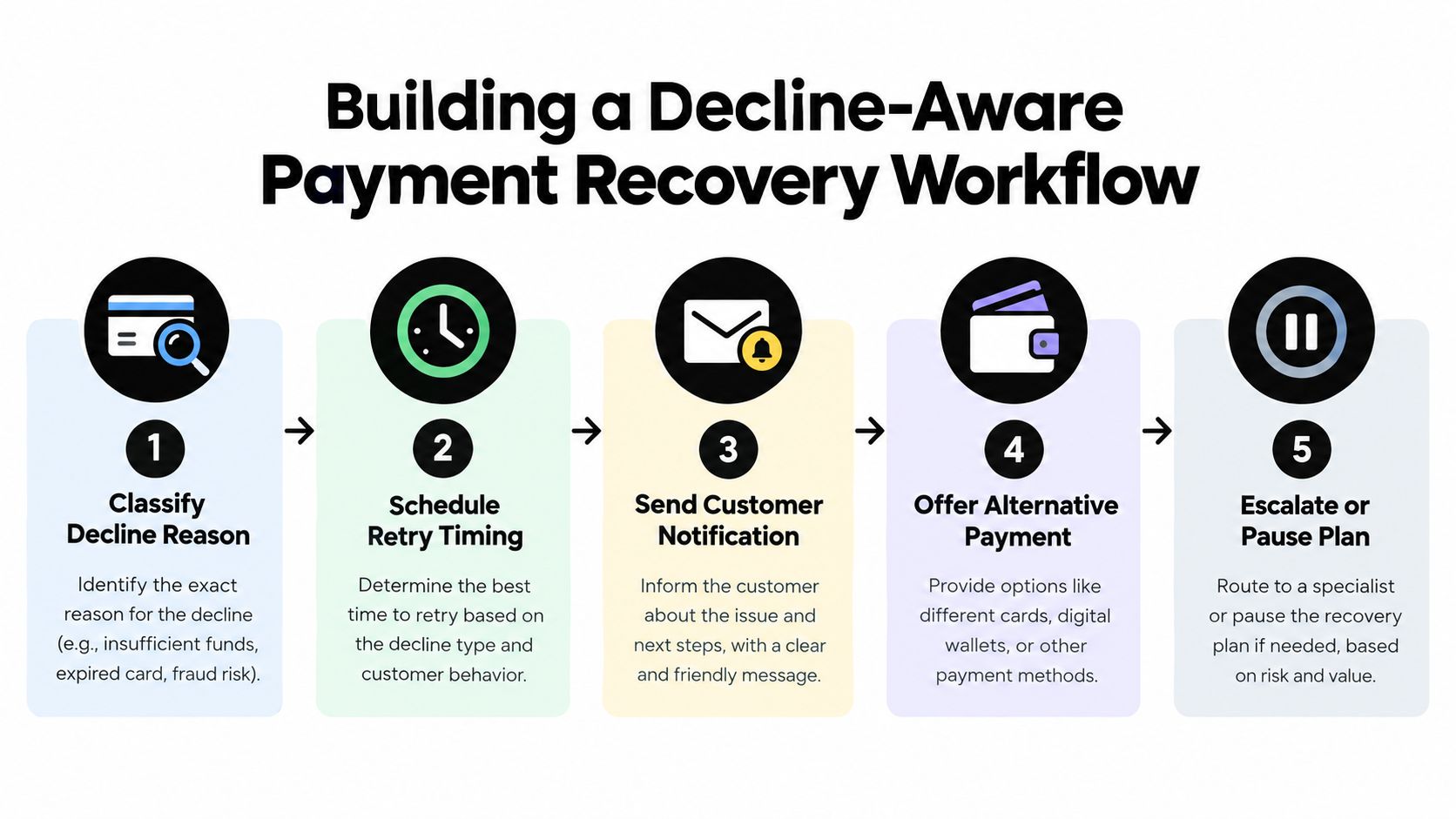
Industry summaries describe directional recovery ranges of roughly 0% to 10% with a single attempt, 20% to 40% with fixed-interval retries, and 70% to 85% when smart retries, card updating, and messaging are combined; the Retention Lens involuntary-churn summary should be treated as context, not a forecast for your store.
Coordinate recovery with order status
Build the sequence around events rather than a batch of disconnected messages. The failed-payment recovery workflow should connect decline classification, customer action, retry eligibility, and fulfillment.
- Make updates direct: Send a secure card-update link instead of requiring another purchase.
- Coordinate channels: Sequence email, SMS, or WhatsApp according to consent and customer preferences.
- Suppress obsolete messages: Stop duplicate reminders after recovery, cancellation, or a fraud flag.
- Define escalation: Tell support when to pause service or review the account.
Measure recovery rate as recovered failed invoices divided by eligible failed invoices. Separately track recovered revenue, days to recovery, involuntary churn, opt-outs, and support contacts.
Don't count an eventual payment as an uncomplicated win if the customer also received an unwanted shipment or requested a refund. Review recovery alongside the order outcome and compare it with a no-retry baseline.
Communicating With Customers and Reducing Repayment Risk
Maximizing plan adoption is the wrong objective. A customer who accepts the plan but can't sustain the charges isn't a retention success.
The CFPB found that 10.5% of unique users at the providers it studied incurred a late fee in 2021, while 13.7% of individual loans involved an order with at least some merchandise returned, according to its study of BNPL growth and operational risks. That makes repayment communication and returns handling part of the product.
Write messages around the customer's decision
Before purchase, disclose total cost, payment amounts, billing dates, applicable fees, and cancellation treatment. Don't preselect financing coercively or describe a smaller immediate payment as a lower total price.
Use templates that name the event and the available action:
- Before a charge: “Your next payment is scheduled for [date] for [amount]. Review your plan or available changes in your account.”
- After a decline: “We couldn't collect your scheduled payment. Update your payment method securely. Your account shows the current order status.”
- After a refund: “We've submitted your refund of [amount]. We'll confirm how it affects your remaining payment schedule.”
Customer-protection test: Can the customer understand the total commitment without opening the terms page or calculating it themselves?
Assign ownership for refunds and disputes
Document who initiates a partial refund, who adjusts the financing balance, and who confirms completion. Reconcile the Shopify order, provider record, and customer message before closing the ticket.
A canceled subscription doesn't, by itself, explain the status of an existing financed purchase. Give support a decision tree that distinguishes future renewals, goods already delivered, pending refunds, and disputed balances.
The Richmond Fed's discussion of BNPL economics and consumer protections provides context for the evolving regulatory environment. Have qualified counsel confirm current obligations by market and financing structure rather than treating a historical regulatory announcement as a universal launch checklist.
Offer hardship options only when you can explain their consequences. A pause may help; a smaller first payment merely postpones part of the obligation unless the overall arrangement changes.
Launch Checklist and Common Questions
A launch is ready when finance, operations, and support can explain the same order without consulting different spreadsheets. Set a stop condition as well as a growth target, so the team knows when to restrict or withdraw an offer.
Approve a controlled release
Assign an owner and a pass condition to each workstream.
- Plan design: Approve the obligation, renewal behavior, billing cadence, and change rules.
- Eligibility: Publish the product and basket policy, then verify it against discounts and mixed carts.
- Economics: Preserve a comparison cohort and calculate contribution after the full cost stack.
- Storefront: Test the selected plan from product page or campaign entry through confirmation.
- Recovery: Validate decline routing, update flows, suppression, and escalation.
- Operations: Complete a partial-return rehearsal and assign reconciliation ownership.
- Reporting: Review conversion, order value, recovery, refunds, and support workload together.
Don't expand exposure while unresolved exceptions are still being handled manually without an agreed process. A narrow launch gives the team room to fix those gaps before they become routine.
Should plans have a minimum basket value?
Often, but derive it from contribution rather than an arbitrary industry convention. Apply the eligibility policy to the actual basket after discounts, and verify that product exclusions still work when customers add other items.
How should partial refunds work?
Identify the returned items and refundable amount, submit the adjustment through the agreed system, and confirm its effect on the remaining balance. Don't promise that every provider will apply the refund to the next installment in the same way.
Does a subscription app replace a financing provider?
Not automatically. Recurring order management, credit provision, settlement, and collections are separate responsibilities, so establish which party performs each function before launch.
What needs review when selling across markets?
Confirm provider availability, disclosures, authorization requirements, cancellation treatment, dispute procedures, and notification language. Keep a dated internal record of the approved configuration and obtain qualified advice when the arrangement involves lending.
The practical next step is to select an eligible product group and run a complete test order through payment, plan change, return, and reconciliation. Approve broader availability only when the economics and exception handling both work.
RecurX offers Shopify subscription plans, customer self-service, payment recovery, and cohort analytics for merchants managing recurring purchases. If subscriptions are the right structure for your store, visit RecurX to explore how those tools fit your billing, recovery, and reporting requirements before launching.
payment plans · customer payment plans · Shopify subscriptions · BNPL · RecurX
Keep reading
- Subscription Churn Rate: How to Reduce It for ShopifyLearn what subscription churn rate means, how to calculate it, and proven strategies Shopify merchants can use to reduce voluntary and involuntary churn.
- subscription-referral-program-shopify
- Buy a Subscription the Smart Way: A Complete How-To GuideLearn how to buy a subscription with confidence. Discover what to check before paying, how recurring billing and cancellation really work, and how
Start growing recurring revenue on Shopify
RecurX has a 14-day free trial and zero transaction fees on every plan. Install in minutes.
Start your free trial →