Best Subscribe and Save Strategies for Shopify
Discover the best subscribe and save strategies for Shopify. Compare native app features, fee structures, and retention tactics to maximize recurring revenue.
Discover the best subscribe and save strategies for Shopify. Compare native app features, fee structures, and retention tactics to maximize recurring revenue.

Most merchants choose a subscribe-and-save program by comparing the size of the discount. That's the wrong starting point. A larger percentage off may increase opt-ins on the product page, but it can also weaken contribution margin, attract customers who cancel after the first shipment, and conceal a payment recovery system that quietly loses otherwise viable subscribers.
The best subscribe and save strategy is a retention engine, not a promotional badge. It combines genuine product fit, native Shopify architecture, flexible customer controls, margin-safe pricing, and automated recovery for failed payments. The frontend offer matters, but the backend determines whether recurring revenue compounds or leaks away after acquisition.
Table of Contents
- Redefining the Best Subscribe and Save Model
- Matching Subscription Models to Product Fit
- Evaluating Native Architecture and Fee Structures
- Optimizing Retention and Payment Recovery
- Strategic Use Cases for Shopify Merchants
- Executing a Platform Migration Without Disruption
- Final Recommendations for Subscription Growth
Redefining the Best Subscribe and Save Model
Subscribe and save began as a convenient way to reorder consumable products. It has become a more durable commercial model because it changes the customer relationship from episodic purchasing to recurring replenishment. Coffee, supplements, skincare, pet products, and household essentials can move from occasional transactions into an operating rhythm that benefits both the buyer and the merchant.
The retention difference is substantial. A 2026 benchmark reports 12-month retention of 55% to 72% for subscription Shopify stores, compared with about 28% for standard ecommerce stores, implying roughly two to three times stronger customer stickiness over that period. The same benchmark places broader ecommerce retention around 30% to 38%, while subscription-economy reporting cited in the benchmark shows approximately 72% B2C retention and 90% B2B retention. These figures are from Ringly's 2026 customer churn benchmark, and they support a structural point, not a promise that every subscription program will perform equally well.
Discount size is only one input
A discount can earn the first recurring order. It can't, by itself, make the second, third, or fourth order sensible for the customer. If delivery frequency is wrong, the portal is difficult to use, or a card decline ends the subscription without a recovery attempt, the original discount becomes an expensive acquisition cost.
A useful subscribe-and-save glossary should distinguish the offer from the operating system behind it. Merchants need to evaluate:
- Margin preservation: Does the pricing structure protect contribution margin as order volume grows?
- Billing control: Can the system handle skips, pauses, swaps, frequency changes, and anchor dates?
- Payment recovery: Does it retry declines intelligently and give customers a direct way to update payment details?
- Customer autonomy: Can subscribers manage their plan without opening a support ticket?
- Data visibility: Can the team separate voluntary cancellation from involuntary churn?
| Evaluation area | Discount-led approach | Retention-led approach |
|---|---|---|
| Acquisition | Emphasizes the largest visible saving | Uses a targeted incentive that fits the margin model |
| Customer experience | Treats the product-page widget as the main feature | Connects the widget, checkout, portal, and notifications |
| Revenue protection | Accepts failed payments as lost orders | Uses retries, dunning, and card-update flows |
| Operations | Support team handles routine changes | Customers manage skips, swaps, and pauses themselves |
| Measurement | Tracks subscription sign-ups | Tracks retention, churn reasons, LTV, ARPU, AOV, and recovery |
| Platform choice | Tolerates fees and fragmented infrastructure | Prioritizes native Shopify integration and predictable economics |
Food is a useful example because replenishment demand is easy to understand, but the category still has operational constraints around inventory, delivery timing, and customer consumption. Quikly's analysis of why food subscriptions are working offers relevant context for merchants assessing recurring food purchases rather than copying a discount mechanic without checking demand patterns.
Practical rule: Set the smallest incentive that makes the recurring commitment feel fair, then invest the remaining margin in retention mechanics.
The merchant's real question isn't “What discount wins the click?” It's “What combination of product fit, convenience, and recovery produces profitable repeat orders?” That question leads to better decisions about architecture, customer experience, and measurement.
Matching Subscription Models to Product Fit
A subscription works best when the customer can predict both when they'll need the product and how much they'll consume. When either prediction fails, the merchant has to compensate with skips, pauses, flexible intervals, and clear reminders. Without those controls, the business often converts a normal repeat buyer into a frustrated canceler.
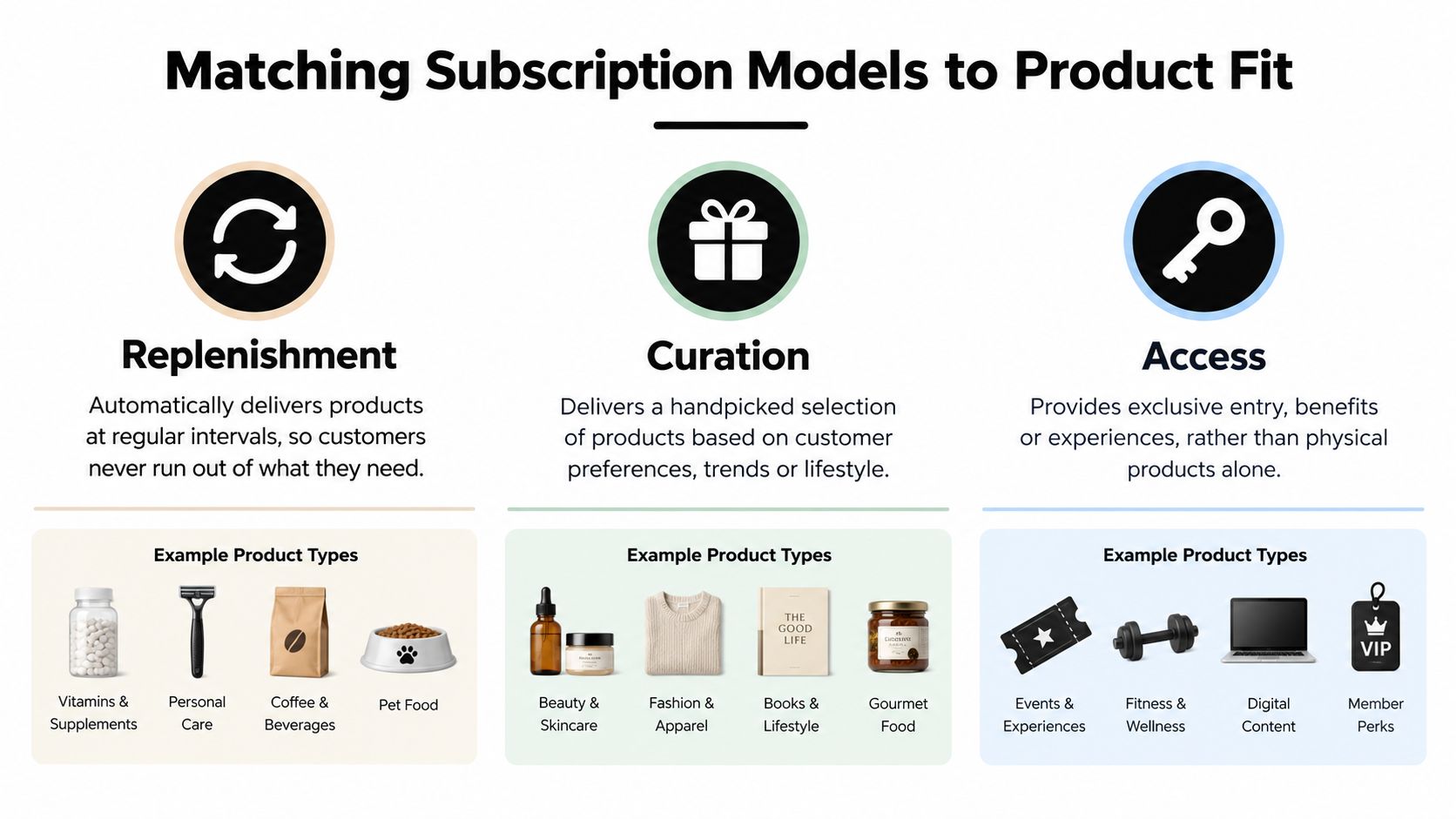
Three models appear most often:
- Replenishment: The customer receives the same or similar consumable product on a chosen schedule. Coffee, vitamins, protein powder, pet food, skincare staples, and cleaning products are natural candidates.
- Curation: The merchant selects a changing assortment, often organized around discovery or a theme. Beauty boxes, snack boxes, and sample collections fit this model.
- Access: The customer pays for benefits such as member pricing, exclusive products, content, or shipping privileges. The recurring value comes from the benefits rather than a predictable physical refill.
Replenishment has the clearest value exchange
Replenishment removes a future shopping task. The customer doesn't need to remember to reorder, compare options, or rebuild a basket. That convenience supports a recurring relationship, provided the delivery interval reflects actual usage.
McKinsey found that 45% of replenishment members remained subscribed for at least one year, about 10 percentage points higher than curation or access services, according to its research on subscription-box consumers. The difference doesn't mean curation and access are poor models. It means their retention logic is different. A discovery box must keep producing novelty, while an access program must continually justify its benefits.
A merchant should test fit before building a complex offer:
- Review the reorder pattern. Look for products customers already purchase repeatedly without a subscription. If repeat demand is weak, a discount may only bring orders forward rather than create durable demand.
- Estimate consumption. Match available frequencies to real usage. A customer who receives too much product will skip, pause, or cancel even if the price is attractive.
- Choose the right commitment. Allow customers to change cadence when consumption varies. Flexible billing isn't a concession, it protects the relationship.
- Check replenishment risk. Perishable items, changing formulas, seasonal needs, and variable household sizes require more control than a standard monthly plan.
- Measure incremental behavior. Compare subscribers with similar one-time buyers. If subscribers would have reordered at the same rate, the discount may be subsidizing existing behavior.
Physical subscriptions are also exposed to more practical friction than digital ones. Benchmark-style reporting cited in the research places physical subscription churn at 5% to 7% monthly, compared with 3% to 5% for digital subscriptions. That makes fulfillment, inventory continuity, delivery timing, and customer controls part of the retention product.
The fit test is straightforward. If the product solves a recurring need, replenishment can be powerful. If the product mainly creates surprise or access, use the corresponding model and don't label it subscribe and save just because a recurring payment is available.
Evaluating Native Architecture and Fee Structures
The subscription platform sits between the storefront, checkout, payment gateway, customer account, fulfillment process, and lifecycle marketing stack. A visually attractive widget can't compensate for broken connections across those systems.
Legacy subscription implementations often depend on embedded interfaces, third-party cookies, or separate account experiences. They can work, but they introduce more points where a theme update, browser restriction, checkout change, or app conflict can degrade the customer journey. A native Shopify implementation keeps the subscription logic closer to the platform's checkout and admin workflows, which simplifies ownership for merchants and developers.
Compare the architecture before comparing the widget
| Feature | Legacy Iframe Apps | Native Shopify Apps |
|---|---|---|
| Storefront experience | Embedded interface may feel separate from the theme | Widget can match theme typography, colors, and layout |
| Checkout relationship | Often depends on an external or layered flow | Designed to work within Shopify's checkout environment |
| Customer account | May use a separate portal or login experience | Can use a merchant-domain customer-account experience |
| Browser dependencies | May rely on third-party cookies or embedded behavior | Uses Shopify-aligned app and session patterns |
| Data flow | More integrations may be needed to connect events | Subscription events can fit existing Shopify workflows |
| Merchant maintenance | Theme and app changes can create more compatibility work | Fewer disconnected surfaces to manage |
| Cost structure | Some providers add per-transaction charges | Zero-fee structures protect revenue when offered |
| Scaling economics | Fees grow with recurring order volume | Costs are easier to model when transaction fees are absent |
The fee question deserves more attention than it usually receives. A per-transaction charge may look small during an early test, yet it applies to the very orders a merchant is trying to grow. Over time, that structure can make the platform more expensive precisely when retention improves. A zero-fee model doesn't make a weak subscription program profitable, but it removes a recurring deduction from every successful renewal.
Architecture beats decoration: A subscription widget earns the opt-in. The checkout, account portal, billing logic, and recovery workflows determine whether the opt-in becomes revenue.
Evaluate the technical details in a live or staging environment, not only in a sales demo. Test mobile rendering, theme inheritance, accessible contrast, product variants, discount stacking, prepaid plans, cancellation flows, and subscription edits. Confirm that customers can skip or swap an item without losing their account history or triggering a confusing checkout loop.
The same scrutiny should apply to admin workflows. Operators need a clear view of active subscribers, upcoming orders, failed payments, churn reasons, and cohort behavior. Developers should check how the app handles Shopify webhooks, privacy requests, billing approvals, and API changes. Merchants comparing Shopify-native subscriptions with app-based implementations should assess operational fit rather than assuming that every native label represents the same depth of integration.
A native architecture is not automatically the right answer for every catalog. It is the stronger default when the merchant wants Shopify to remain the system of record and needs the subscription experience to behave like part of the store, not a separate application attached to it.
Optimizing Retention and Payment Recovery
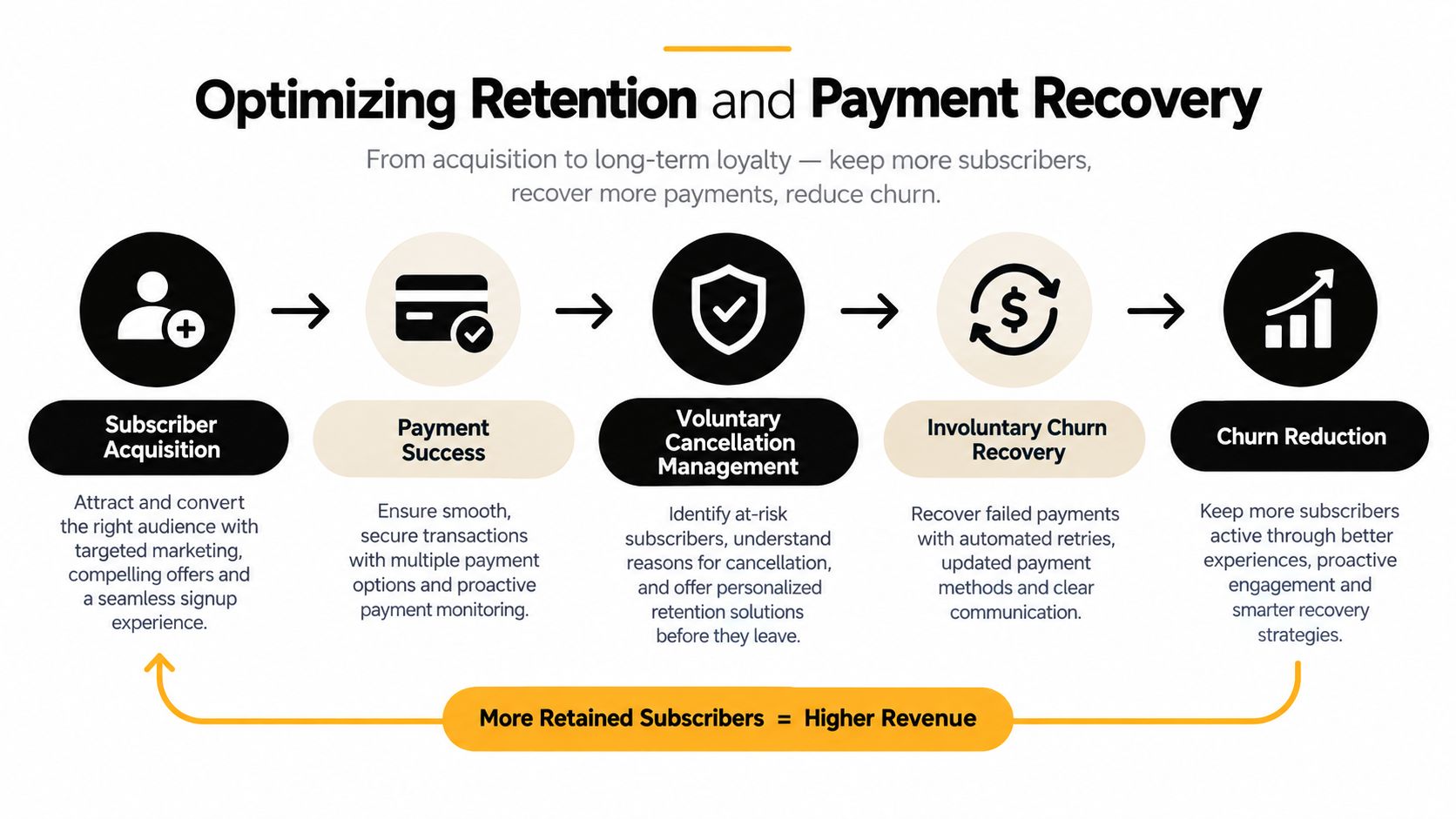
A discount can win the first order while a failed renewal removes the next one. Retention creates the economics. Separate voluntary cancellations from involuntary payment failures because each requires a different operating response.
Voluntary churn reflects a customer decision, often caused by overstocking, weak product fit, delivery friction, price sensitivity, or unclear value. Involuntary churn occurs when the customer still wants the product but the charge fails. Combining both under one churn label produces vague reporting and sends the wrong recovery message.
Build a recovery sequence around the failure
Payment recovery needs an automated sequence, not a single generic reminder. The workflow should identify the decline, select a suitable retry window, provide a direct payment-update path, and stop messaging as soon as the charge succeeds.
Use a sequence such as:
- Detect the failed charge. Tag the subscription, retain the original order context, and record the failure reason when the billing system provides it.
- Retry with timing logic. Space attempts according to the decline type and payment behavior instead of repeating charges at arbitrary intervals.
- Send a direct update path. A one-click card-update link removes unnecessary steps between the customer and a successful renewal.
- Escalate the message. Start with email where appropriate, then use SMS or WhatsApp for customers who have opted into those channels.
- Close the loop. Confirm the recovered payment, update the subscription status, and remove the customer from the dunning sequence.
Payment failures deserve their own dashboard and operating owner. The subscription ecommerce statistics analysis documents payment failure as a significant contributor to subscription loss. Use that kind of benchmark as directional context, not as a universal churn target. Your own recovery rate, retry success by decline type, and time to recovery are more useful for making decisions.
Reduce avoidable cancellations
The cancellation screen should offer practical alternatives without making exit difficult. Let customers skip the next order, extend the interval, swap a product, reduce quantity, or pause the plan. If price is the stated reason, show a controlled offer. If the customer has excess inventory, change the cadence before reducing the price.
Discount design still requires testing. An independent Subscribe & Save coupon experiment found that combining a $2.59 standard discount with an additional $2.75 coupon increased the subscription rate by 50.36% at $7.72 incremental cost per new subscriber. It also reported 124.21% higher 12-month LTV for coupon-acquired subscribers than for non-subscribers, with coupon ROI ranging from 483% to 1,161%, as documented in CartFlows' customer-retention statistics. Treat those results as experiment-specific evidence, not a universal offer template. Test the structure, margin impact, and retention quality rather than assuming the largest discount will produce the best LTV.
The customer portal should expose the controls that prevent unnecessary cancellations. Pair those controls with behavioral tags for repeated skips, late payment, reduced order size, or changing purchase frequency. Lifecycle teams can then tailor the save action to the customer's problem instead of treating every subscriber as equally healthy.
Track voluntary churn, involuntary churn, recovered payments, skipped orders, and retained subscribers after a save offer as separate outcomes. That separation shows whether a discount preserved a relationship, whether a cadence change solved the issue, or whether the merchant gave up margin to retain a customer who would have stayed.
For implementation details, use this guide to recovering failed subscription payments on Shopify. Prioritize customers who still want the product before spending more to acquire replacements.
Strategic Use Cases for Shopify Merchants
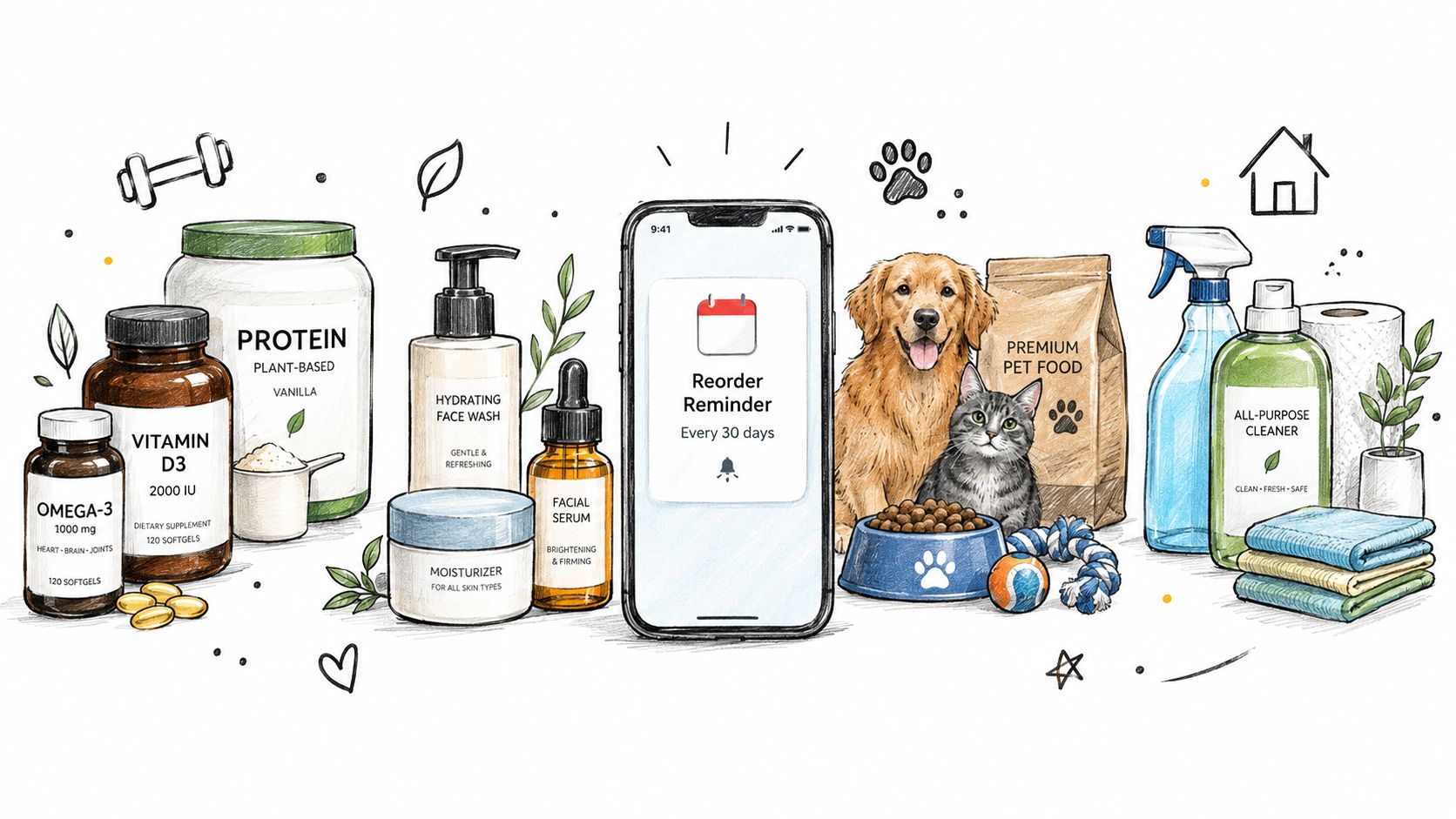
The right subscribe-and-save setup depends on the merchant's constraint. A supplement brand may need reliable replenishment and dosage-aware cadence controls. A skincare company may need product swaps because customers move between routines. A pet brand may benefit from bundles, while a cleaning-products store may win through convenience and a broad household basket.
Configure the offer around the job to be done
For a high-repeat supplement catalog, start with clear individual plans and a small range of sensible intervals. Then add a Build-a-Box path for customers who already buy multiple products. The objective isn't to force every buyer into a bundle. It's to let an existing basket become a recurring routine while preserving control over quantities and timing.
A boutique skincare brand has a different problem. Customers may finish cleanser faster than serum, and a single delivery cadence can create overstock. Product swaps, independent item schedules, and post-purchase education are more useful than a larger initial discount. Lifecycle messages can explain when to reorder, but they shouldn't pressure customers into receiving products they haven't used.
Pet and household merchants can use convenience as the primary value proposition. QR codes and quick checkout links can convert packaging, inserts, social posts, or offline placements directly into a subscription checkout. That route is especially useful when the customer already knows the product and doesn't need another product-page comparison.
Connect subscription events to lifecycle marketing
Subscription status should change the message a customer receives. A new subscriber needs onboarding and delivery expectations. A customer who skips twice may need a cadence suggestion. A failed payment needs a recovery link, not a product recommendation. A long-tenured subscriber may respond to loyalty points, milestone rewards, or a complementary product.
Connect those events to tools such as Klaviyo, Omnisend, Mailchimp, Twilio, or WhatsApp Business where those tools fit the existing stack. Use Shopify Flow or equivalent automation to tag customers by plan, status, product family, and behavior. Keep the segments operationally useful. A dozen precise segments are better than a sprawling taxonomy nobody maintains.
A subscriber is a customer with a schedule. Your marketing should respond to that schedule, not restart the acquisition funnel at every renewal.
Review these scenarios with the team responsible for each workflow:
| Merchant situation | Useful configuration | Common mistake |
|---|---|---|
| Supplements with predictable usage | Individual plans, flexible intervals, replenishment reminders | Offering one cadence for every product |
| Skincare with variable consumption | Swaps, pauses, product education, separate item timing | Treating the entire routine as one fixed bundle |
| Pet food and treats | Build-a-Box, quantity controls, quick reorder paths | Optimizing only for the first discount |
| Cleaning supplies | Multi-item recurring basket, QR links, convenient cadence edits | Making cancellation or skipping difficult |
| Premium niche products | Access benefits, loyalty, exclusive replenishment | Pretending occasional purchases are routine consumption |
Measure each use case against its actual purpose. If the goal is larger recurring baskets, monitor AOV and bundle composition. If the goal is fewer support tickets, monitor self-serve changes. If the goal is improved retention, inspect cohort behavior and cancellation reasons rather than relying on subscriber count alone.
Executing a Platform Migration Without Disruption
Migration anxiety is rational. Active subscribers have stored payment credentials, upcoming billing dates, product relationships, and expectations about delivery. A rushed switch can create duplicate charges, missed renewals, failed payment recovery, or confusing account messages.
Treat subscriber continuity as the primary migration deliverable. The storefront widget is visible, but the billing schedule, customer record, payment token, and renewal logic determine whether revenue continues. A native Shopify architecture can simplify account management and checkout, while a zero-fee structure protects margin on every renewal. Confirm those commercial and technical benefits before prioritizing front-end changes.
Map the records before changing the storefront
Start with an export from the existing provider. Capture customer identifiers, subscription status, products and variants, quantities, billing intervals, next charge dates, discount rules, shipping details, and consent states. Reconcile those records against Shopify before importing anything. A CSV supports portability, but payment tokens require separate handling and may migrate only when the source and destination support a compatible process.
Create a field map before configuring the new plans. A legacy plan called “monthly standard” may not match the Shopify product, selling plan, price, or interval you intend to use. Confirm every variant, bundle component, tax behavior, shipping rule, cancellation status, and next-charge date.
Use a staged launch
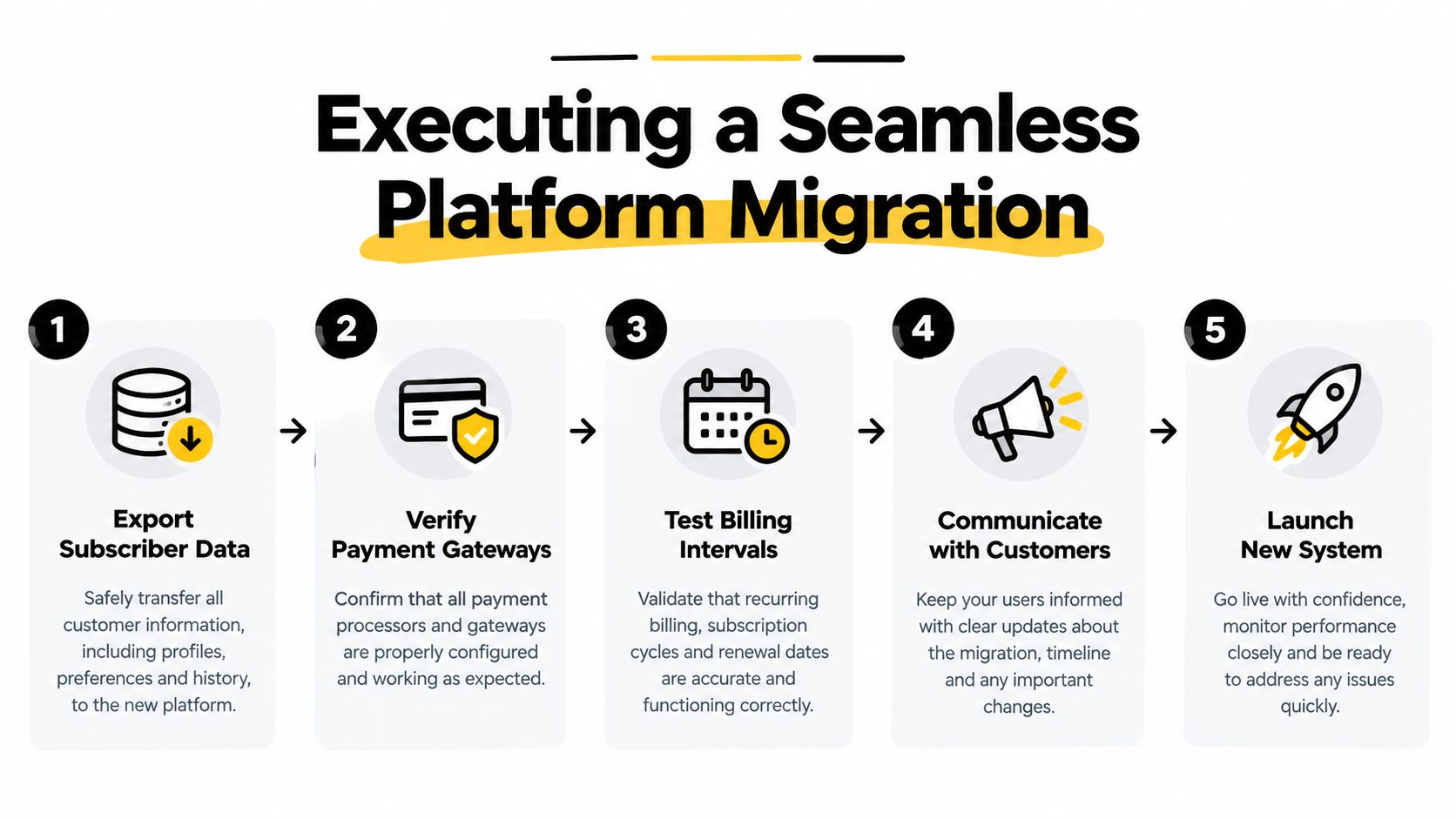
A controlled sequence limits billing surprises:
- Freeze configuration changes: Set a short migration window and record skips, cancellations, address updates, and other changes made during it.
- Verify payment gateways: Confirm token migration where supported. Test the resulting billing relationship without charging customers unexpectedly.
- Test intervals: Use test subscribers to check weekly, monthly, prepaid, and anchor-date scenarios relevant to the catalog.
- Recreate customer controls: Validate pause, skip, swap, frequency changes, payment updates, and cancellation.
- Test dunning: Confirm declined cards trigger the intended retries, notices, and payment-update path before live renewals begin.
- Communicate clearly: Tell customers what is changing, what stays the same, and where they can manage the subscription.
- Monitor first renewals: Compare successful charges, failed payments, fulfillment events, and support contacts with the expected schedule.
Direct connectors can simplify migrations from Recharge, Bold, Skio, Loop, and Yotpo when the required data and token paths are supported. Universal CSV import provides a fallback for records without a direct connector, but it does not replace token migration.
Keep the old system active until reconciliation is complete and the relevant renewal window has been observed. Maintain an audit file containing source records, destination records, exceptions, and manual fixes. Support and finance teams can then answer billing questions with evidence instead of estimates.
Customers should experience continuity, not the technical project. Preserve the promised cadence where possible, avoid unnecessary repricing, and make the new portal easier to use than the old one.
Final Recommendations for Subscription Growth
The best subscribe and save program is not the one with the largest opening discount. It is the one that converts a suitable product into repeat revenue while protecting margin through native Shopify architecture, customer control, zero-fee economics, and automated payment recovery.
Start with product fit, then assess the operating system behind the offer. A discount can encourage the first subscription, but it cannot compensate for poor replenishment timing, a difficult account experience, or failed renewals that no one recovers.
| Decision criterion | Priority | What to verify |
|---|---|---|
| Product fit | Required | Customers consume the product predictably enough for recurring delivery |
| Native Shopify behavior | Required | Checkout, admin, accounts, and storefront work within the existing stack |
| Transaction fees | High | The commercial model does not deduct a recurring fee from every renewal |
| Customer portal | High | Subscribers can skip, pause, swap, change frequency, update payment, and cancel |
| Payment recovery | Required | Decline-aware retries, dunning, and direct card updates are available |
| Discount controls | High | The merchant can set targeted discounts, tiers, trials, or bundle rules |
| Analytics | High | Teams can inspect churn reasons, cohorts, LTV, ARPU, AOV, and recovery |
| Migration support | High for existing programs | Data import, token migration, testing, and reconciliation are documented |
Protect margin before increasing acquisition
Retention should shape the investment order. Before increasing acquisition spend or deepening the subscribe-and-save discount, confirm that subscribers renew, customers can manage their plans, and failed payments enter an automated recovery process. These checks protect contribution margin and make the program a retention engine rather than a promotion that buys temporary volume.
Amazon's Subscribe & Save reporting illustrates the value of normalized measurement. Its benchmark compares sellers with comparable subscription selection using category mix, program tenure, and business size, then examines measures such as sales penetration and year-over-year subscription growth. The Amazon Subscribe & Save benchmarking case study shows why merchants need comparable cohorts instead of relying on raw totals. A mature brand and a new program should not share the same unadjusted baseline.
The operating priorities are straightforward:
- Confirm demand: Do not turn a weak repeat-purchase pattern into a subscription by lowering the price.
- Protect unit economics: Test a targeted incentive and review margin after fulfillment, service, payment, and platform costs.
- Choose native infrastructure: Keep checkout, customer accounts, and administration close to Shopify while avoiding recurring fee drag.
- Give customers control: Skips, pauses, swaps, and cadence changes address practical reasons for cancellation.
- Recover failed payments: Set retry timing, customer notices, and payment-update paths before involuntary churn appears in reporting.
- Measure by cohort and reason: Subscriber count alone cannot show whether the program creates incremental value or only shifts existing orders.
- Plan migration governance: Preserve tokens, schedules, customer expectations, and an auditable record of changes.
A strong program makes reordering easier without making customers feel trapped. Product fit creates the opportunity, disciplined pricing protects margin, native architecture reduces operational friction, and dunning protects renewal revenue. Review these factors together rather than selecting an app from its discount controls alone.
RecurX provides Shopify-native tools for subscription plans, Build-a-Box offers, customer self-service, loyalty, analytics, and automated payment recovery without transaction fees. Visit RecurX to evaluate whether its architecture and migration utilities fit a more resilient subscribe-and-save program.
best subscribe and save · shopify subscriptions · recurring revenue · subscription retention · ecommerce dunning
Keep reading
- QR Code Checkout System: The Omnichannel Growth PlaybookMaster the QR code checkout system for subscriptions. Learn benefits, Shopify integration, and how to drive recurring revenue with RecurX.
- Subscription Pay as You Go: A Shopify GuideLearn how subscription pay as you go works for Shopify stores. This guide covers pricing, benefits, and tips to boost your revenue.
- 8 Welcome Emails for New Clients That Drive RetentionExplore 8 welcome emails for new clients, with templates, subject lines, timing, and subscription examples that improve activation and retention.
Start growing recurring revenue on Shopify
RecurX has a 14-day free trial and zero transaction fees on every plan. Install in minutes.
Start your free trial →