8 Welcome Emails for New Clients That Drive Retention
Explore 8 welcome emails for new clients, with templates, subject lines, timing, and subscription examples that improve activation and retention.
Explore 8 welcome emails for new clients, with templates, subject lines, timing, and subscription examples that improve activation and retention.
A welcome email isn't a thank-you note with a discount code attached. For a new client on a subscription plan, it starts the work of keeping the relationship healthy between the first order and the first renewal. The message needs to confirm what the customer bought, remove uncertainty about billing and delivery, show where to get help, encourage self-service, and make the next useful action obvious.
That matters because welcome flows can outperform ordinary promotional campaigns. Benchmark data collected by Sender's email marketing statistics guide puts welcome-flow open rates around 35.53% to 51.26%, click-through rates around 3.94% to 15%, and placed-order rates around 1.97% to 2.11%, with some high-performing flows approaching 10% placed-order rates. The opportunity isn't to get a new subscriber to open one email. It's to turn early attention into activation, confidence, repeat use, and renewal.
The eight templates below follow that journey. You can combine Shopify subscription data, RecurX's customer portal and loyalty tools, and an email platform such as Klaviyo or Mailchimp to send the right message based on the customer's plan, product, behavior, location, and subscription status.
Table of Contents
- 1. The Subscription Confirmation and Portal Onboarding Email
- 2. The Value and Benefits Reinforcement Email
- 3. The Loyalty and Rewards Introduction Email
- 4. The Payment Security and Confidence Email
- 5. The Personalized Product Recommendation Email
- 6. The First Renewal Countdown and Engagement Email
- 7. The Migration and Setup Completion Email
- 8. The Multi-Language and Localized Welcome Email
- 8-Point Welcome Email Comparison
- Turn Eight Templates Into One Retention Journey
1. The Subscription Confirmation and Portal Onboarding Email
The first message should answer the customer's immediate questions: What did I buy? When will I be charged again? Where can I change it? A receipt alone confirms a transaction, but it doesn't teach a subscriber how to manage an ongoing relationship.
Send this email immediately after purchase, while the decision is still fresh. The subject line should make the email recognizable as both a confirmation and a starting point, such as “Your subscription is confirmed” or “Your subscription is ready to manage.”
What the email should contain
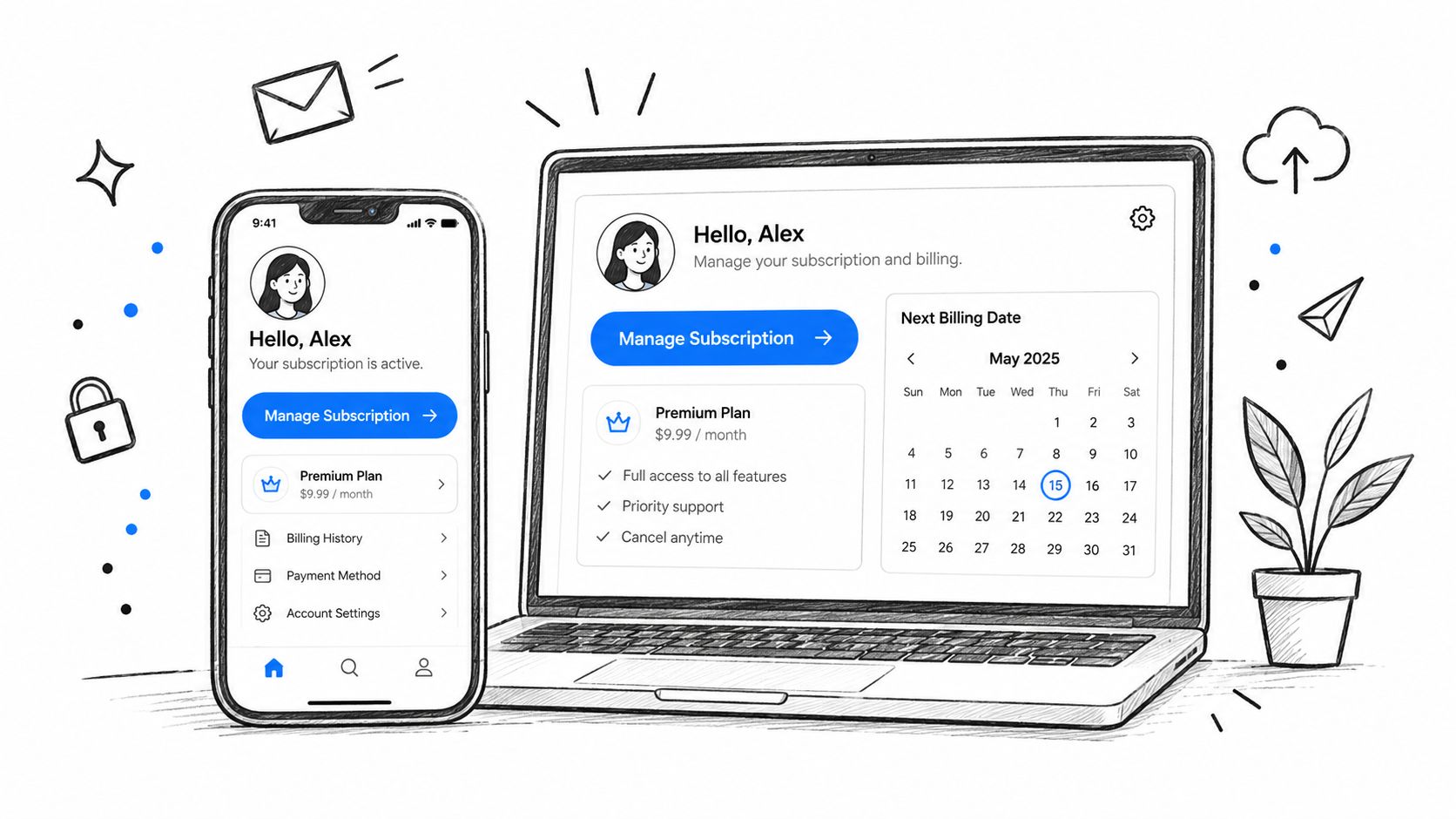
Open with the subscriber's name, the product or membership they selected, the delivery frequency, and the next billing date. Use plain language such as “Your coffee ships every four weeks” rather than relying on internal plan names. If the plan uses anchor-date billing, explain which date controls future charges so the customer isn't forced to infer the schedule from an order confirmation.
The main CTA should be Manage your subscription, linking directly to the RecurX customer portal on the merchant's domain. The portal can give customers access to pause, skip, swap products, change frequency, and update payment details. That single link is more useful than scattering separate links through the email.
Practical rule: The first email should teach one self-service habit, not list every feature your store offers.
Segment this message by plan type and product. A prepaid subscriber needs different billing language from a pay-as-you-go customer, while a Build-a-Box buyer needs an early reminder that products can be changed. If loyalty points accrue on renewals, mention that without letting rewards distract from portal onboarding. Before sending, use a free inbox placement test and check the portal CTA on a mobile screen.
For more guidance on connecting the first message to retention, see how subscription onboarding can reduce first-cycle churn. The risk addressed here is confusion-driven churn, including cancellations caused by unexpected renewal timing or a customer not knowing how to make a simple change.
2. The Value and Benefits Reinforcement Email
A confirmation tells customers what happened. A value email reminds them why they chose a subscription in the first place.
Send it after the confirmation, once the customer has received the essential transaction details. The timing should give the first purchase room to feel real, while the brand is still part of the customer's active consideration. Subject-line direction might include “More value from your subscription” or “What your membership makes easier.”
Start with the customer's desired outcome, not a catalogue of product features. A supplement brand can explain how a recurring routine removes replenishment friction. A coffee merchant can focus on dependable access to a preferred roast. A skincare company can connect regular delivery with a simpler routine. The copy should make the ongoing relationship feel intentional rather than automatic.
Build the value case around the selected plan
Use separate copy for prepaid, pay-as-you-go, membership, and Build-a-Box subscribers. Prepaid customers may care about planning and continuity. Pay-as-you-go customers may care more about flexibility. Build-a-Box customers need to understand that customization is part of the product experience, not an administrative chore.
A useful structure is:
- The outcome: Explain the recurring benefit in customer language.
- The included advantage: Describe subscriber-only access, convenience, pricing, or flexibility that applies to the plan.
- The continuing reason: Show what becomes easier at the next shipment or renewal.
- The next action: Invite the customer to explore their portal, preferences, or member benefits.
Don't manufacture urgency or promise savings that aren't visible in the customer's plan. A testimonial can work well here, but choose one about sustained satisfaction or product fit rather than an exaggerated first impression.
RecurX can support this message with subscription plan details, Build-a-Box options, tiered discounts, and loyalty benefits. Its subscription email marketing guidance is most useful when translated into behavior-based messages rather than copied as a generic broadcast.
The risk addressed is early buyer's remorse. When customers understand the continuing value, they have a stronger reason to keep the subscription active after the novelty of the first order fades.
3. The Loyalty and Rewards Introduction Email
The loyalty email should give subscribers a reason to engage between shipments. Its job is to make the first reward, next milestone, and redemption path clear, without turning the program into a policy document.
Reader goal: understand how the subscription creates ongoing rewards and decide whether to take one useful action. Send the email after the customer has received the value message and is ready to consider the relationship beyond the first order. For some stores, that means after the first renewal or when the customer joins the loyalty program. Subject lines should point to progress, such as “Your subscriber rewards are ready” or “Start earning with every renewal.”
Show the customer's current balance near the top, then identify the next meaningful milestone. If points are awarded per renewal, explain that connection in one sentence. If the store uses VIP tiers, name the next tier and its benefit. A quick scan should answer three questions: what have I earned, what moves me forward, and what can I use now?
Use these copy blocks:
- Welcome to the program: Connect rewards to the customer's subscription.
- How earning works: Explain the actions that earn points, with renewals as the focus where relevant.
- What progress means: Show the next tier or milestone and its benefit.
- How redemption works: Link to store credit, products, or member access.
- A low-friction action: Send the customer to view points, redeem a reward, or check available benefits.
The CTA should lead directly to the relevant portal destination. An immediate, modest reward can prompt the first interaction when the offer is genuine and redemption is easy. RecurX supports points per renewal, VIP tiers, milestone bonuses, and redemption to store credit, so merchants can connect the message to a specific customer action rather than describe the program in general terms.
Segment the email by plan and behavior. Build-a-Box subscribers may respond to a message linking customization with points. Someone who has not visited the portal may need a simpler explanation than an active portal user. RecurX's Shopify loyalty program guidance can help shape the structure, but the final copy must match the store's actual rules.
The subscription risk is low engagement between orders. A visible next milestone gives customers a reason to return before the next renewal decision becomes a cancellation decision.
4. The Payment Security and Confidence Email
A subscriber should never have to guess when the next charge will occur, how to update a card, or what happens after a failed payment. This email reduces that uncertainty before it turns into a support request or cancellation.
Reader goal: confirm that billing is safe, predictable, and controllable. Send the message after the initial onboarding emails, or trigger it when someone opens billing settings, receives a payment warning, or has an expiring payment method. Keep the subject practical, such as “Your subscription is easy to manage” or “Billing details for your subscription.”
Start with the controls, not internal billing terminology. Show where the customer can find the renewal date, update payment details, pause, skip, change frequency, or cancel. Make the CTA lead directly to the relevant portal destination, such as Manage payment details or Manage your subscription. Clear cancellation access protects trust. Perceived lock-in can push a customer to leave sooner.
Build the email around the questions subscribers really ask:
- Billing clarity: Explain when the plan renews and how renewal notifications work.
- Payment protection: Describe the store's security and privacy practices accurately.
- Recovery expectations: State how the store contacts customers after a failed payment and what action they can take.
- Self-service access: Link directly to payment settings in the customer portal.
- Flexibility: List pause, skip, swap, and cancellation options that the plan supports.
RecurX supports decline-aware retry windows, dunning through email, SMS, and WhatsApp, and one-click card-update links. Translate those functions into customer instructions. For example, tell subscribers that they will receive a notice with a way to update payment details. They do not need an explanation of the store's internal recovery sequence.
Segment by plan and billing behavior. A prepaid customer may need different instructions from a pay-as-you-go subscriber. Someone with an expiring card needs the update link immediately, while a customer who has opened billing settings may benefit from a concise explanation of available controls. Match every security or privacy statement to the merchant's actual setup. If the portal uses Shopify customer accounts on the merchant's domain, say so accurately. Do not claim a certification or legal protection the store cannot substantiate.
The risk addressed is payment anxiety and involuntary churn. Customers who know how to resolve a card issue and control their subscription are less likely to abandon it pre-emptively.
5. The Personalized Product Recommendation Email
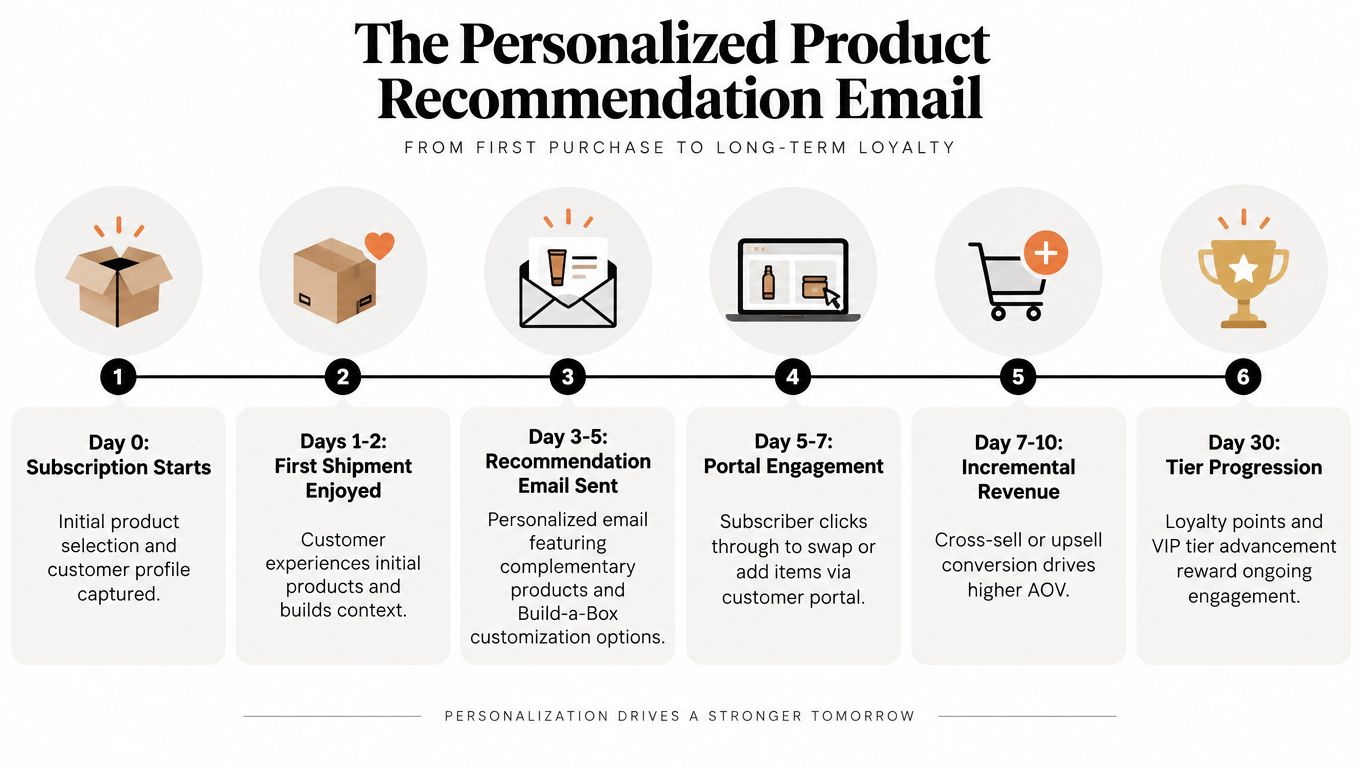
The first recommendation should reduce uncertainty about the next shipment, not pressure a customer into buying more. Send it after the first delivery, once the subscriber has had time to use or assess the product. Use the subscription record to guide the message: plan type, selected product, delivery frequency, and stated preferences.
A useful subject line points to a relevant choice, such as “A useful addition to your routine” or “Customize your next box.” The email's goal is activation: help the customer shape a better second shipment and see that the subscription can adapt.
Build the recommendation around the next shipment
Open with the product already selected, then explain why the suggested item fits. A coffee subscriber might see a compatible grinder or another roast. A skincare subscriber could receive an item that supports the routine they started. A pet-product subscriber might see a complementary product suited to the animal profile or delivery pattern. The copy should name the connection rather than display an unexplained product card.
For Build-a-Box customers, make customization the primary action. Send them to Choose or swap products in the customer portal, not to a general collection page where they must rebuild the subscription. The CTA should lead to the specific upcoming shipment or product-selection control.
Use these audience rules behind the scenes:
- Plan: Prepaid and pay-as-you-go subscribers may have different options for changing an upcoming order.
- Selection: Suggest a complement without repeating the first product.
- Engagement: Give inactive customers one clear recommendation, while portal users can receive more choices.
- Purchase history: Hide products already included or previously rejected.
- Preference: Apply recorded tastes, sizes, routines, and other stated details.
The copy should include a short reason, the product image and description, and one direct CTA. A bonus point, member benefit, or clear plan advantage can support trial, but the recommendation must make sense without an incentive. Test product cards against a simpler layout, and judge results by useful portal actions and later subscription behavior, not clicks alone.
RecurX connects product swaps, bundles, and Build-a-Box flows with the subscription portal. This addresses product mismatch. A customer who can adjust the next shipment easily is less likely to receive an unsuitable product and cancel the subscription.
6. The First Renewal Countdown and Engagement Email
The first renewal is the point where onboarding becomes retention work. The subscriber has received a product, but may still be uncertain about the next shipment, the charge, or the plan's ongoing value. This email should remove that uncertainty while giving the customer enough control to continue, adjust, or stop.
Send it before the first renewal, with enough time to review the shipment and payment method. Use a direct subject-line direction such as “Your next shipment is coming” or “Review your upcoming subscription order.” The reader's goal is simple: understand what will happen next and decide whether the subscription still fits.
Make the renewal decision visible
Show the renewal date, scheduled products, and expected charge near the top. Follow with a short connection to the first product experience, such as an application tip, relevant benefit, or customer story that gives the subscriber a reason to continue.
The core copy should present two clear routes. Continue confidently confirms the upcoming order and explains what the customer can expect. Adjust easily offers direct actions to skip, swap, change frequency, or update payment details. Keep the most likely action prominent, but do not hide skip or cancellation controls. RecurX's portal supports these subscription changes, while its payment recovery tools support failed-payment messages and card updates. Link each CTA to the relevant control rather than a general account page.
Build-a-Box subscribers may need seasonal combinations or available alternatives based on previous choices. Loyalty members can see current progress when it helps them decide whether to renew. A payment reminder should explain the issue and the available fix without sounding threatening.
A renewal email should make continuing easy, but it should also make changing the subscription easy. Control builds trust.
Use segmentation for first-renewal status, plan, product, payment condition, and prior portal activity. Prepaid and pay-as-you-go plans may require different adjustment options, while inactive customers may need a single clear action instead of several competing choices. The CTA should lead to the upcoming shipment or the specific portal control.
The subscription risk is first-cycle churn, including avoidable cancellations, unwanted shipments, and payment failures that could have been resolved before the charge.
7. The Migration and Setup Completion Email
Migration completion is a confidence moment, not a second product welcome. The subscriber already knows the product. They need proof that the move preserved their account, billing status, and subscription controls.
Send this message immediately after successful migration confirmation. Point the subject line to the outcome, with directions such as “Your subscription is now ready in RecurX” or “Your account migration is complete.” The email's goal is to help the customer verify the move before the next order.
Open with the migrated details: active subscription, customer account, payment status, and any information that requires review. If something did not transfer, identify it plainly and give one specific next action. A short explanation is better than leaving the customer to guess.
Use these copy blocks, but present them as a verification path rather than a generic feature list:
- Your account: Show where the customer signs in and confirm the account connected to the subscription.
- Your controls: State which actions are available in the portal, including pause, skip, swap, frequency changes, and payment updates.
- Your next step: Ask the customer to review the upcoming order or confirm preferences. Link directly to that action.
- Your support route: Name the team or direct contact handling migration questions.
Keep the primary CTA focused on verification. A secondary route can direct customers to support when account data or payment status needs correction. Segment the message by migration outcome, subscription type, payment condition, and whether the customer has accessed the portal. Customers with an incomplete transfer need a different action from those whose accounts are ready.
For merchants moving from Recharge, Bold, Skio, Loop, or Yotpo, RecurX provides migration utilities and supported connectors, with universal CSV import where appropriate. Those details belong in merchant setup communications. Subscribers need the result: a working account and a familiar way to manage the subscription.
Agencies and developers can receive a separate admin message about Shopify Flow automation, analytics, exports, or native Shopify workflows. A RecurX migration walkthrough can accompany that written summary.
The risk is transition distrust. A confirmed account state and direct verification step reduce uncertainty before it becomes a support request or cancellation.
8. The Multi-Language and Localized Welcome Email
A translated welcome email can still create confusion. Localization must help subscribers recognize their billing terms, understand the plan, and find support in the way they expect. Match the customer's preferred language or reliable regional data, then keep that language consistent across the email, storefront widget, portal, and transactional notifications.
Send this message with the primary welcome trigger, while the subscription is still being activated. Write the subject line naturally for the market rather than translating an English version word for word. The reader's goal is simple: confirm what they bought and know how to manage it.
Use the email as a short activation checklist:
- Welcome and product context: Describe the product and subscription in wording that sounds natural locally.
- Billing explanation: Show the relevant currency, renewal date, and frequency terminology. A French customer may need a different date presentation from a customer in the United Kingdom.
- Portal action: Link to the localized account experience and ask the subscriber to review the upcoming order or set preferences.
- Support contact: Display the regional channel and hours. Some customers may prefer WhatsApp, others email or a local phone contact.
- Next step: Give one primary CTA, such as reviewing the upcoming order. Keep support as the fallback if the customer needs help.
The segmentation logic should include country, language, payment method, plan, and subscription status. Regional holidays and seasonal delivery conditions can affect how you explain renewal timing, so account for them in the relevant market version.
RecurX supports AI-powered translations for widgets, the customer portal, and notifications, with connections to platforms such as Klaviyo and Mailchimp. Native speakers should review customer-facing copy in important markets before activation. Automated translation may preserve the general meaning while producing unnatural wording around payment, cancellation, or delivery terms.
This email addresses localization friction. It reduces the risk that a subscriber understands the product but cannot interpret the subscription terms, complete setup, or reach the right support team. Surface the local details early, because uncertainty at activation can become avoidable support demand or cancellation.
8-Point Welcome Email Comparison
| Item | Complexity 🔄 | Resources ⚡ | Expected Outcomes ⭐ / Impact 📊 | Ideal Use Cases 💡 | Key Advantages ⭐ |
|---|---|---|---|---|---|
| The Subscription Confirmation & Portal Onboarding Email | Medium, integration + themed design | Low–Medium, template, portal links, triggers | High, reduces support tickets (~30–40%); increases portal adoption 📊 | Subscription-first merchants; immediate post-purchase touch | Sets billing expectations; drives self-service management |
| The Value & Benefits Reinforcement Email | Low–Medium, content-heavy, brand alignment | Medium, copy, visuals, testimonials | High, lowers buyer's remorse; increases LTV ⭐ | Physical goods subscriptions where benefits accrue over time | Articulates ROI; builds emotional loyalty |
| The Loyalty & Rewards Introduction Email | Medium–High, loyalty logic & dynamic content | Medium–High, points system, dashboards, visuals | High, boosts renewals, AOV, retention ⭐⭐ 📊 | Brands using points/VIP programs tied to renewals | Encourages habit formation; gamifies retention |
| The Payment Security & Confidence Email | Low, reassurance copy + one-click links | Low, compliance copy, card-update link, dunning notes | Medium–High, reduces anxiety-driven cancellations; prevents involuntary churn ⭐ | New subscribers worried about recurring charges | Builds trust; reduces failed-payment surprises |
| The Personalized Product Recommendation Email | High, recommendation engine & segmentation | High, product data, personalization tooling | High, increases AOV and upsells when relevant ⭐ 📊 | Build-a-Box and cross-sell-focused subscriptions | Drives incremental revenue via relevant suggestions |
| The First Renewal Countdown & Engagement Email | Medium, timing automation + personalization | Medium, automated scheduling, portal CTAs | High, prevents early churn; increases last-minute engagement ⭐⭐⭐ | Sent 3–5 days before first renewal to re-engage subscribers | Proactive retention touchpoint; enables skips/changes |
| The Migration & Setup Completion Email | Medium, migration-specific details & assets | Medium, migration summary, guides, support channels | High, reduces migration anxiety; drives new-feature adoption ⭐ | Customers migrating from other subscription platforms | Reassures users; highlights platform benefits and support |
| The Multi-Language & Localized Welcome Email | High, translations, locale formatting, cultural review | High, AI translations + native review, localized assets | Medium–High, improves international conversion & retention ⭐ 📊 | Merchants selling internationally or multi-currency markets | Localized experience; clearer billing and support per region |
Turn Eight Templates Into One Retention Journey
These emails work best as a coordinated journey, not as eight disconnected campaigns. Start with the confirmation and portal message immediately after purchase. It should confirm the order, explain the billing rhythm, and give the subscriber one useful CTA. If the customer can't find the portal or doesn't understand the next charge, later value messaging won't repair the first impression.
Follow with value reinforcement while the purchase is still becoming part of the customer's routine. Introduce loyalty when the program is relevant to the plan, product, or renewal behavior. A rewards email shouldn't go to customers who aren't enrolled, and it shouldn't promise benefits that their plan doesn't provide. Payment reassurance can follow as a general confidence message or trigger when a customer changes billing details, receives a payment warning, or needs to update a card.
After the first delivery, send product recommendations based on what the customer chose. For Build-a-Box subscribers, make swaps and customization the main service, with cross-sell as a secondary opportunity. Then send the first-renewal countdown before the charge. Put the upcoming order, date, amount, and available changes in one place so the subscriber can continue, adjust, or resolve a payment issue without contacting support.
Migration and localized messages sit across this journey. A migrated customer needs a completion confirmation instead of a generic first-purchase welcome. An international customer needs the same sequence in the right language, currency, date format, and support context. RecurX can support these paths through Shopify-native subscription management, customer-portal controls, loyalty features, payment recovery, automation tags, and integrations with Klaviyo, Mailchimp, SMS, and WhatsApp tools.
Use segmentation deliberately:
- Plan: Separate prepaid, pay-as-you-go, membership, and Build-a-Box experiences.
- Product: Match education, recommendations, and usage guidance to what the customer receives.
- Locale: Adapt language, currency, dates, payment context, and support channels.
- Status: Distinguish active, paused, skipped, payment-failed, migrated, and cancelled customers.
- Behavior: Use portal visits, product swaps, reward activity, and renewal engagement to decide what comes next.
Measure the journey with operational and customer signals. Track activation, portal engagement, completed subscription changes, renewal completion, payment recovery, churn reasons, cohort retention, and LTV. An open doesn't prove that onboarding worked, and a click doesn't prove that the customer found value. Connect each email's CTA to the behavior it is meant to create.
Start with the confirmation email and improve it before adding complexity. Make every CTA useful, keep billing language plain, and use RecurX features only where they solve a clear customer problem. A portal link is valuable when it gives control. Loyalty is valuable when customers understand the reward. Payment recovery is valuable when it helps a willing subscriber stay active. The sequence becomes stronger when every message earns its place in the customer's experience.
RecurX gives Shopify merchants tools for subscription plans, customer-portal management, loyalty rewards, payment recovery, Build-a-Box flows, analytics, migration, and localized notifications. Visit RecurX to connect those capabilities to a welcome journey that helps new clients activate, manage, and continue their subscriptions.
welcome emails for new clients · welcome email templates · subscription emails · client onboarding · customer retention
Keep reading
- QR Code Checkout System: The Omnichannel Growth PlaybookMaster the QR code checkout system for subscriptions. Learn benefits, Shopify integration, and how to drive recurring revenue with RecurX.
- Best Subscribe and Save Strategies for ShopifyDiscover the best subscribe and save strategies for Shopify. Compare native app features, fee structures, and retention tactics to maximize recurring revenue.
- Subscription Pay as You Go: A Shopify GuideLearn how subscription pay as you go works for Shopify stores. This guide covers pricing, benefits, and tips to boost your revenue.
Start growing recurring revenue on Shopify
RecurX has a 14-day free trial and zero transaction fees on every plan. Install in minutes.
Start your free trial →