How to Sell Subscriptions Online on Shopify
Learn how to sell subscriptions online on Shopify. Build flexible plans, optimize checkout, recover failed payments, and boost retention with RecurX.
Learn how to sell subscriptions online on Shopify. Build flexible plans, optimize checkout, recover failed payments, and boost retention with RecurX.

The most popular advice about selling subscriptions online is also the least complete: install a “subscribe and save” widget, choose a discount, and wait for recurring revenue. That approach can produce a working checkout, but it doesn't create a profitable subscription business. The difficult work starts after the first order, when customers need control, payment failures interrupt renewals, and early cancellations expose weak product-market fit.
Subscription commerce has grown into a major global retail channel. One market estimate values it at USD 180.48 billion in 2025, with a projection of USD 206.26 billion in 2026 and USD 402.2 billion by 2031, implying a 14.28% CAGR from 2026 to 2031 (Mordor Intelligence's subscription e-commerce market estimate). The opportunity is real, but merchants capture it by building retention infrastructure around the offer, not by adding recurring billing as an afterthought.
Table of Contents
- Rethinking the Subscription Launch Strategy
- Designing Flexible Plans and Pricing Models
- Configuring Storefront Widgets and Native Checkout
- Automating Payment Recovery and Dunning Workflows
- Empowering Subscribers with Self-Serve Portals
- Migrating Legacy Data and Tracking Cohort Analytics
Rethinking the Subscription Launch Strategy
A subscription widget can create recurring orders without creating recurring profit. The profitable launch is an operating system for what happens after checkout: customers need control, failed payments need recovery, and every renewal needs a clear reason to continue.
Subscription leakage usually appears outside the initial conversion report. A customer may join successfully, then cancel because the delivery cadence does not match actual consumption. Another may want to stay but lose access after a card expires. A third may need to skip one shipment and cancel because the store offers no practical way to make that change.
Retention economics explain why the renewal experience deserves as much attention as acquisition. Increasing customer retention by 5% has been associated with profit gains of 25% to 95%. Existing customers are typically 60% to 70% more likely to buy than new customers, compared with 5% to 20% for first-time prospects (The Business Research Company's subscription ecommerce report). These figures do not predict results for a particular store, but they show why payment recovery, service workflows, and subscriber controls belong in the launch plan.
Practical rule: Treat every renewal as a new conversion event, not as revenue that happens automatically.
Replace the static offer with a lifecycle system
First confirm that the product fits recurring purchasing. Replenishment subscriptions represented 35.75% of market share in 2025, according to subscription market analysis. Coffee, supplements, skincare, and pet supplies often suit this model because customers consume them predictably. Products purchased irregularly need a stronger membership, access, convenience, or flexibility benefit.
Write the operating model before publishing the plan:
- Acquisition: Present the subscription option on product pages, in email campaigns, and through campaign-specific checkout links.
- Activation: State the first delivery date, billing date, cancellation terms, and available customer controls before payment.
- Retention: Give subscribers a reason to continue after the opening offer, such as convenience, rewards, exclusive access, or product flexibility.
- Recovery: Detect failed payments, run controlled retries, and send customers directly to the payment-update flow.
- Measurement: Separate voluntary cancellations from involuntary churn so the team can distinguish offer problems from billing failures.
Use a pre-launch handoff checklist with a named owner for each stage. Confirm that merchandising has approved the offer, operations can fulfill every cadence, finance has reviewed margin after discounts and payment costs, support has cancellation and skip procedures, and engineering has tested renewal events. Then run test orders for signup, renewal, failed payment, card update, skip, pause, cancellation, and reactivation. This checklist catches ownership gaps before they become customer-facing incidents.
For the commercial and operational questions involved in adding recurring orders to a one-time-purchase store, this guide to starting a subscription business provides a useful starting point. Customer service should join the process early. SupportGPT's retention playbook treats support conversations and lifecycle communication as retention work, which is the right operating boundary for subscription teams.
Design for trust, not entrapment
Rigid plans create cancellation pressure. Shoppers increasingly look for pause, skip, cancel, and membership-style benefits rather than a fixed recurring box with limited control. One report says 36% of shoppers want a product subscription from a retailer, while 24% of businesses offer one (Hostinger's ecommerce trends coverage). The gap points to a service design opportunity, not merely a reason to add more subscription products.
A credible launch includes a self-serve portal, clear renewal notifications, and an offer that does not depend entirely on a permanent discount. Pausing can preserve the account when a customer has excess stock. Product swaps can resolve preference problems without losing the subscription. A transparent cancellation flow protects trust and leaves a path to reactivation.
The launch is ready when the team can explain what happens before, during, and after every renewal. If it can activate a plan but cannot recover a payment or handle a simple customer request, the subscription business is not ready.
Designing Flexible Plans and Pricing Models
Start with the customer's consumption cycle, not the billing setting. A coffee customer may need regular replenishment, while a skincare buyer may consume products at a different pace. A plan that charges too frequently creates surplus inventory and cancellation pressure. A plan that charges too slowly weakens convenience and makes the subscription feel unnecessary.
Map each product against four questions:
- How quickly does the customer use it?
- What quantity feels useful rather than excessive?
- What delivery interval minimizes customer effort?
- What margin remains after fulfillment, support, discounts, and payment costs?
That exercise should determine whether the offer uses weekly, monthly, or yearly billing. The available interval should reflect actual use, not merely the options exposed by an app.

Choose the commercial structure
Pay-as-you-go is the clearest entry point for physical goods. The customer commits to a repeat order, but each cycle remains relatively easy to understand. This model works well when usage varies and the merchant wants to reduce the psychological barrier to signup.
Prepaid plans exchange flexibility for commitment. Customers pay for several scheduled deliveries in advance, usually in return for stronger value or a defined benefit. The merchant gains more predictable cash flow, but the offer needs clear terms for skipped deliveries, refunds, and changes.
Build-a-Box works when customers want variety. Let them select products within a curated structure, then use tiered pricing to reward a larger or longer commitment. The operational risk is complexity, so limit the choices to combinations the warehouse can fulfill consistently.
Memberships sell access rather than replenishment. Benefits might include member pricing, exclusive products, priority access, or rewards. A membership shouldn't borrow the language of a replenishment plan if the customer isn't receiving a predictable physical order.
| Model | Best fit | Main trade-off |
|---|---|---|
| Pay-as-you-go | Regular replenishment with variable demand | Easier signup, less commitment |
| Prepaid | Defined delivery schedules and bundled value | Stronger commitment, more service obligations |
| Build-a-Box | Assortments and mix-and-match products | Higher choice, greater fulfillment complexity |
| Membership | Access, rewards, or exclusive benefits | Requires ongoing value beyond shipping |
Set pricing that protects the relationship
Use tiered discounts carefully. A small initial incentive may encourage trial, while a deeper benefit can be revealed after several successful renewals. This protects margin better than offering the maximum discount from the first order, especially when acquisition costs and fulfillment expenses vary by product.
Free trials can reduce hesitation for digital access or services, but physical goods require a different calculation. Shipping, fulfillment, and product costs still exist during the trial, so the trial must have a clear commercial purpose. If the customer receives a product, state when the first paid renewal occurs and make the upcoming charge easy to understand.
Anchor-date billing can make recurring charges more predictable for customers who prefer a fixed day or delivery window. It can also simplify operations when a store wants billing and fulfillment to follow a consistent schedule. Before publishing the plan, review understanding your account billing so the team knows how billing rules affect the merchant account and customer experience.
For a more detailed planning framework, use this subscription pricing strategy guide to compare commitment, flexibility, discount depth, and expected usage. The right price is the one that makes the repeat purchase feel useful, not merely cheaper.
Configuring Storefront Widgets and Native Checkout
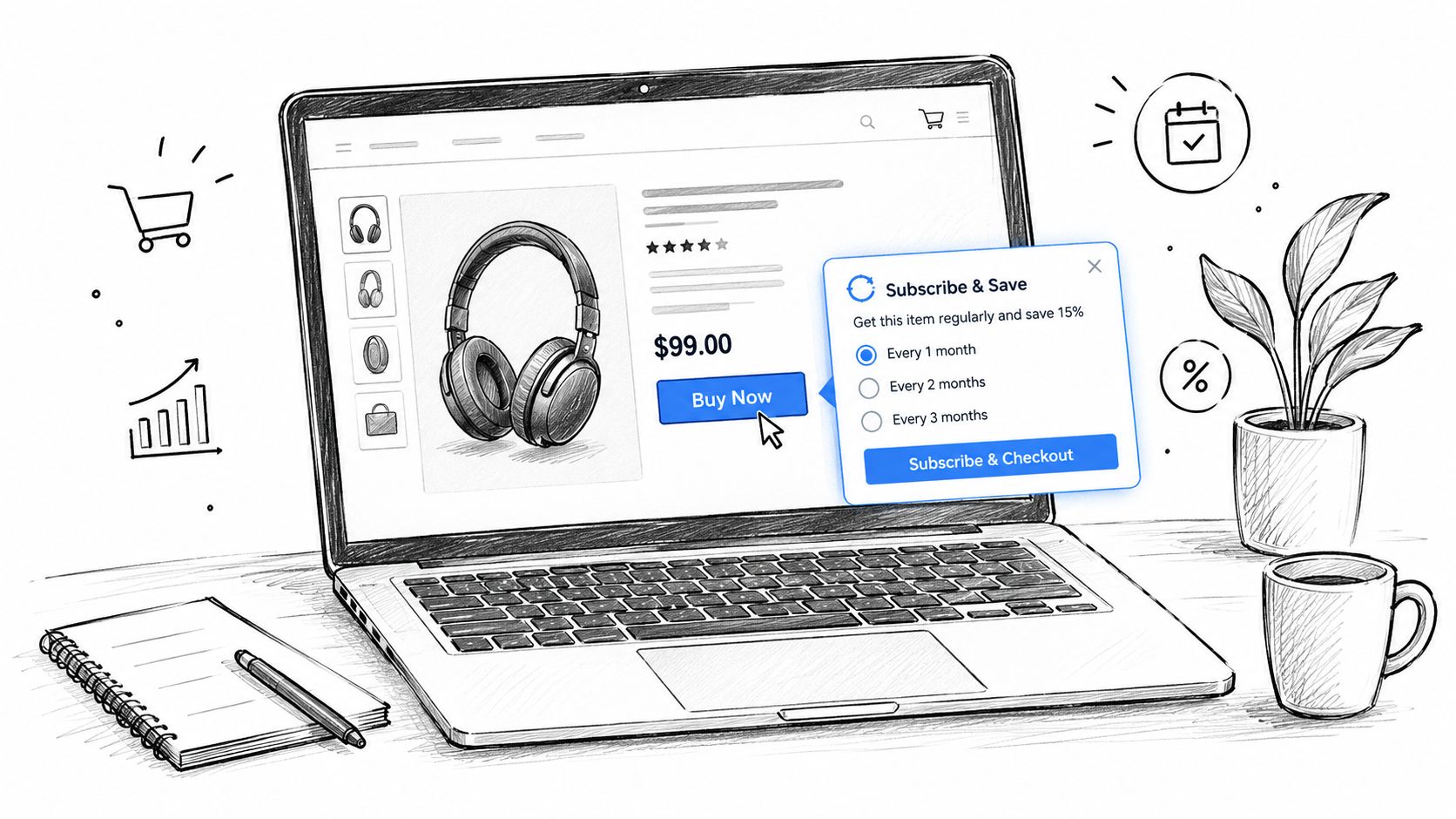
The product detail page decides whether a visitor understands the subscription offer quickly enough to consider it. A widget that looks like an external attachment, uses weak contrast, or hides the cadence beneath a dropdown creates friction before the customer reaches checkout.
Place the subscription choice near the one-time purchase option. Show the delivery interval, price per order, renewal behavior, and savings in the same visual area. Don't make shoppers hunt through an accordion or a separate page to discover whether they can skip or cancel.
Match the storefront without hiding the choice
A theme-matched widget should inherit the store's visual language while preserving a clear distinction between one-time and recurring purchase options. Matching colors and fonts reduces the sense that the shopper has entered a separate application. Accessibility still comes first. Text, controls, selected states, and error messages need sufficient contrast and visible focus behavior.
Use a short information hierarchy:
- Purchase type: Make “One-time purchase” and “Subscribe” easy to compare.
- Cadence: State the delivery or billing interval in plain language.
- Price: Show the amount charged now and explain later renewals.
- Control: Link to subscription terms, cancellation rules, and account management.
- Feedback: Confirm the selected plan before the customer adds the item to cart.
Don't overload the widget with every possible interval. If a coffee product works well on two schedules, show those schedules and explain the difference. A long list of options can make the store appear flexible while making the decision harder.
Keep checkout native
Native Shopify architecture is valuable because the storefront, cart, checkout, customer account, and admin workflows remain connected. Components built around Shopify's Polaris UI and App Bridge v4 hooks can provide a more consistent merchant experience than an embedded flow that depends on third-party cookies or an iframe. The practical standard is simple: the customer should recognize the store throughout the purchase and account-management journey.
Test the full path on mobile. Verify that the plan remains selected when the shopper moves from the product page to cart, that the first charge is clear, and that the confirmation email reflects the correct cadence. Also test discount codes, inventory limits, accelerated checkout behavior, and failed validation states.
Quick checkout links and QR codes help when the subscription is promoted outside the product page. A social campaign, printed insert, or offline event can send shoppers directly to a preconfigured subscription checkout instead of asking them to browse through the catalog. The shortcut only works if the landing experience still explains the commitment and provides a visible route to manage it later.
Automating Payment Recovery and Dunning Workflows
A failed renewal is a billing event before it is a retention decision. Treating every failure as a support ticket creates unnecessary work and cancels customers who may have stayed if the payment issue had been handled promptly. Subscription profitability depends on recovery infrastructure, not only on the widget that collects the first order.
The first distinction is involuntary churn. An expired card, insufficient funds, temporary issuer problem, or authentication failure requires a different response from a customer who actively cancels. Classify the event before choosing whether to retry, notify the customer, or request a new payment method. This separation also keeps recovery reporting distinct from voluntary churn and product dissatisfaction.
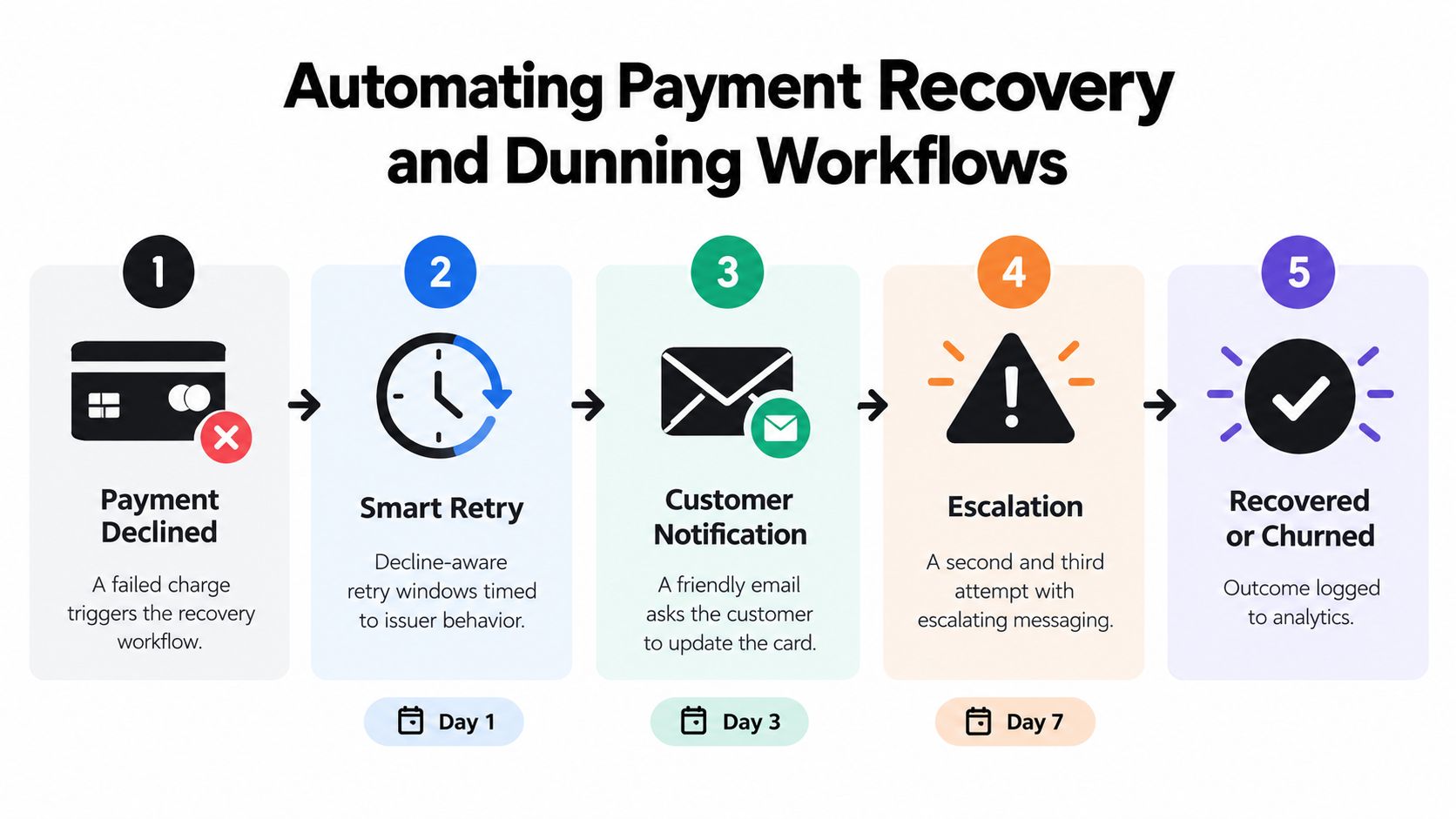
The workflow should identify the failure, select a suitable retry path, and give the subscriber a direct way to correct payment details. Avoid one generic email followed by immediate cancellation. The customer should reach an authenticated, mobile-friendly update page with the subscription, affected order, and next billing consequence clearly shown.
Build decline-aware retry logic
Fixed schedules waste attempts because payment issuers do not treat every decline alike. Temporary authorization issues and insufficient funds may justify another attempt, while expired credentials require an update and hard declines may not be recoverable through retries. Use the processor's response codes and event data to make that decision.
Benchmark guidance describes smart retry recovery of 70% to 85% of soft declines, compared with 40% to 60% for fixed schedules (Slicker's payment recovery guidance). The exact timing should reflect processor behavior, account history, and fulfillment risk. Space attempts rather than repeatedly charging the same method within a short period.
A practical recovery workflow includes:
- Classify the decline: Separate temporary failures, expired credentials, authentication problems, and non-retryable responses.
- Schedule the next attempt: Set retry windows that avoid repeated charges while preserving the order when recovery remains plausible.
- Send a useful notification: Explain the failure, identify any affected shipment or access, and state the action required.
- Provide one-click updating: Link directly to the authenticated payment-update page rather than a generic account login.
- Escalate carefully: Increase urgency in later messages without threatening cancellation before the customer has had a reasonable chance to respond.
- Log the outcome: Record recovered, updated, retried, canceled, and permanently failed states.
Billing insight: A payment-update link should remove steps, not create a support conversation.
Use messaging channels with restraint
Email provides the strongest foundation because it can carry context and a direct action button. SMS can help when the customer has opted in and the message stays short. WhatsApp may fit markets where subscribers already use it for brand communication. The channel matters less than the destination. Every message should lead to a secure update flow that preserves the subscription details and works well on mobile.
Coordinate the channels through event triggers. A customer who updates a card after an email should not receive an unnecessary escalation by SMS. Suppress follow-ups after a successful charge or completed payment update, and record which message produced the recovery.
One industry report analyzed 6 million failed payments across USD 3 billion in subscription revenue and reported recovery of 70% of detected involuntary churn when smarter retry and dunning were used (Churnkey's State of Retention 2025 report). Treat that result as a report benchmark, not a forecast for every store. The operational point is clear: payment recovery needs an owner, controlled tests, and reporting alongside acquisition and merchandising.
The recovery dashboard should group failed renewals by decline type, retry stage, channel, and outcome. Review recovered revenue and prevented cancellations separately from voluntary churn. That view shows whether the next improvement belongs in payment infrastructure, customer messaging, or the product and offer.
Use this failed payment recovery and subscription dunning guide when defining retry windows, notifications, and card-update journeys. Keep the implementation tied to processor events, customer permissions, and clear cancellation rules.
Empowering Subscribers with Self-Serve Portals
A subscriber who needs to email support to skip one shipment is already at risk. The request may begin as a temporary inventory problem, a travel period, or a change in household needs. If the store offers no immediate control, the customer may choose cancellation because it feels like the only reliable option.
A self-serve portal should sit on the merchant's domain and connect to the native customer account experience. Customers need to see active plans, upcoming orders, billing dates, delivery details, and payment status without switching between unrelated systems.
Give customers practical escape valves
The basic controls are pause, skip, swap, change frequency, update payment, and cancel. Each control needs clear consequences. If skipping moves the next shipment date, show the new date immediately. If swapping changes the price, display the difference before confirmation. If pausing preserves the plan but stops billing, state when the account will resume.
The portal should make the preferred retention action easier than contacting support. A customer with too much stock should see “skip next order” or “change frequency” before a cancellation prompt. A customer who dislikes a product should see a swap option when the catalog supports it.
This isn't a case for hiding cancellation. Transparent cancellation protects trust and gives the merchant better feedback. A cancellation reason can identify problems with price, cadence, product fit, shipping, or account control, but the customer shouldn't have to complete an obstacle course to leave.
Turn account controls into retention signals
The portal also creates useful behavioral events. A skip may indicate overstock. A frequency change may indicate a consumption mismatch. A product swap can reveal an upsell opportunity or a preference that merchandising teams should support. Connect those events to lifecycle marketing only when the message adds value.
For example, a customer who pauses a supplement plan might receive a reminder before the scheduled restart. A customer who changes from a shorter to a longer interval may qualify for a different bundle. A subscriber who updates a payment method after a failed renewal should exit the recovery sequence automatically.
Auto-tag customers by plan status, tier, renewal behavior, or recent account action. Those tags can feed Shopify Flow and platforms such as Klaviyo, Mailchimp, Twilio, WhatsApp Business, or Omnisend. Keep the taxonomy understandable. A small number of reliable tags is more useful than a sprawling collection that no one trusts.
Add loyalty without disguising the economics
Rewards can strengthen the reason to stay, but they shouldn't compensate for a poor product or confusing billing. Points per renewal, milestone bonuses, VIP tiers, and store-credit redemption can work when customers understand how rewards accumulate and when they can use them.
A practical structure might reward continued renewals rather than only offering a larger discount. That protects the headline price while giving long-term customers a visible benefit. Make sure rewards rules account for skipped orders, refunds, plan changes, and cancellations.
The portal's most important job is control. Loyalty is a layer on top. When customers can manage their commitment easily, the merchant gets fewer avoidable support requests, clearer behavioral data, and more opportunities to retain customers through relevant interventions rather than generic discounting.
Migrating Legacy Data and Tracking Cohort Analytics
Moving from a legacy subscription app isn't just a data export. It's a billing continuity project. The merchant needs to preserve customer identity, active plans, product mappings, renewal timing, payment status, and communication preferences while ensuring that customers aren't charged twice or left without a scheduled order.
Start with an inventory of the old system. Identify which plans are active, which customers are past due, which subscriptions have upcoming renewals, and which products no longer exist. Include the app's transaction fees, operational limitations, customer-account experience, and reporting gaps in the business case.
Use a controlled migration sequence
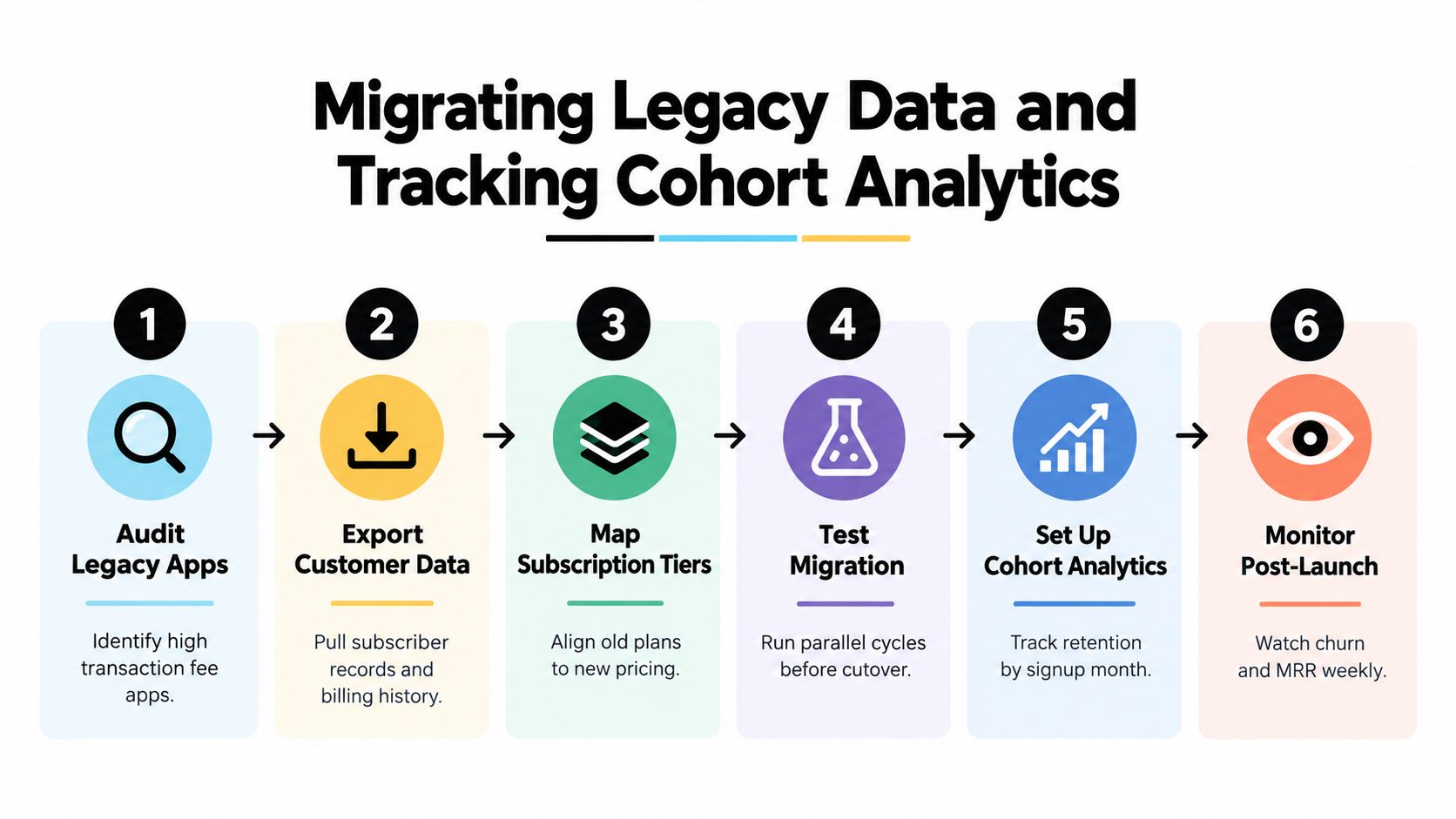
A dependable migration has distinct checkpoints:
- Audit legacy apps: Document active subscribers, plan rules, renewal states, payment status, and high-fee workflows.
- Export customer data: Pull subscriber records, product references, billing history, consent data, and relevant tags.
- Map subscription tiers: Align old plans with the new catalog, cadence, discount logic, and fulfillment rules.
- Test the migration: Run sample records and, where possible, parallel billing or test cycles before cutover.
- Set up cohort analytics: Preserve signup month, acquisition source, plan type, and first-renewal status.
- Monitor post-launch: Watch renewals, failed charges, customer tickets, churn reasons, and recurring revenue after the switch.
Tokenized payment data needs special care. A merchant may be able to migrate payment tokens from a supported platform, but token portability depends on the systems involved and the processor's requirements. If tokens can't move, plan customer communication around secure payment updates rather than recreating subscriptions without notice.
A universal CSV import can help with customer and plan records, while direct connectors may reduce manual mapping for platforms such as Recharge, Bold, Skio, Loop, and Yotpo. Neither route removes the need for reconciliation. Compare the source and destination counts, renewal dates, prices, discounts, and next-order details before turning off the old billing process.
Measure the journey by cohort
Total subscriber count is too blunt for operational decisions. Track the journey from product-page selection through first renewal and later retention.
Useful views include:
| Metric | What it reveals |
|---|---|
| MRR | The recurring revenue base and its movement |
| Churn by reason | Whether customers leave because of price, product, cadence, service, or payment failure |
| First-renewal rate | Whether the initial promise survives the first billing cycle |
| Cohort retention | How signup month, acquisition source, and plan affect durability |
| LTV and ARPU | Whether discounts and rewards create sustainable customer value |
| AOV | Whether bundles, add-ons, or Build-a-Box structures improve order economics |
| Funnel conversion | Where customers abandon the path from product page to post-purchase |
Early lifecycle analysis deserves special attention. Ecommerce subscription businesses often see month-one churn of 15% to 25%, then stabilize later at 4% to 8%, according to subscription benchmarks (Easy Apps Ecom's Shopify subscription statistics guide). The same source reports that one-time-to-subscriber conversion among repeat customers can reach 8% to 15%. These benchmarks point to two practical priorities: target proven buyers and improve the first renewal experience.
Don't average away the differences between cohorts. Compare customers acquired through email with those acquired through paid social. Compare a heavily discounted plan with a standard-price plan. Compare subscribers who used the portal with those who contacted support. A cohort that retains well may reveal the right offer, cadence, or onboarding sequence for the rest of the store.
Operator's standard: If the dashboard can't distinguish voluntary churn from failed payment churn, it isn't ready to guide subscription decisions.
A Shopify-native subscription platform can combine plan setup, customer-account controls, payment recovery, migration utilities, loyalty, and cohort reporting inside the existing merchant workflow. RecurX offers those capabilities, including flexible plans, Build-a-Box flows, payment recovery, customer portals, loyalty features, migration tools, and analytics for Shopify stores.
The migration is complete only when the new system can bill correctly, let customers manage their plans, recover predictable payment failures, and explain why subscribers stay or leave. That is the infrastructure that turns recurring orders into a durable business model.
If you're ready to replace a basic subscribe-and-save widget with a complete retention system, explore RecurX for Shopify-native subscriptions, self-serve customer controls, payment recovery, migration tools, loyalty features, and cohort analytics. Set up the plan structure, map your legacy data, and audit the first renewal cycle before scaling acquisition.
sell subscriptions online · Shopify subscriptions · subscription retention · RecurX Shopify · recurring revenue
Keep reading
- Subscription vs One Time Purchase for ShopifyCompare subscription vs one time purchase models for Shopify. Analyze LTV, churn, and MRR impacts, plus how to implement recurring billing with RecurX.
- QR Code Checkout System: The Omnichannel Growth PlaybookMaster the QR code checkout system for subscriptions. Learn benefits, Shopify integration, and how to drive recurring revenue with RecurX.
- Best Subscribe and Save Strategies for ShopifyDiscover the best subscribe and save strategies for Shopify. Compare native app features, fee structures, and retention tactics to maximize recurring revenue.
Start growing recurring revenue on Shopify
RecurX has a 14-day free trial and zero transaction fees on every plan. Install in minutes.
Start your free trial →