Subscription vs One Time Purchase for Shopify
Compare subscription vs one time purchase models for Shopify. Analyze LTV, churn, and MRR impacts, plus how to implement recurring billing with RecurX.
Compare subscription vs one time purchase models for Shopify. Analyze LTV, churn, and MRR impacts, plus how to implement recurring billing with RecurX.
The subscription box market grew from $57 million in 2011 to $49.7 billion in 2026, with $101.81 billion projected by 2030 (customer churn statistics 2026). That scale tells you something important, subscriptions stopped being a niche checkout choice and became a core ecommerce revenue model. But the same market is also running into consumer fatigue, which is why the key decision is no longer “subscription or one-time purchase,” it's “which model fits the product, the buyer, and the support burden?”
| Metric | One-Time Purchase | Subscription Model |
|---|---|---|
| Revenue pattern | Transactional, ends at checkout | Recurring, compounds over time |
| Customer behavior | Buyer returns only when needed | Buyer renews until cancellation |
| Cash flow | Less predictable | More predictable |
| Operational burden | Repeat acquisition required | Churn, billing recovery, and support management required |
| Best fit | Durable goods, uneven usage, first-time trial | Replenishment products, routine use, ongoing service |
Table of Contents
- The Shift in Ecommerce Revenue Models
- Unit Economics and Lifetime Value Comparison
- When One-Time Purchases Outperform Subscriptions
- Pricing and Discount Strategies for Conversion
- Implementing Subscriptions on Shopify with RecurX
- Choosing the Right Model for Your Brand
- Building a Hybrid Commerce Strategy
The Shift in Ecommerce Revenue Models
In 2026 benchmark reporting, B2C subscriptions showed 72% retention and a median customer lifetime of 2.8 years, while ecommerce overall was described as the lowest-retention industry at 38% (retention statistics). The gap explains why recurring revenue moved from a side offer to a central consideration for many merchants. Retention helps, but it does not remove the operating work behind each renewal.
Why the model changed
A one-time purchase requires the brand to earn the next sale again. A subscription creates an installed customer base that can continue producing revenue when the product fits an established habit. For coffee, supplements, skincare, and pet products, replenishment can align naturally with customer behavior.
The operating questions change with the model. Subscription teams must monitor churn, recover failed payments, manage skips and cancellations, and keep support requests under control. Those tasks create costs that do not appear in the headline recurring-revenue figure. One-time commerce avoids much of that billing administration, but it requires a steady flow of qualified demand and repeated opportunities to win customers back.
Practical rule: use subscriptions when the product is naturally replenished and the delivery interval makes sense. For irregular purchases, forcing recurrence adds friction and can weaken trust.
The tension merchants face now
Consumer sentiment is putting pressure on recurring commitments. Survey data shows 44% of consumers say subscriptions take a moderate or significant bite out of their budget, 90% noticed a price hike last year, and only 58% felt the hike was justified (subscription convenience survey). Customers want clear value, spending control, and an easy cancellation path. A subscription that hides renewal terms or makes cancellation difficult can increase support volume and accelerate churn.
For a Shopify brand, the model choice is a trust decision. Start with the broader ecommerce subscription model, then test whether the product, cadence, and margin support recurring orders. One-time checkout may convert better when commitment feels premature. Subscriptions can work when replenishment is predictable and payment recovery is managed deliberately.
The practical answer is often a hybrid: offer one-time purchase by default or alongside subscription, then use customer behavior to guide the recurring option. That gives shoppers control while allowing the brand to build retention where the economics and product experience support it.
Unit Economics and Lifetime Value Comparison
Subscription math is attractive because frequency compounds. In DTC subscription economics, one benchmark puts subscription LTV at 3 to 5 times higher than one-time buyers at similar gross margins, with subscribers averaging 8 to 18 orders versus 1 to 1.5 for one-time customers (average LTV comparison). That lift doesn't come from a magic price premium, it comes from repeated purchases.
Where the economics separate
A one-time buyer can still be profitable, but the brand has to win the next order all over again. A subscriber, if retained, amortizes acquisition cost across many billing cycles. That changes CAC payback, inventory planning, and the amount of pressure on paid media to keep replacing lost customers.
The difference gets sharper when churn enters the picture. One benchmark model estimates that 5% monthly churn corresponds to an average customer lifetime of 20 months and LTV of $720, while 25% monthly churn drops lifetime to 4 months and LTV to $144 (subscription unit economics). That's an 80% LTV cut from a 20-point churn deterioration. In practice, that's why failed-payment recovery and renewal management matter so much.
| Metric | One-Time Purchase | Subscription Model |
|---|---|---|
| Customer relationship length | Ends after purchase unless the buyer returns | Extends across renewals until cancellation |
| LTV driver | Repeat reacquisition | Purchase frequency and retention |
| Revenue predictability | Low | Higher if churn is controlled |
| Operational sensitivity | A weak funnel hurts growth | Churn and payment failures hurt growth |
| Main lever | More qualified traffic | Retention, recovery, and cadence |
What operators should track
MRR tells you how much recurring revenue is live right now. LTV tells you how far each acquired customer can travel if the offer holds together. AOV matters too, but in subscriptions it's usually not the primary lever, frequency is.
If the product is consumable, think in billing cycles, not just in cart value.
That's also where Shopify implementation affects economics. If the checkout is clunky, the customer portal is confusing, or failed cards aren't recovered, the economics decay fast. A subscription that looks strong on paper can become weak in practice because operational drag eats the recurrence you were counting on.
For teams building this inside Shopify, the subscription architecture should be tied to retention reporting and cohort analysis. The internal planning and modeling side is worth reviewing alongside a dedicated customer lifetime value framework, because the question is not whether subscriptions raise LTV, it's whether the offer can sustain that value after churn, support, and payment failures.
When One-Time Purchases Outperform Subscriptions
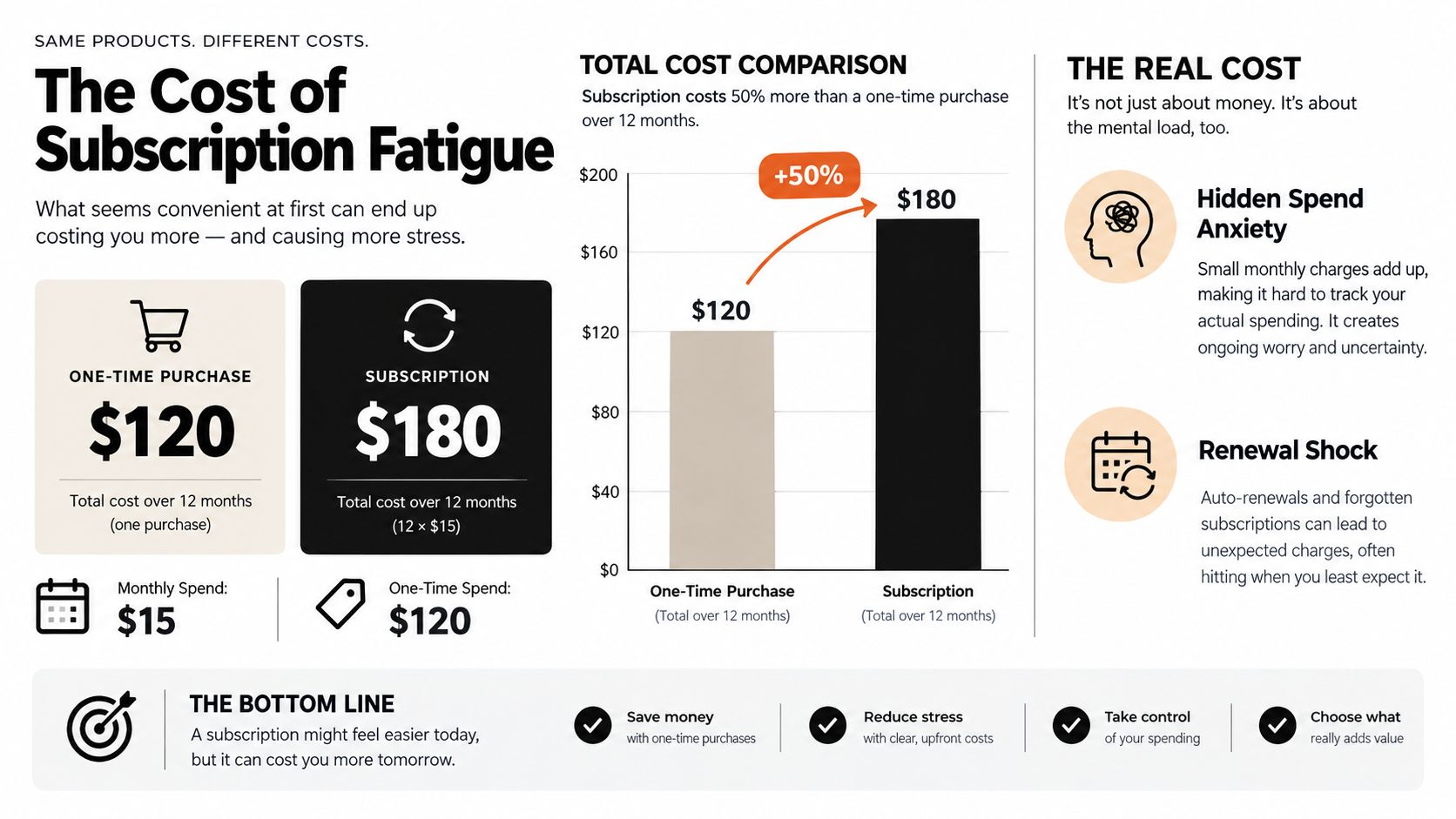
A subscription can look attractive in a forecast and still underperform in the store. Uneven usage, premature renewals, and weak payment recovery can turn recurring revenue into a costly service obligation. Industry coverage has also reported subscription fatigue and renewed interest in one-time purchases in some recurring-capable categories (one-time purchase trend coverage). Merchants should validate the buying pattern before making recurring billing the default.
Categories where friction beats recurrence
Durable goods are the clearest case. If customers do not need replacements on a dependable cadence, another charge feels like an interruption rather than a benefit. Seasonal products, items with unpredictable consumption, and products requiring extended trust-building also tend to favor one-time checkout.
Health, beauty, and wellness brands often push subscriptions because recurring orders can improve the margin model. The first order, however, usually has to prove the formulation, packaging, taste, and delivery experience. A one-time purchase gives the buyer control while the brand earns evidence for a second order. Replenishment reminders, bundles, and a later subscription invitation can then support repeat revenue without forcing commitment too early.
The hidden cost of subscriptions sits after checkout. Churn requires testing, win-back campaigns, and offer management. Failed cards create recovery work, while billing questions and cancellation requests add support volume. Those costs can outweigh the expected recurrence when customers buy irregularly or lack confidence in the product.
Consumer expectations reinforce the need for control. Buyers respond better when cancellation, pausing, and product changes are straightforward, as discussed in this consumer subscription convenience study. A rigid recurring offer can therefore lose to a simpler one-time purchase, even when its projected unit economics appear stronger.
On Shopify, show both paths when usage varies. Make one-time checkout prominent, explain the product's expected lifespan, and use post-purchase education to create a reason for the next order. Track refunds, support contacts, recovery results, and second-purchase rate by initial offer. That comparison reveals whether a subscription is creating durable value or merely shifting operational work downstream.
Pricing and Discount Strategies for Conversion
Discounting works differently in each model. With one-time purchase, pricing should reduce friction without training people to wait for a sale. With subscriptions, the offer has to reward commitment without destroying margin. That balance is why a blunt “subscribe and save” badge is rarely enough on its own.
How to structure the offer
For subscriptions, the cleanest pattern is usually a visible savings incentive paired with flexibility. Free trials can work when the product needs a usage window, but they should be tied to a clear path into the recurring plan, not used as a gimmick. If you're offering a tiered discount, make the progression easy to understand and connect it to retention behavior rather than pure acquisition.
For one-time purchase, bundles and volume pricing often do more work than simple percentage discounts. They raise order value while preserving the customer's sense of control. Post-purchase upsells can also lift revenue, but they need to feel additive, not manipulative.
The practical question is whether the discount changes behavior or just compresses margin. If the customer would have subscribed anyway, deep discounts aren't buying much. If the discount is the only reason they convert, you may be paying for low-intent retention.
What to test on Shopify
Use landing pages and product pages to separate the logic of each offer. A one-time buyer should see clarity, convenience, and straightforward pricing. A subscriber should see replenishment logic, editability, and predictable delivery.
For merchants planning the discount architecture, a focused subscription discount framework can help align pricing with retention instead of chasing a short-term spike. For the comparison side of the funnel, it's also useful to review pre-sell page conversion data when you're evaluating how much explanation a buyer needs before committing.
Practical rule: discount for behavior you want to keep, not for a sale you want to celebrate once.
The best pricing structures usually make the next step obvious. That means one-time buyers get a reason to return, and subscribers get a reason to stay. If the pricing page creates confusion, the market will choose the simplest exit.
Implementing Subscriptions on Shopify with RecurX
Subscriptions on Shopify fail most often at the operational layer, not the pricing layer. A theme mismatch lowers opt-in. A clunky portal increases support volume. Weak payment recovery turns avoidable declines into churn. The implementation has to reduce friction at every step, from product page to renewal.
The storefront and checkout path
The first requirement is that the subscription option looks native on the product page. If the widget clashes with the theme, shoppers hesitate. If the experience feels like a third-party detour, opt-in drops. That's why Shopify-native subscription tooling matters, because the subscription choice needs to sit beside the one-time option without breaking the storefront flow.
One option built for this workflow is RecurX, a Shopify-native subscription app that supports recurring products, memberships, and bundles inside Shopify's storefront and admin. It also supports a self-serve customer portal, dunning workflows, analytics, and plan management within the merchant's existing setup.
The operational stack that prevents churn
Failed payments need automated handling. Cards expire, banks decline, and customers forget to update billing details. If there's no recovery process, involuntary churn climbs. A solid setup should include retry logic and one-click payment updates so the merchant can recover revenue without relying on support tickets.
Customer control matters just as much. When shoppers can pause, skip, swap, or update payment details on their own, support load drops and trust rises. That's especially important for subscriptions, because people don't want to email support every time their usage changes.
You also need reporting that tells you why subscribers leave. Churn by reason, cohort retention, and AOV by plan are more useful than vanity metrics. Without that visibility, merchants end up guessing at the fix instead of adjusting the offer, billing cadence, or recovery flow.
A simple implementation sequence
- Match the widget to the theme. Make the subscription option visually consistent with the product page.
- Define the plan structure. Choose cadence, discount logic, and whether customers can pause or swap.
- Set up recovery workflows. Retry failed cards and send update prompts before the subscription is lost.
- Give customers control. Use a portal for skips, pauses, frequency changes, and payment updates.
- Track retention behavior. Watch cohorts, churn reasons, and repeat order patterns.
- Adjust based on usage. If churn appears early, the problem is usually expectation mismatch, not just price.
That sequence turns subscriptions from a billing feature into an operational system. Without it, the recurring revenue promise looks better than it performs.
Choosing the Right Model for Your Brand
The right choice usually becomes obvious once you ask the customer, the product, and the team the same set of questions. If the item is replenished on a reliable cadence, if the buyer expects continuity, and if your support team can handle recurring account changes, subscriptions are often the cleaner model. If usage is irregular, the category is trust-sensitive, or commitment feels premature, one-time purchase usually wins the first conversion.
A decision filter that works in practice
Start with replenishment cadence. Coffee, supplements, skincare, and pet consumables can support recurrence because the buyer already knows the product will run out. Durable goods and occasional-use items usually can't justify the same ask.
Then look at the support burden. If the team can't absorb payment failures, cancellations, and plan changes cleanly, subscriptions become more expensive to run than they look at launch. That's not a reason to avoid them entirely, but it is a reason to keep the rollout narrow until the operations are stable.
Finally, check how the customer prefers to buy. The data on cancellation ease, pause options, and subscription fatigue makes one thing clear, control matters. If your audience wants flexibility, give it to them upfront instead of trying to win back trust later.

The safest model is the one that matches usage, not the one that looks best in a forecast.
The real decision is often hybrid
Most brands don't need to force a binary choice. A one-time purchase can serve as the trust-building entry point, while a subscription can become the default for repeat buyers who already show replenishment behavior. That keeps the checkout flexible without giving up recurring revenue where it actually belongs.
The strongest merchants use purchase data to segment buyers after the first order. People who reorder quickly can be invited into subscription. Buyers who hesitate can stay in one-time purchase until their usage pattern is clearer. That approach respects consumer control and protects LTV at the same time.
Building a Hybrid Commerce Strategy
A hybrid setup should be built into the product, checkout, and post-purchase workflow. The goal is to give customers two buying paths while keeping inventory, billing, and retention data easy to manage.
Setting up the dual-path product page in Shopify
Start with one product record and two purchase options: a one-time purchase and a subscribe-and-save plan. Display both options near the price, show the delivery interval for the subscription, and state the saving clearly. Customers should understand the commitment before adding the product to cart.
Keep fulfillment rules aligned across both options. Confirm that inventory is shared correctly, subscription orders follow the same shipping logic, and discount codes do not reduce recurring orders below an acceptable margin. Test the product page, cart, checkout, customer portal, and cancellation flow before sending paid traffic.
RecurX gives Shopify merchants a way to place one-time purchase and subscription choices on the same product, manage billing recovery, and keep subscription administration within the storefront and admin. Visit RecurX to assess how that setup fits your catalog and support workflow.
Building the post-purchase conversion path
The first order should trigger a useful follow-up sequence, not an immediate subscription push. Tag customers by product, order quantity, and reorder timing. A customer who purchases the same replenishable product again within a short interval can receive an invitation to subscribe, while irregular buyers can receive usage guidance or a reminder instead.
Use Shopify Flow or an equivalent automation layer to apply tags after fulfillment and route customers into the right message sequence. The subscription invitation should explain the delivery schedule, savings, pause controls, and cancellation process. Clear terms reduce avoidable support tickets and payment disputes.
Review the results by cohort. Track subscription conversion, cancellation timing, payment recovery, support contacts, and contribution margin separately from one-time sales. A hybrid strategy earns its place when recurring revenue improves retention without creating more operational work than the margin can support.
subscription vs one time purchase · Shopify subscriptions · ecommerce retention · RecurX · recurring revenue
Keep reading
- How to Sell Subscriptions Online on ShopifyLearn how to sell subscriptions online on Shopify. Build flexible plans, optimize checkout, recover failed payments, and boost retention with RecurX.
- QR Code Checkout System: The Omnichannel Growth PlaybookMaster the QR code checkout system for subscriptions. Learn benefits, Shopify integration, and how to drive recurring revenue with RecurX.
- Best Subscribe and Save Strategies for ShopifyDiscover the best subscribe and save strategies for Shopify. Compare native app features, fee structures, and retention tactics to maximize recurring revenue.
Start growing recurring revenue on Shopify
RecurX has a 14-day free trial and zero transaction fees on every plan. Install in minutes.
Start your free trial →