How to Curate Subscription Boxes That Actually Convert
Learn how to curate subscription boxes that retain customers, with practical steps on product selection, bundling, pricing, and fulfillment for Shopify stores.
Learn how to curate subscription boxes that retain customers, with practical steps on product selection, bundling, pricing, and fulfillment for Shopify stores.

You've sourced products you're proud of, built a polished Shopify product page, and packed a box that looks good in an unboxing video. Yet subscription conversions have stalled, and customers who loved their first delivery are starting to cancel. Your warehouse can ship the assortment correctly, but that doesn't mean subscribers want it again.
To curate subscription boxes that convert beyond the introductory offer, you need more than good taste. You need a system that translates customer preferences into useful shipments, protects margin when customers make changes, and catches disappointment before the next renewal.
Table of Contents
- Why Curation Is a Retention Problem Before It Is a Fulfillment Problem
- Audience Research and Product Selection
- Designing the Bundle and Box Theme
- Pricing, Discounts, and Trial Mechanics
- Personalization Models and Avoiding Irrelevant Inventory
- Fulfillment and Shopify Implementation
- Measuring Retention and Running Your First 90 Days
Why Curation Is a Retention Problem Before It Is a Fulfillment Problem
Consider a hypothetical skincare merchant reviewing cancellations after a successful launch. The orders arrived intact, the packaging looked premium, and the products matched the advertised theme. But customers with fragrance sensitivities received scented products, while occasional users accumulated items faster than they could finish them.
Nothing went wrong at the packing bench. The merchant fulfilled the wrong promise for those subscribers.
The disappointment is easy to recognize:

Separate shipment success from subscription success
Industry summaries report that roughly 38% of subscription-box customers cancel within three months, more than half cancel by month six, and curation models commonly experience 8–15% monthly churn, although methodologies vary across the subscription retention benchmarks collected by Subjolt. Treat those figures as planning ranges, not forecasts for your store.
A shipment report answers whether customers received their orders. A retention report should help you understand whether those orders earned another renewal.
Operating principle: A correctly packed box can still be an incorrectly curated box.
Before changing suppliers or commissioning new packaging, separate cancellation reasons into useful categories:
- Assortment mismatch: The subscriber received products they wouldn't choose or use.
- Consumption mismatch: The next shipment arrived before the previous products were finished.
- Economic mismatch: The ongoing price no longer matched the customer's budget or perceived value.
- Service failure: Damage, billing confusion, or an unresolved support issue weakened trust.
Don't automatically code every cancellation as price sensitivity. Ask whether customers would still want the assortment at the regular price if its contents and timing fit better.
Define discovery in the customer's terms
A customer researching where to find a Napa Valley wine club, for example, has already expressed a category preference. That's a useful reminder to define the boundaries of discovery before selecting surprises. Novelty within a preferred category is different from novelty without constraints.
The practical objective is renewable relevance. Your product page, preference collection, merchandising rules, and customer controls should all support the same promise. If they describe different experiences, better fulfillment won't solve the underlying problem.
Audience Research and Product Selection
Start with the routine you're serving, not the inventory you can buy cheaply. A discounted product isn't a good candidate if customers won't use it, can't safely receive it, or already have too much of it.
Write a working audience definition that includes the customer's current purchases, intended use, exclusions, and consumption pattern. Then look for evidence that would challenge it.
Collect signals that change selection decisions
Shopify order history can help you identify repeat purchases and category combinations. Competitor reviews can provide language for interview questions, but don't treat another merchant's complaints as proof about your audience. Search trends can suggest topics to investigate, not establish product fit.
Draft a preference quiz around decisions your merchandising team can make. Compare survey apps for Shopify by how they capture structured responses and connect those responses to customer records, rather than choosing solely on presentation.
Ask customers what they already own, what they finish, and what they avoid. In beauty, an ingredient exclusion is more actionable than a broad interest in wellness. For coffee, brewing equipment and preferred preparation matter more than whether someone describes themselves as adventurous.
Turn research into a candidate list
These are illustrative selection scenarios, not merchant case studies. A coffee box for morning-routine drinkers might prioritize dependable flavor profiles, compatible grind options, and useful quantities. A specialty-explorer box might emphasize processing methods and origin variety, while still respecting equipment constraints.
For a pet assortment, separate life stage, size, and chew strength before choosing toys or treats. Don't assume a customer's interest in premium pet products makes every product suitable for their animal.
Product Selection Scoring Rubric
| Criterion | Weight | What to Score |
|---|---|---|
| Safety and eligibility | Mandatory gate | Sensitivities, size suitability, category exclusions, destination restrictions |
| Routine fit | High | Whether the customer has a clear use for the product |
| Consumption compatibility | High | Whether the quantity fits the intended delivery cadence |
| Contribution margin | High | Landed cost, handling requirements, and expected discount exposure |
| Discovery value | Moderate | Whether the item adds a relevant experience rather than filler |
| Supply reliability | Moderate | Availability, shelf life, and acceptable replacement options |
Use qualitative weights until you have enough operating evidence to justify a numerical model. A precise score built on guesses is still a guess.
Annotate each shortlisted SKU with consumption rate, sensitivity risk, available sizes, regulatory notes, and substitution eligibility. Reject unsuitable products before ranking attractive ones. This keeps commercial pressure from turning a safety or fit constraint into a negotiable preference.
Designing the Bundle and Box Theme
A theme should help customers understand why products belong together. It shouldn't become a reason to include weak items.
A skincare-routine theme can give an assortment coherence. A regional-coffee theme can make discovery easier to explain. But if the available supporting products don't fit the subscriber profile, choose a flexible assortment instead of forcing the concept.
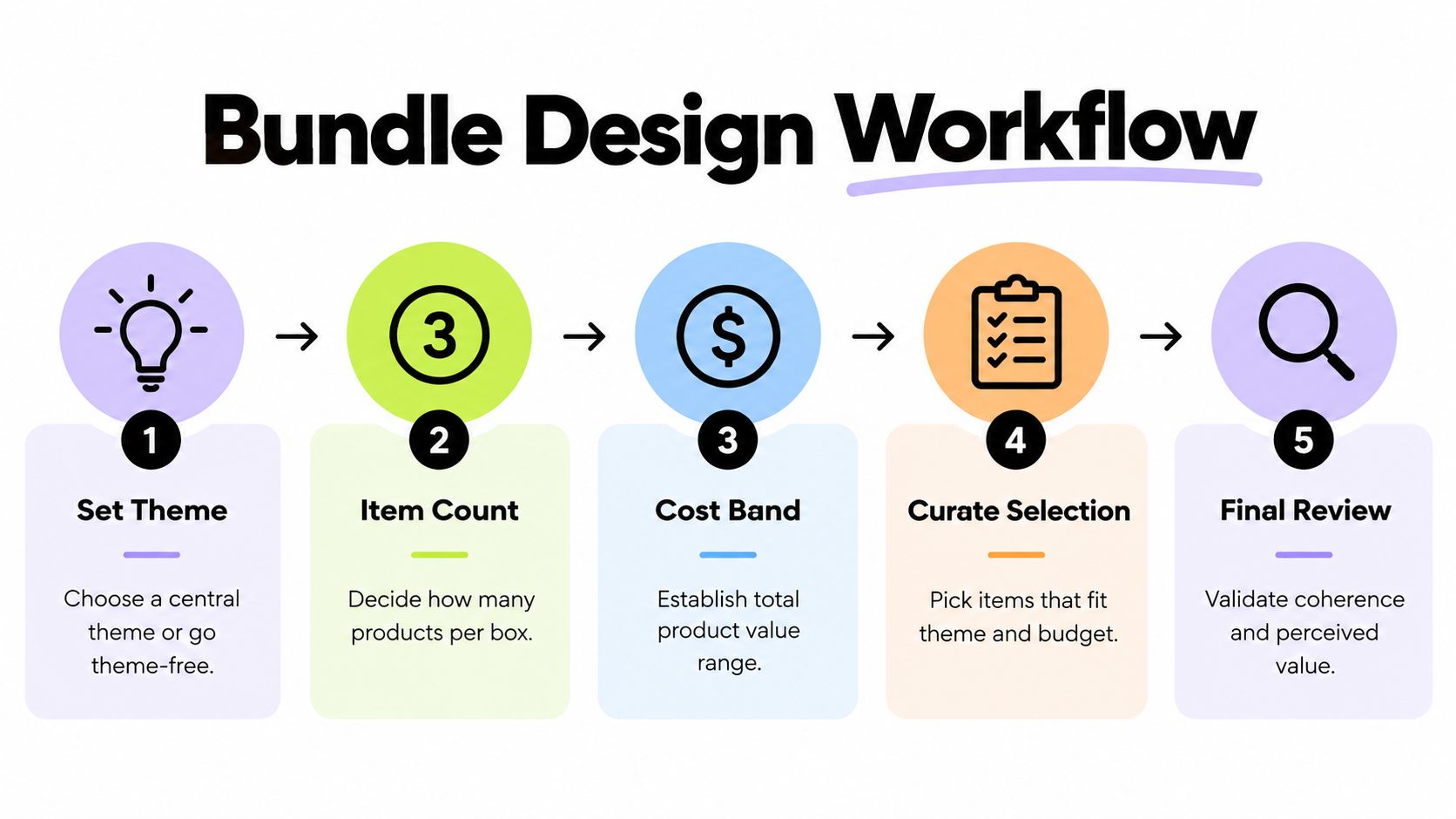
Use this workflow to keep creative decisions connected to operating constraints:
Build around utility, then add discovery
Define the hero product as the item that delivers the box's central benefit. Supporting products should complement it, introduce a relevant variation, or help the customer use it. Don't add filler to make the advertised item count look generous.
Set the item count and cost band using your own sourcing and fulfillment model. Apply hard constraints for allergens, dimensions, shipping weight, shelf life, and destination restrictions before optimizing assortment variety.
A useful packing specification includes:
- Bundle purpose: The routine or experience the shipment supports.
- Component roles: Which products are essential and which are optional discovery items.
- Eligibility rules: The customer profiles permitted to receive each component.
- Release conditions: Approved inventory, expiration checks, and confirmed replacement mappings.
A theme is a merchandising explanation, not permission to override customer exclusions.
Approve replacements before you need them
Suppose a supplier delivers the wrong coffee SKU shortly before your packing deadline. A replacement that fits the theme but conflicts with a subscriber's brewing method isn't equivalent. Your team should check functional fit, quantity, margin, and customer expectations before releasing it.
For a restricted product delayed by a compliance review, don't substitute another item merely because it has similar retail value. Escalate the affected assortment for approval, and communicate any material change before fulfillment.
Packaging belongs in the same review. Don't assume a recurring box is environmentally preferable to ordinary replenishment because its packaging looks sustainable. The discussion of subscription-box packaging trade-offs supports examining packaging, delivery, and unwanted-product waste together.
Track packaging material per shipment, product usefulness, and replacement or damage events. A smaller package doesn't compensate for an assortment customers discard. Where suitable, test refills, consolidated deliveries, or customer-selected bundles against both service quality and contribution margin.
Pricing, Discounts, and Trial Mechanics
Price the ongoing experience before designing the introductory offer. Otherwise, you risk acquiring customers for a deal your regular box can't economically sustain.
The pricing stack includes customer payment, shipping contribution, introductory concessions, loyalty discounts, and any retention incentives. The visual below illustrates those components, not recommended prices or a forecast for your store:
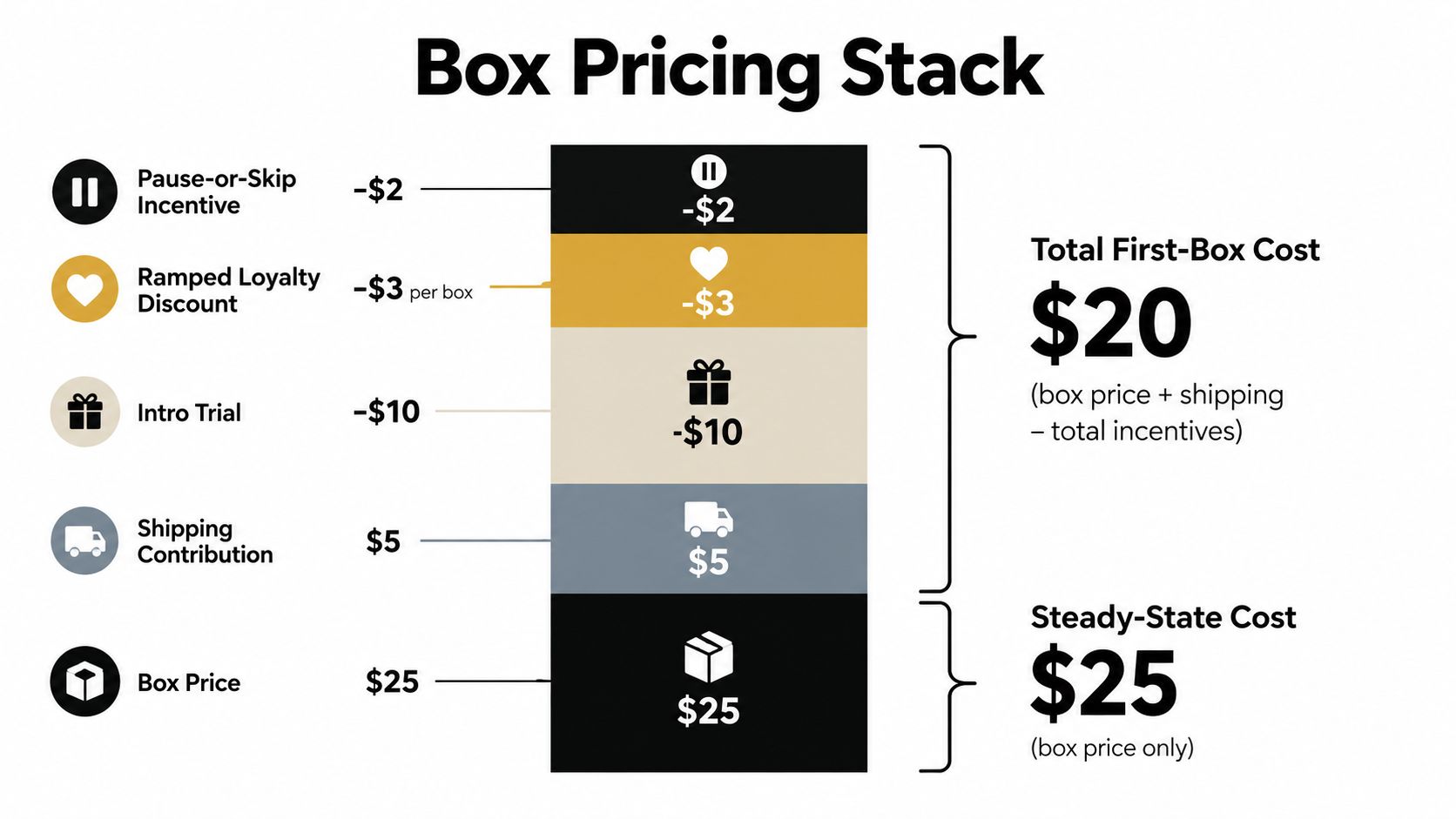
Calculate what remains after the shipment
Start with net box revenue, then subtract product costs to understand merchandise gross margin. For an operating decision, go further: deduct packaging, pick-and-pack charges, payment costs, shipping subsidy, and expected service costs. Keep gross margin and contribution margin distinct.
Use actual supplier quotes and warehouse charges, not a generic beauty-box example. The practical approach to bundle product pricing is to test whether the whole assortment remains viable after discounts and component changes.
Consider two hypothetical offers without assuming prices. One subsidizes the first shipment heavily and renews at full price. Another uses a smaller introduction benefit and rewards retained customers later. Neither is automatically better: compare retained contribution, refunds, and subsequent full-price renewals rather than first-order conversion alone.
- Introductory offers: State what customers receive now and what they'll pay at renewal.
- Tenure discounts: Define eligibility clearly and check whether other rewards can stack.
- Shipping contributions: Make recurring charges visible before checkout.
- Retention incentives: Reserve concessions for a diagnosed problem instead of discounting every cancellation attempt.
Sell discovery without hiding the economics
Customers need enough detail to judge value even when individual products remain a surprise. For a category-specific reference, review what's inside a whiskey kit when considering how to explain an unfamiliar discovery format. Use that prompt to clarify your own contents, serving or usage expectations, and purchase terms.
A free trial still carries product and fulfillment costs. Specify whether it means a sample shipment, a waived subscription charge, or another benefit, and make the paid transition explicit.
Anchor-date billing also needs careful communication. If customers join close to the shared billing date, they shouldn't have to infer when they'll next pay or which shipment that payment covers.
Don't extend a trial because the next renewal looks weak. First establish whether customers reject the price, the products, or the timing. A discount can change the payment amount, but it can't make an unsuitable assortment useful.
Personalization Models and Avoiding Irrelevant Inventory
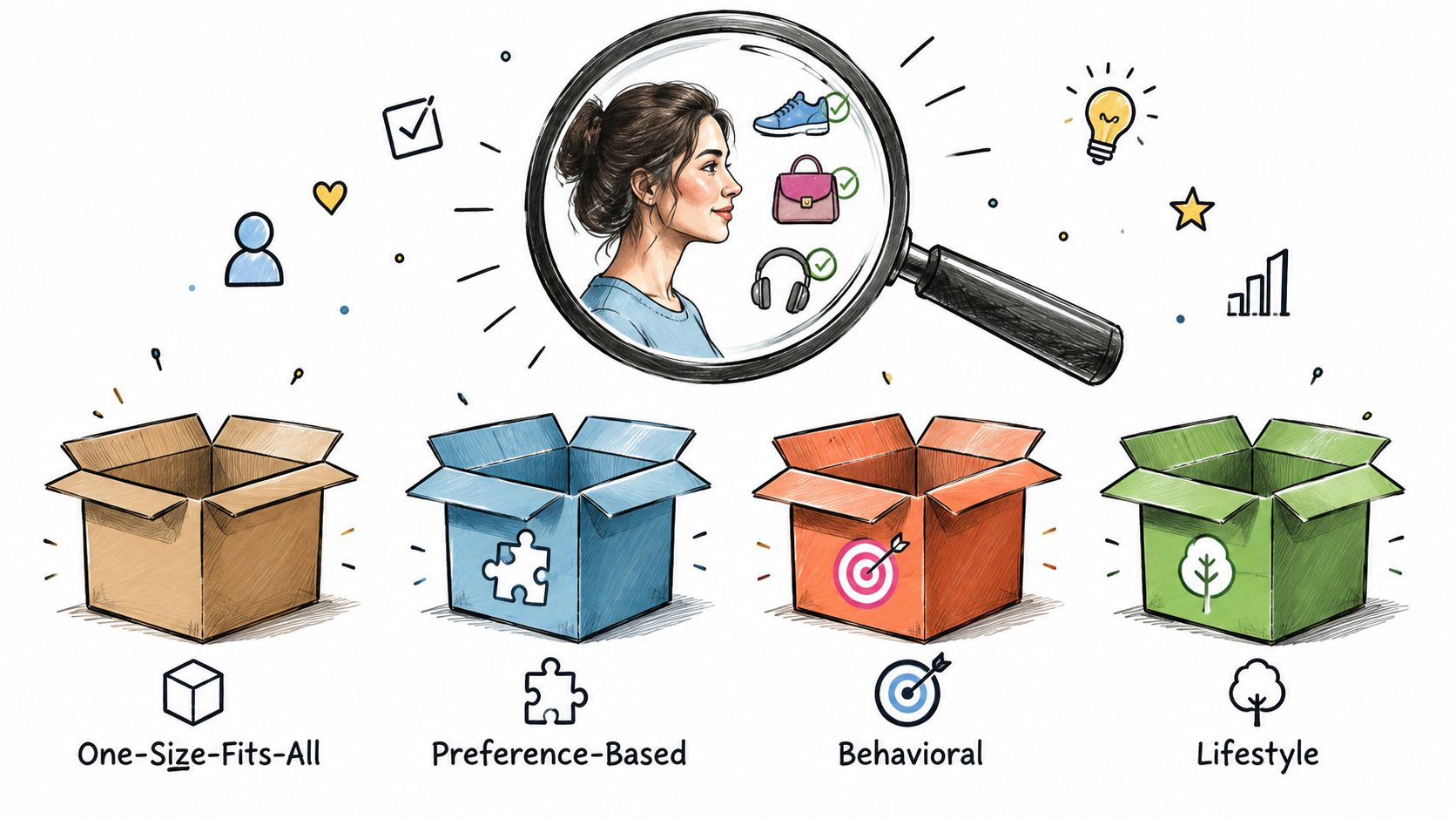
Choose a personalization model your team can fulfill accurately. More customer choice creates more decisions about inventory reservation, substitutions, and shipment readiness.
The operating differences matter more than the label:
| Model | Customer control | Operational trade-off |
|---|---|---|
| One-size-fits-all | Accepts the standard assortment | Simple assembly, limited individual fit |
| Preference-quiz curation | States preferences and exclusions | Requires reliable profile-to-SKU rules |
| Build-a-Box | Selects eligible components | Requires component availability and selection validation |
| Curated hybrid | Receives a default assortment with optional swaps | Preserves discovery while adding deadline and reservation logic |
Limit surprise rather than eliminating it
Use a curation budget: define what can vary and what must remain stable. Customers might allow new flavors while excluding certain ingredients, or welcome unfamiliar apparel designs while keeping size and category fixed.
For an apparel-specific reference, smart t shirt box buying tips can help frame the questions a buyer brings to a surprise purchase. Your onboarding should resolve the constraints that would make a surprise unwearable.
Industry summaries attribute 68% of cancellations to taste or lifestyle mismatch and identify unused items as a cancellation reason at 57% in another summary, but these are secondary estimates rather than transparent category-specific datasets, as discussed in Alibaba's subscription-box relevance analysis. Use them to prioritize investigation, not to assign causes to your own customers.
Store preferences, ratings, swaps, skips, purchases, and returns as structured signals. Apply hard exclusions first, then rank eligible products by fit, margin, availability, weight, and novelty.
This video provides an additional reference alongside the model comparison:
Test personalization against a standard assortment
An independent quasi-experimental study covering 47,318 subscribers across 12 box firms reported 23.1% higher repeat purchases, 34.0% lower quarterly churn, and $87 higher estimated lifetime value per subscriber, with category variation, in the American Impact Review personalization study. Those findings don't establish that your implementation will produce the same outcomes.
Randomly hold out customers receiving standard curation and test a single change at a time. Compare renewal, product acceptance, refunds, margin, and fulfillment exceptions.
Testing guardrail: Customer enthusiasm about personalization isn't evidence that personalization improved retention.
Don't overfit sparse profiles or offer so many choices that customers delay completing their box. A bounded, useful assortment is preferable to an unrestricted catalog that your warehouse can't reliably assemble.
Fulfillment and Shopify Implementation
Translate the merchandising policy into checkout, customer-account, and warehouse behavior. If the storefront promises swaps but the fulfillment export ignores them, the customer experiences a broken promise rather than a technical limitation.
Map each decision to a Shopify surface
A Shopify-native subscription application can handle recurring plans, while Shopify Flow and lifecycle messaging tools support segmentation and communication. Check the boundaries between those systems before configuring the offer.
| Operating decision | Implementation surface | Acceptance check |
|---|---|---|
| Delivery cadence | Pay-as-you-go or prepaid selling plans | Checkout displays the correct billing and delivery terms |
| Customer-selected assortment | Build-a-Box or mix-and-match flow | Eligible component selections reach the fulfillment record |
| Subscription opt-in | Theme-matched product-page widget | Price, frequency, and offer conditions are readable |
| Subscription changes | Native customer-account portal | Pause, skip, swap, and frequency changes affect the intended renewal |
| Failed payment handling | Decline-aware retries and card-update messaging | Recovery doesn't create duplicate fulfillment |
| Campaign acquisition | Subscription checkout links or QR codes | The selected plan and recurring terms remain clear |
Keep preference data accessible to the assembly process, not just the marketing platform. Determine which system owns the approved assortment and when that assortment becomes final.
For lifecycle communications, connect Klaviyo or Mailchimp to renewal events and customer status. Twilio or WhatsApp Business can support consented messaging where appropriate. Confirm event timing and suppression rules so paused customers don't receive messages telling them a box is about to ship.
Test the exceptions before launch
Place test orders through the actual storefront and inspect the records your fulfillment partner receives. Include changed components, paused plans, prepaid subscriptions, and failed-payment recovery.
- Warehouse substitutions: Require approval for component replacements and export the final SKU list, not merely the bundle's parent product.
- Anchor-date errors: Check store timezone, cutoff interpretation, and the distinction between billing date and shipment date.
- Missed swap windows: State the deadline in customer-facing language and define how late changes are handled.
- Localized experiences: Review translated widget, portal, and notification text together, including recurring-charge terminology.
Quick-checkout links are useful for social campaigns, but bypassing the product page also bypasses its explanations. Preserve essential subscription information at checkout.
Monitor fulfillment exceptions, support contacts, missed change requests, and recovery-related order anomalies alongside subscription metrics. Give support staff visibility into what the customer selected and what the warehouse shipped. Without that shared record, every dispute becomes a manual reconstruction.
Measuring Retention and Running Your First 90 Days
Build a cohort dashboard by acquisition source, theme, product category, first-renewal outcome, and cancellation reason. The practical framework for subscription cohort analysis helps separate a weak acquisition audience from an assortment problem.
Establish an operating rhythm
Use the retention checkpoints introduced earlier: review day 30 and day 90, then continue tracking the cohort through day 180. Don't judge a launch solely by recurring revenue accumulated before customers have had a meaningful chance to renew.
- Launch checklist: Verify preference capture, approved assortments, change deadlines, and cancellation-reason collection.
- Weekly review: Inspect net subscriber movement, involuntary churn, support contacts, and products customers reject.
- Experiment review: Compare preview, swap, or win-back interventions against holdout cohorts using retained contribution and refunds.
- Merchandising review: Investigate repeat-item complaints before adding novelty or replacing customer favorites.
Read metrics together
Track MRR, churn by reason, LTV, ARPU, AOV, and product acceptance. An increase in order value isn't necessarily progress if customers accept fewer products or require more refunds.
Win-back messages should address the recorded cancellation reason. Invite customers back to a corrected experience, not the same assortment with a temporary discount.
Keep the operating rule simple: don't add novelty without measuring fit. The work is to earn the next renewal, then learn from what customers used.
RecurX offers Shopify-native subscriptions, Build-a-Box flows, a self-service customer portal, payment recovery, and cohort analytics. Visit RecurX to explore how those tools can connect your curation rules with customer choices, fulfillment workflows, and renewal measurement.
curate subscription boxes · subscription box strategy · Shopify subscriptions · box curation guide · DTC retention
Keep reading
- Buy a Subscription the Smart Way: A Complete How-To GuideLearn how to buy a subscription with confidence. Discover what to check before paying, how recurring billing and cancellation really work, and how
- Shopify Customer Retention: A Practical Playbook for 2026Boost Shopify customer retention in 2026 with this practical playbook. Learn loyalty, dunning, cohorts, and lifecycle tactics that grow LTV.
- Shopify Subscription Sales: A Practical 2026 PlaybookGrow Shopify subscription sales with a 2026 playbook on plan design, storefront widgets, checkout links, Build-a-Box, dunning, migrations, and retention
Start growing recurring revenue on Shopify
RecurX has a 14-day free trial and zero transaction fees on every plan. Install in minutes.
Start your free trial →