Shopify Subscription Sales: A Practical 2026 Playbook
Grow Shopify subscription sales with a 2026 playbook on plan design, storefront widgets, checkout links, Build-a-Box, dunning, migrations, and retention
Grow Shopify subscription sales with a 2026 playbook on plan design, storefront widgets, checkout links, Build-a-Box, dunning, migrations, and retention
Shopify facilitated $378.4 billion in gross merchandise volume in fiscal 2025, up from $292.3 billion in 2024 and $235.9 billion in 2023, which tells you something simple about subscription strategy on the platform, recurring revenue sits inside a very large commerce engine, not on the fringe of it. Shopify Payments also processed $67.2 billion of GMV in 2025, and payment penetration reached 65.6% (Shopify 2025 annual report). If you're building Shopify subscription sales, you're not adding a widget, you're designing a recurring-revenue system that has to survive checkout friction, decline codes, customer fatigue, and migration risk.
Most stores still treat subscriptions as a product-page toggle and a billing retry rule. That's why MRR stalls. The merchants that grow recurring revenue keep seven layers working together, plan design, storefront conversion, checkout surfaces, Build-a-Box flows, dunning, retention controls, migration, and measurement. The money is usually not hiding in a prettier widget, it's hiding in fewer failed renewals, better plan fit, and cleaner cohort management.
Table of Contents
- Why Shopify Subscription Sales Deserve a Real System
- Designing Subscription Plans That Match Your Catalog
- Storefront Widgets, Checkout Links, and Build-a-Box
- Fighting Involuntary Churn With Decline-Code Recovery
- Loyalty, Portals, and the Real Value of Pause and Skip
- Migrating From Recharge, Bold, Skio, or Loop Without Losing MRR
- Measuring MRR, Churn, LTV, and Cohort Retention
Why Shopify Subscription Sales Deserve a Real System
Shopify facilitated $378.4 billion in gross merchandise volume in fiscal 2025, up from $292.3 billion in 2024 and $235.9 billion in 2023. That scale tells you something simple about subscription strategy: recurring revenue sits inside a very large commerce engine, not on the fringe of it. Shopify's fiscal 2025 filing also notes that most merchants subscribe to Basic and Grow plans, while most GMV comes from Shopify Plus and other enterprise offerings. For subscription operators, that is a reminder that the pain usually shows up after a store has enough volume to feel every failed renewal.
A subscription program is built, not installed. The parts are familiar, but they only work when they are treated as one system.
- Plan design: Match the billing shape to the product and the customer's consumption rate.
- Storefront conversion: Make the subscription offer visible and credible on product pages and landing pages.
- Checkout surfaces: Remove friction for campaigns, offline channels, and fast-buy entry points.
- Build-a-Box: Give shoppers a reason to subscribe when their basket is personalized, not fixed.
- Dunning: Recover avoidable payment failures before they become silent churn.
- Retention mechanics: Pause, skip, swap, and frequency changes keep revenue alive without forcing a cancellation.
- Migration and measurement: Moving platforms and reading cohorts cleanly are part of revenue, not afterthoughts.
Practical rule: if you cannot explain where each renewal succeeds or fails, you do not have a subscription system yet, you have a billing app.
The part many operators learn late is less obvious. A meaningful share of churn is not a pricing problem or a product problem, it is an infrastructure problem. If a customer wanted the product but their card failed or their issuer blocked the charge, the job is recovery, not persuasion.
That is why involuntary churn needs its own workflow. Voluntary cancellation asks why the customer left. Decline-code recovery asks whether the renewal could have been saved. Treat those as separate problems, and the next sections get much easier to operate.
Designing Subscription Plans That Match Your Catalog
The first mistake is copying another merchant's widget and assuming the interval is the strategy. It isn't. The plan shape has to match the way your product gets used, the way inventory moves, and the amount of margin you can safely trade for commitment.
Pick the plan before you pick the discount
There are four plan types that matter in practice. Pay-as-you-go fits consumables with variable usage, because customers don't always burn through product on a clean schedule. Prepaid works when the buyer will trade cash up front for a lower effective price. Memberships make sense when access matters more than replenishment. Build-a-Box fits mix-and-match catalogs where the customer wants control over assortment.
Billing interval comes next. Weekly, monthly, and yearly plans are not interchangeable. A monthly offer can feel too slow for some replenishment categories and too fast for others, especially when the shelf life is short or the customer consumes unevenly. Free trials should be treated as sampling, not as the default starting point. They're useful when the product needs proof, but they can also attract low-intent signups if the category already has strong repeat behavior.
Use pricing mechanics that reward staying, not just joining
Ramped discounts usually work better than front-loaded generosity. A deep first-order discount can subsidize low-quality signups, while a discount that improves on the second, third, or fourth order rewards customers who continue. Anchor-date billing also helps when shipments go out in waves, because it aligns recurring orders with a real fulfillment rhythm instead of forcing the warehouse to chase random dates.
Practical rule: don't ask whether the discount converts. Ask whether it still makes sense after the third renewal.
A useful decision frame is simple. If the product is consumed quickly and replenishment is predictable, lean into recurring shipments and tighter intervals. If the product is seasonal, bundled, or usage varies widely, use a more flexible plan, or risk training customers to pause immediately after sign-up. That's how a subscription starts looking like a coupon program.
Storefront Widgets, Checkout Links, and Build-a-Box
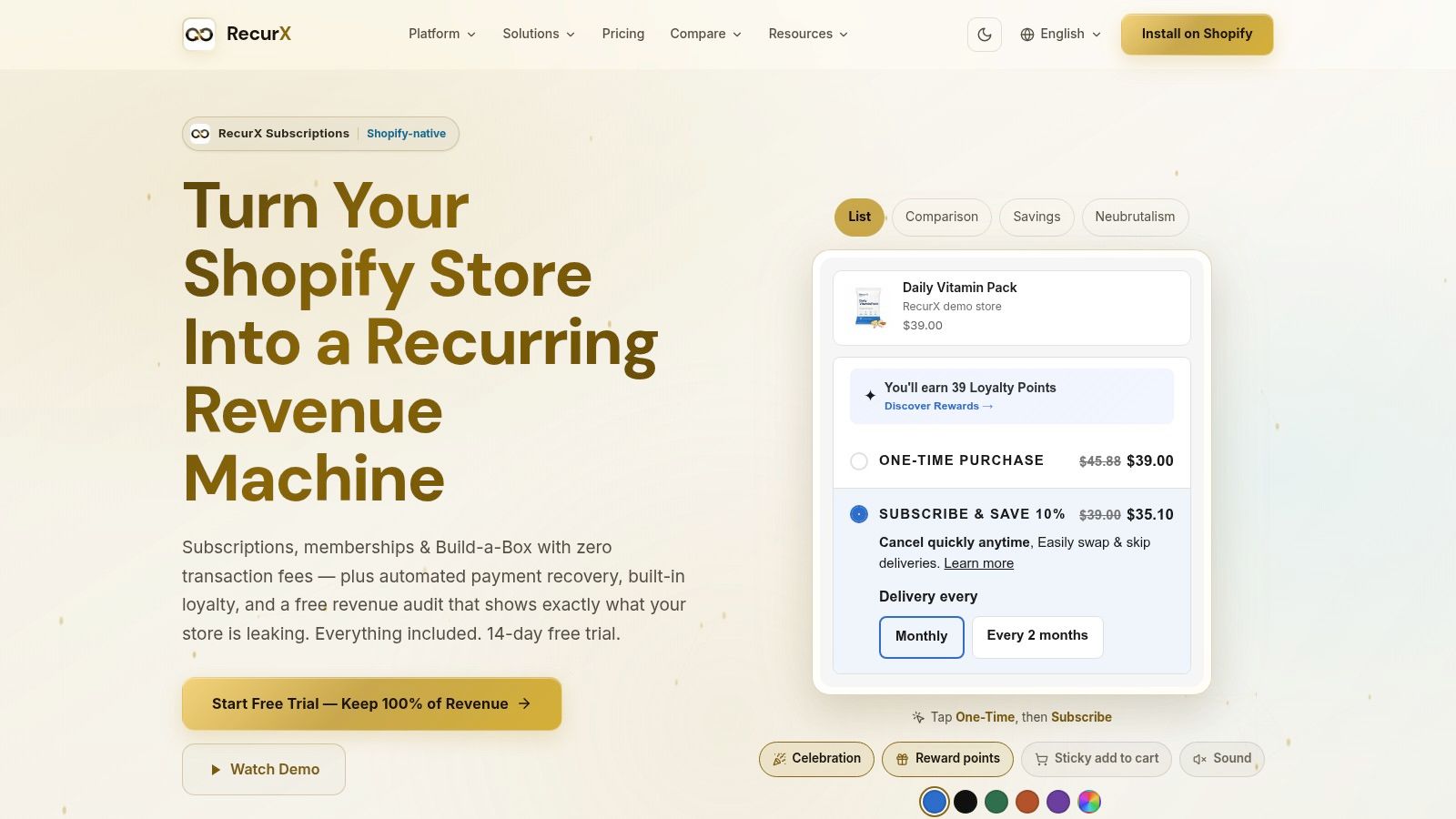
The storefront decides whether subscription intent turns into action. A widget can't rescue a weak offer, but a bad widget can absolutely bury a good one. Theme-matched templates matter because the offer has to look native to the store, not bolted on after the fact.
Make the subscription offer feel like part of the store
The best storefront setup respects the merchant's design system. That means typography, color contrast, spacing, and button hierarchy need to match the product detail page. Accessibility matters too, because subscription opt-in is hard enough without forcing buyers to decipher a visually broken selector.
Quick checkout links and QR codes are useful when the buyer doesn't need a long product page. Think campaigns, social posts, live events, pop-up retail, and insert cards. Those surfaces work when the purchase decision is already formed and the goal is to reduce steps, not explain the product from scratch.
Treat Build-a-Box as its own conversion path
Build-a-Box is not just a widget variant. It's a different shopping motion. A curated bundle works when the merchant knows the best combination already. Mix-and-match works when the customer wants autonomy, especially in categories where preference is personal and repeat order value rises when the box feels custom.
A tiered subscriber discount can lift order value without forcing a one-size-fits-all bundle. Used carefully, it gives shoppers a reason to add one more item to the box while preserving the recurring structure. Used badly, it cannibalizes single-purchase revenue and makes the economics harder than they need to be.
The media assets matter here because conversion is visual. The screenshot above shows the kind of native, store-aligned presentation that should be the baseline, not the premium feature. The embedded video below is useful after you've seen the visual, because it helps you think about the flow, not just the layout.
After the visual layer is in place, the next question is whether your acquisition sources can enter subscription flow without friction.
If your app can't support both a storefront widget and a direct checkout path, you're leaving channels on the table. The buyer who scans a QR code after a demo, or taps a campaign link from a creator post, shouldn't need to re-learn the product page just to subscribe. That's where fast entry points pull their weight.
Fighting Involuntary Churn With Decline-Code Recovery
The quiet leak in subscription revenue is often payment failure. Merchant Risk Council reports that failed payments can account for 20–40% of total churn, and only about 5% of customers lost to a payment issue reportedly resubscribe. In the same source, an industry dataset covering 15 million subscriptions and 6 million failed payments found that insufficient funds made up 42.3% of declines overall, with 50.1% in the United States, 66% in the United Kingdom, 62% in Germany, and 81.4% in Australia (Merchant Risk Council). That spread is why involuntary churn needs its own recovery system.
Separate the decline reason before you choose the fix
Expired cards, temporary cash flow issues, fraud-related bank blocks, and deliberate cancellations do not respond to the same message. If you treat them alike, you waste retries, frustrate good customers, and miss the billing weak points that need attention.
The recovery play should start with the decline code, then move to timing and channel. A card that is out of date usually needs a fast payment update path. An insufficient-funds decline may need another try after the customer's account clears. A fraud or bank block needs a different message, because the customer has to verify or replace the payment method before the charge can clear.
A single global sequence rarely performs well because the mix changes by market and by issuer behavior. The practical fix is to route each failure into the right path instead of sending one generic dunning flow to everyone.
Map decline type to action
- Insufficient funds: retry with a calm, useful message. The customer may only need time.
- Expired card: send a one-click payment update link early, because it is usually the easiest fix.
- Fraud or bank block: explain the problem clearly and give a direct path to verify or replace the payment method.
- Intentional cancellation: do not frame it as a payment issue, because that breaks trust.
Save dunning for recovery, not persuasion. Discounts belong in retention offers, not in the first payment-failure message.
Channel choice matters too. Email is the baseline, but SMS and WhatsApp can work well when the customer expects faster resolution. The point is to match the recovery step to the actual failure, not to treat every missed payment like a marketing opportunity. For a practical sequence, the failed payment recovery guide for Shopify merchants is a useful companion reference.
Loyalty, Portals, and the Real Value of Pause and Skip
Retention features are often sold as perks, but on Shopify they're operational tools. The self-serve portal should let customers pause, skip, swap, change frequency, and update payment details without opening a support ticket. When that works well, fewer customers leave just because life got busy.
Pause and skip are not revenue leaks by default
A pause can be a retention intervention, not a failure. If a customer is using the product slower than your shipment cadence, forcing a cancellation often creates a deeper loss than allowing a temporary break. Skip does similar work when timing, travel, or inventory already in the home would otherwise make the next shipment feel redundant.
The point is not to maximize the immediate renewal count at all costs. The point is to preserve the relationship long enough for the customer to come back on their own terms. Support teams feel the difference immediately when customers can self-serve routine changes on the merchant's own domain instead of reaching out for every adjustment.
Loyalty should stack with plan pricing
Loyalty mechanics work best when they reinforce the subscription rather than compete with it. Points per renewal, VIP tiers, milestone bonuses, and store credit redemptions can all sit alongside recurring pricing. That gives customers a reason to stay without forcing the brand to rely on blunt discounting.
A smart downgrade path matters too. If a customer doesn't need the full box or the full frequency, a lighter plan can preserve revenue better than a hard cancellation. The same goes for swaps, which can rescue a relationship when the product fit is off but the category is still right.
Practical rule: track retained revenue and future reactivation, not just the fact that a customer stayed active this month.
On Shopify, the portal is the control center. The less friction there is around payment updates, swaps, and frequency changes, the fewer support tickets you'll have to triage later. RecurX is one option in this space, since it keeps those controls inside Shopify's native checkout and customer-account flow, but the requirement is simpler, the portal has to make staying easier than leaving.
Migrating From Recharge, Bold, Skio, or Loop Without Losing MRR
A migration moves billing logic, customer expectations, payment credentials where supported, and historical subscription state at the same time. A rushed cutover can create churn on launch day and leave a clean-looking storefront hiding a very expensive revenue leak.
Know the path before you cut over
The most common exits are from Recharge, Bold, Skio, and Loop Subscriptions, with a universal CSV fallback when the source system does not support a cleaner path. If token migration is supported, it usually causes less friction because customers do not need to re-enter payment details. If it is not, the migration needs tighter customer communication and a staged retry policy that is already tested before launch.
A useful place to sanity-check the surrounding stack is browse SignalZen's integrations, especially if messaging, support, or automation tools need to line up with the new subscription flow.
Use a controlled cutover sequence
A clean migration usually follows the same order.
- Import historical subscriptions first. Preserve status, cadence, and billing anchor where possible.
- Verify customer notification timing. Customers need to know what changes and what stays the same.
- Set retry policy before launch. The first failed renewal after migration should not become a support fire drill.
- Check the Shopify admin after the switch. Confirm plan visibility, portal access, and order creation.
- Monitor the first billing cycle closely. Early issues are easier to fix before they spread.
Supported migrations can land in roughly an hour, but only when the source system, customer base, and payment setup are straightforward. Real-world migrations often take longer because of edge cases, not because the app install itself is hard. Sequence and verification do the work.
A Shopify subscription migration guide is useful when you want the mechanics in one place, especially if you are deciding whether to move incrementally or cut over in a single event. The better choice is the one that protects active subscribers first and internal convenience second.
| Migration Path Comparison | Direct Connector | Token Migration | Realistic Cutover |
|---|---|---|---|
| Recharge | Supported in some cases | Where supported | Controlled cutover after verification |
| Bold | Supported in some cases | Where supported | Controlled cutover after verification |
| Skio | Supported in some cases | Where supported | Controlled cutover after verification |
| Loop | Supported in some cases | Where supported | Controlled cutover after verification |
| CSV fallback | No | No | Slower, manual cutover |
Measuring MRR, Churn, LTV, and Cohort Retention
A subscription program that can't be measured can't be improved. Revenue alone is too blunt, because it hides whether growth is coming from new signups, better retention, higher order value, or fewer failed payments. You need cohort math to see which lever moved.
Use the right metric for the right question
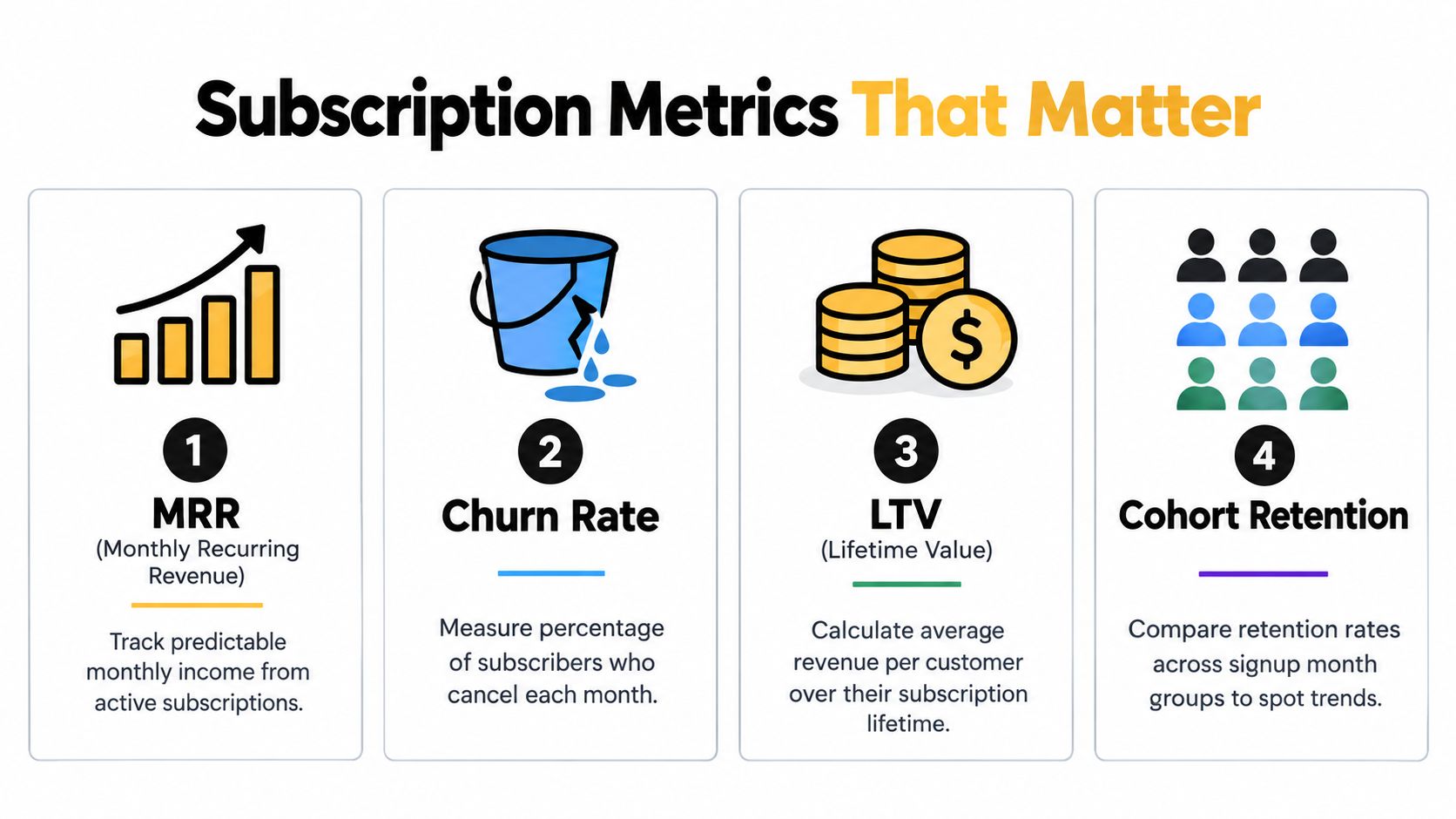
MRR is the directional health check. It tells you whether recurring revenue is rising or falling, but not why. Churn by reason is where the actual diagnosis starts, because voluntary cancellation and involuntary payment failure need different fixes. LTV is a forecast, not a victory lap, and it should be treated as a working estimate that changes as cohorts mature. ARPU and AOV are revenue levers that show whether customers are spending more per order or per account.
For a basic explanation of churn framing that Shopify store owners can share internally, the guide for Shopify store owners from Arlo Inc. is a helpful reference point. The important thing is not the label, it's whether your team can separate cancellation from payment failure in reporting.
Build a weekly review routine
Cohort retention is the operating view that catches problems early. A good weekly review looks at signup month groups, renewal behavior, failed payments, and which plan tiers are holding value. If the same cohort starts slipping after the first or second renewal, the issue is usually in product fit, onboarding, or timing. If declines spike without a matching rise in intentional cancellations, the issue is likely in payment recovery or issuer behavior.
The first 30, 60, and 90 days after launch should be simple. Check whether subscription opt-in is healthy at the product page, whether payment recovery is working, whether portal usage is cutting support load, and whether cohorts are stabilizing after the first renewal cycle. If you wait for quarter-end to notice a problem, you're already late.
RecurX helps Shopify merchants sell and manage subscriptions, memberships, and bundled products with payment recovery, analytics, and loyalty tools inside Shopify. If you're building or fixing Shopify subscription sales, visit RecurX to see how the stack fits together and decide whether it matches your catalog, migration path, and retention workflow.
shopify subscription sales · subscription apps · shopify dunning · Build-a-Box · subscription analytics
Keep reading
- Buy a Subscription the Smart Way: A Complete How-To GuideLearn how to buy a subscription with confidence. Discover what to check before paying, how recurring billing and cancellation really work, and how
- How to Curate Subscription Boxes That Actually ConvertLearn how to curate subscription boxes that retain customers, with practical steps on product selection, bundling, pricing, and fulfillment for Shopify stores.
- Shopify Customer Retention: A Practical Playbook for 2026Boost Shopify customer retention in 2026 with this practical playbook. Learn loyalty, dunning, cohorts, and lifecycle tactics that grow LTV.
Start growing recurring revenue on Shopify
RecurX has a 14-day free trial and zero transaction fees on every plan. Install in minutes.
Start your free trial →