Shopify Customer Retention: A Practical Playbook for 2026
Boost Shopify customer retention in 2026 with this practical playbook. Learn loyalty, dunning, cohorts, and lifecycle tactics that grow LTV.
Boost Shopify customer retention in 2026 with this practical playbook. Learn loyalty, dunning, cohorts, and lifecycle tactics that grow LTV.
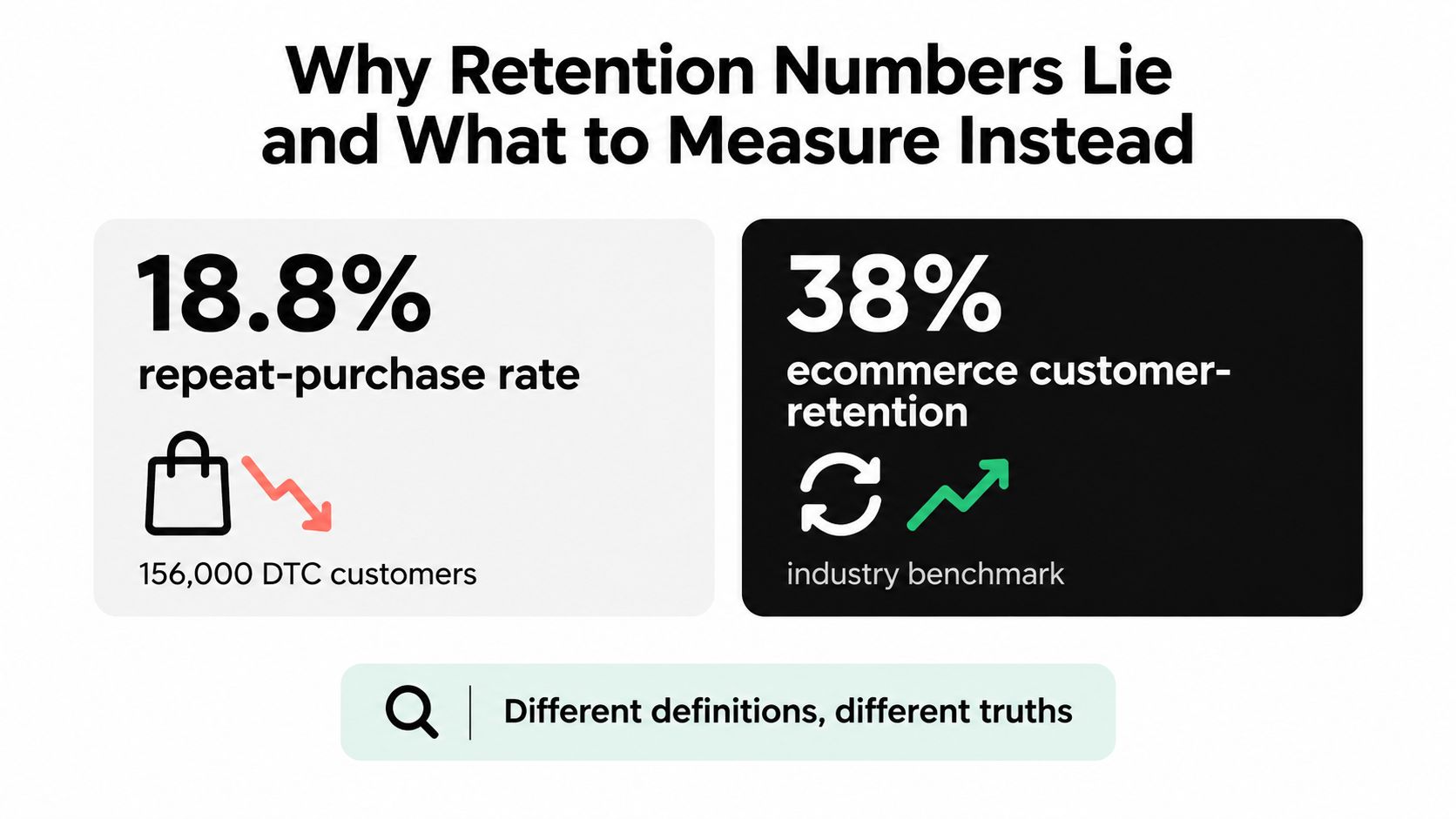
18.8% repeat-purchase rate is a very different story from a ~38% ecommerce retention benchmark, and the gap is exactly why shopify customer retention gets misread so often. One number can make a store look broken or healthy depending on how you define the cohort, the window, and the product.
For a Shopify merchant, the job isn't to chase a prettier percentage. It's to separate voluntary churn, involuntary churn, and revenue per cohort, then fix the failure mode that's leaking money.
Table of Contents
- Why Retention Numbers Lie and What to Measure Instead
- Instrumenting the Funnel from Product Page to Second Order
- Designing Loyalty and Rewards That Move Repeat Purchases
- Running Payment Recovery as an Involuntary Churn Control System
- Giving Customers a Self-Serve Portal That Actually Cuts Tickets
- Building Segmented Lifecycle Flows in Email and SMS
- Reading Cohorts and Closing the Loop on Churn
Why Retention Numbers Lie and What to Measure Instead
A single retention headline hides more than it reveals. Analysts at Shopify found an average 18.8% repeat-purchase rate in a large direct-to-consumer sample, while Shopify guidance cites a ~38% ecommerce customer-retention benchmark Shopify customer retention research. Those figures are useful only if you know which cohort, category, and time window they describe.
Category context changes the read. Consumable brands landed roughly in the 22% to 44% range, while fashion brands were generally around 10% to 17%. A coffee, skincare, or supplement brand should not benchmark itself against apparel and call the gap a retention problem.
Track the right unit of retention
The useful unit is first-to-second-order conversion. From there, cohort survival shows whether the issue is weak acquisition, poor onboarding, replenishment timing, payment failure, or product-market fit. A broad returning-customer rate folds all of those failure modes into one number and makes diagnosis harder than it needs to be.
Repeat buyers also need to be read as a revenue segment, not just a loyalty signal. A Shopify-focused analysis reports that repeat customers represented 21% of the customer base but generated 44% of total revenue and 46% of total orders repeat customer revenue analysis. That split is why retention work should be tied to the failure mode it fixes, whether that is voluntary churn, involuntary churn, or weak revenue per cohort.
If you are comparing retention frameworks across channels, SaaS customer retention strategies can help as a reference point, but Shopify merchants still have to account for replenishment cycles, checkout friction, and payment recovery.
Instrumenting the Funnel from Product Page to Second Order
The fastest way to misread retention is to celebrate first-order conversion as if it were proof of loyalty. A better baseline starts at the product page, follows the shopper through checkout, and then checks whether they make it to the second order. Baymard's benchmark of 344 large US and European ecommerce sites found a global average cart-abandonment rate of 70.19%, and its checkout research says roughly one in five users abandon because the process is too long or complicated Baymard checkout usability research.
That matters because checkout friction can look like a retention problem when it's really a conversion problem. If a discount pushes more shoppers into subscription opt-in but weakens margin or causes faster early cancellation, the store may look busier while the business gets worse. Instrumenting the funnel is how you catch that.
Build the baseline before changing a widget
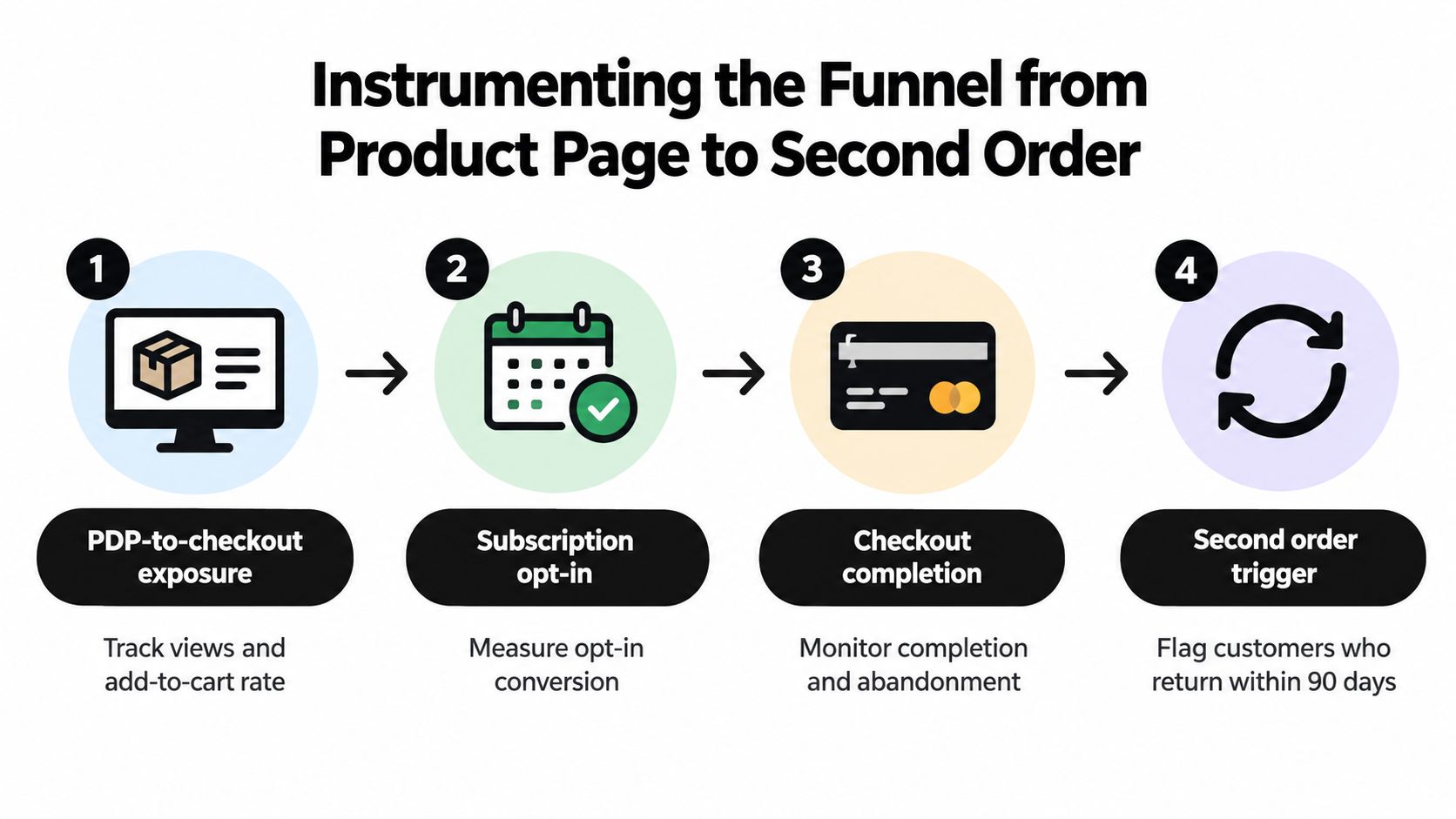
Start with the full path, not just the subscription toggle. Track PDP-to-checkout exposure, subscription opt-in, checkout completion, and second-order survival, then segment each metric by device and theme. If one theme converts better on mobile but underperforms on the second order, that's useful. It tells you the experience is winning the first click and losing the relationship.
A practical setup is to calculate cohort retention by first-order month, subscription interval, product, market, and acquisition source. Then compare the same cohort across at least one complete billing cycle before making a call. That prevents a short-lived promo spike from being mistaken for durable retention.
Here's the operational mistake I see most often, and it's expensive:
- Higher opt-in isn't the same as healthier retention. A lower-friction offer can raise starts while creating weaker commitment.
- More checkout completions aren't the same as more revenue quality. If AOV or contribution margin drops, the gain may be superficial.
- A shorter cancellation rate isn't always progress. Sometimes it means the wrong customers were pushed into the plan.
The useful outputs are cohort-level net revenue retention and gross churn, not just customer counts. If those move in opposite directions, the mechanics deserve a closer look, because the store may be buying growth with discount depth or unnecessary friction.
Designing Loyalty and Rewards That Move Repeat Purchases
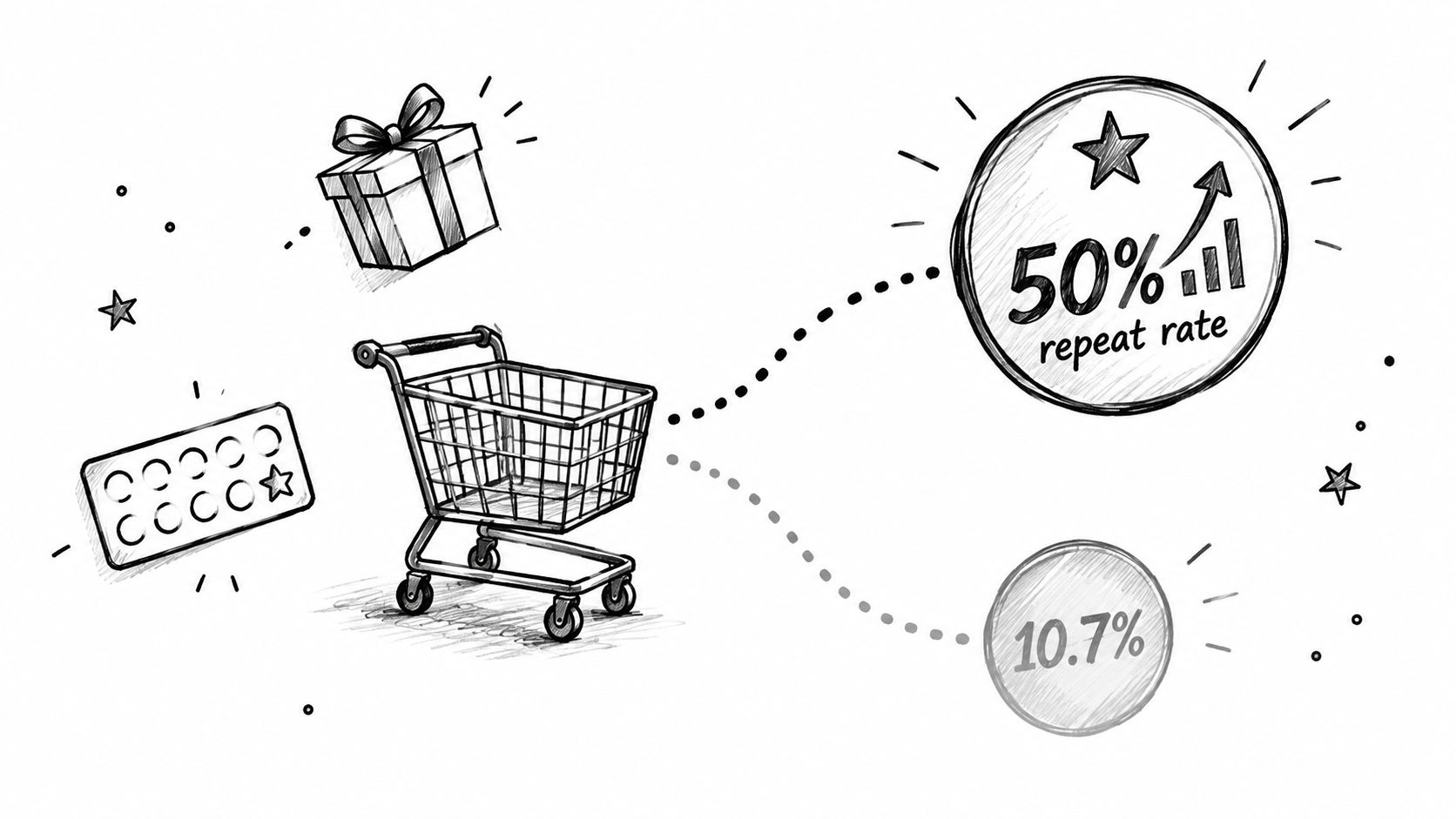
Loyalty programs work only when they change buying behavior. A Shopify-focused analysis found that loyalty-reward redeemers had a 50% repeat-purchase rate, compared with 10.7% for non-redeemers. The gap is large enough to matter, but it does not prove rewards caused the full lift.
The useful question is more specific. Which part of the reward system is helping the second order appear, and which part is just adding margin pressure?
Use rewards to reinforce the renewal path
For subscription-led stores, the strongest loyalty design usually follows the behaviors that already signal continuation. That includes points per renewal, VIP tiers, and milestone bonuses that reward customers after they have already shown repeat intent. Once a shopper is on a replenishment cycle, a well-timed reward can make that habit harder to break.
Redemption rules matter as much as earning rules. Store credit should fit the margin structure, not fight it. Stackable rewards can work, but only if shipping, discounts, and subscription pricing still leave room for profit. If rewards become the reason people only buy on sale, the program is training discount dependence.
For merchants comparing workflows, loyalty program tips from ECORN are useful alongside cohort data, especially when you are deciding how to handle reward visibility and redemption timing.
A loyalty program should answer one question, “What makes the next purchase easier or more valuable than the last one?”
The practical test is simple. Compare renewals and second orders for customers who redeem versus customers who do not, then check whether redemption improves retained revenue without eroding margin. If rewards only pull forward demand you would have gotten anyway, the program is acting like a subsidy, not a retention system.
If you want a concrete implementation reference, the subscription loyalty program playbook for Shopify is a useful companion for mapping rewards to renewal behavior in practice.
Running Payment Recovery as an Involuntary Churn Control System
A failed payment is usually a billing failure, not a loyalty problem. An industry summary cited failed-payment rates of 20% to 28% for ecommerce subscriptions, which puts payment recovery squarely in the involuntary churn bucket rather than the edge case bucket failed payment benchmarks.
One reminder email is not a recovery system. Real recovery needs state, timing, and clean reconciliation.
Build the decline state table first
Start with a decline-state table that includes failure code, retry eligibility, billing age, customer value, and payment-method geography. That table tells you whether the next action should be a retry, a card-update prompt, a localized message, or a pause. Without it, every customer gets the same message, and the team learns very little from the outcome.
A working recovery flow usually looks like this:
- Identify the failure state. Separate expired card data, insufficient funds, issuer decline, and blocked transactions.
- Send the right action. Use a one-click update link when the card is stale, and a retry sequence when the issue is timing.
- Reconcile before changing access. Subscription, invoice, and payment state should match before entitlement changes.
- Deduplicate webhook events. Idempotency matters because duplicate events can create false recoveries or duplicate-charge risk.
For teams building this in Shopify, RecurX supports decline-aware retry windows, dunning sequences through email, SMS, and WhatsApp, and one-click card-update links. Those features only help if the state logic is clean.
For a deeper walkthrough of dunning logic, see the failed payment recovery guide for Shopify.
The metric that matters is not just recovered payments. Track recovered recurring revenue divided by failed recurring revenue, then separate that from customers recovered, days to recovery, later renewal survival, and support contacts. That is the difference between durable retention and a temporary authorization reversal that looks good in the dashboard.
Aggressive retries can create new churn if they trigger issuer friction, complaints, or dispute handling.
Strong operators test retry windows by market, keep the messaging localized, and preserve grace-period access where the economics allow it. If recovery lifts in the short term but support contacts rise, the system is fighting the bank, not fixing churn.
Giving Customers a Self-Serve Portal That Actually Cuts Tickets
A good portal does two things at once. It reduces support load and gives customers a clean way to stay subscribed without opening a ticket. When that works, pause, skip, swap, and frequency changes stop being friction points.
The practical win is trust. A portal hosted on the merchant's domain, tied into native customer accounts, feels like part of the store instead of a detour into a third-party app.
Ship the controls customers actually use
For a supplements or coffee brand, the first version of the portal should handle pause, skip, swap products, change frequency, and update payment details. Those are the actions that keep a customer from leaving when the timing or product mix is off. If a shopper can solve the problem themselves, they're less likely to treat cancellation as the default path.
That said, not every request belongs in the portal. Delayed shipments, plan upgrades, and prepaid edge cases often still need a human review because they touch fulfillment rules or billing exceptions. A portal shouldn't pretend to replace support, it should remove the repetitive work that support never needed to do in the first place.
A useful shipping order is:
- Day one: pause, skip, swap, update card, change cadence.
- Next: cancellation reason capture and save offers.
- Later: edge-case routing for prepaid plans and complex order states.
The measurement is straightforward. Track ticket deflection on the repetitive requests, then watch whether customers who use self-serve controls stay active longer than customers who contact support first. If the portal reduces tickets but also increases cancellations, it's too aggressive or too confusing.
For a practical design reference, customer portal design guidance from RecurX fits well with merchant-domain account flows and the kind of self-service controls that subscription buyers expect.
Building Segmented Lifecycle Flows in Email and SMS
Lifecycle messaging works when it matches the customer's state, not when it blasts the same promotion to everyone. Browse, first order, fulfillment, renewal, pause, lapse, and win-back are different moments, and each one deserves a different message. The channel also matters, because the urgency of the ask should match the medium.
Email is best for education and follow-up. SMS is better for time-sensitive renewal nudges. WhatsApp can make sense in higher-LTV markets where the channel is already part of the customer's daily behavior.
Use tags to stop sending generic flows
Auto-tagging by status, plan tier, and behavior gives you the segmentation backbone for Shopify Flow and your email platform. Once the tags are in place, you can route customers into the right lifecycle branch without building a dozen disconnected campaigns. That means one flow for first-order education, another for renewal reminders, and another for lapse recovery.
A simple lifecycle matrix helps keep the logic tidy.
| Lifecycle Stage | Primary Channel | Message Type | Suppression Rule |
|---|---|---|---|
| Browse | Product education | Suppress if purchase happened | |
| First order | Setup and use guidance | Suppress if renewal email already sent | |
| Renewal | SMS | Time-sensitive reminder | Suppress after payment update |
| Lapse | Win-back and reason capture | Suppress if customer is already active again |
The discipline is in the suppression rules. Frequency caps keep deliverability healthy and prevent renewal nudges from becoming noise. If a customer receives a payment update email, a reminder SMS, and a win-back email in the same window, they'll stop reading all of them.
For campaign setup and segment logic, AI-powered CRM campaign help from CRAIM is a useful reference when you're mapping lifecycle events to channel behavior and trying to avoid duplicate sends.
Keep the testing cadence tight. Check engagement, suppression, and conversion together, because a flow that gets opens but weak renewals is still underperforming. The goal isn't more sends, it's fewer lost subscriptions.
Reading Cohorts and Closing the Loop on Churn
The clearest retention teams don't argue about one metric in isolation. They read MRR, churn by reason, LTV, ARPU, AOV, and cohort retention together, then decide which failure mode deserves attention first. That mix matters because recent subscription research reports average monthly churn around 20%, and 54% of surveyed U.S. businesses say more than 20% of their churn is involuntary subscription economy report.
That finding changes how budget should be allocated. If involuntary churn is a major share of the leak, loyalty campaigns won't fix it. Payment recovery, card updates, and cleaner decline handling deserve the first pass.
Make the weekly review about causes, not guesses
A strong weekly retention review has four moves:
- Pull churn by reason. Separate price/value, product experience, pause needed, failed payment, unrecognized charge, and bank block.
- Split voluntary from involuntary churn. They need different fixes and different owners.
- Compare recovery cohorts to a control. If the recovery flow is real, the no-intervention group should look different.
- Reallocate spend toward the highest-ROI lever. Don't keep funding tactics that only feel active.
That review should also surface the leaks hiding inside operations. If cancellation reasons cluster around payment failures, the fix is systems work. If they cluster around product fit, onboarding and education matter more. If they cluster around pause requests, the portfolio and cadence probably need adjustment.
A simple checklist keeps the next step obvious:
- Reason codes are missing.
- Involuntary churn isn't separated from voluntary churn.
- Recovery cohorts aren't benchmarked against a control.
- Renewal messaging isn't tied to plan tier or billing state.
- Self-serve options still create support tickets.
RecurX gives Shopify merchants the subscription analytics, payment recovery, customer portal, and cohort tooling to work this way instead of guessing from a single retention percentage. If you want to turn retention into a diagnostic system instead of a vanity metric, visit RecurX and see how it fits into your Shopify workflow.
shopify customer retention · shopify loyalty · subscription retention · dunning strategy · cohort analysis
Keep reading
- Buy a Subscription the Smart Way: A Complete How-To GuideLearn how to buy a subscription with confidence. Discover what to check before paying, how recurring billing and cancellation really work, and how
- How to Curate Subscription Boxes That Actually ConvertLearn how to curate subscription boxes that retain customers, with practical steps on product selection, bundling, pricing, and fulfillment for Shopify stores.
- Shopify Subscription Sales: A Practical 2026 PlaybookGrow Shopify subscription sales with a 2026 playbook on plan design, storefront widgets, checkout links, Build-a-Box, dunning, migrations, and retention
Start growing recurring revenue on Shopify
RecurX has a 14-day free trial and zero transaction fees on every plan. Install in minutes.
Start your free trial →