How Do Loyalty Points Work? Rates and Redemptions
How do loyalty points work? See earn rates, 100 points = $1 redemptions, expiry, stacking with subscription discounts, and the LTV effect.
How do loyalty points work? See earn rates, 100 points = $1 redemptions, expiry, stacking with subscription discounts, and the LTV effect.
Loyalty points are deferred reward units earned on spending, renewals, referrals, or milestones, then exchanged later at a published rate such as 100 points equals $1. You earn a balance first and use it for a reward later, rather than receiving an immediate price reduction.
You might be looking at a checkout message promising points on your next coffee subscription, wondering what they're worth. Or you might be the merchant deciding whether that promise will bring customers back without eating through your margin. Both questions start with the same requirement: a clear exchange rate and a reliable record of what's been earned and spent.
Table of Contents
- How Loyalty Points Turn Spend Into Dollars
- The Points Ledger, Expiry and Breakage
- Store Credit Versus Discounts and Free Rewards
- A Four Renewal Subscription Points Example
- How Points Change Retention and Lifetime Value
- Set a Points Rate You Can Explain and Afford
How Loyalty Points Turn Spend Into Dollars
Say a shopper places a $50 order in a hypothetical program that awards 1 point per dollar. They earn 50 points, not a discount on that purchase. If they eventually accumulate 500 points, they can exchange those points for $5 in store credit under the program's published conversion rule.
Two linked rates make that calculation possible:
- The earning rate tells customers how quickly they accumulate points through qualifying actions.
- The redemption rate tells them what their accumulated points can buy.
Keep those rates separate. A merchant can increase the points awarded for a renewal without changing the value of every point already sitting in customer accounts.
Read the rate before the reward
The following is an illustrative program, not a universal set of loyalty rules. Every positive award uses the same fixed conversion, so its store-credit equivalent is the points balance divided by 100.
Sample earn and redeem values at 100 points = $1
| Action | Points | What it means |
|---|---|---|
| Spend $1 | 1 | About 1% back if this is the only earn rule |
| Place a $50 order | 50 | Same 1 point per dollar, no bonus |
| Successful subscription renewal bonus | 100 | Flat award after payment captures, on top of spend points |
| Referral | 200 | One-time earn, not a price cut on the referred order |
| Fifth-order milestone | 500 | Threshold bonus after a defined order count |
| Redeem 500 points as store credit | -500 | Balance falls by 500; credit applies at a later checkout |
Read the rows as different events in one account. The spending rows describe the base earning rule; the renewal, referral, and milestone rows add conditional bonuses. The redemption row subtracts points rather than creating another award.
Under these example rules, the referral has $2 of potential store-credit value, and the milestone has $5. Neither is cash paid to the customer, and neither necessarily reduces the price of the action that earned it.
Make progress understandable
Points give shoppers a visible target without requiring merchants to reduce every transaction's price immediately. For context on why visible progress and anticipated benefits can influence participation, Quikly's explanation of the psychology of customer rewards is a useful companion to the arithmetic.
The mechanism is familiar across markets, though preferences differ: a 2024 BCG survey of more than 10,000 consumers across nine countries found points, cashback, and promotions among the top five loyalty benefits for 85% of North American respondents, 75% of Europeans, and 55% of Asia-Pacific respondents.
Transparency test: A shopper should be able to explain both how points accumulate and what they can exchange them for without contacting support.
The Points Ledger, Expiry and Breakage
Breakage is the share of issued points that will never be redeemed. It isn't the same as today's unused balance, because customers may still redeem points that remain valid. Earning a point creates potential future value, not proof that a reward has been claimed.
Think of the system as a digital punch card with a dated transaction history. The merchant adds points after qualifying events, subtracts them when customers redeem, and records reversals or expiration separately.
Follow each event through the account
Earn triggers can include qualifying spending, a captured subscription renewal, a validated referral, an eligible social share, or a paid-order milestone. Each trigger needs a precise definition so the same action doesn't accidentally generate duplicate awards.
For renewals, post points after payment captures, not when an invoice is scheduled. Reverse the associated award if the payment is refunded or charged back. An order number, payment reference, and earn-rule identifier help support teams explain each adjustment.
The ledger flow makes those distinctions visible.
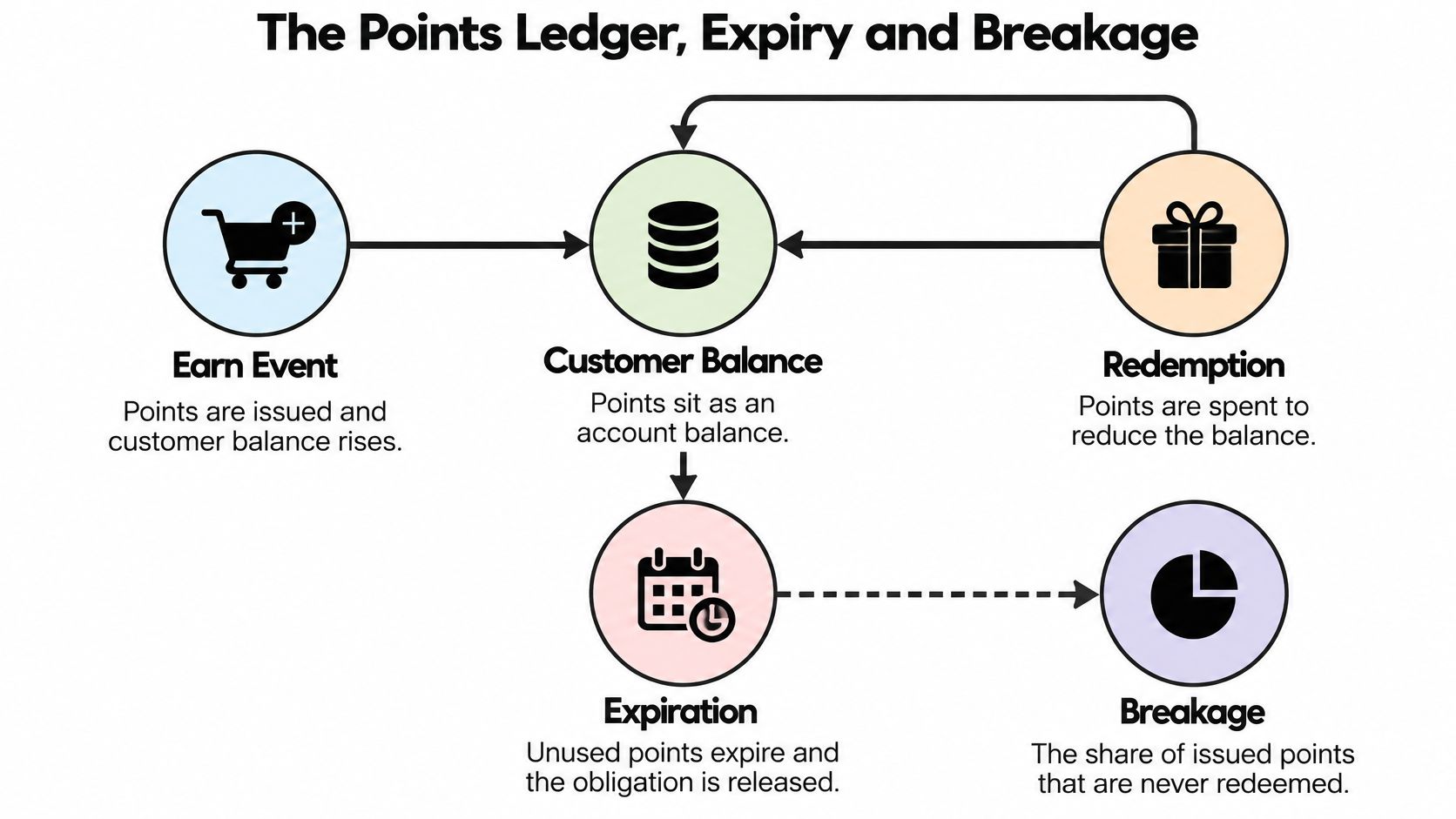
Keep the reporting categories distinct:
- Issued records points created by the program.
- Earned identifies customer awards that have satisfied the eligibility conditions. Document whether pending awards count as issued.
- Redeemed records points exchanged for benefits.
- Expired records points removed under a disclosed expiration rule.
- Breakage estimates or measures the portion that ultimately goes unredeemed.
Separate customer value from merchant liability
A practical forecasting model is loyalty liability = outstanding points × expected cost per redeemed point × expected redemption rate, reflecting the factors described by Milliman's explanation of loyalty-program liabilities. Customer-facing reward value and merchant fulfilment cost aren't necessarily identical, especially for product rewards.
Under IFRS-style treatment, part of the original transaction may be allocated to the points obligation rather than recognized immediately as product revenue. Treat the formula as a planning model, not a substitute for your accountant's revenue-recognition policy. Overestimating redemption can overstate the reserve, while underestimating it can leave the merchant facing unexpected reward costs.
A 2025 EY loyalty-market study, summarized in Smile's loyalty-program statistics compilation, found brands most commonly estimated reward redemption at 41%–60%, while the most frequently reported point-breakage range was 31%–40%. Those are reported ranges, not assumptions every new program should adopt.
Set expiration deliberately
Expiration can reduce outstanding obligations, but customers lose usable value when their points disappear. In Antavo's Global Customer Loyalty Report 2025, 40.7% of global loyalty-program members wanted points not to expire.
Publish whether expiration follows issuance, inactivity, or another event. If converted rewards have a separate deadline, show that deadline too, and send reminders before balances become unusable.
Track issuance cohort, expiration date, earn trigger, and redemption channel. Reconcile those records with outstanding balances, reward fulfilment, and payment reversals rather than relying solely on the number displayed in the customer portal.
Store Credit Versus Discounts and Free Rewards
A shopper can exchange points for several benefits that look similar on a rewards page but behave differently at checkout. Store credit, a discount coupon, a free product, and free shipping create different costs and restrictions.
For subscriptions, distinguish the agreed plan price from the loyalty benefit.
Subscription pricing stays the price of the plan. Redeemed points provide a separate credit or reward on top, subject to the published stacking rules; they don't rewrite the plan's discount.
Compare what the customer actually receives
The table describes possible program designs, not mandatory checkout behavior. Coupon combination settings and reward restrictions must match the terms customers see.
Redemption forms and how they sit on a subscription price
| Reward | Member experience | Stacks with plan discount | Forecast difficulty |
|---|---|---|---|
| Store credit at a fixed rate | Partial use at the next checkout, leftover points stay | Yes, as a separate balance on top of plan price | Low when 100 points always equals $1 |
| Percent-off coupon | One order only, balance often cleared when exchanged for the coupon | Only if allowed under a defined combined-discount cap | Medium, order timing and value are uneven |
| Free product | A specific SKU, subject to stock | Independent of the percent off | Medium, cost is goods and fulfilment, not face value |
| Free shipping | Useful only if freight would have been charged | Often stacks when checkout rules allow | Low for predictable shipping costs; no added value on free-shipping orders |
| Ongoing VIP tier price | A standing lower price, not a one-time redemption | Replaces or stacks only by an explicit rule | High, because the reduction continues while eligibility remains |
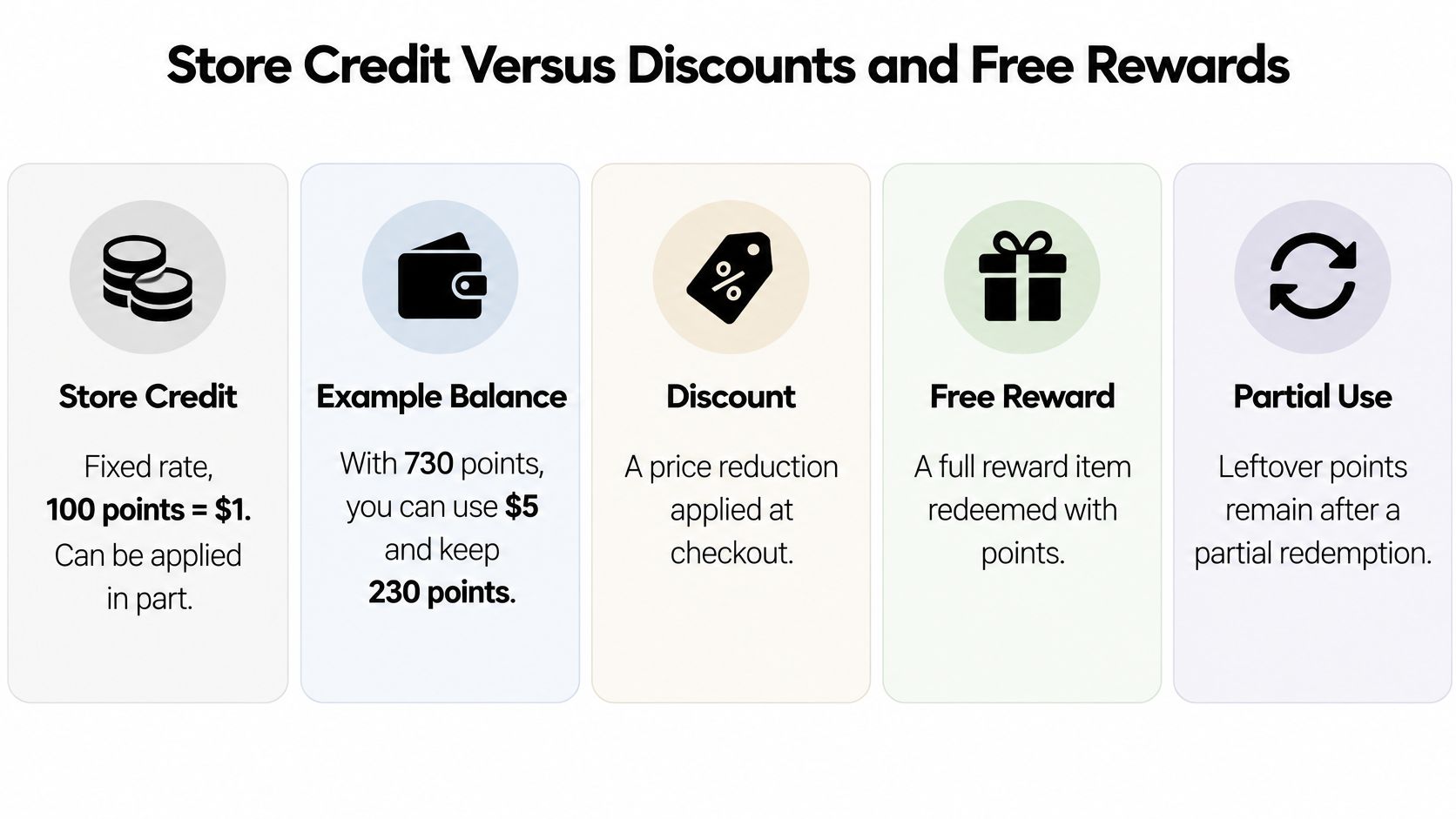
For an illustrative partial redemption, a member with 730 points could exchange 500 points for $5 and retain 230 points. That only works if the program permits that redemption amount and leaves the unused balance intact.
The comparison below shows why a balance, a coupon, and a product reward shouldn't be described interchangeably.
Predictability versus aspirational value
Research summarized by the American Marketing Association finds that customers are less likely to redeem when the money-to-points exchange rate is variable rather than fixed. When customers expect a better-value option later, they may keep saving.
A reward catalog can still be useful, particularly for members who want special products. But show the points required for each item and avoid implying that all options offer the same monetary value.
Merchants should also distinguish store-bound rewards from cashback rewards. A benefit usable only with the issuing store shouldn't be presented as unrestricted cash.
Before launching, test reward selection, partial use, checkout application, and the remaining balance. If customers must exchange points manually before a subscription bills, explain that step before the renewal, not after the charge.
A Four Renewal Subscription Points Example
Consider a hypothetical coffee subscriber named Maya. Her monthly plan has a $30 list price and a 10% subscribe-and-save discount, making the normal charge $27 before any loyalty credit.
Her example program awards 1 point per dollar charged, plus 100 points after each captured renewal. She can redeem points at 100 points = $1 of store credit, with partial redemption allowed. A separate 500-point milestone bonus becomes available on her fifth paid order, so it doesn't enter the four-renewal calculation.
Establish the billing sequence
For this scenario, the merchant applies any selected store credit before charging the saved payment method. Spend points follow the amount charged, excluding the credit-funded portion. These are example program rules, not a universal definition of eligible spending.
This process illustration shows how the plan price, renewal award, and spending award fit together.
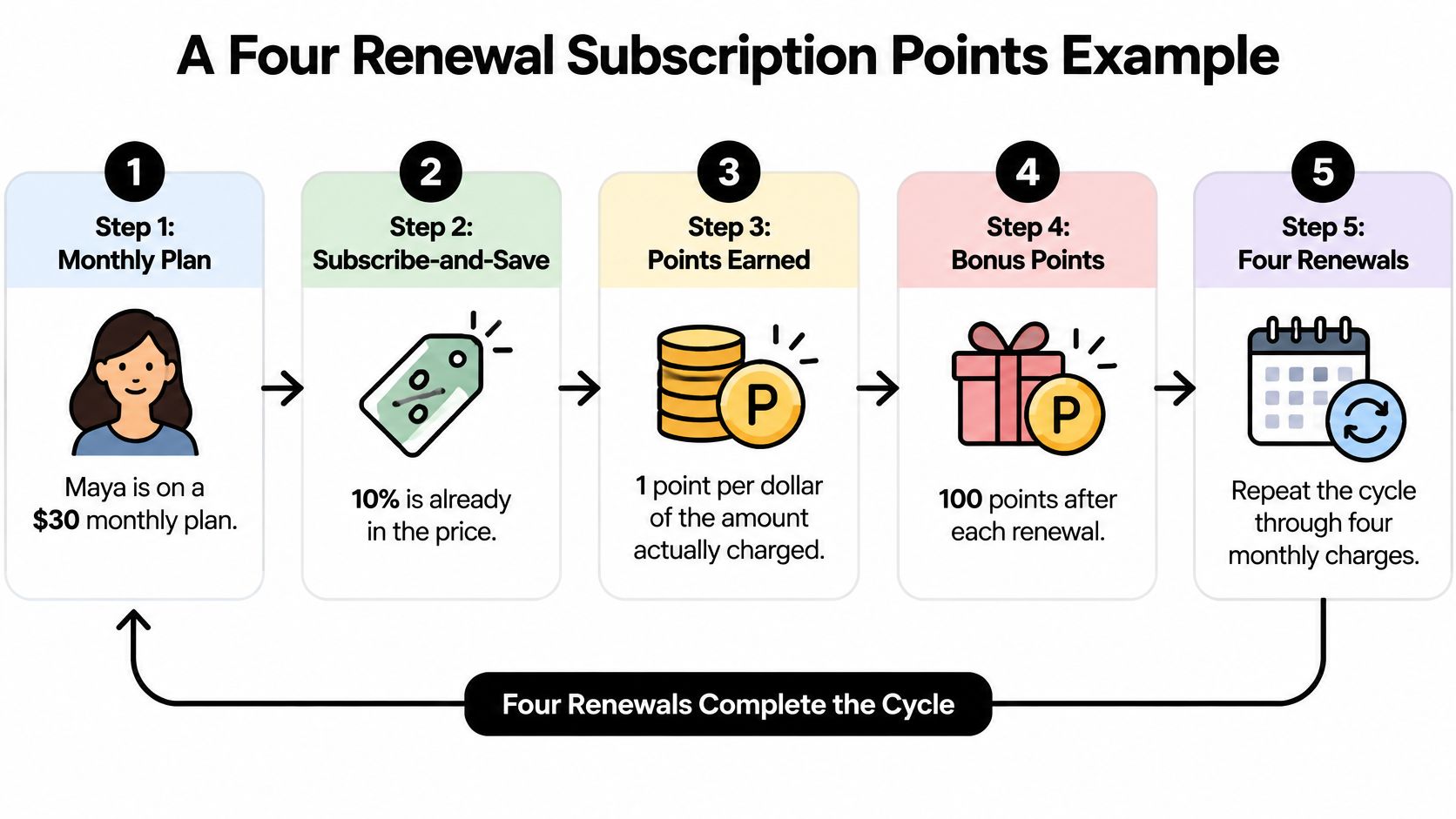
In month 1, Maya's payment captures at $27. The merchant posts 27 spend points plus 100 renewal points, giving her 127 points.
In month 2, another successful $27 payment earns the same 127 points. Her running balance becomes 254 points.
Maya's running points balance by month
| Month | Balance after |
|---|---|
| Month 1 | 127 |
| Month 2 | 254 |
| Month 3 | 179 |
| Month 4 | 306 after the retry captures |
Apply the credit without changing the plan
Before month 3 bills, Maya redeems 200 points for $2 in store credit. Her points balance falls to 54, and her payment charge becomes $25. The subscription's 10% discount hasn't changed; the separate credit reduces what remains payable.
After that payment captures, she earns 25 spend points plus 100 renewal points. Her closing balance is therefore 179 points.
In month 4, the initial payment fails. Maya earns nothing from that attempt. When the retry successfully captures the normal $27, the merchant posts 127 points, bringing her balance to 306.
Reconciliation check: Closing balance equals opening balance plus posted awards, minus redemptions, expirations, and reversed awards.
If the merchant refunds the month-four retry, it removes that cycle's 127 points, returning Maya to 179 points, assuming no other activity. A paused month also earns nothing because there's no captured renewal.
Cancellation needs its own disclosed rule. For this hypothetical program, Maya keeps her existing balance under the ordinary expiration terms after cancellation, but she stops earning renewal awards. The merchant tells her this before her first renewal rather than inventing a cancellation rule afterward.
When implementing a subscription loyalty program on Shopify, test this entire sequence against payment and reward records. Supplements, skincare, and pet-food subscriptions use the same reconciliation approach: the product changes, but the account still needs to balance.
How Points Change Retention and Lifetime Value
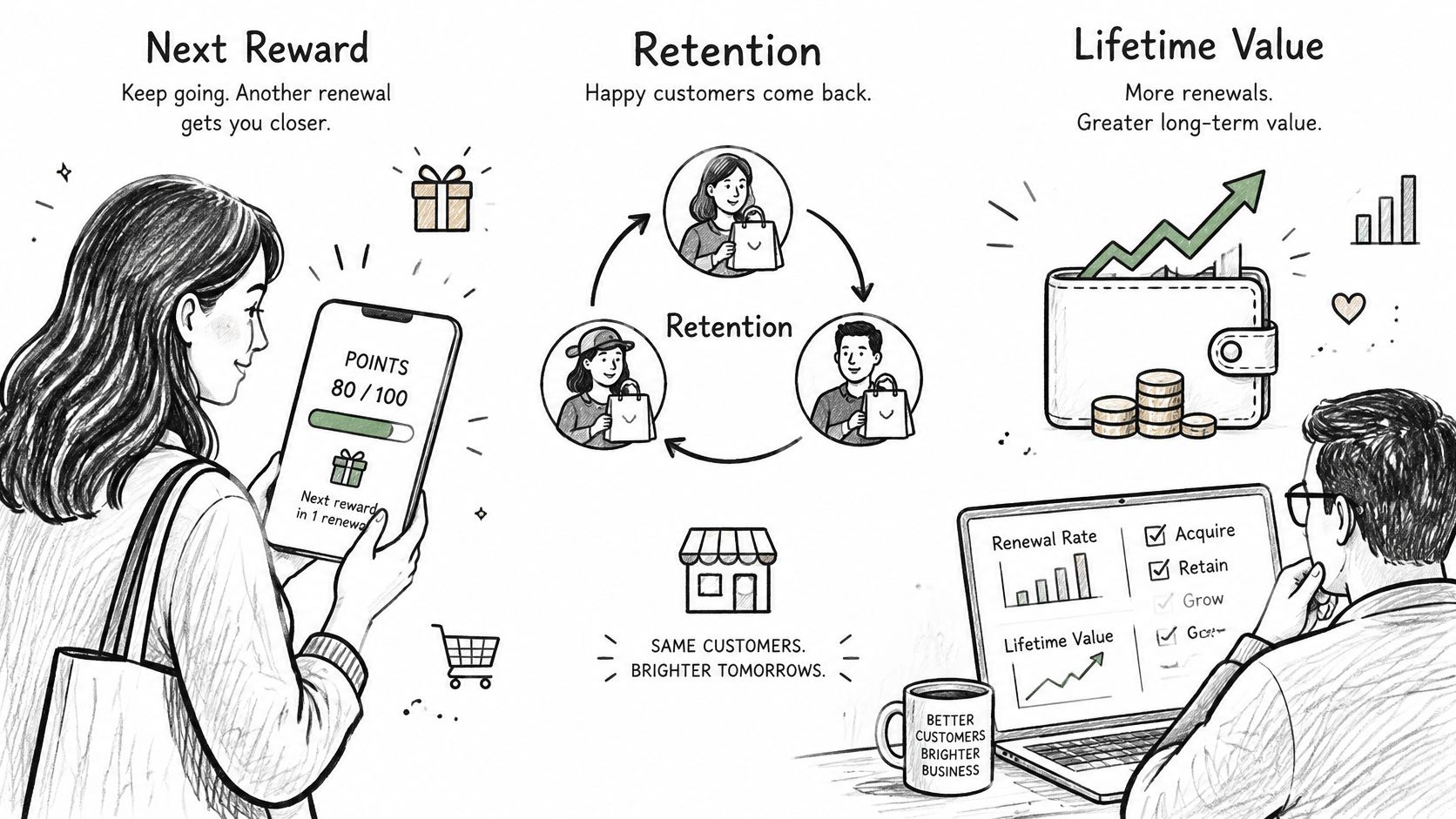
Consider a subscriber who stays longer because the next reward feels useful and attainable. The merchant benefits only if the additional contribution from those purchases exceeds the program's incremental costs, including redeemed rewards, fulfilment, and administration.
That's the practical connection to customer lifetime value. More renewals don't automatically mean more profit, especially when a merchant has layered loyalty rewards onto an already-discounted subscription.
The illustration highlights the relationship between repeat participation and long-term value, without guaranteeing a performance lift.
Measure behavior, not just enrollment
A visible next reward may give a subscriber a reason to continue. A usable redemption lets the customer experience the promised benefit. But a large balance that never becomes useful may indicate confusion or unreachable thresholds rather than loyalty.
Track cohorts using checks that separate participation from outcomes:
- First redemption participation: What share of members has used a reward?
- Purchases after redemption: Do customers keep buying once they've claimed the benefit?
- Churn near expiration: Do cancellations or support complaints cluster before balances expire?
- Incremental lifetime value: How do comparable members perform after accounting for reward costs?
Don't assume redeemers stayed longer because they redeemed. Customers who already intended to buy repeatedly may be more likely to earn enough points in the first place. Compare customers with similar starting behavior, and use a controlled rollout where practical.
The embedded video offers another format for considering the topic.
Ease of use has to survive checkout
Research published by Digitas and Fetch ahead of holiday 2025 found that 87% identify ease of use as critical, while 40% have abandoned programs when rewards take too long to earn. A generous advertised award won't fix an awkward redemption process.
Let members see eligible rewards before renewal, understand how to apply them, and confirm the result afterward. Where automatic application is supported, make the customer's choice and the resulting charge visible.
Keep recurring VIP discounts separate in your profitability analysis. A standing lower price affects every eligible future order, whereas a redeemed credit is a discrete event.
Personalization also has a boundary. Reward the renewal without demanding unrelated personal information, explain why each requested field is needed, and don't make basic redemption conditional on unnecessary data sharing. Customers should understand the value exchange as clearly as they understand the points exchange.
Set a Points Rate You Can Explain and Afford
The best starting design is one your customer can understand and your finance team can reconcile. Add complexity only when it serves a defined purpose, such as rewarding consecutive paid renewals or recognizing a meaningful milestone.
Complete the launch checks
Publish the base rules. State the earning rate and redemption value together. Define eligible spending, bonus triggers, posting time, and whether taxes, shipping, or credit-funded purchases qualify.
Choose a default redemption. Fixed-value store credit is a straightforward starting point when you want customers to use part of a balance. Confirm how that credit interacts with subscription billing and coupon restrictions.
Make the first reward reachable. Test how long an ordinary subscriber would wait, not just your highest-spending customer. Show upcoming expiration clearly and send reminders rather than surprising members with an empty account.
Model several cost scenarios. Use conservative, central, and higher-redemption assumptions based on your own customers as evidence develops. Include renewal bonuses, fulfilment costs, refunds, and chargebacks rather than budgeting only for base spending awards.
Review the obligations. Check applicable consumer-protection requirements and agree on the accounting treatment before relying on expiration or breakage. Keep the customer terms, operational ledger, and finance reports consistent.
Test before awarding live points
Run the worked subscription scenario by hand, then reproduce it in a test workflow. Check a successful renewal, partial redemption, failed payment, recovered payment, refund, pause, and cancellation. Have someone outside the implementation team explain the resulting balance using only the customer-facing terms.
For Shopify merchants, our RecurX loyalty tools include automatic renewal points, configurable spending, referral and social-share earn rules, VIP tiers, milestone bonuses, and store-credit redemption that stacks on top of plan pricing.
Put your earning and redemption rules into practice with a subscription ledger customers can understand. Visit RecurX to explore built-in subscription loyalty, then configure your rewards and test the full renewal-to-redemption journey before launch.
how do loyalty points work · loyalty points · points redemption · store credit · customer retention
Keep reading
- 8 Shopify Flow Examples Subscription Merchants Can Copy8 practical Shopify Flow examples for subscription stores, with triggers, conditions, and actions for tagging, dunning, churn rescue, and loyalty.
- Customer Winback Strategies: 8 Proven Tactics for 2026Discover 8 customer winback strategies to recover lapsed subscribers, from dunning and card-update links to save flows, loyalty rewards, and SMS sequences.
- Shopify App Charges Explained: Billing Types and CostsLearn how Shopify app charges work: subscription, usage and one-time fees, billing cycles, pricing models and how to check your bill.
Start growing recurring revenue on Shopify
RecurX has a 14-day free trial and zero transaction fees on every plan. Install in minutes.
Start your free trial →