Customer Winback Strategies: 8 Proven Tactics for 2026
Discover 8 customer winback strategies to recover lapsed subscribers, from dunning and card-update links to save flows, loyalty rewards, and SMS sequences.
Discover 8 customer winback strategies to recover lapsed subscribers, from dunning and card-update links to save flows, loyalty rewards, and SMS sequences.
Your churn report spikes on a Monday morning and your first instinct is product. Customers must be unhappy, bored, or finding something better. Sometimes that's true. Often it isn't. A card expired. A pantry shelf filled up. A pay cycle got tight, a trip disrupted a routine, or a subscriber forgot to reorder before running out.
That's why effective customer winback strategies start with diagnosis, not discounting. Treat every lapsed customer the same and you'll send a coupon to someone who needed a card link, a reminder to someone who needed a smaller box, and a sales pitch to someone who needed a break. You'll spend margin without fixing the cause.
The timing also matters more than many assume. An analysis summarized by Silver Spoon Agency found that 45% of winbacks occurred within 30 days of churn and 66% within 90 days, across 3,974 companies and 4.78 million returned customers. Wait for a quarterly campaign and you've missed the window when intent is warmest.
The eight tactics below are organized by why the customer left. Match the tactic to the cause, trigger it from the event itself, and measure whether the customer stays after returning. Reactivation without a second renewal isn't a win. It's a discounted order with extra reporting.
Table of Contents
- 1. Pause-Instead-of-Cancel Reactivation
- 2. Cancellation Save Flow with Reason-Based Offers
- 3. Involuntary Churn Recovery via Dunning and Card-Update Links
- 4. Loyalty Points and Milestone Reactivation Rewards
- 5. Multi-Channel Lapsed Customer Campaigns (Email, SMS, WhatsApp)
- 6. Quick Checkout Links and QR Codes for Reorder Campaigns
- 7. Predictive Churn Segmentation and Triggered Winback Journeys
- 8. Product Reintroduction and Build-a-Box Reconfiguration
- How the eight customer winback strategies compare at a glance
- Build a Winback Plan Around the Reason Customers Left
1. Pause-Instead-of-Cancel Reactivation
Say a supplement subscriber has three unopened jars in a cabinet. She doesn't dislike the product. She dislikes another box arriving this week. If cancel is the only visible option, she'll cancel, and you'll spend money later trying to win back a customer who only needed time.
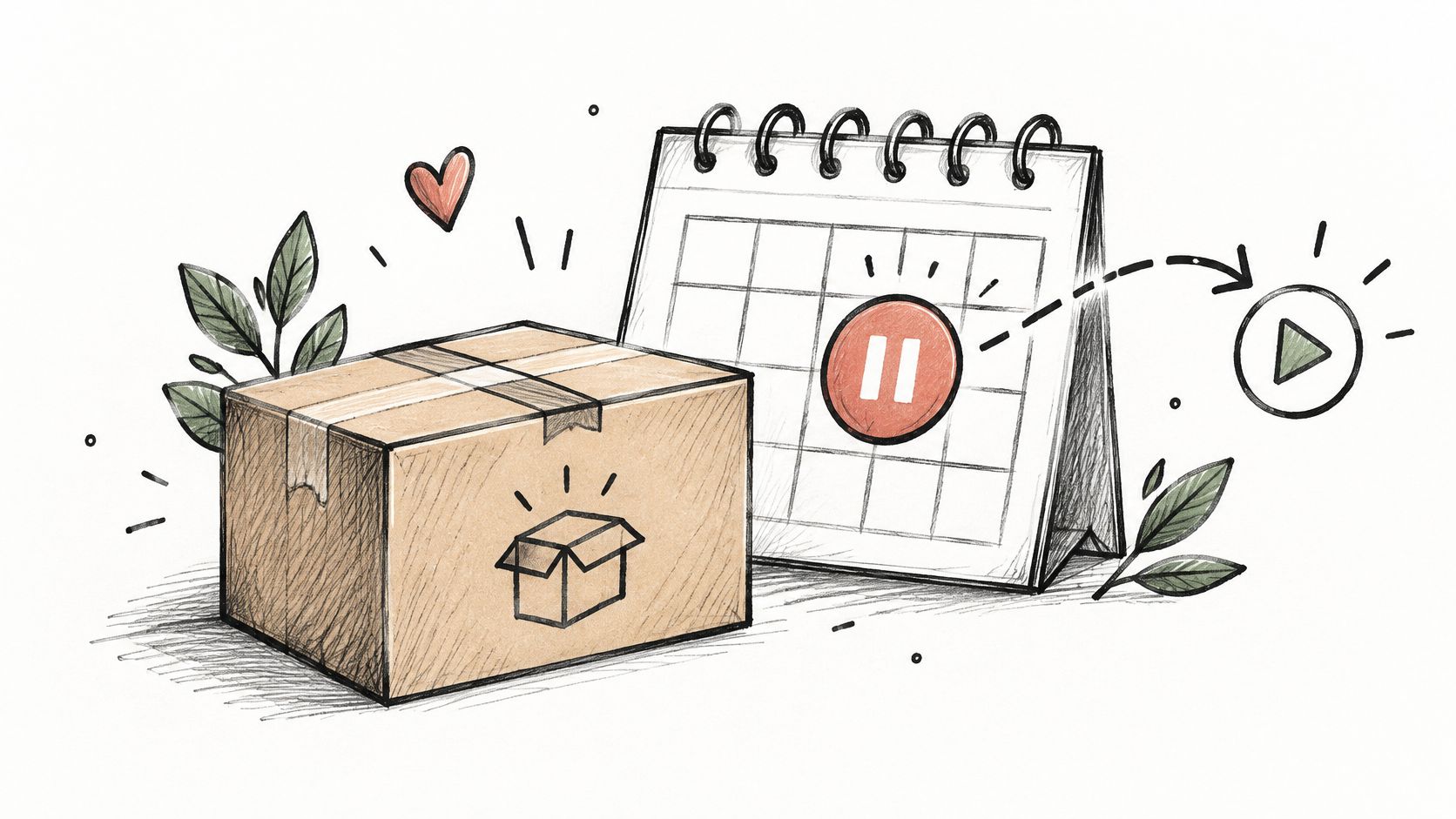
Pause and skip solve that problem before it becomes churn. Offer pause as a named option on the cancellation screen, placed before the final cancel button. Let customers skip one delivery, pause for a set period, change frequency, or swap products in the same self-serve portal. Amazon Subscribe & Save lets customers skip deliveries and change frequency without cancelling, and Audible and Peloton have offered membership pause options as an alternative to cancellation.
Set a resume date, not an open-ended pause
Limit pauses to 30, 60, or 90 days and send a reminder a few days before resumption so the next shipment isn't a surprise charge. Ask why they're pausing. Travel, overstock, and budget each deserve a different resume message. Someone pausing for overstock may need a longer interval permanently, not just a delayed box.
Track resume rate by pause duration in cohort analytics. If short pauses resume well and long pauses don't, shorten the default and add a check-in before the end date. Customers also need a clear path to cancel or update recurring shipments without hunting through support pages.
Practical rule: A paused subscriber still has an account, a payment method, and a scheduled return. A cancelled subscriber has none of those advantages.
The trade-off is short-term revenue delay. Accept it. Delayed revenue from a retained subscriber is worth more than a forced shipment followed by a chargeback, a support ticket, and a permanent exit.
2. Cancellation Save Flow with Reason-Based Offers
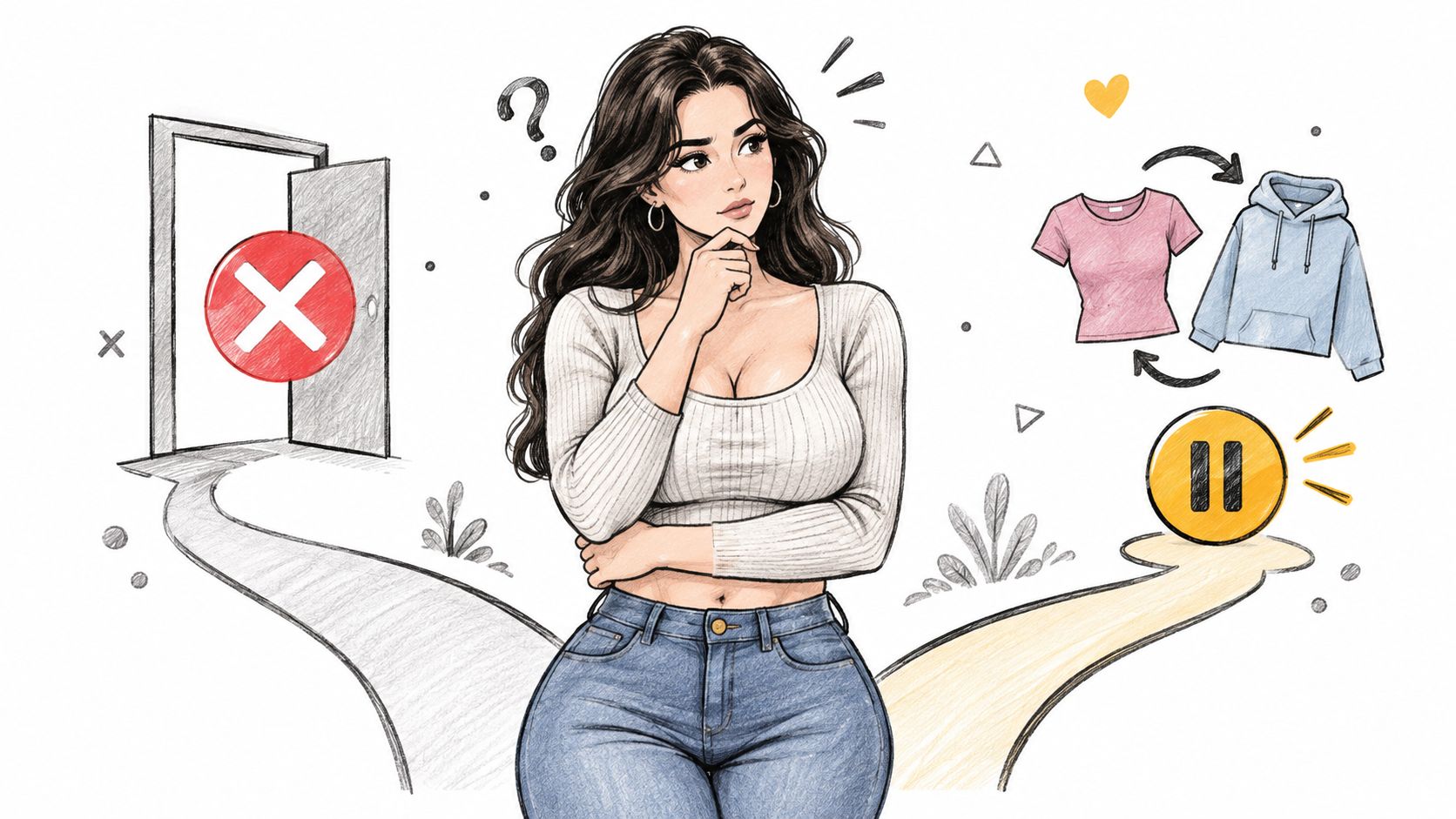
Don't guess at the cancellation screen. Ask one question, route by the answer, and keep the whole flow to two or three steps. A customer who selects "too much product" needs a frequency change or product swap. A customer who selects "too expensive" may need a smaller box, a lower-cost plan, or a limited incentive. A dissatisfied customer needs service recovery, not a louder coupon.
This distinction matters because cancellation is often temporary. The Mastercard subscription economy report finds that 31% of consumers frequently cancel and resubscribe, which means many exits aren't final rejections. Streaming and meal-kit services commonly present pause or plan downgrade options at the point of cancellation for exactly this reason.
Match the offer to tenure and reason
- Too much product: Offer skip, longer intervals, or a smaller quantity before any price cut.
- Price pressure: Offer a downgrade or bundle change first, then a measured incentive if tenure justifies it.
- Product fit: Offer a swap to a different flavor, formula, or routine step.
- Service problem: Route to support with a clear fix and follow-up, not a generic offer.
A well-built subscription cancellation flow records the reason even when the save fails. That data feeds later winback copy. Use Shopify Flow to tag customers who accepted a save offer so you can monitor them separately. Review save rate and post-save retention monthly. A save that churns at the next renewal is margin leakage, not retention.
Keep the exit honest. Customers comparing how easy canceling a car wash membership feels against other subscriptions notice dark patterns quickly, and trapped customers rarely return.
3. Involuntary Churn Recovery via Dunning and Card-Update Links
A failed payment is a billing problem, not a decision to cancel. Keep it on a separate recovery track from voluntary churn. Benchmark evidence summarized by Stay AI indicates failed payments can account for roughly 20–40% of subscription churn. Treating these customers as ordinary lapsed buyers risks sending promotions to people who never chose to leave.
Start dunning as soon as a payment fails, rather than waiting for the final retry. Keep the message direct: “Your payment didn't go through. Update your card to keep your delivery on schedule.” Include a one-tap card-update link in every email, SMS, and WhatsApp message. Requiring a customer to log in and search for billing settings adds friction when a shipment is at risk.
Segment by decline type before you retry
- Expired card: Prioritize the update link instead of retrying credentials that are no longer valid.
- Insufficient funds: Schedule retries around typical paydays for your audience.
- Soft decline: Space retries and increase reminder reach across channels.
- Authentication required: Prompt the customer to complete verification.
Pause promotional winback messages while recovery is active. Offering a discount during dunning can associate a failed card with a deal and blur your results. Track failed renewal rate, recovered invoices, recovered recurring revenue, and net involuntary churn as a funnel, not just message opens.
RecurX includes payment recovery on both plans, with decline-aware retry windows, dunning sequences by email, SMS, and WhatsApp, and a one-tap card-update link in every message. Use the guide to reducing involuntary churn to shape the recovery flow. Keep the sequence focused on restoring payment access; discount-based winback belongs to a different churn cause.
4. Loyalty Points and Milestone Reactivation Rewards
A lapsed customer with unspent points doesn't need a new discount. She needs a reminder that she already earned something. That's a different message, and it costs you less because you're activating an existing balance instead of inventing a fresh incentive for everyone.
This gap is wider than most brands realize. Reporting by InternetRetailing on a 2025 survey of 1,000 consumers in the U.S. and Europe found that 89% cite value for money as the main reason for trying subscriptions, yet only 30% report access to a loyalty program. If you've built points and tiers, use them as a reactivation asset before reaching for percentage-off offers.

Build the return around earned value
Send lapsed subscribers their actual points balance or store credit with a specific product it can cover. Set expiry reminders so customers return before rewards lapse, and be explicit about the date. Tiered programs in retail commonly use points expiry as a reactivation trigger because the deadline is real, not manufactured urgency.
For stronger accounts, offer a milestone bonus tied to staying, not just returning. A bonus across the next few renewals rewards the behavior you want, which is a second and third order, not one discounted checkout. Say a coffee subscriber returns for store credit and earns extra points on her next renewals. She has a reason to stay past the first bag.
Check the stacked math before you launch. Loyalty credit plus plan pricing plus free shipping can quietly erase contribution margin on the return order.
Measure return orders after incentive cost, fulfillment, and payment fees. If a loyalty segment returns once and disappears, tighten the reward toward future renewals instead of increasing the headline offer.
5. Multi-Channel Lapsed Customer Campaigns (Email, SMS, WhatsApp)
Some customers didn't hate your product. They drifted. A replenishment reminder tied to their prior product and expected usage interval will outperform a generic "we miss you" blast because it answers a practical question: am I about to run out?
Build the sequence around the event, then escalate channels carefully. A workable structure is an email at day 7 featuring the most-purchased product, an SMS at day 21 with a one-click reorder link, and a final email at day 45 with a service option or tested incentive. Keep the whole sequence to three to five touches and stop when it ends.
Let customers hear from you on the channel they chose
Use SMS and WhatsApp only for customers who opted in. Orchestrate the flow in Klaviyo, Mailchimp, or Omnisend using subscription status and tags, and compare channel performance by segment instead of judging the sequence as one blended number. SMS often wins on speed for time-sensitive reorders. Email gives you room to explain a product change or new bundle.
Benchmark reporting summarized by Shno places average automated reactivation at roughly 12–18% of lapsed customers. Treat that as context, not a target to chase with deeper discounts. Your primary metric should be incremental reactivation margin against a no-offer control, tracked through the second renewal.
- Day 7 email: Personal reminder with the previous product and a restart link.
- Day 21 SMS or WhatsApp: Short reorder prompt for opted-in customers.
- Day 45 email: Reason-matched offer, pause restart option, or product swap.
- Exit point: Suppress non-responders from further winback touches and protect deliverability.
Say a pet brand notices a customer whose food should be running low. A short message naming the exact formula and delivery size will do more work than a brand story and a coupon code.
6. Quick Checkout Links and QR Codes for Reorder Campaigns
Every extra step between intent and checkout loses return customers. A lapsed subscriber who clicks a winback message already knows your product. Sending her to a product page to rebuild the same plan she had before is friction you've chosen to keep.
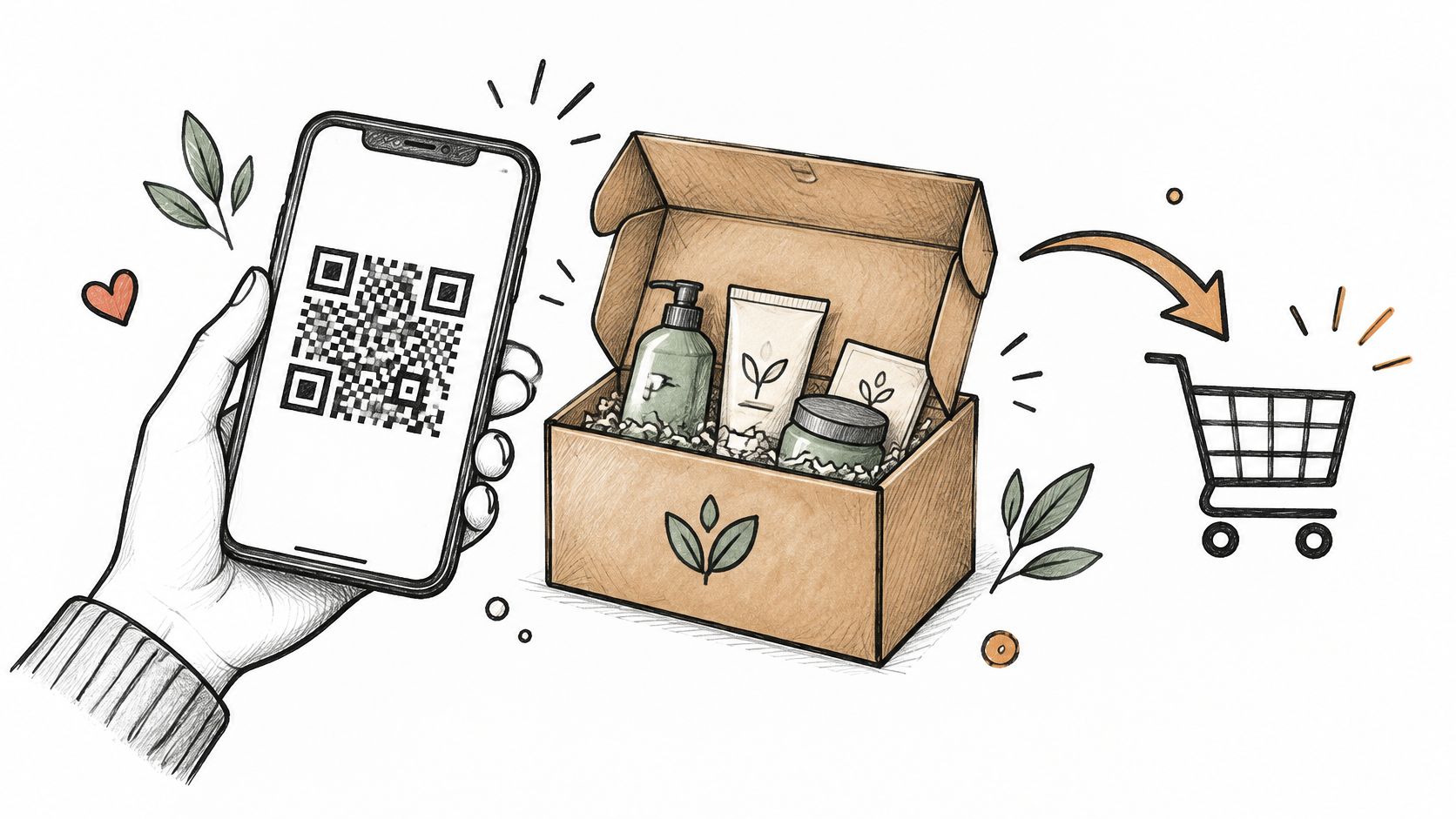
Quick checkout links carry a pre-built plan or product straight into checkout. Use them in email and SMS campaigns, social posts, packaging inserts, and QR codes on boxes that already reached the customer. A coffee brand can email lapsed subscribers a one-click link to reactivate the previous plan. A pet food brand can print a QR code on an insert that opens the reorder checkout for that formula.
One link per segment, one job per link
Create separate links for each segment and offer so you can measure which combination converts. Pair each link with a single clear line such as "Restart your subscription in one click." Don't ask the customer to restart, upgrade, add a bundle, and join a referral program in the same message.
Monitor drop-off inside the checkout funnel. If customers click but abandon, your pre-set plan may be wrong. The quantity, frequency, or product mix that caused the original exit shouldn't be the default you push them back into. This breakdown of a QR code checkout system covers the mechanics of pre-built links for campaigns and offline placements.
What I'd watch: Clicks tell you the message worked. Checkout completion tells you the plan still fits. Report both, and don't let a strong click rate hide a bad default configuration.
QR codes work best where the product is physically present. A code on the last refill pouch reaches the customer at the exact moment of need, which no scheduled email can reliably match.
7. Predictive Churn Segmentation and Triggered Winback Journeys
The cheapest winback is the one you trigger before cancellation. You don't need a data science team to start. You need two or three behavioral signals your team already collects and the discipline to act on them while the subscription is still alive.
Start with simple triggers: two consecutive skipped orders, a failed payment, declining order frequency, or a long gap since the last successful renewal. A supplement brand that sees two skips can send a check-in with a swap or frequency option. A coffee brand that sees orders stretching further apart can offer a longer interval before the customer decides the cadence itself is the problem.
Find your drop-off point in the cohorts
Review cohort retention by acquisition month to identify when subscribers typically leave. If month three is where retention breaks, your intervention belongs in month two. Use churn-by-reason data to write the actual message. "We noticed you've skipped twice, want a smaller delivery every other month?" addresses a cause. "Come back for 15% off" doesn't.
Bluecore reported in its customer growth benchmarks coverage that 74% of customers across retail categories made one purchase and never returned, a figure published in 2024. That scale is exactly why broad, untriggered campaigns waste effort. Segment by tenure, prior order count, order value, product category, and cancellation reason, then trigger journeys from behavior.
Measure triggered groups against comparable untriggered cohorts. If your at-risk journey produces reactivations that churn again at the next renewal, you've built an early-warning system that finds problems without fixing them. Feed the reason data back into product, pricing, and cadence decisions. That's where the durable gain sits.
Auto-tag customers by status and behavior for Shopify Flow so segments update without manual list work. Manual exports go stale within a week, and stale segments send winback offers to people who already returned.
8. Product Reintroduction and Build-a-Box Reconfiguration
Sometimes the customer left because she was tired of the product. No reminder fixes boredom, and no discount makes the same box interesting again. You need something genuinely different to offer: a reformulation, a new flavor, a seasonal item, or a configuration she builds herself.
Build-a-Box and mix-and-match plans give lapsed subscribers control they didn't have before. A skincare brand can reintroduce a lapsed customer's routine with a new complementary product in a custom box. A pet food brand can offer a seasonal flavor first to customers who cancelled last quarter. The message is specific: what changed, and how it fits you now.
Give them a reason that's actually new
- Lead with the change: Name the new formula, flavor, or product and what it does differently.
- Limit the choices: Keep Build-a-Box options manageable so customers decide quickly instead of deferring.
- Test small first: Send the reintroduction to a small lapsed segment before a full launch and compare second-renewal retention.
- Keep swaps open: Let returning customers move between products without cancelling when tastes shift again.
This works for variety-driven categories beyond food and skincare. A sleep brand, for example, can bring back lapsed customers with melatonin-free options for your nighttime routine for subscribers who left because the original formula didn't suit them.
The trade-off is operational complexity. More configurations mean more pick-and-pack variation and more chances to set a wrong default. Keep the return offer narrower than your full catalog. Say a supplement brand offers three curated return bundles instead of forty individual products. The customer gets novelty and control, and your warehouse gets a configuration it can fulfill accurately.
Don't use reintroduction to disguise an unchanged product. Customers who return for something new and find the old box will leave faster the second time, and they'll ignore your next launch announcement too.
How the eight customer winback strategies compare at a glance
| Item | Target Segment | Primary Channel | Margin Impact | Main Trade-off |
|---|---|---|---|---|
| Pause-Instead-of-Cancel Reactivation | Subscribers considering cancellation due to temporary needs | Self-serve customer portal | Preserves future revenue without discounting, but pauses generate no revenue | Keeps the relationship active, but some customers may never resume |
| Cancellation Save Flow with Reason-Based Offers | Customers actively attempting to cancel | Cancellation flow | Non-discount options protect margin; discounts can erode it | Offers address churn reasons, but lengthy flows may frustrate customers |
| Involuntary Churn Recovery via Dunning and Card-Update Links | Customers lost to failed payments | Email, SMS, and WhatsApp | Recovers revenue without win-back discounts | Low-effort recovery, but depends on customer response and careful retry timing |
| Loyalty Points and Milestone Reactivation Rewards | Lapsed customers with renewal history or loyalty balances | Loyalty messaging and store credit | Encourages repeat orders, but rewards can create liabilities or reduce margin | Personalizes incentives, but stacked rewards may become unprofitable |
| Multi-Channel Lapsed Customer Campaigns (Email, SMS, WhatsApp) | Lapsed subscribers segmented by status or behavior | Email, SMS, and WhatsApp | Campaign costs vary by channel; targeted messaging can improve efficiency | Broad reach and automation, but adds cost, compliance needs, and over-messaging risk |
| Quick Checkout Links and QR Codes for Reorder Campaigns | Lapsed customers who already know what they want | Email, SMS, WhatsApp, social, and QR codes | Reduces checkout friction without requiring discounts | Simplifies reordering, but preset plans may not fit current needs |
| Predictive Churn Segmentation and Triggered Winback Journeys | Customers showing early signs of churn | Automated journeys via analytics and Shopify Flow | Focuses incentives on at-risk customers, potentially limiting unnecessary discounts | Enables earlier intervention, but weak data can lead to inaccurate or premature outreach |
| Product Reintroduction and Build-a-Box Reconfiguration | Lapsed customers bored with products or bundles that no longer fit | Targeted product or bundle campaigns | Can increase average order value without relying solely on discounts | Offers a fresh reason to return, but requires product work and can overwhelm with choices |
Build a Winback Plan Around the Reason Customers Left
Start with your cancellation and failure data, not with a campaign calendar. Pull your top churn reasons for the last quarter and sort them into buckets you can act on: payment failure, overstock or timing, price, product fit, and simple forgetfulness. If your portal doesn't capture reasons today, fix that first. Every tactic in this article depends on knowing which bucket a customer belongs in.
Assign one or two tactics per bucket. Payment failures go to decline-aware dunning with card-update links, and promotional messages stay suppressed until billing recovery ends. Overstocked customers get pause, skip, and frequency changes. Price-sensitive customers get a smaller plan or bundle before they get a discount. Bored customers get a swap, a Build-a-Box configuration, or a genuine product reintroduction. Customers who drifted get a replenishment-timed sequence with a one-click restart link.
Set the sequence length in advance and respect it. A 60-day window with clear exit points gives you enough touches to test without turning winback into permanent pressure. Define what counts as won back before you launch. I'd require a paid renewal followed by a second successful order, because a single discounted checkout tells you almost nothing about whether the original problem is solved.
Review results monthly by cohort and reason. Compare save rate, reactivation margin after incentive and fulfillment costs, second-renewal rate, and 90-day retention for each treatment against a holdout where you can. Kill offers that produce cheap first orders and fast second exits. Move budget toward the treatments that return customers who stay. Bluecore's 2025 Customer Movement Benchmarks reported that retailers' reactivation rates increased by 10.6% from 2023 to 2024, which suggests the merchants improving fastest are treating reactivation as a measured system rather than an occasional blast.
Keep the stack simple enough that your team will run it. With RecurX, dunning, cancellation flows, win-back, and loyalty are included in the price rather than sold as add-ons, and both plans include the customer portal, payment recovery, loyalty, and cohort analytics. Plans can always be cancelled and your data remains yours, so you can test these strategies on your own cohorts without lock-in risk and keep only what your numbers justify.
Put reason-based winback on your store with pause and skip controls, cancellation save flows, payment recovery, loyalty rewards, and quick checkout links working from the same subscription data. Visit RecurX to set up your first segmented recovery journey and measure it by second-renewal retention, not clicks.
customer winback strategies · subscriber winback · churned subscribers · dunning sequences · lapsed customer recovery
Keep reading
- 8 Shopify Flow Examples Subscription Merchants Can Copy8 practical Shopify Flow examples for subscription stores, with triggers, conditions, and actions for tagging, dunning, churn rescue, and loyalty.
- How Do Loyalty Points Work? Rates and RedemptionsHow do loyalty points work? See earn rates, 100 points = $1 redemptions, expiry, stacking with subscription discounts, and the LTV effect.
- Shopify App Charges Explained: Billing Types and CostsLearn how Shopify app charges work: subscription, usage and one-time fees, billing cycles, pricing models and how to check your bill.
Start growing recurring revenue on Shopify
RecurX has a 14-day free trial and zero transaction fees on every plan. Install in minutes.
Start your free trial →