Recurring Revenue Billing Playbook
Master recurring revenue billing for Shopify DTC. Explore pricing models, retention metrics, payment recovery, and global compliance strategies.
Master recurring revenue billing for Shopify DTC. Explore pricing models, retention metrics, payment recovery, and global compliance strategies.
The most popular advice about recurring revenue billing is incomplete: set up automatic charges, add a few retry emails, and watch monthly recurring revenue grow. That approach treats a subscription like a delayed checkout transaction. In practice, the difficult work starts after the first payment, when customers need to pause, products need to change, cards fail, regulations differ by market, and finance must reconcile cash with earned revenue.
A durable recurring billing operation connects pricing, fulfilment, payment recovery, customer control, compliance, and accounting. The merchant isn't just collecting money on a schedule. The merchant is managing an ongoing commercial relationship whose health depends on what happens between renewals.
Table of Contents
- The Recurring Revenue Operating System
- Choosing the Right Subscription Pricing Model
- Tracking the Metrics That Actually Matter
- Engineering a Stateful Payment Recovery Workflow
- Turning Cancellation Controls Into Revenue Growth
- Navigating Global Compliance and Cross-Border Billing
- Aligning Billing Events With Revenue Recognition
The Recurring Revenue Operating System
Recurring revenue billing changes the business model from isolated orders to a sequence of customer decisions. A customer joins, renews, changes a plan, skips a shipment, updates a payment method, pauses for a season, or cancels. Each event affects inventory, support workload, cash forecasting, retention analysis, and sometimes revenue recognition.
Zuora's Subscription Economy Index, based on anonymized and aggregated activity from more than 500 subscription businesses worldwide, found that tracked subscription companies achieved a 17% compound annual growth rate over the 11 years through 2022, compared with 4.6% for the S&P 500. The tracked subscription companies therefore expanded approximately 3.7 times faster over that period. In 2022, they grew revenue 12%, compared with 10.6% for the S&P 500.
Those figures cover multiple industries and monetization approaches. They don't prove that every subscription plan will outperform a one-time purchase, but they do show why recurring billing deserves operating-level attention. The model can improve revenue predictability and retention economics, but only when the merchant can see what happens across the customer lifecycle.
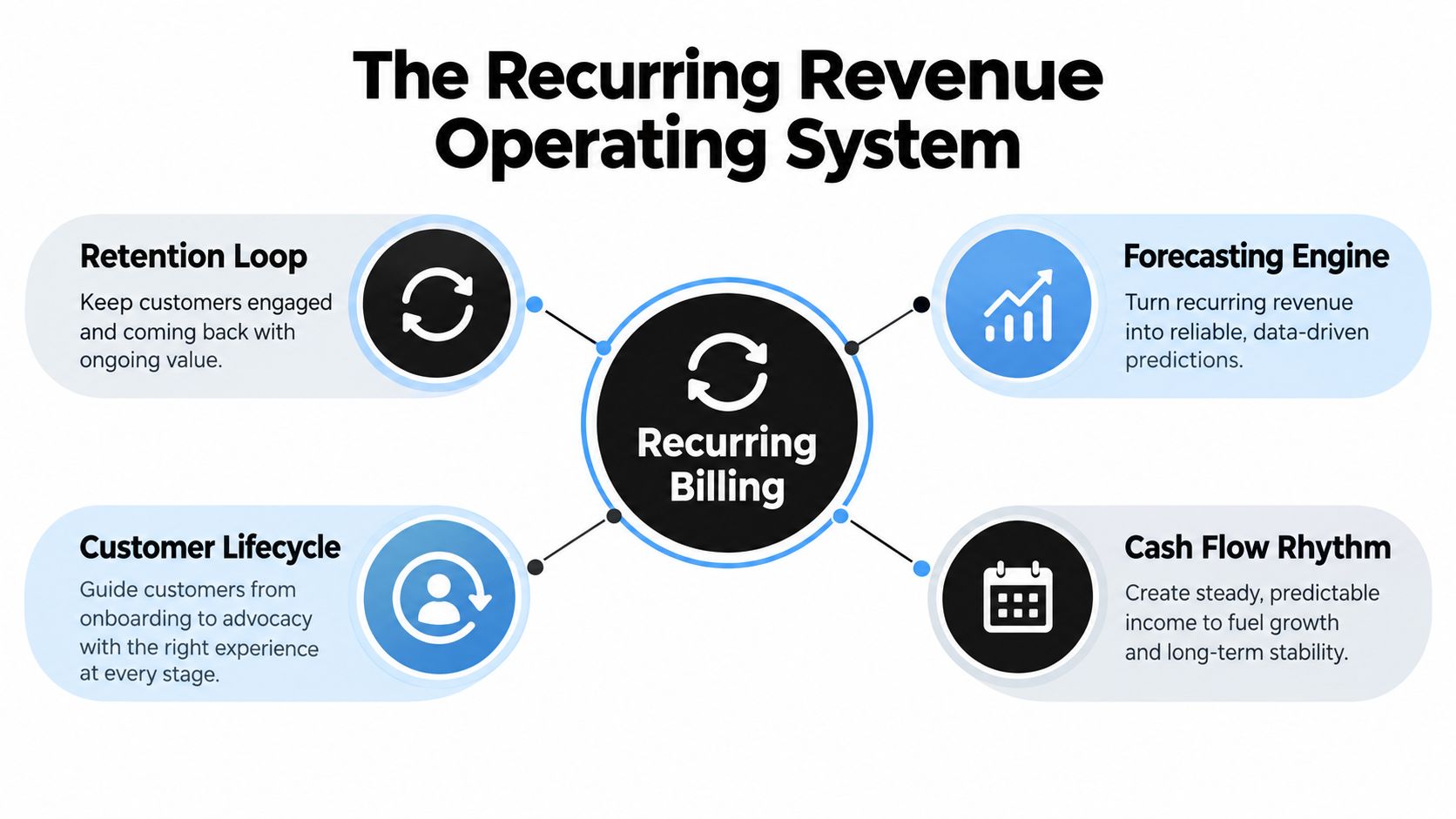
The four operating views
A Shopify brand should treat billing data as a shared system for several teams:
- Retention loop: Cancellation reasons, pauses, skips, swaps, and reactivations show whether customers are receiving the right product at the right cadence.
- Forecasting engine: Subscriber growth, average revenue per account, renewal dates, plan mix, and expansion activity give finance and operations a better view of expected demand.
- Customer lifecycle: The same account can move from first order to renewal, downgrade, pause, recovery, and reactivation. Those states need to remain connected.
- Cash flow rhythm: Scheduled charges are not the same as collected cash. Failed payments, refunds, chargebacks, and fulfilment timing all affect actual cash position.
Practical rule: A successful charge is an event in the operating system, not the definition of a healthy subscription.
Native Shopify integration matters because the storefront, customer account, order record, fulfilment workflow, and merchant administration should share consistent subscription states. Real-time analytics matter for the same reason. If the retention team sees cancellations in one system, support sees pauses in another, and finance exports orders from a third, nobody has a reliable view of the customer base.
Choosing the Right Subscription Pricing Model
The right model depends on how customers consume the product, how much choice they want, and how much complexity the warehouse can absorb. A coffee customer may need a predictable replenishment cadence. A skincare customer may use products at different speeds. A pet owner may value a fixed bundle but still need the ability to swap a flavour or size.
| Model | Best fit | Main strength | Operational trade-off |
|---|---|---|---|
| Pay-as-you-go | Regular consumables with predictable replenishment | Low entry friction and simple renewal logic | Revenue remains exposed to cancellation at every cycle |
| Prepaid bundle | Products with a clear planned usage period | Collects cash upfront and can simplify fulfilment planning | Creates refund, pause, and deferred-revenue complexity |
| Membership | Brands with benefits beyond the shipped product | Separates access and loyalty from individual orders | The value proposition must remain useful between purchases |
| Build-a-Box | Engaged customers who want selection | Supports choice, bundling, and higher basket value | Inventory, substitution, and pricing rules become more demanding |
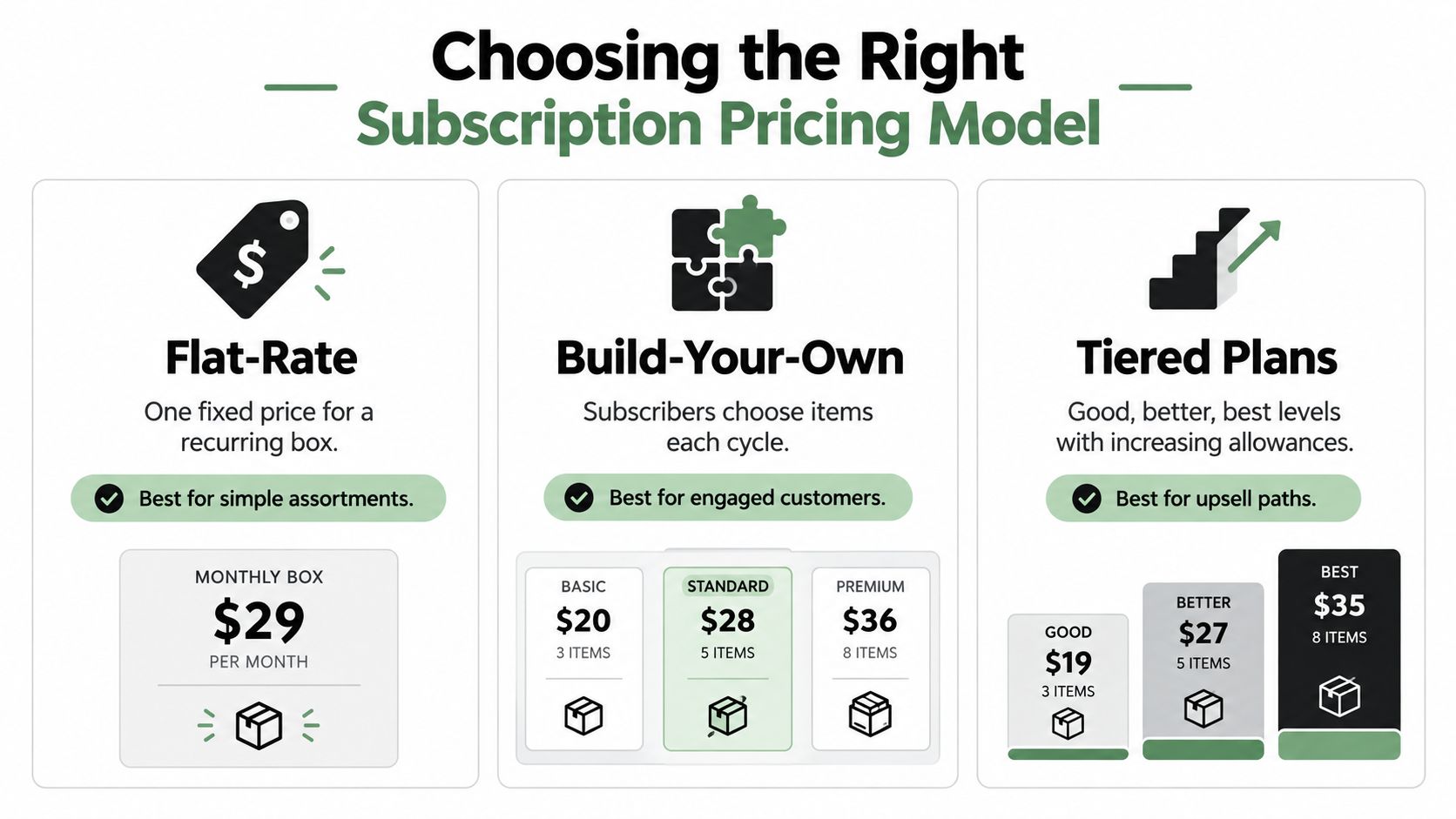
Flat-rate plans work when simplicity improves conversion. A customer chooses one box, one cadence, and one price. Build-a-Box plans can lift perceived control and help customers assemble a routine, but the product catalogue, stock rules, and renewal calculations must handle every allowed combination.
Tiered discounts deserve careful design. A discount that increases after a defined number of successful orders can reward commitment without giving away the full margin on the first purchase. The rule should be tied to a clear event, such as completed renewals, rather than an ambiguous calendar date. Customers should understand what triggers the next tier and what happens if they pause, skip, or downgrade.
Match cadence to consumption
Use shorter intervals when the product is consumed quickly and customers can predict replenishment. Use longer intervals when customers need more time to finish the product or when excess inventory is a common cancellation reason. Flexible weekly, monthly, and yearly options let the customer select a realistic rhythm instead of forcing every product into a monthly template.
The important test isn't whether the discount looks attractive. It's whether the plan reduces subscriber fatigue while protecting fulfilment margin. Model the cost of packing, shipping, product swaps, customer support, discounts, and failed-payment recovery before setting the price.
For a deeper treatment of plan structure and discount mechanics, see this subscription pricing strategy guide.
A strong checkout also explains the renewal date, billing interval, product contents, cancellation method, and any prepaid commitment before the customer submits payment. Clear expectations reduce avoidable disputes and give the support team fewer ambiguous cases to resolve.
Tracking the Metrics That Actually Matter
Top-line sales can hide a weak subscription base. A merchant may acquire customers rapidly while losing a material share of existing subscribers through cancellation or payment failure. Recurring revenue billing needs cohort and lifecycle analysis, not just an order count.
Zuora's 2022 Subscription Economy Index snapshot recorded an average quarterly churn rate of 6.13% in the first half of 2022, down from 6.50% in 2019. The same report recorded average subscriber growth of 2.35% per quarter in the first half of 2022, compared with 0.86% as the quarterly average during 2021. These figures show why growth and churn must be read together.
Build a metric hierarchy
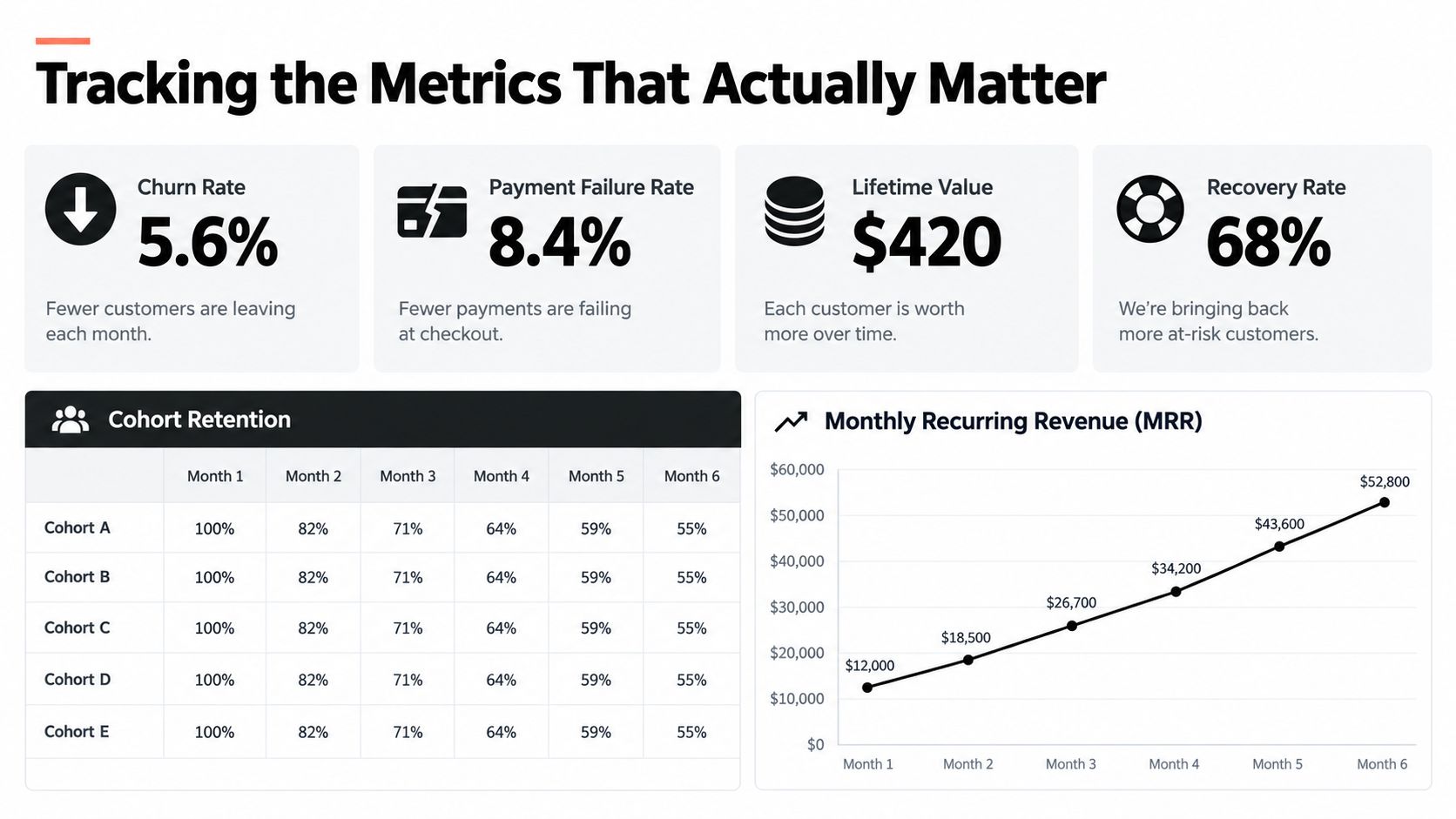
Monthly recurring revenue is useful for understanding the contracted run rate, but it shouldn't be treated as collected cash or recognized accounting revenue. Track the movement behind the number:
- Subscriber growth: Separate new subscribers, reactivations, upgrades, downgrades, and cancellations.
- Churn by reason: Distinguish product dissatisfaction, price sensitivity, excess inventory, payment failure, delivery problems, and temporary pauses.
- ARPU and AOV: Review average revenue per account and average order value by plan, product, cadence, and acquisition source.
- Retention by tenure: A plan that looks healthy overall may lose most customers shortly after the first shipment.
- Recovery performance: Measure payment recovery separately from voluntary retention.
Segment every important metric by plan, tenure, product, geography, billing interval, and cancellation reason. A skincare plan with a longer usage cycle shouldn't be compared directly with a fast-moving supplement plan. Likewise, a customer who pauses because they have too much stock isn't equivalent to one who cancels after a poor delivery experience.
Useful diagnostic: If subscriber growth rises while the active base remains flat, inspect cancellation and failed-payment cohorts before increasing acquisition spend.
Cohort tables make this visible. Group customers by start month or first product, then track renewal, pause, cancellation, recovery, and reactivation behavior over time. This approach connects lifecycle decisions to margin. It can reveal that a discount attracts signups but produces short-lived accounts, or that a simple skip option preserves more future value than an aggressive save offer.
A practical dashboard should show the subscription funnel from product-page selection through checkout, first fulfilment, renewal, payment recovery, pause, cancellation, and reactivation. RecurX's Shopify subscription metrics and KPI guide covers the measurement layer merchants need to keep those events connected.
Engineering a Stateful Payment Recovery Workflow
Blind retries create noise because they treat every decline as the same problem. A failed payment can result from insufficient funds, an expired card, an invalid payment method, issuer restrictions, or a temporary network condition. Each case needs a different next action.
The recovery workflow should preserve the full state of every failed attempt:
- Detect the decline. Store the decline code, network response, attempt timestamp, subscription status, amount, currency, and next eligible retry time.
- Classify the reason. Separate transient conditions, such as insufficient funds, from hard declines involving an invalid or closed payment method.
- Schedule an appropriate retry. Retry transient failures according to an intentional window. Don't consume attempts against a payment method that needs replacement.
- Coordinate communication. Send a message that matches the retry state and provides a secure, one-click payment-method update flow.
- Recover or escalate. Resume the subscription after successful collection, or move the customer into a graceful pause or support path when recovery fails.
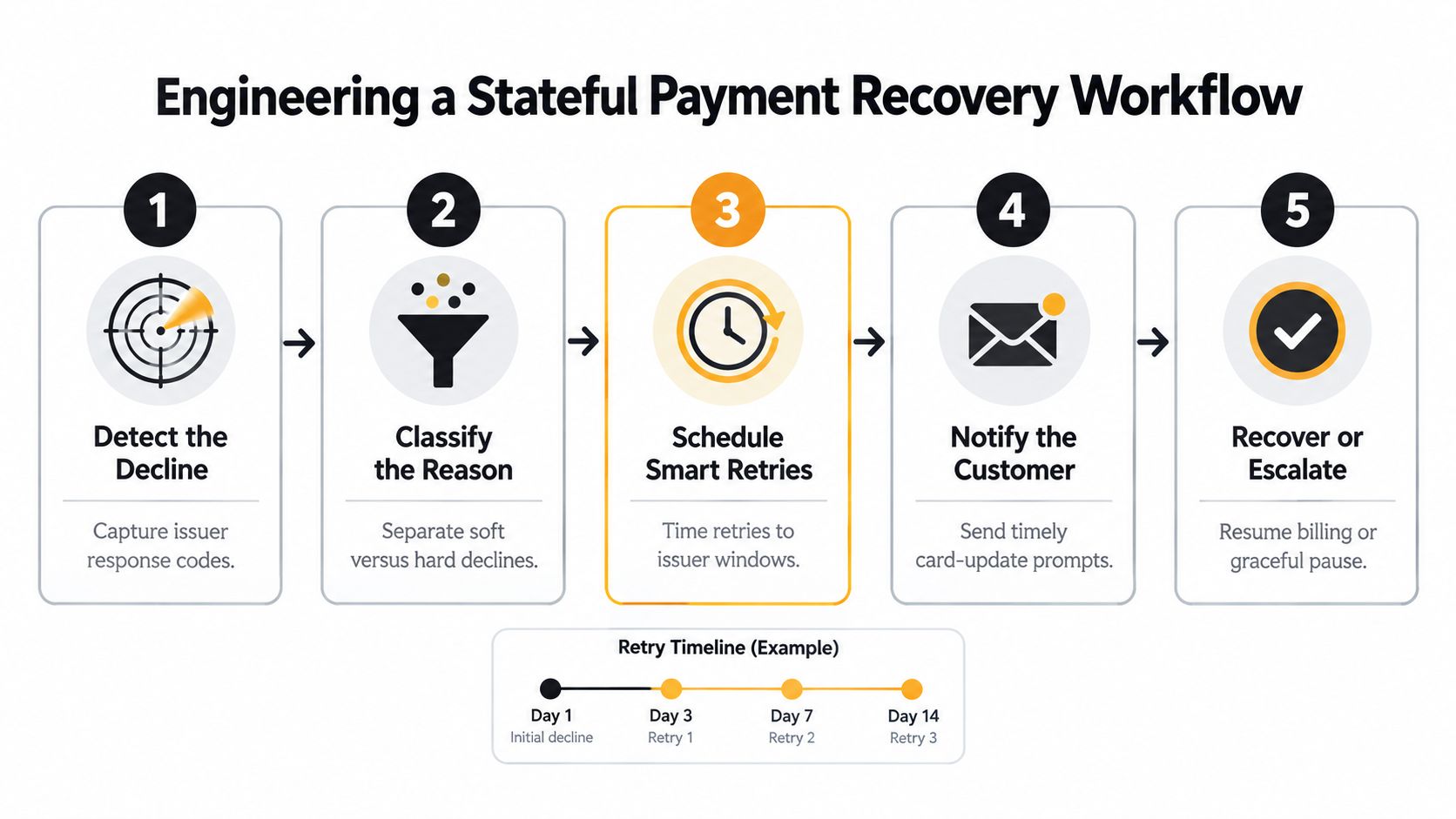
Treat messaging as part of the state machine
A generic reminder sent repeatedly doesn't give the customer a useful next step. The message should reflect what happened. A transient decline can explain that the system will try again, while a hard decline should direct the customer to replace the payment method immediately.
Email, SMS, and WhatsApp can support different moments in the sequence, but every channel must link to the same authenticated update experience. The email layer also needs basic delivery hygiene. Teams that send recovery messages should understand SPF, DKIM and DMARC explained so legitimate notices are less likely to fail authentication or reach the wrong folder.
Recovery analytics must separate recovered dollars from retained future recurring value. A successful retry may collect one invoice while the subscription cancels later. Track recovery rate by decline reason and retry attempt, median time to recovery, involuntary-churn rate, recovered gross margin, and post-recovery retention over later customer periods. Segment the results by market, card network, currency, billing interval, and tenure.
The available neutral search results don't establish a defensible global benchmark for retry recovery percentages. Treat any internal recovery claim as a hypothesis until merchant cohorts validate it. Test retry timing and message channel while holding the payment amount and customer segment constant.
For implementation patterns, see this failed payment recovery and subscription dunning guide. A Shopify-native application such as RecurX can combine decline-aware retry windows, email, SMS, and WhatsApp dunning, one-click card updates, and subscription status management within the merchant workflow.
Turning Cancellation Controls Into Revenue Growth
A cancellation flow shouldn't be a hostage negotiation. Friction may delay a cancellation, but it can also damage trust, increase support work, and make a future purchase less likely. Customers who have too much product often need a pause or skip, not a reason to abandon the brand permanently.
Mastercard and FT Strategies found that 74% of consumers are more likely to subscribe when cancellation is simple, while 31% of global consumers frequently cancel and resubscribe, according to their subscription economy research. The same research identified payment pauses as the most effective retention tactic ranked by U.S. subscription businesses. A separate 2025 survey of consumers in the U.S. and U.K. reported that 78% wanted pause or swap options, 58% had paused rather than canceled when given the choice, and 82% were more likely to subscribe when cancellation was easy.
The commercial lesson is straightforward. Control can be a retention feature. A customer who pauses during travel, skips a shipment because of excess stock, or swaps an unsuitable product remains reachable for reactivation.
Design the portal around real customer situations
Give customers self-serve access to the actions they need:
- Pause: Offer clear duration choices and explain whether the next billing date moves.
- Skip: Let customers skip the next shipment without cancelling the underlying plan.
- Swap: Present in-stock alternatives that preserve the cadence and product value.
- Change frequency: Support a slower interval for customers whose consumption has changed.
- Update payment: Keep the payment method flow separate from cancellation so a card problem doesn't look like a product rejection.
- Cancel: Make the final step clear, immediate, and easy to confirm.
The save experience should ask a useful question, not create an obstacle course. If the customer selects “too much product,” offer a slower cadence or pause. If they select “product issue,” route them to support or a swap. If they select “too expensive,” show the plan alternatives only when those alternatives solve the stated problem.
Measure saved orders, pause-to-reactivation rate, swap retention, cancellation completion time, support contacts, and future reactivation revenue. Don't call a delayed cancellation a retention win. A healthy programme preserves customer choice and earns the next order by making the subscription fit the customer's life.
Navigating Global Compliance and Cross-Border Billing
International expansion turns recurring revenue billing into a compliance and payment-design problem. A workflow that works in one storefront may fail in another because consent language, renewal notices, cancellation controls, payment methods, and consumer-protection expectations differ by market.
Recent reforms illustrate the risk. Mexico's December 2025 reforms introduced requirements involving express consent for recurring charges, renewal notifications, and simplified cancellation. Argentina's 2025 changes required a prominent online cancellation button. European subscription protections are enforced through existing consumer-protection frameworks rather than one unified subscription statute, which creates a fragmented set of disclosure and cancellation obligations. The U.K. is also developing variable recurring payments through open banking, showing that payment design is moving beyond cards.
Create a market-readiness matrix
Before launching a localized subscription flow, record the requirements and evidence for each market:
| Area | Operational question |
|---|---|
| Consent | What wording and interaction demonstrate that the customer authorized recurring charges? |
| Renewal notice | Must the merchant notify the customer before renewal, and through which channel? |
| Cancellation | Can the customer cancel online with the same ease as signup? |
| Evidence | Which consent, notice, and cancellation events must the merchant retain? |
| Payment method | Should cards be supplemented by bank-based recurring payments or local alternatives? |
| Localization | Are the checkout, portal, notices, and support instructions translated consistently? |
Store consent evidence with the subscription record, including the relevant plan, price, cadence, market, storefront version, and customer action. Maintain an immutable event log for consent changes, renewals, notices, pauses, cancellations, refunds, and payment-method updates. Localized testing should verify the whole journey, not just the product page. A merchant should test signup, renewal messaging, account management, and cancellation from each target storefront.
Payment design should follow customer behaviour and regulatory fit. Cards may provide a familiar experience, while bank-based recurring payments can offer a different route where open-banking infrastructure and customer adoption support it. Don't add a payment method without defining fallback handling, reconciliation, refund rules, and customer support ownership.
The result is a single expansion discipline: localize the customer experience, preserve central event governance, and make every important decision auditable. Translated notifications, localized cancellation parity, payment-method fallbacks, and market-specific evidence retention belong in the same operating plan.
Aligning Billing Events With Revenue Recognition
Cash collection and revenue recognition answer different questions. A customer may pay upfront for a subscription or prepaid bundle, but the merchant may still owe future goods or services. Under ASC 606, an upfront payment generally creates a contract liability when consideration arrives before the merchant transfers the promised goods or services. Revenue is recognized as the merchant satisfies the applicable performance obligations.
For a physical-goods subscription, that usually means connecting each successful billing event to the related order fulfilment or delivery event. The merchant shouldn't recognize the entire annual or prepaid amount just because the payment succeeded. Deloitte's ASC 606 overview of identifying a contract explains the contract-liability and performance-obligation framework finance teams need to apply.
Separate the operational states
A reliable system should keep these states distinct:
- Authorization: The payment method has been approved for the intended transaction.
- Capture: Funds have been collected or the payment has been finalized.
- Fulfilment: The promised goods have been shipped or delivered according to the contract.
- Refund: Funds have been returned, in whole or in part.
- Cancellation: The customer or merchant has ended future obligations.
- Revenue recognition: The accounting system has recognized the amount associated with satisfied performance obligations.
These states shouldn't be collapsed into a single “paid” flag. A prepaid customer can be paid, unfulfilled, paused, partially refunded, or cancelled at the same time from different operational perspectives.
Use an immutable billing-event ledger
A practical migration and control process looks like this:
- Inventory legacy data. Export active subscriptions, plan versions, billing dates, payment states, prepaid balances, pauses, skips, cancellations, refunds, chargebacks, and fulfilment status.
- Map identifiers. Connect each subscription to the customer, product, order, payment event, fulfilment record, and accounting reference.
- Normalize plan terms. Record cadence, quantity, price, discount, tax treatment, prepaid coverage, and remaining obligations.
- Rebuild event history. Preserve original authorization, capture, renewal, change, refund, cancellation, and fulfilment timestamps rather than importing only the current status.
- Define recognition rules. Map each product or bundle to the performance obligation and the point at which the obligation is satisfied.
- Reconcile monthly. Compare the event ledger with orders, refunds, chargebacks, fulfilment records, collected cash, receivables, and the contract-liability subledger.
- Audit exceptions. Investigate missing fulfilment, duplicate captures, negative balances, unallocated refunds, and subscriptions whose plan changes alter the remaining transaction price.
Pauses, swaps, skips, and frequency changes can modify delivery schedules, refund exposure, and remaining obligations. The ledger must therefore capture the before and after state, the effective date, the customer action, and the financial consequence.
MRR dashboards remain valuable for operating decisions, but they aren't GAAP revenue ledgers. Finance should be able to trace recognized revenue back to the underlying billing and fulfilment events, while operators should be able to see how those events affect renewal performance and cash flow.
RecurX gives Shopify merchants tools for recurring plans, prepaid subscriptions, memberships, Build-a-Box products, customer-portal controls, decline-aware payment recovery, cohort analytics, loyalty features, and localized subscription communications. Visit RecurX to evaluate how its Shopify-native recurring billing workflow can support flexible retention controls, payment recovery, and operational reporting.
recurring revenue billing · subscription billing · Shopify subscriptions · payment recovery · DTC retention
Keep reading
- Shopify Subscription API: A Complete Integration Guide 2026Learn how to use the Shopify Subscription API with GraphQL examples, secure authentication, and webhook handling in this 2026 guide.
- Subscription vs One Time Purchase for ShopifyCompare subscription vs one time purchase models for Shopify. Analyze LTV, churn, and MRR impacts, plus how to implement recurring billing with RecurX.
- How to Sell Subscriptions Online on ShopifyLearn how to sell subscriptions online on Shopify. Build flexible plans, optimize checkout, recover failed payments, and boost retention with RecurX.
Start growing recurring revenue on Shopify
RecurX has a 14-day free trial and zero transaction fees on every plan. Install in minutes.
Start your free trial →