Subscription Metrics: The 7 KPIs Every Shopify Merchant Must Track
Most Shopify subscription merchants are measuring something — but not always the right things. Tracking revenue alone misses the signals that predict churn, cap growth, or reveal that unit economics are quietly breaking down. This guide covers the seven subscription KPIs that matter most, what good looks like for each, and the order in which to fix them.
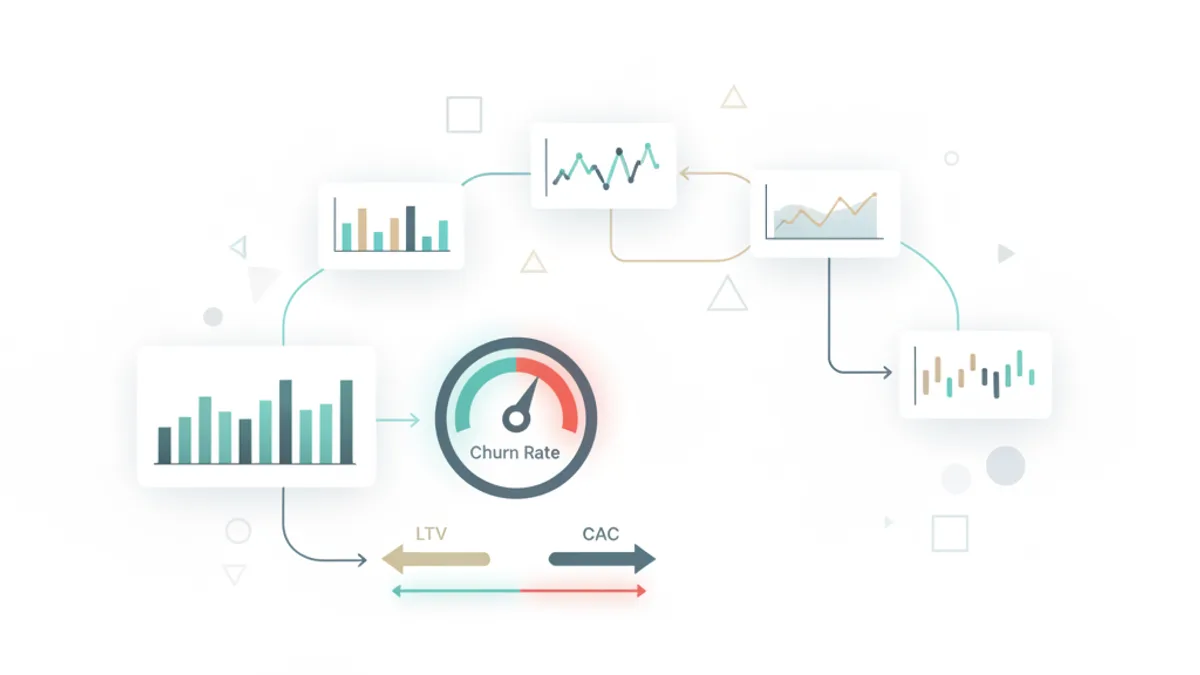
The seven KPIs every subscription merchant needs: MRR (your revenue baseline), subscriber churn rate (are you leaking), net revenue retention or NRR (are you growing or shrinking from within), LTV (what a customer is worth), LTV:CAC (is growth sustainable), ARPU (revenue per subscriber), and active subscriber count (your headline growth number). Fix churn first — it improves every other metric downstream.
Why most merchants track the wrong things
It is tempting to focus on total revenue or gross new-subscriber counts — they are visible and they feel good on a strong day. But for a subscription business, those numbers can look healthy while the underlying engine is eroding. A brand adding 200 new subscribers a month but churning 210 is shrinking, even if monthly revenue holds temporarily while the churn compounds.
The right metrics are the ones that reveal the health of the engine, not just today's output. Revenue is an output. Churn rate, LTV, and NRR explain why revenue is heading where it is heading — and give you time to act before the number moves.
The 7 subscription KPIs at a glance
These seven metrics cover revenue, retention, unit economics, and growth. Together they give a complete picture of subscription health. The sections below explain each one in detail.
| KPI | What it measures | Benchmark to aim for |
|---|---|---|
| MRR | Committed monthly revenue from all active subscribers | Growing month-over-month |
| Subscriber churn rate | Subscribers who cancel or fail payment each month, as a percentage | ≤5–7% for consumer subscriptions |
| Net revenue retention (NRR) | Revenue retained after churn, minus downgrades, plus expansion | >100% means the base is self-growing |
| LTV | Total expected revenue per subscriber over their full tenure | LTV ≥ 3× CAC |
| LTV:CAC ratio | Revenue per customer relative to what it cost to acquire them | 3:1 or better |
| ARPU | Average monthly revenue per active subscriber | Trending up over time via upsells or bundles |
| Active subscriber count | Subscribers currently in a paid, active status (net of churn) | Net positive each period |
MRR: your revenue baseline
Monthly Recurring Revenue is the sum of all committed subscription revenue in a given month. It is the foundation metric: everything else is either upstream of it (how many subscribers paying how much) or downstream of it (what happens to that revenue over time).
Track MRR broken into components: new MRR from new subscribers, expansion MRR from upsells and frequency upgrades, and churned MRR lost to cancellations and failed payments. That decomposition tells you which lever to pull. Not enough new MRR points to an acquisition problem. Too much churned MRR points to a retention problem — and fixing retention is almost always cheaper than acquiring replacements.
One important note: MRR is committed revenue, not cash collected. A failed payment reduces real cash received but may not immediately show up in a simple MRR count if your billing system marks the subscription active during retries. Track both contracted MRR and collected cash to catch the gap.
Subscriber churn rate: are you leaking?
Subscriber churn rate is the percentage of active subscribers who cancel or fail payment in a given period. For monthly subscriptions, monthly churn is the standard. Annualize it to compare across businesses: a 5% monthly churn is roughly 46% annual churn — meaning nearly half your base turns over in a year.
The most important thing to do with churn is to split it into two buckets. Involuntary churn happens when a payment fails — the card declines, expires, or is flagged by the bank. These customers still want your product; they just had a billing hiccup. Recover them with dunning: automated retry logic timed to the decline reason, pre-expiry card-update emails, and account-updater services that automatically update stored card numbers when banks reissue cards.
Voluntary churn is when a subscriber actively decides to leave. That requires a different fix: understanding why they are leaving (cancellation-reason surveys), and giving them options that keep the relationship alive — pause, skip, frequency change, or a swap to a lower-price product — rather than forcing a binary cancel decision.
Net revenue retention: the growth signal inside your base
Net revenue retention (NRR) measures what happens to a cohort of recurring revenue over time, accounting for churn and downgrades on one side, and upsells, cross-sells, and frequency upgrades on the other. The formula: NRR = (starting MRR + expansion MRR − churned MRR − contraction MRR) ÷ starting MRR × 100.
An NRR above 100% means your existing subscriber base grows in value on its own — before you acquire a single new customer. That is a powerful compounding dynamic: even with flat new acquisition, the business grows. An NRR of 95% means you need new acquisition just to stay even.
For Shopify brands with simple subscribe-and-save and no upsell motion, NRR is mostly 100% minus revenue churn rate. Adding a meaningful upsell — a bundle upgrade, a higher-frequency tier, an add-on — can push NRR above 100% and fundamentally change the growth math.
LTV and LTV:CAC — the unit economics test
Lifetime value (LTV) is the total revenue you expect from a subscriber from their first order until they cancel. The simplest estimate: average monthly spend × average subscriber lifetime in months. A margin-adjusted version multiplies by gross margin — useful when comparing acquisition channels with different product mixes.
LTV tells you something useful only when compared to what you paid to acquire that customer (CAC). An LTV:CAC ratio of 3:1 or better means each dollar of marketing returns three dollars in lifetime revenue — a healthy signal that acquisition is sustainable and improvable. A ratio below 1:1 means you are funding customers at a loss that the subscription economics cannot recover.
The most common way to improve LTV:CAC is not to cut marketing spend — it is to reduce churn, which extends average subscriber lifetime and raises LTV without touching acquisition costs. A brand that goes from 8% monthly churn to 5% extends average subscriber tenure from 12.5 months to 20 months, more than doubling LTV from the same acquisition cost.
ARPU and active subscriber count
ARPU (average revenue per user) divides total MRR by active subscriber count. It is a quick diagnostic: if MRR is growing but ARPU is falling, new cohorts are on cheaper plans or smaller baskets than older ones — a sign that your acquisition mix is shifting toward lower-value customers. Rising ARPU over time, through bundles, higher-frequency plans, and add-ons, means you are getting more revenue from each relationship without adding acquisition cost.
Active subscriber count is the headline growth number, but track it net: new subscribers added minus subscribers churned in the same period. Gross new-subscriber counts hide a churning base. A brand that acquires 300 and churns 280 is not growing — it is on a treadmill. Net subscriber growth is the number that matters for forecasting and for understanding whether retention work is showing up in the headline.
Common mistakes in subscription measurement
Even merchants who track these metrics regularly make a few consistent errors:
- Conflating subscriber churn with revenue churn. A high-value subscriber and a low-value subscriber count equally in subscriber churn rate, but revenue churn shows the actual dollar impact — which matters for forecasting.
- Ignoring involuntary churn in the churn rate total, which understates true churn and misses the easiest recovery wins.
- Treating contracted MRR as cash flow — MRR counts a subscription as active during payment retries, but the cash has not been collected.
- Not decomposing MRR into new, expansion, and churned components, which makes it impossible to diagnose whether the problem is acquisition-side or retention-side.
- Using a blended average LTV instead of cohort-level LTV, which can hide the fact that newer cohorts are churning substantially faster than the cohorts that built the historical average.
A practical metrics review cadence
You do not need a complex dashboard to start. A weekly check on subscriber churn rate and MRR movement will catch most acute problems. Monthly, review LTV:CAC and NRR to assess whether the unit economics are improving or drifting. Quarterly, run a cohort retention analysis — group subscribers by their sign-up month and chart what percentage of each cohort is still active at 1, 3, 6, and 12 months. This is where you find the insight to actually diagnose a problem: a specific acquisition cohort that churns faster than average usually points to a messaging or channel mismatch.
If you had to fix one thing, fix churn. Improving churn improves LTV, NRR, and MRR simultaneously, without spending more on acquisition. It is the metric with the widest downstream leverage.
Frequently asked questions
What is the most important metric for a subscription business?
Churn rate is the most important metric to fix, because it flows into every downstream number — lower churn means higher LTV, better NRR, and more efficient CAC. MRR is the most important metric to monitor daily, because it is the clearest signal of whether the business is growing or contracting. Track both.
What is a good churn rate for a Shopify subscription?
For consumer subscriptions billed monthly, churn of 5–7% per month or lower is considered healthy; below 3–4% is strong. Track the trend over three to six months rather than a single data point — a consistently declining churn rate is the signal that retention work is compounding.
How do I calculate net revenue retention (NRR)?
NRR = (starting MRR + expansion MRR − churned MRR − contraction MRR) ÷ starting MRR × 100. For most Shopify brands with straightforward subscribe-and-save and no upsell motion, expansion and contraction MRR are close to zero, so NRR ≈ 100% − monthly revenue churn rate.
Mo Boumzoud — Founder, RecurX. Mo is the founder of RecurX and writes about subscription commerce, retention, and growth for Shopify merchants. RecurX powers subscriptions for direct-to-consumer brands.
Keep reading
- 15 Customer Retention Strategies for Ecommerce (2026)15 proven, practical retention strategies for ecommerce and subscription brands — ordered by return on effort, with the tactics that actually move churn.
- How to Start a Subscription Business in 2026 (Step-by-Step)Choose a model, validate demand, price it right, launch on Shopify, and grow with retention — the complete playbook for starting a subscription business.
Start growing recurring revenue on Shopify
RecurX has a free-forever plan and zero transaction fees on every tier. Install in minutes.
Install RecurX free →