7 Shopify App Examples for Subscription Stores
Explore 7 Shopify app examples, from RecurX to Yotpo, with storefront patterns, retention tactics, trade-offs, and practical selection lessons.
Explore 7 Shopify app examples, from RecurX to Yotpo, with storefront patterns, retention tactics, trade-offs, and practical selection lessons.
The popular advice about Shopify app examples starts in the wrong place. A long feature list doesn't tell you whether a subscription experience will convert, preserve margin, reduce support work, or recover failed payments. The useful example is the one whose storefront widget, customer portal, recovery flow, and analytics match the way your team operates.
This comparison examines RecurX, Recharge, Skio, Loop Subscriptions, Appstle Subscriptions, Bold Subscriptions, and Yotpo Subscriptions as recognizable storefront and integration patterns. RecurX is the featured product example. The others provide comparison points for migration, lifecycle messaging, bundles, merchandising, localization, and retention-tool consolidation. The analysis focuses on what shoppers see, what merchants manage, and which trade-offs become important after launch.
For broader ecommerce content workflows, see this ecommerce content creation tool.
Table of Contents
- 1. RecurX
- 2. Recharge
- 3. Skio
- 4. Loop Subscriptions
- 5. Appstle Subscriptions
- 6. Bold Subscriptions
- 7. Yotpo Subscriptions
- Top 7 Shopify Subscription Apps, Feature Comparison
- Turn These Examples Into a Storefront Plan
1. RecurX
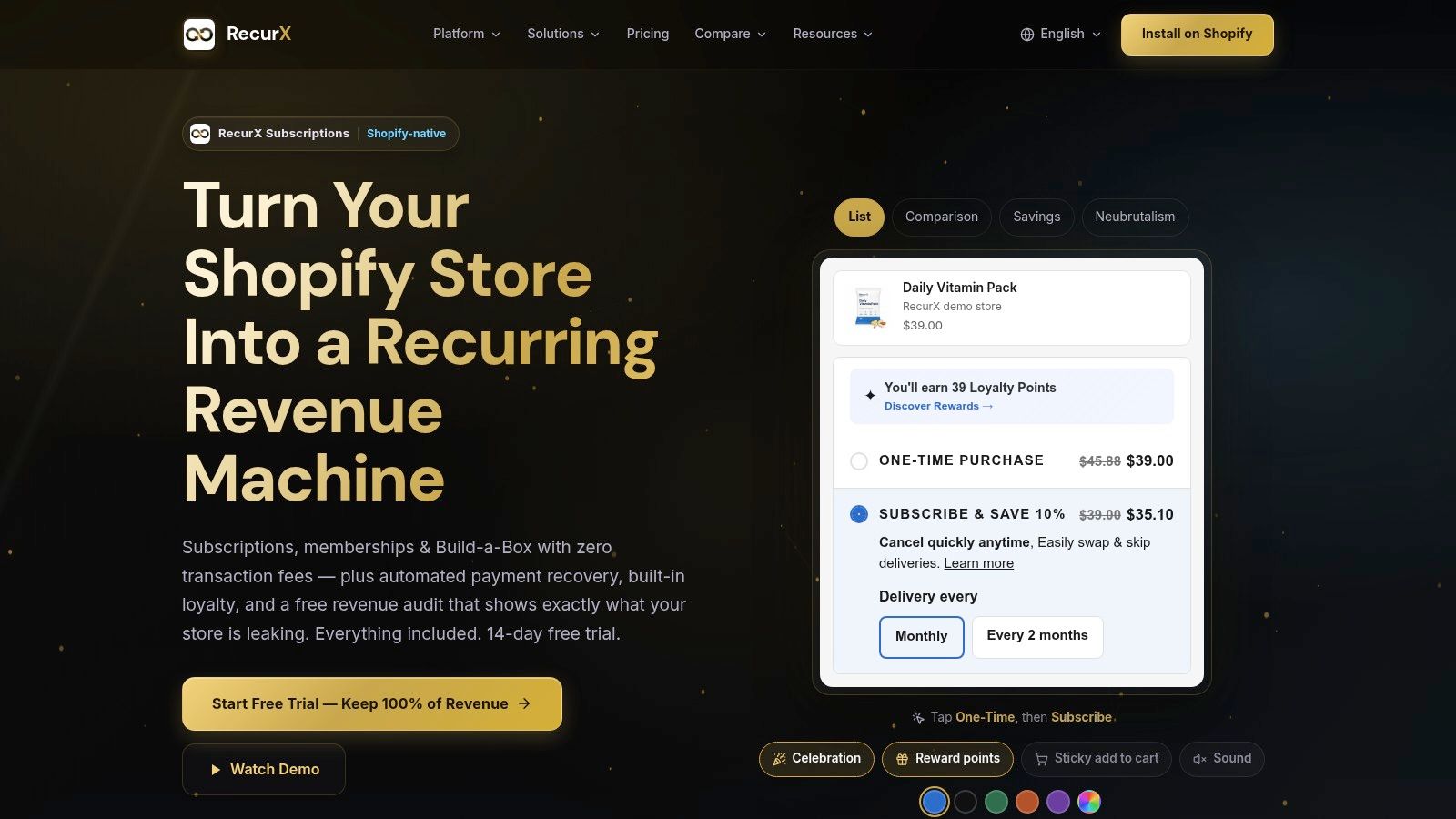
RecurX makes recurring orders part of the existing Shopify storefront. Product-page widgets can follow the store's theme, while the customer portal remains on the merchant's domain through Shopify customer accounts. Shoppers can pause, skip, swap products, change frequency, or update payment details without being sent to a separate subscription site. That continuity connects the visible offer to the account experience that determines whether customers keep control of future orders.
The integration pattern also shapes merchant operations. RecurX runs through Shopify admin and checkout interfaces, giving teams one workflow for subscription plans, customer actions, loyalty, bundles, and reporting. Recurring commerce attaches to the existing product catalog, which can reduce the migration from one-time selling to subscription selling for teams already organized around Shopify products and accounts.
Where RecurX stands out
Zero transaction fees across its plans gives merchants direct control over subscription revenue instead of allocating a percentage of recurring orders to the app. The financial trade-off is straightforward: fee control can matter more as recurring volume grows, while ecosystem breadth and platform maturity may matter more to teams seeking a large network of established add-ons.
Retention operations are built into the same pattern. Decline-aware retries, email, SMS, and WhatsApp dunning, plus one-click card-update links, address payment failures before they become avoidable cancellations. The portal and recovery flow therefore influence retention alongside the initial subscribe choice.
RecurX also supports Build-a-Box flows, curated bundles, quick checkout links, branded QR codes, loyalty tiers, and plan-based discounts. Its analytics connect product-page interactions with post-purchase behavior, including MRR, churn reasons, LTV, ARPU, AOV, and cohort retention. These tools give merchants a way to compare merchandising decisions with downstream subscription results rather than judging the widget in isolation.
Practical rule: Treat the portal and recovery flow as part of the offer. A persuasive subscribe widget cannot compensate for a frustrating cancellation or payment-update experience.
RecurX fits DTC brands launching or scaling recurring physical products and teams migrating from another subscription platform. This Shopify subscription implementation guide is relevant when planning the move from selling plans and product-page widgets to a self-service portal. Migration still requires checks on saved payment methods, theme behavior, and subscriber-volume transfer. RecurX has a smaller public review footprint than long-established incumbents, so that maturity trade-off deserves explicit validation.
RecurX suits merchants prioritizing native Shopify behavior, fee control, migration flexibility, and built-in retention infrastructure over a large add-on ecosystem.
2. Recharge
Recharge represents the mature enterprise migration pattern. Its storefront experience combines subscription selling with a customer portal, while its merchant tooling focuses heavily on retention, cancellation prevention, dunning, reactivation, bundles, gifting, rewards, and referrals. That breadth makes Recharge a natural candidate for brands whose subscription program already touches several parts of the lifecycle.
The customer-facing difference appears after the first order. A shopper can encounter cancellation-prevention journeys, reactivation prompts, bundle choices, and account controls rather than a simple recurring-order editor. These interactions can help a merchant learn whether a customer is leaving because of price, product fit, timing, or friction, provided the team configures the flows carefully.
The ecosystem trade-off
Recharge supports Shopify checkout behavior involving discounts, taxes, and shipping, and it offers a storefront widget alongside tools for custom experiences, including a JavaScript SDK and Storefront API. That gives developers room to reproduce the subscription experience inside a heavily customized theme or a more complex commerce build.
The cost decision deserves equal attention. Recharge uses metered per-transaction pricing, so the subscription fee grows with recurring order activity. That may be acceptable for merchants who value enterprise onboarding, support, and ecosystem depth, but it changes the margin calculation compared with a flat-fee alternative. Stores using Shopify Markets or complex selling-plan configurations should also test the complete checkout and account journey before switching traffic.
Recharge is strongest when migration risk and feature maturity outweigh the appeal of simpler fee modeling.
The Recharge platform fits a brand that wants a broad subscription operating system and structured support around a significant migration. It may be less attractive for a merchant whose primary goal is to minimize variable costs or keep the stack compact.
3. Skio
Skio is built around the idea that the customer portal can become the center of retention. Rather than treating account management as a utility page, its pattern combines lifecycle Journeys, segmentation, payment-recovery campaigns, loyalty, referrals, and upsell experiences. The storefront gets the customer into a subscription, but the portal and automated communications do much of the work that follows.
That changes how a merchant should evaluate the app. The key question isn't only whether shoppers can edit an order. It's whether the brand has a coherent path for skipped deliveries, failed payments, product changes, reactivation, and loyalty rewards. Skio's visual operations and merchant-facing UX support teams that want to manage those journeys without turning every adjustment into a manual task.
A portal-led retention model
Skio also supports Build-a-Box, volume discounts, and an AI-driven upsell carousel. These tools connect merchandising to subscription retention. A customer who wants variety can change the composition of an order, while a customer with growing demand can receive a more relevant offer than a generic discount.
The trade-off is financial complexity. Skio applies a per-order platform fee alongside a percentage fee, which can make the total cost heavier as recurring order volume expands. Merchants should model that structure against gross margin, average order value, discounting, and the amount of lifecycle automation they'll use.
Its Skio subscription platform is a strong comparison for brands prioritizing journey orchestration and portal-led churn reduction. Teams considering a move should also understand the broader context in this Recharge and Skio comparison, particularly when platform ownership and migration decisions affect long-term operational planning.
4. Loop Subscriptions
Loop Subscriptions follows a transparent, Shopify-account-centered pattern. Its customer portal is accessible through Shopify customer accounts with a single login, so shoppers don't need to remember a separate subscription credential or visit an unfamiliar domain. That small interaction choice can reduce friction when customers need to skip, swap, or update a recurring order.
On the storefront, Loop supports preset and build-your-own bundles, checkout links, and enhanced checkout options for Shopify Plus merchants. The merchant therefore gets a path from a standard Subscribe & Save offer to more structured subscription merchandising without abandoning the core Shopify purchase flow.
Transparent pricing with operational controls
Loop doesn't apply a per-order flat fee, which makes its pricing easier to reason about than a model that adds a fixed charge to every recurring transaction. Paid tiers still include a percentage fee, so the merchant needs to calculate the effect on subscription margin rather than treating “no per-order fee” as a zero-cost arrangement.
The operational toolkit includes smart dunning, cancellation flows, and one-click action links delivered through email or SMS. Those links can turn a recovery or cancellation message into an immediate account action instead of sending the customer through multiple screens. Higher tiers add managed migration and sandbox testing, while advanced API and webhook access is reserved for Pro and Enterprise plans.
Loop is a good fit when the buying decision depends on predictable structure, a single-login portal, and managed migration support.
The Loop Subscriptions platform deserves attention from smaller stores as well as established brands because it offers a Free Forever tier for small subscriber counts. Before choosing it, compare the plan's integration limits with the automations your operations and lifecycle teams expect to run. A Recharge versus Loop comparison can help frame that decision around pricing, migration, and portal behavior rather than feature count alone.
5. Appstle Subscriptions
Appstle Subscriptions takes the broad-feature, budget-conscious route. Its storefront pattern is particularly relevant to merchants selling configurable products, because Build-a-Box, bundles, tiered discounts, and subscription memberships can be presented as part of the product offer rather than added after checkout.
That matters for categories where customer choice drives order value. A merchant might let shoppers combine products, select a recurring cadence, and access a tiered incentive within one buying journey. The customer portal then provides one-click login and quick actions, giving shoppers a practical way to manage the arrangement without contacting support for every change.
Flexibility requires compatibility testing
Appstle supports translations, automation, APIs, and bulk operations, making it useful for teams that need to adapt subscription logic across products or markets. Its free plan and 0% transaction-fee positioning also make it an accessible starting point for merchants testing whether recurring orders fit their catalog.
The less visible decision is compatibility. Complex bundle setups can interact with themes, discounts, inventory rules, and other apps in ways that aren't obvious from a feature page. Community feedback is mixed around some stability and integration edge cases, so a serious implementation should test the exact theme, bundle logic, checkout behavior, and downstream fulfillment workflow before launch.
The Appstle Subscriptions app is best for merchants who want bundling, memberships, and localization options without immediately assembling several separate tools. It's less suitable for a team that wants to skip technical validation because the app's feature breadth can increase the number of interactions that need testing.
6. Bold Subscriptions
Bold Subscriptions is the merchandising-suite pattern. It makes the most sense when subscriptions need to work closely with Bold's pricing, upsell, and broader commerce tools. Instead of treating recurring orders as an isolated retention mechanism, Bold connects them to product-page upsells, in-portal offers, discount logic, and customer segments such as VIP or wholesale buyers.
The storefront implication is clear. A shopper may see a subscription offer alongside merchandising incentives, while an existing subscriber can encounter relevant upsells inside the portal. That can increase the commercial role of the account area, but it also means the merchant must keep pricing and discount rules understandable. A portal that presents too many offers can make routine subscription management feel promotional rather than helpful.
Validate the theme and discount stack
Bold supports Shopify Functions-based discount logic and integrates with Bold Custom Pricing and Bold Upsell. Those connections are valuable for merchants already committed to Bold's ecosystem, particularly when subscriber pricing must coexist with wholesale or segmented pricing rules.
The trade-off is recurring-order transaction fees. Merchants should also validate compatibility on their current Online Store 2.0 theme, because historical theme caveats make a staging test more useful than a purely feature-based comparison. Check the product page, cart, checkout, portal, discount stacking, and post-purchase communication as one connected journey.
The Bold Subscriptions platform fits brands that want subscription functionality embedded in a broader merchandising strategy. It's a weaker standalone choice if the merchant's only requirement is basic recurring billing with minimal ecosystem dependency.
7. Yotpo Subscriptions
Yotpo Subscriptions follows a retention-consolidation pattern. Its subscription widget and Shopify account-page portal sit alongside Yotpo's Reviews, Loyalty, and SMS products, giving merchants one vendor for social proof, rewards, messaging, and recurring orders. That arrangement can reduce the number of disconnected tools a lifecycle team has to coordinate.
The shopper experience benefits when those systems share context. A subscriber might see loyalty rewards connected to renewals, receive SMS communications through the same retention environment, and manage the subscription from an account page rather than moving across separate services. Reviews and user-generated content can also support the acquisition side of the subscription offer, although the quality of the experience depends on how the merchant connects each module.
Consolidation is valuable only when the stack is broad
Yotpo offers a passwordless customer portal, which removes a common account-access obstacle. Its documentation-led setup also suits teams that want to configure the experience without a large custom implementation.
Pricing is less transparent than tools with clearly published subscription tiers, and the strongest value usually appears when a merchant already plans to adopt several Yotpo products. As usage grows, premium pricing across those modules can outweigh the administrative benefit of consolidation. Review the complete contract, message volume, loyalty requirements, and analytics access instead of evaluating the subscription component alone.
The Yotpo Subscriptions suite is a logical choice for merchants seeking one retention vendor across reviews, loyalty, SMS, and subscriptions. It's less compelling for a store that already has effective lifecycle tools and wants a narrowly focused subscription platform.
Top 7 Shopify Subscription Apps, Feature Comparison
| Solution | Implementation Complexity 🔄 | Resource & Pricing ⚡ | Expected Impact 📊 | Ideal Use Cases 💡 | Key Advantages ⭐ |
|---|---|---|---|---|---|
| RecurX | Low–Medium, Shopify-native (Polaris/App Bridge), theme-auto widgets and migration tools for quick setup | Flat monthly ($29/$49), 0% transaction fees, 14-day trial; Basic capped at 1,000 subs | Higher opt-in and retention; reported 40–60% recovery on first retry; preserves margin 📊 | DTC Shopify merchants launching/scaling Subscribe & Save, subscription boxes, migrations | Keeps 100% revenue, native checkout UX, built-in retention + analytics |
| Recharge | Medium–High, Enterprise-grade migration and deep configurable flows; can require specialist setup | Metered per-transaction pricing (can add up at scale); enterprise support options ⚡ | Mature retention outcomes and stability for high-volume stores 📊 | High-volume or enterprise merchants needing robust migration and advanced retention | Deep feature depth, 24/7 support, extensive ecosystem |
| Skio | Medium, Fast onboarding and merchant-facing UX with lifecycle "Journeys" | Per-order + percentage fees (can be costly at scale) | Strong churn reduction via lifecycle automation and recovery campaigns 📊 | Brands prioritizing churn reduction, embedded loyalty and polished portal | Embedded loyalty, strong analytics & payment-recovery tooling |
| Loop Subscriptions | Low–Medium, Simple tiered setup, Shopify-account portal, straightforward migrations | Flat monthly tiers with no per-order flat fee; percentage on paid tiers; Free Forever option for small counts | Transparent cost structure + reliable dunning and portal UX 📊 | Merchants wanting predictable pricing, strong dunning and single-login portals | Free managed migration, sandbox testing, transparent pricing |
| Appstle Subscriptions | Medium, Feature-rich with APIs for customization; may need compatibility checks for complex bundles | Competitive pricing with free plan and 0% transaction messaging on paid tiers | Good for bundling/build-a-box, translations and automation outcomes 📊 | Budget-conscious merchants needing bundling, multilingual support and responsive help | Broad feature set, responsive support, customizable automations |
| Bold Subscriptions | Medium, Integrates tightly with Bold merchandising suite; validate theme compatibility | Recurring transaction fee applies; integrated with Bold ecosystem | Drives subscriber AOV via upsells and custom pricing flows 📊 | Merchants using Bold Custom Pricing or needing upsell + wholesale/ VIP pricing | Longstanding platform, strong upsell and pricing integrations |
| Yotpo Subscriptions | Medium, Embedded theme widgets and passwordless portal; part of a larger product suite | Pricing not transparently published; often bundled into broader contracts ⚡ | Unified retention metrics when combined with Yotpo Loyalty/Reviews/SMS 📊 | Merchants wanting a single vendor for reviews, loyalty, SMS and subscriptions | Tight integration with Yotpo retention stack, consolidated analytics |
Turn These Examples Into a Storefront Plan
Choose the storefront pattern before choosing the app. Decide whether the product page needs a simple Subscribe & Save selector, a bundle builder, a prepaid offer, loyalty messaging, or a more customized merchandising experience. That decision determines how much control the widget needs and whether the subscription app must coordinate with pricing, bundles, reviews, or campaign landing pages.
Then test the account experience. Customers should be able to understand their next charge, change products, skip a delivery, update payment details, and cancel without unnecessary support contact. The portal isn't a back-office detail. It shapes whether subscribers feel in control and whether your team can handle routine requests at scale.
Recovery deserves its own evaluation. Compare decline-aware retries, card-update links, dunning channels, cancellation flows, and reactivation journeys. A platform that creates recurring orders but leaves failed payments and avoidable cancellations to manual work may increase operational burden even if the storefront widget looks polished.
Match the pattern to the operating priority
- RecurX suits merchants seeking zero transaction fees, native Shopify behavior, built-in retention infrastructure, and migration flexibility.
- Recharge fits brands prioritizing mature enterprise migration support, broad retention features, and ecosystem depth.
- Skio is designed for lifecycle Journeys, portal-led experiences, payment recovery, and churn-focused operations.
- Loop Subscriptions works well when transparent pricing, Shopify customer accounts, and managed migration are central requirements.
- Appstle Subscriptions appeals to budget-conscious merchants that need bundles, Build-a-Box flows, automation, and translation support.
- Bold Subscriptions makes sense for brands already using Bold's merchandising suite for pricing and upsells.
- Yotpo Subscriptions is strongest when reviews, loyalty, SMS, and subscriptions should sit with one retention vendor.
The wider market context supports this gap-first approach. An independent benchmark of Shopify stores found dedicated analytics or attribution apps missing in 98.1% of stores, subscriptions missing in 97.4%, support missing in 89.4%, reviews missing in 75.1%, and email or SMS missing in 64.6%, as reported by Store Inspect's Shopify technology-gap benchmark. Those figures don't identify the best app. They show why merchants should diagnose the missing operational layer before comparing brand names.
Before launch, validate the following in a staging environment:
- Theme behavior: Confirm widget styling, accessibility, mobile layout, and compatibility with product options.
- Checkout compatibility: Test discounts, taxes, shipping, selling plans, and market-specific settings.
- Portal actions: Verify pause, skip, swap, frequency changes, payment updates, cancellation, and login behavior.
- Recovery workflows: Trigger failed payments and check retry timing, messages, links, and customer status changes.
- Integrations: Map Klaviyo, SMS, WhatsApp, loyalty, reviews, fulfillment, Shopify Flow, APIs, and webhooks.
- Migration constraints: Confirm subscriber records, active plans, billing dates, payment tokens, historical data, and redirect requirements.
- Analytics: Make sure the team can separate acquisition, subscription conversion, churn reason, recovery, cohort retention, and recurring revenue.
The best Shopify app example is therefore not the one with the most impressive list of features. It's the implementation pattern that makes the storefront clear, the portal useful, recovery measurable, and merchant operations manageable. Select against those outcomes, then test the complete customer journey before moving active subscribers.
RecurX gives Shopify merchants a native subscription experience with theme-matched widgets, self-service account management, payment recovery, bundles, loyalty, analytics, and migration tools. If you're comparing Shopify app examples for a recurring-product storefront, visit RecurX to evaluate how its zero-transaction-fee model and retention infrastructure fit your stack.
Shopify app examples · Shopify subscriptions · subscription apps · retention marketing · ecommerce apps
Keep reading
- Recurring Revenue Billing PlaybookMaster recurring revenue billing for Shopify DTC. Explore pricing models, retention metrics, payment recovery, and global compliance strategies.
- Shopify Subscription API: A Complete Integration Guide 2026Learn how to use the Shopify Subscription API with GraphQL examples, secure authentication, and webhook handling in this 2026 guide.
- Subscription vs One Time Purchase for ShopifyCompare subscription vs one time purchase models for Shopify. Analyze LTV, churn, and MRR impacts, plus how to implement recurring billing with RecurX.
Start growing recurring revenue on Shopify
RecurX has a 14-day free trial and zero transaction fees on every plan. Install in minutes.
Start your free trial →