Best Subscription App for Shopify: Top Picks Compared 2026
Find the ideal subscription app for Shopify to boost recurring revenue. Compare features, pricing, and reviews to choose the best solution for your store.
Find the ideal subscription app for Shopify to boost recurring revenue. Compare features, pricing, and reviews to choose the best solution for your store.
What makes the best subscription app for Shopify, the number of billing options, or the amount of revenue it protects after a payment fails? Subscribe-and-save is only the visible layer. A serious subscription stack also has to handle transaction fees, customer self-service, payment recovery, analytics, integrations, migration risk, and operational complexity without creating a second system for the merchant or the customer.
Shopify has made subscriptions a native operating model. Its documentation covers subscription revenue, active subscriptions, cancellations, purchase-option reporting, and lifecycle metrics such as MRR, churn, retention, and cohorts in the admin environment (Shopify's subscription considerations). The platform supports subscription products across the online store, Shopify POS, Shop, and custom storefronts, although some channel-specific implementations require dedicated extensions and Cart API work (Shopify's subscription implementation guidance).
This comparison evaluates 10 Shopify subscription apps through the decisions merchants face: fee exposure, subscription complexity, retention depth, Shopify-native implementation, migration effort, and the amount of developer or vendor support required. RecurX is assessed alongside established platforms, flexible mid-market tools, and enterprise options, so you can narrow the field before committing data, payment methods, and customer workflows to a new system.
Table of Contents
- 1. RecurX
- 2. Recharge
- 3. Loop Subscriptions
- 4. Skio
- 5. Appstle Subscriptions
- 6. Bold Subscriptions
- 7. Seal Subscriptions & Loyalty
- 8. PayWhirl Subscriptions
- 9. Ordergroove
- 10. Smartrr
- Top 10 Shopify Subscription Apps, Feature & Pricing Comparison
- Match the App to Your Growth Model
1. RecurX
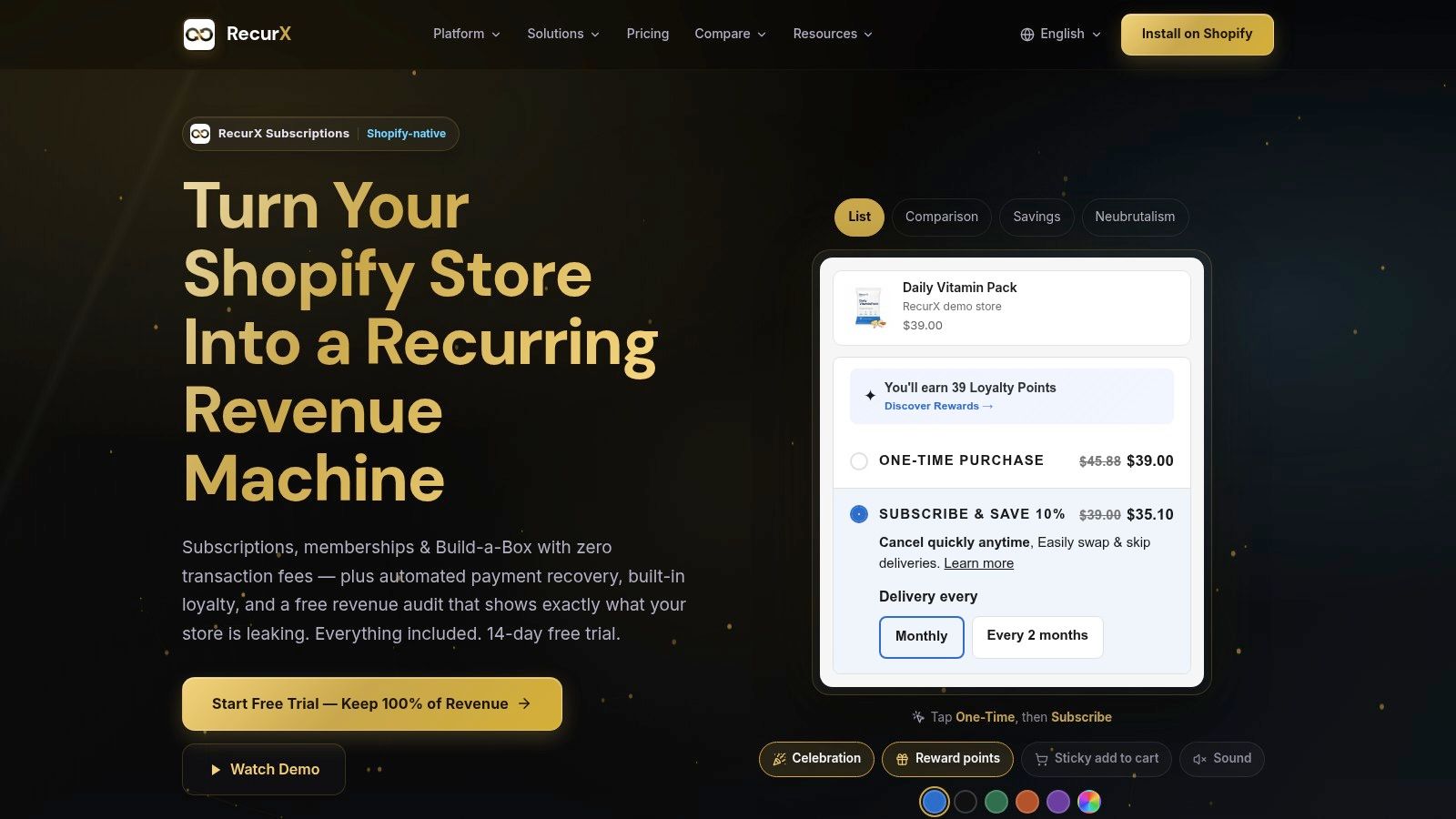
RecurX is the strongest fit for merchants that want a Shopify-native subscription app without adding a percentage fee to every recurring order. Its positioning is unusually broad: the platform combines selling plans, prepaid subscriptions, memberships, Build-a-Box flows, loyalty, payment recovery, analytics, customer self-service, and marketing connectors in one operating layer.
The central commercial distinction is zero transaction fees across its plans. That makes the pricing model easier to forecast than a percentage-of-GMV structure, particularly for brands with high average order values or substantial recurring volume. RecurX offers a 14-day free trial, with Basic priced at $29 per month for up to 1,000 active subscribers and Pro at $49 per month with unlimited subscribers, according to the supplied product brief. Merchants should still confirm current plan limits and included connectors before switching.
The app is built around Shopify's native checkout and admin experience, using Polaris and App Bridge. Customers can manage subscriptions on the merchant's domain, including pausing, skipping, swapping products, changing frequency, updating payment details, and cancelling. That matters operationally because a portal that exposes the right controls can reduce the need for support agents to make routine contract changes manually.
Retention and conversion depth
RecurX puts retention closer to the product than many basic subscription tools. Its payment-recovery workflow uses decline-aware retry windows, dunning through email, SMS, or WhatsApp, and one-tap card-update links. The supplied brief reports 40% to 60% recovery on the first retry, but that figure is a product-reported claim rather than an independently verified benchmark, so merchants should request the underlying methodology and test recovery by payment failure type.
The storefront layer is also more developed than a single subscribe-and-save widget. RecurX provides 20 widget templates, theme matching, contrast validation at render time, and A/B testing. Its plan types include pay-as-you-go, prepaid, memberships, tiered discounts, anchor-date billing, free trials, bundles, and mix-and-match subscriptions. Built-in loyalty can reward renewals through points, VIP tiers, milestones, or store credit.
Practical rule: A low app fee doesn't automatically mean a low total cost. Compare the subscription fee with payment recovery, support workload, migration services, and the developer time needed to reproduce your existing customer experience.
Migration and limitations
RecurX provides migration utilities for Recharge, Bold, Skio, Loop, Yotpo, and CSV imports, with token migration where supported. That gives agencies and merchants a clearer exit path from legacy platforms, but migration still needs contract validation, payment-token checks, selling-plan testing, and customer-account QA. The product brief describes supported migrations as targeting about an hour, which should be treated as a workflow target, not a guarantee for complex stores.
The trade-off is maturity. RecurX has fewer public reviews and fewer long-term case studies than the longest-established incumbents. Basic also caps active subscribers, while some integrations and portal capabilities are reserved for Pro. Choose it when margin preservation, native operations, accessible widgets, and retention tooling matter more than the reassurance of a large legacy ecosystem.
2. Recharge
Recharge remains a credible choice for brands that need a mature subscription environment rather than a lightweight installation. It supports replenishment programs, subscription boxes, memberships, prepaid plans, variant-level selling plans, customer self-service, upsells, cancellation-prevention flows, APIs, and webhooks.
Its practical advantage is ecosystem depth. A team with custom workflows, a technical partner, or an established lifecycle stack can use the platform's documentation and extensibility to build around subscription contracts instead of treating the app as a closed widget. That makes Recharge particularly relevant when the store needs unusual portal actions, custom order logic, or integrations that go beyond standard Shopify flows.
The fee question
The commercial decision is less straightforward than the feature list. Published starter pricing includes per-transaction processing fees, so the merchant must model the fee against recurring order volume rather than looking only at the monthly platform charge. A flat-fee alternative may be more economical for a high-volume brand, even if Recharge's ecosystem reduces implementation risk.
Recharge also tends to require more configuration than a simple subscribe-and-save tool. That isn't necessarily a weakness. Complex catalogs benefit from deeper controls, but a small merchant may pay in setup time and operational complexity for capabilities it won't use.
The best reason to choose Recharge is maturity plus extensibility. The strongest reason to reject it is fee exposure or unnecessary complexity. Merchants comparing it with a native, flat-fee alternative can review this Recharge alternative for Shopify, then calculate total cost using active contracts, average recurring order value, cancellation volume, and support requirements.
3. Loop Subscriptions
Loop Subscriptions is built for merchants that want predictable subscription costs and a polished retention experience. Its published positioning emphasizes flat monthly plans with no per-order app fees, which directly addresses the margin problem created by percentage-based subscription pricing.
That pricing structure is useful when recurring revenue is growing faster than the merchant's appetite for variable software costs. The comparison shouldn't stop at the headline fee, though. Confirm which plan includes the integrations, migration support, portal controls, analytics, and automation your team needs.
Loop supports customer portals, discount logic, migration assistance, and integrations with Klaviyo, Yotpo, and more than 30 tools according to the supplied product brief. A first-cycle promotion that changes after a defined renewal pattern can help merchants separate acquisition pricing from ongoing subscription economics, rather than locking every renewal into the initial discount.
Where Loop fits
Loop makes sense for a DTC brand moving away from a metered-fee tool but not yet needing a sales-led enterprise deployment. Its Shopify-native focus can reduce the distance between the storefront, customer account, and subscription contract. That helps teams that want a modern customer experience without rebuilding the entire subscription stack.
The limitation is ecosystem breadth compared with the longest-tenured platforms. Advanced customizations may still require vendor support or developer involvement, especially around unusual bundle rules, custom storefronts, or complex operational automations. Loop is therefore best for a merchant with clear requirements and a willingness to validate edge cases before migration.
For a direct comparison of commercial and operational trade-offs, see this Recharge versus Loop Subscriptions analysis. The important question isn't which app has more features. It's whether the predictable fee model and retention workflow justify any migration or customization effort.
4. Skio
Skio targets Shopify brands that treat subscription performance as an operational discipline, not just a recurring checkout option. Its strengths are a clean merchant experience, analytics orientation, migration support, and tools for managing subscription programs at scale.
The platform is particularly relevant for stores selling across markets. Selling-plan management can align with Shopify Markets and localized pricing, while discount-stacking controls help teams define how subscription incentives interact with other promotions. Those details matter because international pricing can create unexpected contract behavior if the merchant hasn't tested currency, market, discount, and renewal combinations together.
Developer involvement and migration
Skio is a premium option, so the financial decision extends beyond software fees. A merchant should compare its onboarding and support model with the internal cost of maintaining a less expensive app. White-glove assistance can be valuable during a migration, bulk update, or pricing change, but it may be unnecessary for a simple replenishment catalog.
Some currency behaviors still inherit Shopify constraints. That means Skio doesn't remove the need for platform-level validation. Before a launch, test plan creation, checkout, renewal, customer-account actions, discount stacking, and price changes in each important market.
Migration is a contract exercise, not a widget swap. Validate active plans, renewal dates, payment methods, discounts, customer accounts, and order history before redirecting every subscriber.
Skio suits a scaling brand that values analytics clarity and guided implementation. It is less compelling for a small store that needs only basic recurring billing and wants to keep monthly software overhead low.
5. Appstle Subscriptions
Appstle Subscriptions is a flexible option for merchants that want broad subscription functionality without immediately moving into an enterprise buying process. It supports multiple subscription types, prepaid programs, bundles, memberships, customer portals, and integrations, making it useful for stores whose model is more complicated than a single replenishment product.
Its pricing appeal comes from accessible entry options, including free-tier limits described in the product brief. That can lower the barrier to testing a subscription model before committing to a larger platform. The trade-off is that total cost can rise as the merchant adds APIs, webhooks, advanced add-ons, or higher-volume capabilities.
Configuration versus control
Appstle gives merchants a wide configuration surface. That's helpful for teams that need control over plan behavior, bundle structures, memberships, and price updates. It also creates a governance requirement: someone must document which settings govern existing subscriptions, new subscribers, discounts, renewals, and customer-account changes.
Automatic and selective price-update controls are especially relevant when product costs or market pricing change. A merchant should decide whether existing subscribers retain their current price, receive a new price after notice, or require an explicit customer action. That policy is as important as the app setting because it affects retention, support contacts, and compliance workflows.
Appstle is a good fit for value-conscious brands that want configurability and approachable onboarding. It may become less attractive when the store requires advanced integrations, deep retention automation, or extensive custom development that pushes the merchant into higher tiers. Treat the free or entry plan as a testing environment, not proof that the long-term stack will remain inexpensive.
6. Bold Subscriptions
Bold Subscriptions has a long history in Shopify subscriptions and is particularly relevant to merchants using Shopify Plus workflows or the broader Bold ecosystem. It supports API access, complex subscription experiences, and connections with Bold Custom Pricing for member or VIP pricing programs.
That ecosystem fit is the main reason to consider it. A brand that already uses Bold tools may be able to coordinate subscription benefits with member pricing more naturally than it could across unrelated applications. It can also appeal to teams that need deeper customization than a basic selling-plan app provides.
Cost and operational fit
Published plans use transaction-based pricing, so recurring order volume directly affects the software bill. That creates fee exposure as the subscription program grows. Merchants should model the cost against gross margin, average order value, renewal frequency, and the value of Bold's support or customization capabilities.
Bold frequently offers a 60-day free trial, according to the supplied product brief, but trial duration and commercial terms can change. Confirm the current offer before using it as part of a migration plan.
The platform is less attractive for a small store that needs a straightforward recurring product and predictable fixed pricing. Its value appears when the merchant has complex pricing relationships, Plus requirements, or an existing Bold investment. Otherwise, the added ecosystem depth may not offset the transaction-fee structure and configuration work.
7. Seal Subscriptions & Loyalty
Seal Subscriptions & Loyalty is aimed at cost-sensitive merchants with straightforward subscription requirements. It supports fixed schedules, anchor dates, minimum-commitment controls, and basic loyalty features, while its published plan model does not add per-order fees.
That combination makes Seal practical for a small catalog, a simple replenishment program, or a merchant that wants loyalty attached to recurring orders without adopting a large retention platform. The flat-plan structure also makes budgeting clearer than a percentage-of-revenue model, provided the selected plan includes the required subscriber volume and capabilities.
The edge-case test
Seal's limitations become more relevant when operations are complicated. Enterprise features, advanced automation, and deep integrations may be less extensive than those offered by premium competitors. Support or carrier-related edge cases can also require workarounds, so the merchant should test shipping rules, delivery dates, skipped orders, address changes, and failed payments before launch.
This is a tool to evaluate by operational simplicity, not by feature-count comparison. If the store sells one replenishable product family and customers need pause, skip, and cancel controls, Seal may cover the core workflow. If the business runs bundles, multiple markets, custom checkout, or elaborate retention campaigns, the team should confirm those flows in a staging environment.
Seal is best when predictable cost and basic scheduling outrank enterprise extensibility. It isn't the obvious choice for a brand that expects its subscription model to become a complex membership, loyalty, and multi-channel system.
8. PayWhirl Subscriptions
PayWhirl offers a balanced Shopify subscription toolkit for merchants that want native selling-plan support, a customer portal, invoices, bulk actions, and clear Shopify-billed plans. Its developer-friendly documentation makes it appealing to teams that want control without buying a heavily managed enterprise deployment.
The Shopify-native implementation is important. Selling plans and checkout integration keep the core purchase flow close to Shopify's purchase-option model, which can simplify setup and reduce the number of separate billing systems a merchant must reconcile. Developers still need to validate theme behavior, customer accounts, order editing, and integrations rather than assuming native checkout solves every operational issue.
Retention depth
PayWhirl's weakness is not basic subscription management. It's the relative lack of a heavily marketed loyalty and retention suite compared with premium competitors. Merchants can build more advanced lifecycle workflows through Shopify and third-party integrations, but that shifts responsibility to the internal team.
That makes PayWhirl a sensible choice for an SMB with a competent operator or developer who wants a clean foundation and transparent plan structure. It's less suitable for a retention team looking for extensive built-in dunning, loyalty, cancellation prevention, and behavioral segmentation in one application.
Before signing up, verify whether the current plan includes the features you consider essential and whether any usage-based charges apply. PayWhirl's appeal lies in balance. It doesn't try to be every system at once, which can be an advantage when the merchant already has a strong email, SMS, analytics, or loyalty stack.
9. Ordergroove
Ordergroove is an enterprise-grade platform for Shopify Plus brands with complex catalogs, global operations, and demanding subscription economics. It supports advanced incentive and pricing controls, price-lock logic, APIs, migration options, headless implementations, and dedicated customer success in common deployments.
The platform is designed for a different decision than an entry-level subscription app. An enterprise merchant may need to coordinate markets, currencies, incentives, customer accounts, fulfillment logic, lifecycle marketing, and custom storefront behavior. Ordergroove's developer documentation and headless options are relevant when standard theme widgets cannot represent the required experience.
When enterprise depth is justified
Ordergroove is typically sales-led, with pricing quoted according to usage or volume. That means the merchant must evaluate the proposal against implementation support, developer resources, migration risk, and the cost of operational failure. A higher platform cost can be rational when a complex subscription program requires dedicated expertise, but it's overkill for a basic replenishment plan.
The right questions are architectural. Does the app support the required Shopify Plus checkout and account flows? Can it preserve the commercial rules applied to existing subscribers? How will the team monitor payment recovery, price changes, and cross-market renewals? What happens when the storefront is headless or the product catalog changes?
For a broader explanation of the capabilities expected from a subscription billing platform, compare the operating requirements rather than the vendor's feature labels. Ordergroove earns consideration when complexity is the business model. It doesn't earn consideration merely because the store has a large catalog.
10. Smartrr
Smartrr emphasizes subscriber experience, branded account portals, loyalty-style features, bundles, memberships, and analytics. It supports both curated and replenishment subscriptions, along with digital and physical products, so it can fit brands that want recurring revenue connected to a broader membership proposition.
Its customer portal is the main differentiator. A branded, self-service experience can help subscribers manage products and preferences without contacting support, while retention actions and dunning keep the platform focused beyond initial conversion. That makes Smartrr a strong candidate for a brand where the subscription relationship is part of the customer experience, not just a billing schedule.
Margin and price-change constraints
Published plans use percentage-of-subscriber-GMV fees, according to the supplied product brief. That structure can become material as average order value or recurring volume rises, so the merchant should compare it with flat-fee options before deciding. A percentage fee may be acceptable if the portal, analytics, and retention features replace other tools, but that needs to be demonstrated in the store's own economics.
Price changes also require careful testing. Existing subscriptions don't automatically retro-update without the relevant customer action, following Shopify constraints described in the brief. That can protect customer expectations, but it also means the merchant needs a clear communication and migration process for price adjustments.
Smartrr suits a brand that prioritizes a polished portal and multiple subscription program types. It is less compelling when the primary requirement is the lowest recurring software cost or when the merchant wants full control over price changes without platform-level limitations.
Top 10 Shopify Subscription Apps, Feature & Pricing Comparison
| Product | Core features ✨ | UX / Quality ★ | Pricing & value 💰 | Target audience 👥 | Notable differentiator |
|---|---|---|---|---|---|
| RecurX 🏆 | Flexible plans (pay-as-you-go, prepaid, memberships, Build-a-Box), loyalty, dunning, native widgets & portal, analytics, migrations | 5.0★, accessible theme-matched widgets, A/B testing | 14‑day trial; Basic $29/mo (≤1k subs), Pro $49/mo (unlimited), zero transaction fees 💰 | DTC brands, Shopify Plus, agencies 👥 | 🏆 Zero tx fees; Shopify-native (Polaris/App Bridge); WCAG auto-match widgets |
| Recharge | Customer portal, upsell/cancellation flows, prepaid & variant-level plans, extensive APIs | Mature ecosystem, proven at scale ★★★★ | Starter includes per-transaction fees, costs rise with volume 💰 | Scale DTC & enterprise merchants 👥 | Large ecosystem, extensive docs & enterprise support |
| Loop Subscriptions | Flat monthly plans, portal, Klaviyo/Yotpo integrations, migration support | Transparent UX, high App Store rating ★★★★ | Flat fees; $0 per-order/app fees (reduces margin erosion) 💰 | DTC brands migrating from metered-fee tools 👥 | Transparent pricing + strong retention UX |
| Skio | Markets/localized pricing, discount stacking, bulk ops & migrations | Clean merchant UX, analytics-forward ★★★★ | Premium pricing vs entry-level apps 💰 | Scaling brands needing analytics & onboarding help 👥 | White-glove onboarding and operational tooling |
| Appstle Subscriptions | Bundles, memberships, prepaid, selective price updates, portal | Highly configurable, frequent updates ★★★ | Competitive entry tiers; higher tiers add cost at scale 💰 | SMBs and mid-tier merchants 👥 | Strong configurability and approachable onboarding |
| Bold Subscriptions | Plus-oriented APIs, member/VIP pricing synergy, complex models | Long-standing, Plus-certified ★★★ | Published plans include transaction-style fees, can erode margins 💰 | Shopify Plus & brands needing deep customization 👥 | Deep customization; integrates with Bold suite for pricing |
| Seal Subscriptions & Loyalty | Fixed schedules, anchor dates, minimum commitments, basic loyalty | Budget-friendly, simple UX ★★ | Flat-plan pricing; clear predictable cost, good for small catalogs 💰 | Cost-sensitive small stores & simple subscribe programs 👥 | Strong value for straightforward use cases |
| PayWhirl Subscriptions | Shopify selling-plan support, portal, invoices, bulk actions | Developer-friendly, clear docs ★★★ | Transparent Shopify-billed pricing; balanced for SMBs 💰 | SMBs and developer teams seeking flexibility 👥 | Good balance of configurability and cost |
| Ordergroove | Enterprise APIs, price-lock/incentive controls, headless & Markets support | Enterprise-grade, dedicated success ★★★★ | Sales-quoted, usage/volume pricing, typically higher cost 💰 | High-volume enterprise / Shopify Plus merchants 👥 | Advanced incentives, global/enterprise feature set |
| Smartrr | Curated/replenishment subscriptions, branded portal, dunning, bundles | Strong branded subscriber UX ★★★★ | Percentage-of-GMV fees on published plans, can impact margins 💰 | Brands wanting a branded portal & loyalty-like features 👥 | Brandable portals with retention actions and analytics |
Match the App to Your Growth Model
The right subscription app for Shopify depends less on the longest feature list than on the failure mode you're trying to avoid. If recurring fees are eroding margin, prioritize a flat or zero-transaction-fee model and calculate the full cost at your expected subscription volume. If support tickets are the constraint, evaluate pause, skip, swap, frequency changes, payment updates, cancellation flows, and the quality of the customer portal. If failed payments are the main source of churn, inspect retry timing, card-update links, dunning channels, and reporting by failure reason.
Choose RecurX when zero transaction fees, built-in payment recovery, accessible storefront widgets, native Shopify operations, loyalty, analytics, and supported migration are central requirements. Its combination is especially relevant to DTC brands selling supplements, coffee, skincare, pet products, bundles, or memberships, and to agencies moving clients from Recharge, Bold, Skio, Loop, or CSV-based systems. The candid limitation is maturity. RecurX has fewer public reviews and long-term case studies than established incumbents, while some integrations and capabilities depend on the selected plan.
Consider Recharge when ecosystem depth, documentation, APIs, webhooks, and mature subscriber workflows justify transaction-fee exposure. Choose Loop when predictable monthly pricing and retention UX matter, but the business doesn't need the broadest enterprise ecosystem. Skio fits scaling brands that value analytics, guided onboarding, and market-aware selling-plan management. Appstle is attractive for configurable subscriptions, bundles, memberships, and accessible entry tiers, while Seal suits simpler programs where budget control matters more than advanced orchestration.
Bold remains relevant for Plus merchants and brands already using Bold pricing tools. PayWhirl is a balanced foundation for teams comfortable extending Shopify with integrations. Smartrr makes sense when the branded subscriber portal is part of the product experience. Ordergroove belongs on the shortlist only when global, headless, high-complexity, or enterprise operational requirements justify a sales-led deployment.
Before switching, verify current pricing, subscriber limits, included integrations, Shopify channel compatibility, account architecture, migration requirements, and any restrictions on payment-token transfer. Shopify supports subscriptions across online store, POS, Shop, and custom storefront channels, but channel support can involve different implementation work, so don't treat an app-store listing as proof that every flow is ready for production.
Use this implementation sequence:
- Export subscriber data: Preserve contracts, products, selling plans, renewal dates, discounts, customer identifiers, statuses, and order history.
- Validate payment migration: Confirm whether payment tokens can move between platforms and identify subscribers who require a secure payment-method update.
- Test selling plans: Recreate intervals, prepaid terms, anchor dates, bundles, minimum commitments, trials, discounts, and market-specific pricing.
- Test the customer portal: Verify pause, skip, swap, frequency changes, address updates, payment updates, cancellation, and reactivation on mobile and desktop.
- Run payment-recovery scenarios: Test declines, retries, dunning messages, card-update links, expired cards, and the final subscription status after recovery fails.
- Protect analytics continuity: Map MRR, active subscriptions, cancellations, churn reasons, cohorts, LTV, AOV, and renewal reporting before and after launch.
- Monitor post-launch churn: Watch involuntary churn, voluntary cancellations, support contacts, failed renewals, portal usage, and plan-level retention instead of relying only on new subscription orders.
A migration is complete only when the customer can buy, manage, renew, recover, and cancel without confusion, and the merchant can explain every contract state in Shopify's admin.
RecurX combines zero transaction fees with Shopify-native selling plans, customer self-service, payment recovery, loyalty, analytics, accessible widgets, and migration tools for supported platforms. If those priorities match your subscription model, visit RecurX to review the current plans and assess whether it can replace a fee-heavy or fragmented subscription stack.
subscription app for Shopify · Shopify subscriptions · subscription management · recurring revenue · Shopify apps
Keep reading
- Shopify Subscription API: A Complete Integration Guide 2026Learn how to use the Shopify Subscription API with GraphQL examples, secure authentication, and webhook handling in this 2026 guide.
- Subscription vs One Time Purchase for ShopifyCompare subscription vs one time purchase models for Shopify. Analyze LTV, churn, and MRR impacts, plus how to implement recurring billing with RecurX.
- How to Sell Subscriptions Online on ShopifyLearn how to sell subscriptions online on Shopify. Build flexible plans, optimize checkout, recover failed payments, and boost retention with RecurX.
Start growing recurring revenue on Shopify
RecurX has a 14-day free trial and zero transaction fees on every plan. Install in minutes.
Start your free trial →