10 Shopify Plus Apps for Enterprise Growth
Compare 10 Shopify Plus apps for subscriptions, B2B, marketing, support, analytics, and growth, with pricing signals, trade-offs, and migration notes.
Compare 10 Shopify Plus apps for subscriptions, B2B, marketing, support, analytics, and growth, with pricing signals, trade-offs, and migration notes.
Most advice about Shopify Plus apps gets the sequence wrong. It starts with the catalog, then ranks tools by popularity, then assumes the store with the most integrations has the strongest operation. That's backwards. A better Shopify Plus stack starts with the bottleneck.
If recurring revenue is the constraint, you need subscription infrastructure that protects margin and lowers churn. If AOV is lagging, merchandising and post-purchase systems matter more than another email app. If support volume is swamping your team, self-serve account tools and a Shopify-native helpdesk will usually outperform another layer of automation. And if you're migrating from a legacy stack, the question isn't feature count. It's implementation risk, data continuity, and how much operational complexity each new tool adds.
That matters because Shopify Plus merchants don't run light app stacks. One 2026 benchmark found Plus stores install 3.7 apps on average versus 1.4 on standard stores, a 2.6x gap, which signals a much denser and more specialized operating model for larger merchants (Shopify store benchmark analysis). The ecosystem is also large enough to create real selection risk. By April 2026, the Shopify App Store had 17,591 active apps, and one industry report estimated Shopify Plus merchants averaged 11.4 installed apps (Shopify app ecosystem statistics).
That's why this comparison doesn't treat all Shopify Plus apps as interchangeable. I'm evaluating each one by the operational problem it solves, the dependencies it creates, the pricing signals to watch, and the trade-offs that show up after launch, not during the demo. If you want broader ecommerce growth operations insights, that same lens applies across your whole stack.
Table of Contents
- 1. RecurX
- 2. Recharge
- 3. Skio
- 4. Loop Subscriptions
- 5. Ordergroove
- 6. Rebuy
- 7. Klaviyo
- 8. Gorgias
- 9. Okendo
- 10. Tapcart
- Shopify Plus Apps: Top 10 Feature Comparison
- Choose the Stack That Matches Your Next Constraint
1. RecurX
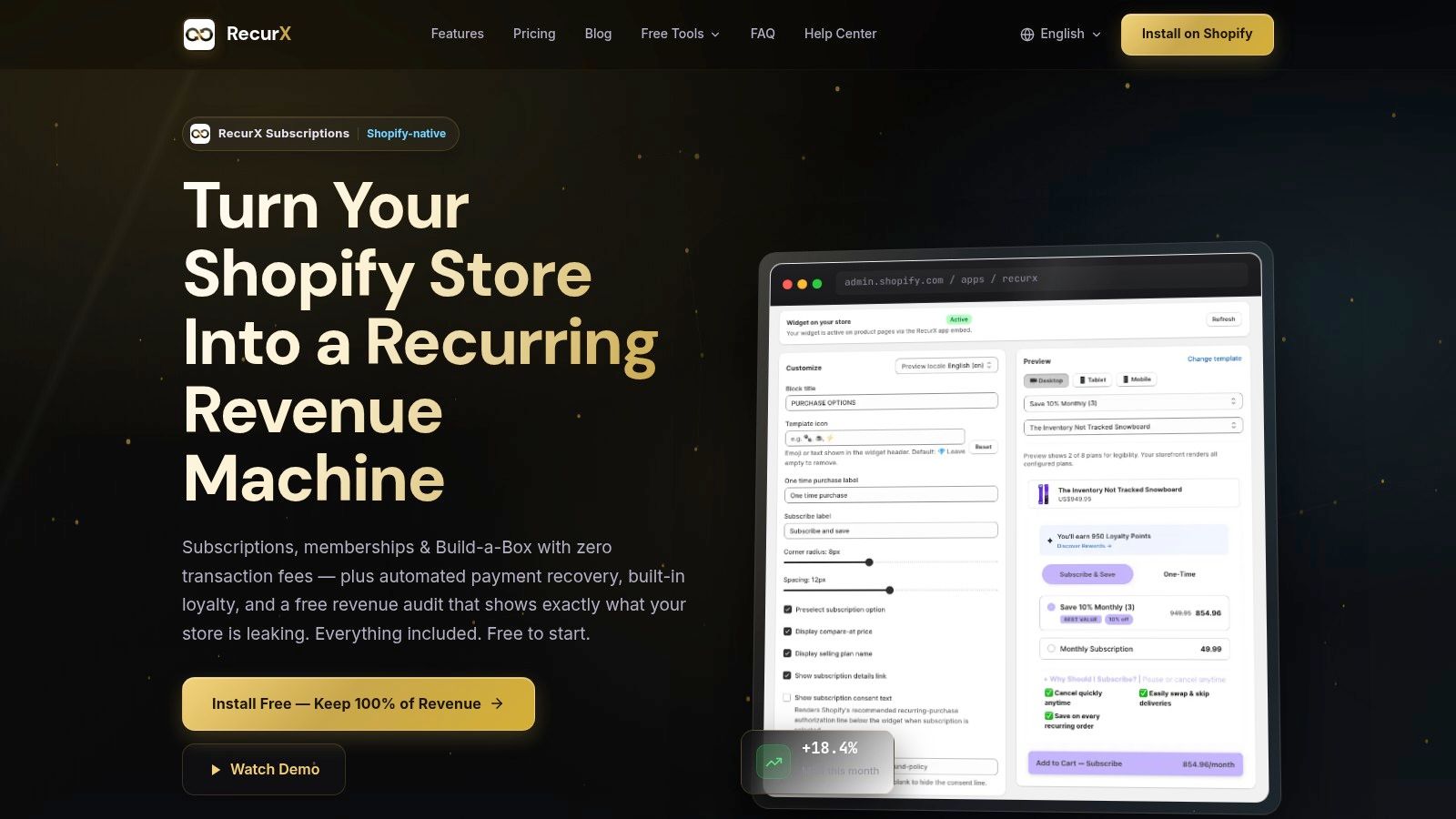
RecurX is a good fit for Plus merchants whose subscription problem is operational, not just technical. Plenty of apps can add recurring orders. Fewer reduce the hidden costs that show up after launch: transaction fees that erode margin, failed-payment churn, support tickets from weak self-service, and extra software added just to patch retention gaps.
That framing matters for enterprise teams. A subscription app does not sit alone in the stack. It affects support load, retention workflows, reporting quality, checkout behavior, and migration risk. RecurX stands out because it tries to keep more of that system in one product instead of pushing merchants toward separate tools for loyalty, dunning, portal management, and analytics.
Its product architecture also suggests a tighter Shopify fit than older platforms that still feel partly external. RecurX uses Shopify-native components such as Polaris UI, App Bridge v4, and JWT sessions. For Plus operators already standardizing on Shopify checkout extensibility and customer accounts, that lowers the chance that subscriptions become an awkward side system with separate admin logic.
Where RecurX fits best
RecurX makes the most sense for replenishment brands with recurring purchase behavior already baked into the catalog. Supplements, coffee, skincare, and pet consumables are the obvious examples. It is also worth considering for agencies or in-house teams replacing a legacy subscription app where fee structure, migration effort, and retention tooling all need review together.
The pricing signals are unusually clear. RecurX offers a free tier for small programs, then paid plans starting at $9.90 per month, $49 per month, and $149 per month as subscriber volume and feature needs increase. Across those plans, the notable commercial point is zero transaction fees, including on the free tier. For merchants with strong subscriber retention and healthy order volume, that can matter more than a lower headline app price.
Practical rule: If subscriptions are already a meaningful revenue line, compare fee models first. A platform that charges on every recurring order often gets expensive faster than teams expect.
Trade-offs, implementation effort, and migration notes
RecurX covers more than recurring billing. The platform includes payment recovery, retry logic, card-update flows, dunning through email, SMS, and WhatsApp, self-serve account controls, bundle support, Build-a-Box capabilities, loyalty features, and subscription analytics tied to metrics such as churn reasons, LTV, ARPU, AOV, and cohort behavior. That breadth is useful when the operational goal is stack reduction, but it also means teams should decide early which modules they will use. Buying an all-in-one system and then keeping separate loyalty or messaging tools defeats part of the cost case.
Migration is one of its more relevant enterprise claims. RecurX supports moves from platforms such as Recharge, Bold, Skio, Loop, and Yotpo, with CSV migration and token migration where supported. The vendor also promotes a fast path for supported migrations. That should be treated as a starting point, not a guarantee. Larger Plus merchants still need to validate token portability, historical contract data, customer portal redirects, cancellation flows, and reporting continuity before cutover.
There are constraints. Some advanced capabilities are reserved for the Scale plan, and the free tier is narrow by design. RecurX also has less long-term market history than some incumbent subscription vendors, which may matter to procurement teams that prefer mature ecosystems, larger implementation partner networks, or a long public record of enterprise support.
The upside is practical. Retention tooling is built into the product instead of sold as a chain of add-ons. The customer portal runs through Shopify customer account integration on the merchant's own domain, which can reduce support contacts tied to subscription edits. Its merchandising layer also goes further than many billing-first competitors, with prebuilt widgets designed to match store styling and support accessibility checks.
RecurX is not the obvious choice for brands that want a heavyweight services model around subscriptions. It is a stronger fit for merchants that want to protect subscription margin, simplify the retention stack, and keep billing, self-service, and recovery logic closer to Shopify.
2. Recharge
Recharge remains one of the default names in subscription infrastructure because it's mature, broadly integrated, and familiar to agencies and operators who've run large DTC programs before. That familiarity is a real asset. When a team has to migrate quickly or support a complex existing subscriber base, proven implementation patterns matter.
Its core strengths are what most Plus merchants expect from an established subscription platform: native Shopify checkout support, subscription contracts, customer portal controls, dunning logic, payment recovery, and multi-currency handling. Recharge also benefits from a broad partner ecosystem, which makes it easier to slot into an existing analytics, retention, or support stack.
Where Recharge makes sense
Recharge is a good fit when your team values ecosystem maturity over fee minimization. It's especially practical for brands that already rely on external tools for loyalty, support, and analytics, and just need a subscription engine with established migration playbooks.
One reason it stays so relevant is market penetration. In a 2026 adoption study of 74,777 Shopify Plus stores, subscriptions were still selective rather than universal, with Bold Subscriptions at 6.1% adoption, while core ecosystem tools such as Shop Pay, PayPal Express, and Klaviyo showed much higher penetration (Shopify Plus app adoption study). The takeaway isn't that one subscription app “wins.” It's that subscription tooling has to justify itself in a crowded Plus stack.
Recharge is often easiest to defend when subscriptions are already a meaningful business model, not a speculative side project.
Trade-offs to watch
The biggest caution is pricing structure. Recharge commonly involves platform or processing-related costs that can become expensive at volume. That doesn't automatically make it a poor fit. It means enterprise buyers should model the cost curve before migration, especially if subscription revenue is already large.
Implementation effort is moderate. The platform is well documented, but advanced use cases often require coordination across lifecycle marketing, customer experience, and analytics. If you're comparing leading subscription systems head-to-head, this Recharge vs Loop subscriptions comparison is a useful secondary read.
Recharge is best for teams that want a mature subscription platform and can accept the pricing complexity that often comes with category incumbents. Visit Recharge.
3. Skio
Skio has built its reputation around cleaner onboarding and a more efficient subscription launch experience. That makes it appealing to Shopify Plus teams that want recurring revenue infrastructure without a long implementation runway.
Its best feature isn't breadth. It's control over recurring pricing behavior. Skio supports automatic recurring-price policy changes after a set number of cycles, which is useful for trial-to-standard pricing, introductory discounts, or phased subscriber economics. Not every brand needs that. Subscription-led DTC brands often do.
Best use case
Skio works well when your bottleneck is getting a polished Subscribe and Save program live fast, while preserving enough control to manage plan logic over time. Theme-native widgets and native selling-plan support reduce the amount of storefront adaptation many teams have to do after install.
This kind of simplicity matters in a Shopify Plus environment that's already app-heavy. Another 2026 ecosystem analysis estimated that only about 9.4% of Shopify Plus stores used the leading subscriptions app, while Plus merchants averaged 11.4 apps each, reinforcing that subscriptions sit inside a crowded operational stack rather than defining it (Shopify app ecosystem map for Plus merchants).
Where complexity shows up
Skio is less compelling if your program needs highly specialized dunning behavior, more complex bundle logic, or a broader embedded retention system. Those needs can still be addressed, but often through workarounds or adjacent tools. That's the recurring trade-off with leaner subscription systems. Faster setup can mean more reliance on external apps later.
A few candid points:
- Good fit: Brands that want fast deployment and straightforward selling-plan controls.
- Less ideal: Teams looking for one app to cover subscriptions, loyalty, advanced recovery, and deeper analytics in one place.
- Pricing signal: Plus-scale pricing usually requires a quote, so procurement visibility may come later than some operators prefer.
If Skio is on your shortlist, compare not just front-end widgets but also migration flexibility, retry logic, and reporting depth. This Skio alternative analysis is worth reviewing before you commit. You can explore the product at Skio.
4. Loop Subscriptions
Loop Subscriptions is appealing for a less glamorous reason than feature volume. It makes subscription economics easier to forecast. For Shopify Plus operators managing an already layered stack across retention, support, analytics, and merchandising, a flat-fee model with no per-order take rate can be more useful than a broader feature set that gets more expensive as recurring revenue grows.
That pricing structure changes the evaluation. The question is not only what Loop can do at launch. It is whether its cost model stays sensible once subscriptions connect to email, customer support, product reviews, and on-site personalization. Teams comparing Loop with Recharge, Skio, or even a lighter fallback such as RecurX should model total operating cost alongside churn recovery and portal flexibility.
Where Loop fits best
Loop is strongest for merchants that already know their subscription program shape. Prepaid plans, memberships, build-a-box offers, tiered discounts, and step-up pricing are the clearest examples. Shopify-native checkout support also reduces friction if the goal is to keep the storefront and recurring purchase flow close to core Shopify behavior instead of building a more customized subscription layer.
The practical advantage is control without immediate enterprise overhead.
That said, Loop works best in the middle of the market. It covers more than a basic subscribe-and-save app, but it does not signal the same service-heavy, fully customized operating model as platforms built for larger enterprise subscription programs. If your retention stack already depends on Klaviyo flows, Gorgias support macros, and review data from Okendo, Loop can fit cleanly. If you want the subscription app itself to own more of the retention and service logic, validate those boundaries early.
What to test before rollout
Loop still requires careful scenario testing before migration or launch. Mid-cycle changes, cancellation rules, failed payment handling, customer account expectations, and payment-processor edge cases should all be reviewed in staging. Those checks matter because subscription apps rarely fail on headline features. They fail on operational exceptions that create finance tickets, support load, or reporting inconsistency.
A few candid signals:
- Good fit: Plus merchants that want predictable app spend, solid selling-plan flexibility, and a subscription system that can sit alongside existing retention and support tools.
- Less ideal: Teams that need highly custom enterprise logic, heavier white-glove implementation, or a subscription platform that replaces several adjacent systems.
- Pricing signal: Flat-fee pricing is attractive at scale, but buyers should still ask how migration, support scope, and advanced configuration affect total cost.
- Implementation note: The work is usually in migration mapping, portal rules, and lifecycle integrations, not in turning on the app.
Visit Loop Subscriptions.
5. Ordergroove
Ordergroove sits in a different tier from lighter Shopify subscription apps. It's built for merchants that treat recurring commerce as an enterprise program with custom rules, service requirements, and integration expectations, not just a storefront feature.
That distinction matters because Shopify's native platform has expanded. Multiple independent guides note that by 2026, checkout customization, B2B basics, and some automation had moved closer to core Shopify functionality, while app value shifted toward specialized gaps such as subscriptions, retention, and complex orchestration (analysis of Shopify Plus native capability shifts). Ordergroove lives in that specialized layer.
When Ordergroove earns its cost
If you need installment logic, access-based subscriptions, membership structures, deep API control, implementation services, and enterprise identity controls like SSO, Ordergroove deserves consideration. It's suited to programs where recurring commerce interacts with finance rules, customer entitlements, or more involved offer architectures.
This is not the tool for merchants that just want to turn on Subscribe and Save next quarter. It's for operators who expect a longer deployment, heavier internal coordination, and a more formal vendor relationship.
The real trade-off
Ordergroove's limitation isn't feature weakness. It's organizational overhead. Enterprise pricing is usually custom, implementation is more involved, and contract complexity rises with the sophistication of the deployment.
That's often justified when the subscription model itself is complex. It's wasteful when the merchant mainly needs basic replenishment subscriptions. If your team includes product, engineering, finance, and CX stakeholders in the buying process, Ordergroove is more likely to fit. Explore Ordergroove.
6. Rebuy
Rebuy matters when conversion rate is acceptable but basket formation is weak. In that situation, another retention tool usually does less than better product discovery, smarter cart logic, and tighter post-purchase merchandising.
That framing is important because Rebuy is often bought as a personalization app, while its day-to-day job is closer to revenue orchestration across the buying journey. It covers product recommendations, bundles, cart offers, checkout extensions, post-purchase upsells, and merchandising inside customer account or subscription flows. For Plus teams, that breadth can reduce app sprawl. It can also centralize too much influence in one system if ownership is unclear.
A useful way to evaluate Rebuy is by asking which constraint comes first. If the current problem is low AOV, weak attach rate, or poor cross-sell visibility, Rebuy is a logical candidate. If the current problem is subscriber billing logic, churn prevention, or support workflow depth, it belongs behind tools like Recharge, Skio, Loop, Ordergroove, Klaviyo, or Gorgias in the buying order.
Why some Plus teams get strong results from it
Rebuy gives merchandising and growth teams more control over commercial moments that Shopify does not manage on its own. That includes deciding which add-ons appear in cart, which bundles deserve promotion, which post-purchase offers should fire, and how subscription-related offers are surfaced to the right shoppers.
The upside is highest when the business already has meaningful traffic, clear product affinities, and a team willing to test offer logic continuously. Rebuy can support subscription commerce well, but usually as a multiplier rather than the core recurring engine. A subscription app manages billing, skips, swaps, and customer rules. Rebuy improves what gets added around those flows.
What to weigh before buying
Complexity rises fast once Rebuy touches PDPs, cart, checkout, post-purchase, and subscriber experiences at the same time. Attribution becomes the first problem. If every incremental item is credited to the personalization layer, reporting can overstate lift and hide whether merchandising logic is improving behavior.
Implementation effort also varies more than buyers expect. A simple recommendation rollout is one project. Coordinating bundles, cart rules, checkout offers, and subscription data across several storefront experiences is another.
Before rollout, buyers should verify three things:
- Data dependencies: Rebuy needs reliable product, order, cart, and often subscription data to make its logic useful.
- Operating owner: Someone on merchandising, growth, or ecommerce has to manage tests, placements, exclusions, and offer fatigue.
- Pricing shape: Plan limits, feature gating, and revenue-based pricing signals need review before Rebuy expands into more surfaces.
Rebuy is usually a good fit for Plus merchants whose next operational problem is monetizing existing demand more efficiently, not creating demand from scratch. See Rebuy.
7. Klaviyo
Klaviyo matters on Shopify Plus because retention systems usually fail at coordination, not message volume. A merchant can have strong acquisition, a capable subscription app, and plenty of customer data, then still send the wrong message after a skip, failed payment, swap, or cancellation request. Klaviyo earns its place when it becomes the system that turns those events into usable customer-state logic.
That role is broader than email. Klaviyo sits between Shopify, subscription infrastructure, support tooling, and paid growth audiences. If Recharge, Skio, Loop, or Ordergroove manages the recurring order, Klaviyo often handles the communication logic around onboarding, replenishment timing, churn risk, win-backs, and cross-sell sequences. In practice, that makes it one of the coordination layers in a Plus stack, not just a campaign tool.
The upside is clear when the underlying event model is clean. The limitation is just as clear when it is not. If multiple apps pass overlapping events, customer properties, and product signals into Klaviyo, teams often end up with bloated profiles, duplicate triggers, conflicting segments, and attribution disputes that make retention reporting less credible.
A better buying question is simple: what operational problem is Klaviyo solving for you?
If the answer is lifecycle orchestration across subscription, retention, and merchandising, the fit is strong. If the answer is only newsletter sends and basic flows, many Plus merchants will pay enterprise-level software costs for capability they do not use.
Three practical signals help separate a good fit from an expensive one:
- Strong fit: You need segmented journeys tied to subscriber status, product behavior, purchase history, and support or loyalty signals.
- Pricing signal: Costs usually rise with profile growth, messaging volume, and poor list hygiene. Large databases with weak suppression rules become expensive fast.
- Implementation dependency: Success depends on event governance. Someone has to define naming conventions, map subscription states correctly, and decide which platform owns each trigger.
This also affects migration planning. Teams moving from a lighter ESP into Klaviyo should audit flows before importing them. Recreating every legacy automation usually preserves old mistakes. Subscription brands get more value by rebuilding around real lifecycle states such as active subscriber, skipped next order, failed charge, churned, and reactivated. This subscription email marketing guide is a useful reference for that planning process.
Klaviyo is a strong choice for Plus merchants that need one retention layer to work across ecommerce, subscription, and customer data systems. It is a weaker choice for teams without clear ownership, because the platform rewards disciplined operators and punishes loose taxonomy. You can evaluate the platform at Klaviyo.
8. Gorgias
Support usually exposes stack problems earlier than checkout does. On Shopify Plus, rising ticket volume is rarely just a service issue. It often signals weak self-serve flows, poor subscription visibility, fragmented order data, or too many apps forcing agents to assemble context by hand.
Gorgias is useful because it treats support as an ecommerce workflow, not a generic inbox. Agents can view Shopify data inside conversations and act on common commerce requests without jumping across as many tools. For Plus merchants, that distinction matters more than having the longest feature list. A broad helpdesk can still slow a team down if subscription status, order history, loyalty context, and marketing signals sit in separate tabs.
The strongest fit is a brand whose support queue is absorbing operational work that should be distributed across the stack. Subscription brands are a good example. Failed payments, skip requests, delivery timing questions, and plan changes all generate avoidable tickets if the customer portal is weak or the subscription app does not pass clean status data into support. Gorgias improves agent efficiency, but it does not fix the upstream design problem. Teams still need their subscription system, portal layer, and retention tools to agree on customer state.
That is also the main trade-off. Gorgias can reduce handling time while increasing system dependence. Once macros, automations, and app connections are built around it, support becomes more capable and more tightly coupled to the rest of the stack. Migration is possible, but it gets harder when business logic lives inside helpdesk rules instead of in the underlying commerce systems.
A practical evaluation is to map the queue before buying more seats or more automation. Separate tickets into two groups. Exception handling, such as damaged orders, fraud review, or edge-case account issues, is a good use of Gorgias. Routine tasks, such as order status checks or basic subscription changes, usually belong in self-serve flows first.
Pricing deserves more scrutiny than the demo usually gives it. Costs can rise with ticket growth and AI usage, so the key question is not whether automation exists. It is whether the platform will reduce human workload enough to offset volume-based pricing during peak periods and post-purchase surges.
Gorgias is a strong choice for Plus merchants with meaningful service complexity and enough systems discipline to keep support data clean. It is a weaker choice for brands trying to use the helpdesk as a substitute for a better subscription portal, account experience, or retention architecture. You can evaluate the platform at Gorgias.
9. Okendo
Okendo addresses a quieter problem than subscriptions or support. Trust density. On larger stores, social proof can't just be a reviews widget under the fold. It has to feed conversion, retention, and customer insight across the journey.
That's why Okendo is more interesting as a customer marketing layer than as a pure review tool. Reviews with attributes, photo and video UGC, AI summaries, and adjacent modules for loyalty, referrals, surveys, and quizzes give merchants a way to consolidate pieces that often sprawl across separate apps.
Why it matters operationally
For Shopify Plus teams, Okendo is most useful when they want social proof to connect with lifecycle marketing and merchandising. Tight Shopify and Klaviyo integrations help, especially when review content, loyalty behavior, and segmentation need to inform one another.
The bundle story is the appeal. If your current stack uses one tool for reviews, another for referrals, and another for loyalty nudges, Okendo can reduce overlap. That's usually more valuable than any one feature on its own.
Limits to keep in mind
The trade-off is pricing shape. Costs often scale with order volume, and some advanced capabilities are modular rather than fully included. That means Plus merchants should ask for current bundle pricing based on realistic usage, not entry-level assumptions.
Merchants usually overestimate the value of “more reviews” and underestimate the value of structured review data they can actually reuse in merchandising and retention.
Okendo is a strong fit for DTC brands that want UGC, review capture, and adjacent customer marketing capabilities in a cleaner package. Visit Okendo.
10. Tapcart
A branded mobile app is usually purchased too early.
For many Shopify Plus brands, the constraint is not mobile conversion. It is repeat engagement after the first purchase. Tapcart addresses that problem by giving teams a direct channel for push notifications, app-only merchandising, and logged-in customer experiences that are harder to reproduce well in the browser.
The value is clear only if mobile already behaves like a retention channel. Brands with frequent drops, replenishment cycles, membership perks, or strong loyalty participation can justify the extra layer. Brands with weak repeat demand usually add channel complexity faster than they add revenue.
That trade-off matters more than feature breadth. Tapcart's no-code app builder and Shopify sync reduce development burden, but they do not reduce operating burden. Someone still has to own campaign planning, app merchandising, QA, and audience logic across the app, email, SMS, support, and subscription stack.
A practical way to evaluate Tapcart is to test four dependencies before procurement:
- Retention model: Do customers already return often enough to support app install behavior and push engagement?
- System fit: Will subscriptions, loyalty status, reviews, and promotions display cleanly inside the app, or will key journeys break across tools?
- Team capacity: Is there an owner for app content, launch calendars, and segmentation?
- Pricing signal: Expect custom pricing. Ask for total cost in the context of projected app-driven revenue, not just app launch speed.
Tapcart tends to work best as part of a connected retention system, not as a standalone growth fix. If your stack already includes tools such as Recharge or Skio for subscriptions, Klaviyo for lifecycle messaging, Gorgias for support, and Okendo for social proof, the app can become the mobile surface that ties those programs together. If those systems are still fragmented, the app often exposes that fragmentation rather than solving it.
The migration question is less technical than operational. Replacing a custom mobile app with Tapcart may simplify maintenance. Launching a first app from a mobile web store adds a new channel that needs governance from day one.
Explore Tapcart.
Shopify Plus Apps: Top 10 Feature Comparison
| Product | Core features | UX & Quality | Value & Pricing | Target & USP |
|---|---|---|---|---|
| RecurX 🏆 | Subscriptions, Build‑a‑Box, widgets, portal, loyalty, dunning, analytics | 20 theme‑auto WCAG templates; native Shopify UX (Polaris/App Bridge); ★★★★★ | Free → Scale (Free ≤25; $9.90/$49/$149); 💰 zero transaction fees | 👥 DTC & Plus brands; ✨ zero fees, fast ~1h migration, built‑in retention |
| Recharge | Subscription billing, contracts, dunning, portal, multi‑currency, integrations | Proven enterprise flows; rich docs; ★★★★ | Tiered pricing + platform/processing fees; 💰 can be high at volume | 👥 Large DTC & Plus; ✨ mature ecosystem & migration playbooks |
| Skio | Selling‑plan controls, price‑ramp, theme‑native widgets, portal, SMS options | Fast setup; merchant‑friendly onboarding; ★★★★ | Lean SMB pricing; Plus quotes for scale; 💰 mid/quote | 👥 Brands focused on Subscribe & Save; ✨ cycle-based price automation |
| Loop Subscriptions | Flat monthly plans, payment recovery, Build‑a‑Box, portal, Shopify-native | Predictable flows; straightforward migration support; ★★★★ | Flat monthly (no per-order fees); 💰 predictable billing | 👥 High-volume / Plus merchants; ✨ flat-fee model, migration help |
| Ordergroove | Advanced promos, installments, API-first, subscription manager, SSO | Enterprise-grade controls; implementation-heavy; ★★★★ | Custom enterprise quotes; 💰 premium | 👥 Complex enterprise programs; ✨ deep pricing & service offerings |
| Rebuy | AI recommendations, dynamic bundles, personalization across PDP/cart/checkout | Strong personalization & AOV lift potential; ★★★★ | Package/enterprise pricing; ROI-focused; 💰 variable | 👥 Plus merchants seeking AOV lift; ✨ AI-driven dynamic bundles |
| Klaviyo | Email & SMS automations, segmentation, deep Shopify data sync | Mature CDP & flows; Shopify playbooks; ★★★★★ | Profile-based pricing; SMS carrier fees; 💰 scales with profiles | 👥 Lifecycle marketing teams; ✨ rich Shopify integrations & templates |
| Gorgias | Omnichannel helpdesk, Shopify order actions, AI automations | Ecommerce-native support UX; ★★★★ | Ticket/AI metered pricing; 💰 can spike at scale | 👥 Support teams for Shopify stores; ✨ actionable Shopify context & macros |
| Okendo | Reviews & UGC, photo/video, loyalty & referrals (add‑ons), Klaviyo sync | Strong on-site UGC displays; ★★★★ | Module/add-on pricing; volume-based; 💰 scales with orders | 👥 DTC brands prioritizing UGC; ✨ bundled reviews + loyalty |
| Tapcart | No-code mobile app builder, push notifications, in-app merchandising | Branded mobile apps fast; real‑time Shopify sync; ★★★★ | Custom quotes per features/scale; 💰 enterprise | 👥 Brands wanting mobile channel; ✨ fast no-code app + push engagement |
Choose the Stack That Matches Your Next Constraint
The right Shopify Plus apps rarely come from a “top tools” list alone. They come from being honest about what's slowing the business down right now. If recurring revenue is unstable, start with subscription infrastructure. If support volume is rising faster than headcount, start with self-serve account control and a better support layer. If conversion is healthy but order value is flat, prioritize merchandising and personalization before adding more acquisition pressure.
The sequence matters because Shopify Plus stores don't operate with one app per problem. As noted earlier, app density is already high across larger merchants. Adding software without naming the operational constraint usually gives you overlap, more data handoffs, and more internal work to manage exceptions. Enterprise capability isn't just feature breadth. It's the ability to solve a specific bottleneck without creating two new ones.
A practical buying sequence is straightforward:
- Identify the primary bottleneck: Choose one. Recurring revenue, migration risk, AOV, lifecycle marketing, support load, social proof, or mobile retention.
- Shortlist a leader and one alternative: Don't compare six tools at once. Compare one category leader against one credible counter-option.
- Validate Shopify Plus dependencies: Check checkout extensibility requirements, customer-account behavior, Shopify Flow compatibility, and whether the app writes useful data back into your core systems.
- Model full commercial cost: Include usage-based charges, enterprise packaging, implementation help, migration effort, and any add-ons your team will realistically need.
- Test the ugly workflows: Failed payments, plan swaps, portal logins, order edits, analytics exports, support handoffs, and migration edge cases usually reveal more than the polished demo environment.
For subscription-led merchants, RecurX deserves special attention when margin protection, migration speed, retention tooling, and operational simplicity are all high priorities. Zero transaction fees on every plan change the economics. Built-in loyalty and dunning reduce the need for extra retention software. The native Shopify architecture lowers the chance that your subscription system becomes an awkward sidecar. And the migration connectors matter if you're already paying for complexity you no longer want.
That doesn't make every other tool secondary. Recharge remains a serious option for teams that want subscription maturity and a broad ecosystem. Skio fits merchants that want a cleaner launch path. Loop appeals to operators who care about predictable billing. Ordergroove serves heavier enterprise subscription programs. Rebuy addresses AOV and personalization. Klaviyo anchors lifecycle messaging. Gorgias handles support complexity. Okendo helps turn UGC into a more integrated trust and retention asset. Tapcart gives repeat-purchase brands a stronger mobile engagement channel.
The strongest Shopify Plus stack is the one your team can operate well. Pick the app layer that removes the next constraint, not the app catalog that looks most impressive in procurement.
If subscriptions are central to your Shopify Plus growth plan, RecurX gives you a Shopify-native way to launch or migrate recurring revenue without per-order transaction fees, while keeping retention, loyalty, analytics, and self-serve account management in one system. It's a practical fit for brands that want less stack sprawl and more control over subscription margin. See how it works at RecurX.
shopify plus apps · Shopify Plus · ecommerce apps · subscription apps · Shopify marketing
Keep reading
- How to Set Up Recurring Payments on ShopifyLearn how to set up recurring payments on Shopify the right way. Covers gateways, tokenization, dunning, retries, and monitoring MRR and churn.
- Shopify Subscription Theme Explained and How to ChooseLearn what a Shopify subscription theme is, how it works with apps like RecurX, and how to choose a Shopify subscription theme that converts.
- Shopify Subscription Template Setup Made SimpleLearn how to implement and customize your Shopify subscription template with RecurX widgets, theme matching, and QA tips for higher conversions.
Start growing recurring revenue on Shopify
RecurX has a free-forever plan and zero transaction fees on every tier. Install in minutes.
Install RecurX free →