Shopify Subscription Discount Playbook That Works
Set up a Shopify subscription discount that lifts retention, not just sign-ups. Covers tiers, trials, ramp pricing, testing, and the metrics that matter.
Set up a Shopify subscription discount that lifts retention, not just sign-ups. Covers tiers, trials, ramp pricing, testing, and the metrics that matter.

A 20% subscription discount can increase sign-ups while weakening the business underneath them. The important question isn't whether a Shopify offer converts. It's whether the price structure still produces healthy, active customers after the first renewal, when the introductory incentive no longer feels new. One 2026 benchmark reports that discounts above 20% were associated with a 35% churn increase, despite improving conversion, which makes discount depth a retention and margin decision, not a checkout-only decision (Swell's subscription retention guidance).
Shopify gives merchants a solid foundation for this work. From the Discounts page, you can create subscription-only discounts, limit codes to subscription purchases, and configure recurring-payment rules. Shopify also supports percentage discounts, fixed amounts, fixed prices, and weekly, monthly, or yearly delivery intervals in its subscription plan discount workflow (Shopify's subscription discount documentation). The playbook below focuses on what happens after that setup, how to structure the incentive so the second and third orders justify the first-order cost.
Table of Contents
- Why Most Shopify Subscription Discounts Leak Retention
- The Four Discount Structures Shopify Merchants Actually Use
- Native Shopify Billing Versus a Subscription App
- Building a Tiered Ramp Discount Step by Step
- Pricing, Messaging, and Segmentation Practices That Hold
- Testing Subscription Discounts the Right Way
- A Pre-Launch Checklist Before You Ship the Discount
Why Most Shopify Subscription Discounts Leak Retention
The most common Shopify subscription discount is easy to explain: offer a large saving on the first order, collect the opt-in, then return the customer to the standard recurring price. That structure can inflate the sign-up rate while leaving the customer unprepared for the next charge. If the buyer joined mainly for the deal, the price reset becomes a cancellation trigger rather than a renewal moment.
The more useful benchmark compares curated, stackable, or personalized incentives with flat-rate discounts. An analysis of 100 top subscription businesses reported that those more deliberate incentive structures produced 40% more repeat orders and improved retention after the second order by 32% versus flat-rate offers (Ordergroove's retention analysis). The lesson isn't that every store should copy one percentage. It's that the offer should be designed around the renewal behavior you want.
Practical rule: Treat every discount as a retention investment with a measurable payback period, not as a conversion ornament.
The four structures used most often shift different cohort metrics:
- Tiered discounts can encourage customers to reach later billing cycles, affecting order progression and longer-run subscriber value.
- A ramp after a defined number of orders rewards commitment and can improve retention around the early renewal window.
- Free or discounted trials are designed to move trial conversion into a paid renewal, but they can attract low-intent users when the value isn't clear.
- Anchor-date billing reduces uncertainty around the first recurring charge and can influence early payment continuity and cancellation avoidance.
A useful way to think about the trade-off is to separate day-30 retention, day-90 retention, and contribution margin. A discount that wins the first order but loses the next renewal is expensive acquisition. A smaller opening incentive that keeps the customer active can produce better economics even if its headline conversion rate looks less impressive. That's the broader principle behind stop wasting budget on the wrong goal, especially when acquisition reporting hides what happens after checkout.
| Discount Structure | Day-30 Retention | Day-90 Retention | Contribution Margin Impact |
|---|---|---|---|
| Flat discount | May produce strong initial opt-in, but the price reset can create early cancellations | Vulnerable when the introductory price ends | Repeated margin loss if the discount continues on every order |
| Curated or personalized discount | Designed around the customer's behavior or milestone | Better suited to repeat-order progression | Discount spend can be concentrated where it changes behavior |
| Time-bound ramp | Gives the customer a clear path from incentive to standard pricing | Helps test whether commitment grows across renewals | Front-loaded cost with a defined renewal floor |
| Benefit-loaded offer | Uses credit, bonus product, or access instead of only reducing price | Can support perceived value without training customers to wait for a lower price | Often protects the monetary price while adding controlled fulfillment cost |
The table is a decision tool, not a promise of a universal outcome. Measure the cohorts that receive each structure, then keep the offer that produces profitable active subscribers rather than the one that merely produces the most initial orders.
The Four Discount Structures Shopify Merchants Actually Use
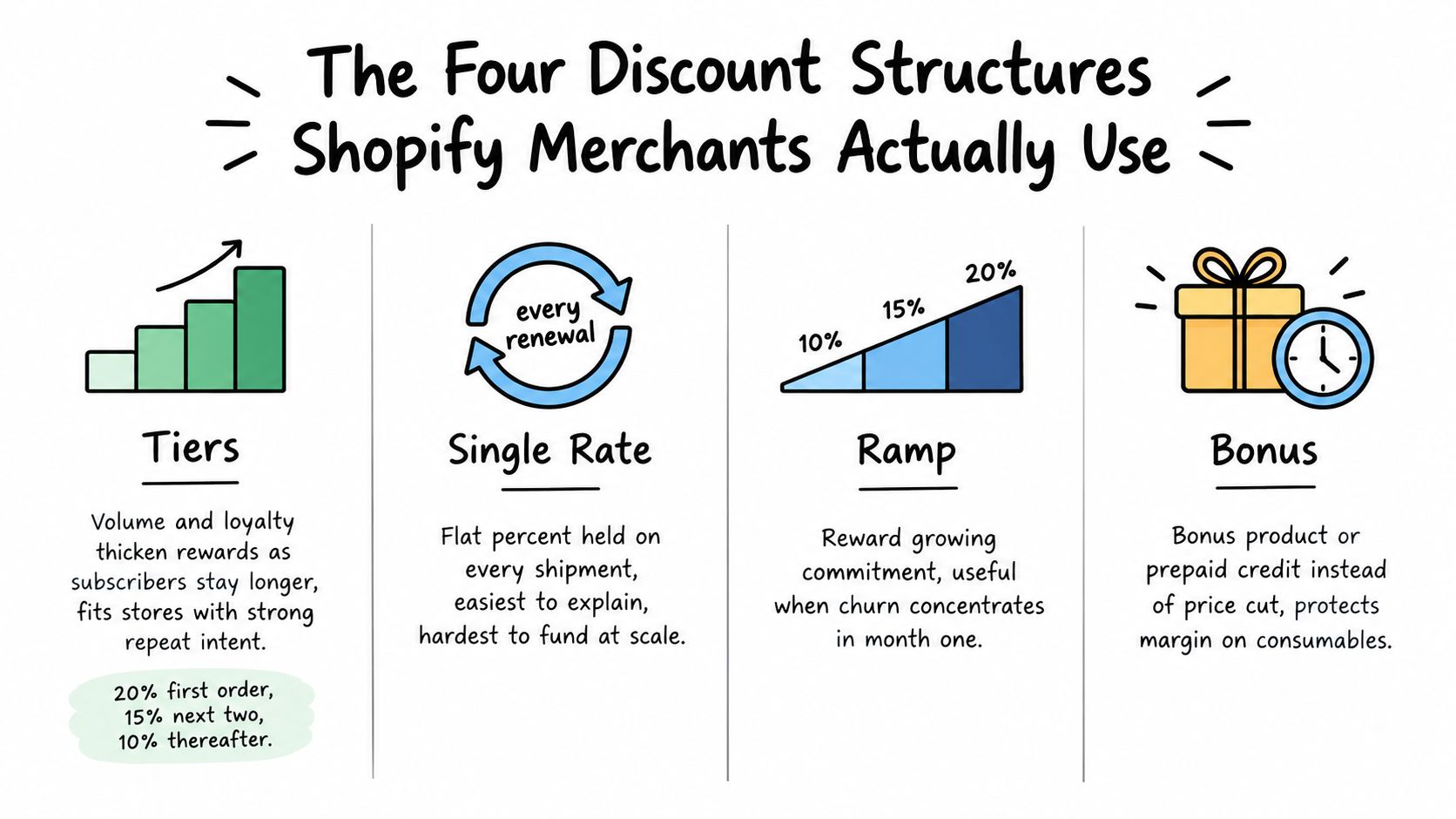
A Shopify subscription discount changes more than checkout conversion. Its depth and timing shift retention, renewal progression, trial conversion, and contribution margin in different ways. Choose the structure according to the behavior you need to change, not the highest opt-in rate.
Tiered discounts reward continued participation
A tiered plan starts with a stronger offer, then steps down as the subscriber demonstrates intent. A replenishment store might offer 20% off the first order, 15% off the next two, and 10% thereafter, as shown in the comparison asset. Coffee, pet food, vitamins, and skincare are natural fits because the customer already understands why another order is useful.
Track order progression, particularly movement from the first charge to the second and later renewals. The structure can improve early commitment while protecting more margin over time. State the schedule clearly on the product page. Calling it “20% off subscriptions” would hide the actual terms and create avoidable disappointment when the discount changes.
Ramp-after-N-orders pricing rewards tenure
A ramp starts with a modest saving and grants a stronger price after the second or third successful renewal. It suits products that require habit formation, education, or repeated use before customers recognize their full value.
The main cohort metric is 90-day LTV, supported by renewal progression. Customers earn the larger incentive through continued use, so the merchant does not pay the maximum discount to subscribers who cancel after the first shipment. The trade-off is a weaker initial offer, which can reduce opt-ins even as it improves the economics of retained cohorts.
Trial cycles fit products that need to prove value
A free or discounted trial fits products customers need to experience before deciding whether they belong in a routine. Vitamins, specialty coffee, and pet food can benefit when onboarding explains usage and expected results. For physical goods, a discounted first cycle often tests payment intent more directly than a completely free shipment.
Measure trial-to-paid conversion, then check the first paid renewal. Many trial starts with few paid continuations indicate sampling demand, not durable subscription demand. A discounted opening cycle also makes the margin cost visible before the customer reaches standard pricing.
Anchor-date billing reduces calendar friction
Anchor-date billing ties the recurring charge to a chosen weekday, calendar date, or signup anniversary. Customers know when payment will occur, while the merchant can coordinate fulfillment and reminders around a predictable schedule. This helps when an arbitrary renewal date confuses customers or separates the first delivery from their established routine.
Watch cancel-button avoidance and payment continuity. Anchor billing cannot correct poor product quality or an unsuitable delivery frequency. It can remove uncertainty that otherwise triggers preventable cancellations or failed payment follow-up.
Shopify's native discount capabilities cover common discount types and recurring application rules. For specialized calculations, merchants should understand how Shopify Function discounts work, then verify that the selected implementation presents identical terms at checkout, in account management, and in renewal communications. The structure is only as reliable as the customer-facing explanation and the cohort reporting behind it.
Native Shopify Billing Versus a Subscription App
Native Shopify billing is a sensible starting point when the offer is simple. A merchant can create subscription discounts in the Shopify admin, configure the applicable discount type, and let the platform apply the discount to the next subscription charge. That approach keeps the workflow close to Shopify's standard Discounts page and avoids introducing another operational surface.
An app becomes more useful when the pricing rule depends on order count, tenure, cancellation reason, or customer behavior. Tiered ramps, multi-stage trials, loyalty credits, and cancel-save offers require more than a single introductory price. They also require reporting that separates cohorts instead of presenting subscription volume as one blended number.
| Capability | Native Shopify Billing | Subscription App, RecurX |
|---|---|---|
| Simple subscription-only discount | Appropriate for standard percentage, fixed-amount, or fixed-price rules | Also supported, with additional plan controls |
| Discount changes by order count | Usually requires additional implementation | Designed for tiered or ramped rules |
| Free trial and delayed discount | Possible only within the supported plan configuration | Can be modeled as a distinct trial-to-renewal journey |
| Anchor-date billing | Limited by the billing setup in use | Available when the app supports date-based scheduling |
| Customer self-service | Shopify customer-account experience and supported subscription tools | Portal controls can include pause, skip, swap, and frequency changes |
| Cohort analytics | Requires merchants to assemble deeper analysis | May expose retention, churn, and plan-level reporting |
| Operational cost | Lower tool complexity | Adds app evaluation, implementation, and management work |
The decision shouldn't be based on subscriber count alone. Consider the complexity of the rule, the cost of repeated margin leakage, the need for cancellation-save flows, and the level of cohort reporting your team can act on. A small store with one flat offer may have no reason to add app complexity. A growing store that wants discounts to change after renewals needs a system that can evaluate order history reliably.
For a deeper technical comparison, review Shopify native subscriptions versus apps. The practical conclusion is straightforward: use native billing for a clean baseline, and use an app path when the retention hypothesis depends on logic Shopify's basic discount workflow doesn't express. That distinction matters for the tiered ramp configuration that follows.
Building a Tiered Ramp Discount Step by Step
A tiered ramp should be configured as a sequence of explicit rules, not as a vague promise that long-term subscribers will receive “ongoing savings.” The customer needs to know what happens after the first order, while the merchant needs a clear evaluation trigger that won't drift when the subscription changes frequency.
Start with the rule and its thresholds
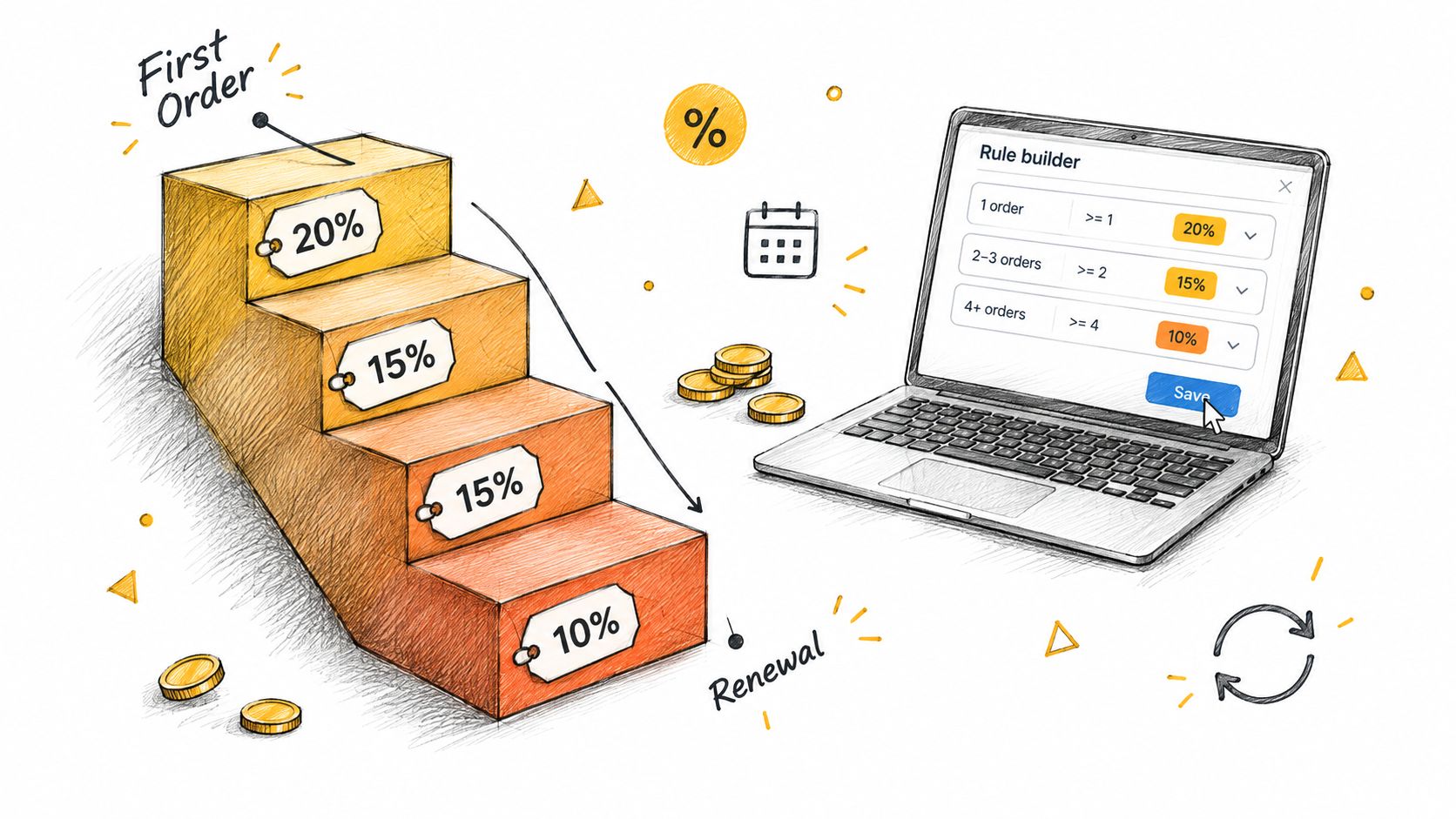
In RecurX, begin by creating a subscription discount rule for the relevant product or selling plan. Choose an order-count trigger, then enter the discount ladder:
- Order one: Apply 20% off.
- Orders two and three: Apply 15% off.
- Order four onward: Apply 10% off.
The exact percentages are a configuration example, not a universal recommendation. The structure matters because it creates a visible path from acquisition incentive to sustainable renewal price. Before activating it, calculate contribution margin at every step, including shipping, fulfillment, payment costs, and any bonus included in the offer.
Attach the rule only to the products or selling plans that match the retention hypothesis. A predictable replenishment product can support a renewal ladder more naturally than a low-frequency purchase that customers don't need on a fixed schedule. Then preview the storefront language so the product page, cart, checkout, and customer portal all show the same discount progression.
For implementation patterns and configuration considerations, see this guide to tiered discounts for Shopify.
Add the billing calendar deliberately
Anchor-date billing belongs in the same setup flow when the first renewal date creates operational or payment noise. Select the preferred weekday or anniversary rule, then check how the platform handles the gap between the initial order and the anchored charge. The aim is to make the upcoming charge understandable, not to hide a change in timing.
If you offer a free trial, decide whether the trial counts as an order for the ramp. A clean variant keeps the trial at its stated trial condition and starts the discount at order two, when the first paid renewal occurs. A trial that lasts longer than the product's normal usage cycle may delay the point at which you learn whether the customer values the subscription, so document the interaction before launch.
Verify the live behavior
Before sending traffic, run a test subscription through the full lifecycle:
- Product assignment: Confirm the rule is attached to the intended selling plan.
- Order trigger: Verify that the discount changes according to completed order count, not page views or checkout attempts.
- Renewal price: Check the next charge and the later charge in the customer account view.
- Trial transition: Confirm when the trial ends and when the first paid discount applies.
- Anchor date: Verify the next billing date and delivery expectation.
- Cancellation state: Check whether canceling, pausing, or skipping preserves the correct future rule.
- Customer messaging: Make sure the storefront and transactional messages state the future renewal price.
Don't test only the initial checkout. Most pricing mistakes appear at the first renewal, where the merchant and customer see the rule behave under real billing conditions.
Pricing, Messaging, and Segmentation Practices That Hold
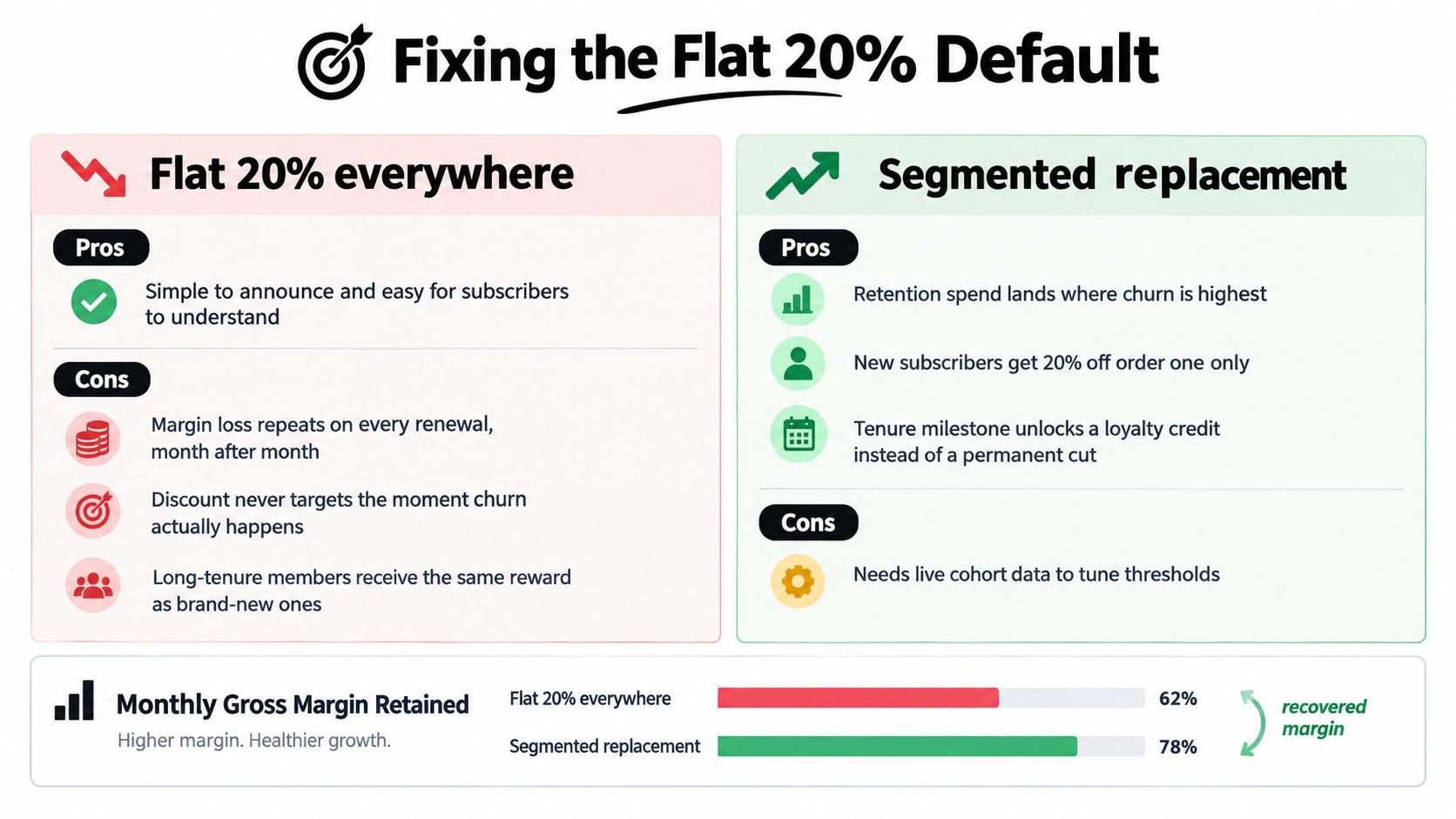
A flat 20% discount on every renewal can buy sign-ups while weakening retention economics. It repeats the margin sacrifice even when price is not the reason a customer cancels. A customer receiving shipments too often needs a longer interval or skip option. Someone disappointed by the product needs a service or product fix. A permanent price cut addresses neither problem and can subsidize a short-lived subscription.
Set discount depth against cohort behavior, not conversion rate alone. Put more incentive at the point where acquisition friction is highest, then move toward a renewal price that supports contribution margin after the customer has used the product and can judge its value. The benchmark cited earlier reports that discounts above 20% were associated with a 35% churn increase, so the winning offer is not automatically the one with the highest initial take rate.
Pricing choices that survive the renewal
Use a structure that gives each pricing decision a measurable job:
- Use ramp tiers: Apply the strongest incentive at the beginning, then step toward a sustainable recurring price. This shifts early activation and second-order behavior while limiting later margin loss.
- Cap lifetime discounts: End the introductory saving after a defined point, or replace it with a controlled loyalty credit. The cap protects later contribution margin and makes the offer easier to forecast.
- Protect add-on economics: Keep add-on SKUs outside the permanent subscription discount unless they support a clear retention goal. This preserves order-level margin.
- Test quantity breaks: A quantity-based benefit can raise average order value without reducing the unit price on every future shipment.
- Use non-price benefits: Bonus products, store credit, access, or loyalty points can improve perceived value without permanently resetting the headline price.
Tie every structure to one cohort metric before launch. Quantity breaks may shift average order value. A tenure credit may improve later renewal behavior. A capped discount may preserve contribution margin after the first few orders. A ramp should be judged on renewal progression, not only on subscription starts.
Show the price customers will actually pay
Offer cards should show the future renewal price, not just the opening percentage. State the trial length plainly, explain when billing begins, and display the delivery interval. “Save 20%” creates an expectation gap if the customer cannot see the price after the introductory period.
Make the recurring commitment easy to evaluate. “Your first delivery is discounted, then renews at the standard subscription price” is less dramatic than a large percentage, but it gives the customer a fair basis for deciding and reduces avoidable cancellation at renewal.
Segment before changing the offer
Returning buyers already have product evidence. They may value convenience, delivery control, or flexibility more than an aggressive acquisition discount. Prepaid annual customers have made a different commitment from monthly subscribers, while VIP cohorts may respond to a loyalty benefit that leaves their accepted price intact.
Set separate rules when the data supports them. A sitewide incentive can undercut high-LTV customers and overpay customers who would have subscribed without extra savings. Use this subscription pricing strategy guide to map plan structure, discount depth, and customer segment to the cohort metric the offer is meant to move.
Testing Subscription Discounts the Right Way
A high sign-up rate doesn't prove that a Shopify subscription discount works. It proves that the offer persuaded someone to start. The test begins when the first renewal approaches and continues through the later cohort windows that reveal whether the subscriber remains active at an acceptable margin.
Start with a control cohort using the existing offer and a treatment cohort using the new structure. Match the groups as closely as possible on acquisition week, traffic source, and product line. Don't change the discount, onboarding flow, landing page, and delivery promise in the same experiment, or you won't know which change created the result.
A practical benchmark recommends 400 to 800 subscribers per arm before reading the result and running the test for at least two full billing cycles (EasyApps' Shopify subscription benchmark). Treat that as a planning reference rather than a guarantee of statistical certainty. Your category, traffic mix, cancellation behavior, and billing cadence still determine how much evidence you need.
| Metric | Why It Matters | Target Window | Watch For |
|---|---|---|---|
| Active subscriber rate | Shows whether the offer produces continuing customers | Day 30 and day 90 | A strong start followed by a sharp renewal drop |
| Second-order rate | Tests whether the customer crosses the first commitment hurdle | First renewal | Trial or first-order buyers who never become recurring buyers |
| Refund rate | Identifies whether the incentive attracts mismatched expectations | From first order through renewal | Refunds concentrated in one acquisition source or offer |
| Contribution margin per subscriber | Connects discount cost to economic value | By cohort and billing cycle | Higher volume with weaker margin after fulfillment and discount costs |
| Cancellation reason | Explains whether price is actually the problem | At each cancellation event | “Too much product,” preference, payment, or product-quality issues |
| Saved subscriber activity | Tests whether cancellation offers create durable retention | Through day 90 | Subscribers saved briefly but inactive soon afterward |
Measure day-30 and day-90 retention by cohort, not as an aggregate subscription total. The cancellation-save benchmark recommends checking whether at least 70% of saved subscribers remain active at 90 days; otherwise, the offer may be masking the underlying issue (Loop's cancellation-save analysis). Compare recurring-discount cohorts with one-time-discount cohorts on order-three retention and contribution margin before expanding the rule.
If the new offer loses, ship the loser cleanly. Restore the control rule, archive the treatment configuration with its audience and dates, record the result, and avoid layering another discount change into the same measurement window. A negative result is useful when the team can identify what failed and preserve the learning.
A Pre-Launch Checklist Before You Ship the Discount
A discount should pass operational checks before it reaches paid traffic. Use the sequence below as a release gate, and assign one person responsibility for reading the cohort report at the planned review points.
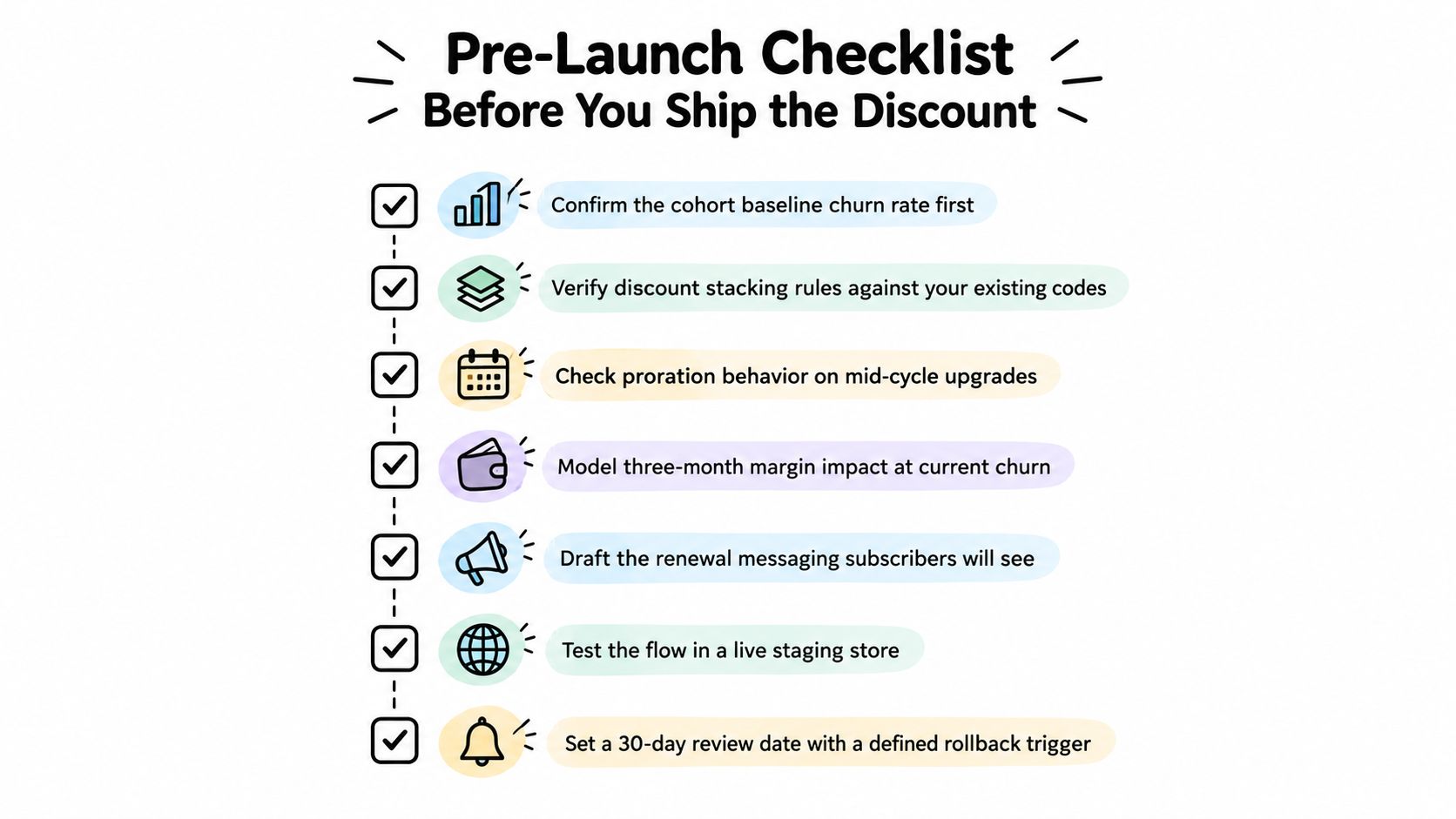
- Set the baseline: Record current day-30 and day-90 retention, contribution margin, refunds, and cancellation reasons before changing the offer.
- Match the structure to the gap: Use tiers when discount depth needs to decline, a ramp when commitment is the problem, a trial when trial-to-paid conversion needs work, and anchor billing when the first bill creates confusion.
- Check stacking rules: Confirm Shopify or the subscription app handles existing discount codes, plan discounts, shipping benefits, and loyalty rewards as intended.
- Model the renewal economics: Calculate the margin effect across the opening order and later renewals, rather than judging the offer on first-order revenue.
- Review customer-facing terms: Show the trial length, first charge, future renewal price, delivery interval, and discount end condition in product copy and transactional messaging.
- Test the live journey: Run the product page, checkout, customer account, renewal, pause, skip, and cancellation paths in a staging or controlled store.
- Segment the test: Separate acquisition sources, product lines, returning buyers, prepaid plans, and VIP customers when the traffic volume supports it.
- Lock the review plan: Set the test window, define the success metric in advance, schedule the day-30 and day-90 reads, and name the rollback owner.
Shipping the checklist, not merely shipping the discount, is what compounds retention.
RecurX gives Shopify merchants tools for tiered discounts that ramp after a defined number of orders, free trials, anchor-date billing, customer self-service, payment recovery, and cohort analytics. Visit RecurX to evaluate whether its subscription infrastructure fits your discount test and retention workflow.
shopify subscription discount · subscription pricing · shopify retention · recurring revenue · subscription analytics
Keep reading
- Subscription vs One Time Purchase for ShopifyCompare subscription vs one time purchase models for Shopify. Analyze LTV, churn, and MRR impacts, plus how to implement recurring billing with RecurX.
- How to Sell Subscriptions Online on ShopifyLearn how to sell subscriptions online on Shopify. Build flexible plans, optimize checkout, recover failed payments, and boost retention with RecurX.
- QR Code Checkout System: The Omnichannel Growth PlaybookMaster the QR code checkout system for subscriptions. Learn benefits, Shopify integration, and how to drive recurring revenue with RecurX.
Start growing recurring revenue on Shopify
RecurX has a 14-day free trial and zero transaction fees on every plan. Install in minutes.
Start your free trial →