How to Create a Subscription Box: A 2026 Guide
Learn how to create a subscription box for your business in 2026. This guide covers planning, packaging, and launch strategies to boost recurring revenue.
Learn how to create a subscription box for your business in 2026. This guide covers planning, packaging, and launch strategies to boost recurring revenue.
Most advice on how to create a subscription box starts with acquisition. Pick a niche, run ads, collect subscribers, and worry about the rest later. That order is backwards. A subscription box isn't a one-time product launch. It's a renewal system attached to a physical experience, and the business only works when customers keep choosing the next shipment.
The practical work starts before Shopify configuration. You need a repeatable reason to buy, a box that can be sourced and assembled without chaos, pricing that leaves room for acquisition, and retention controls that make skipping, pausing, updating payment details, or canceling straightforward. The founders who build those mechanics early can learn from real customer behavior instead of discovering their economics after growth has already exposed every weakness.
Table of Contents
- Why Most Subscription Boxes Fail Before They Scale
- Choosing Your Subscription Box Model
- Setting Up Your Shopify Subscription Infrastructure
- Pricing Strategy and Discount Structures
- Building Customer Experience and Retention Tools
- Launch Testing and Operational Readiness
- Moving From Launch to Sustainable Growth
Why Most Subscription Boxes Fail Before They Scale
Subscriber acquisition gets the attention because it produces visible numbers quickly. Retention is less glamorous, but it determines whether those new customers become an asset or an expensive short-term liability. McKinsey found that 15% of online shoppers had signed up for at least one recurring product subscription, yet more than one-third canceled within three months and over half canceled within six months. McKinsey's subscription-box research makes the uncomfortable point clear: a compelling first order doesn't guarantee a second one.

Your revenue ceiling is set by churn. If customers leave before the contribution from their orders covers acquisition and fulfillment costs, more acquisition just feeds the leak. That's why a subscription forecast should begin with retention assumptions, not a subscriber target.
The first six months expose weak economics
The same McKinsey research found that replenishment subscriptions retained customers better over time, with 45% of members subscribed for at least one year, roughly 10 percentage points higher than curation or access models. That doesn't make replenishment automatically superior, but it shows how a clear recurring need can be stronger than novelty alone.
A separate industry summary reports 10.5% average monthly churn, 125 days of median subscriber tenure, and 62% of subscribers canceling within the first six months. The summarized subscription-box metrics should be treated as historical context, not a promise about your own results. Your job is to find out why your customers leave, then fix the reasons you can control.
Practical rule: Design the second shipment before you advertise the first. If the customer has no clear reason to continue, acquisition is only postponing the problem.
Payment failures deserve separate attention. A customer who wants to stay can still disappear when a card expires, a bank declines a transaction, or a payment method needs reauthorization. Treating every failed renewal as voluntary churn distorts your diagnosis and leaves recoverable revenue on the table.
Choosing Your Subscription Box Model
The model determines what customers expect and how difficult each shipment becomes. A founder with a narrow catalog and limited fulfillment capacity shouldn't begin with the same architecture as a brand managing many variants, swaps, and personalized bundles.
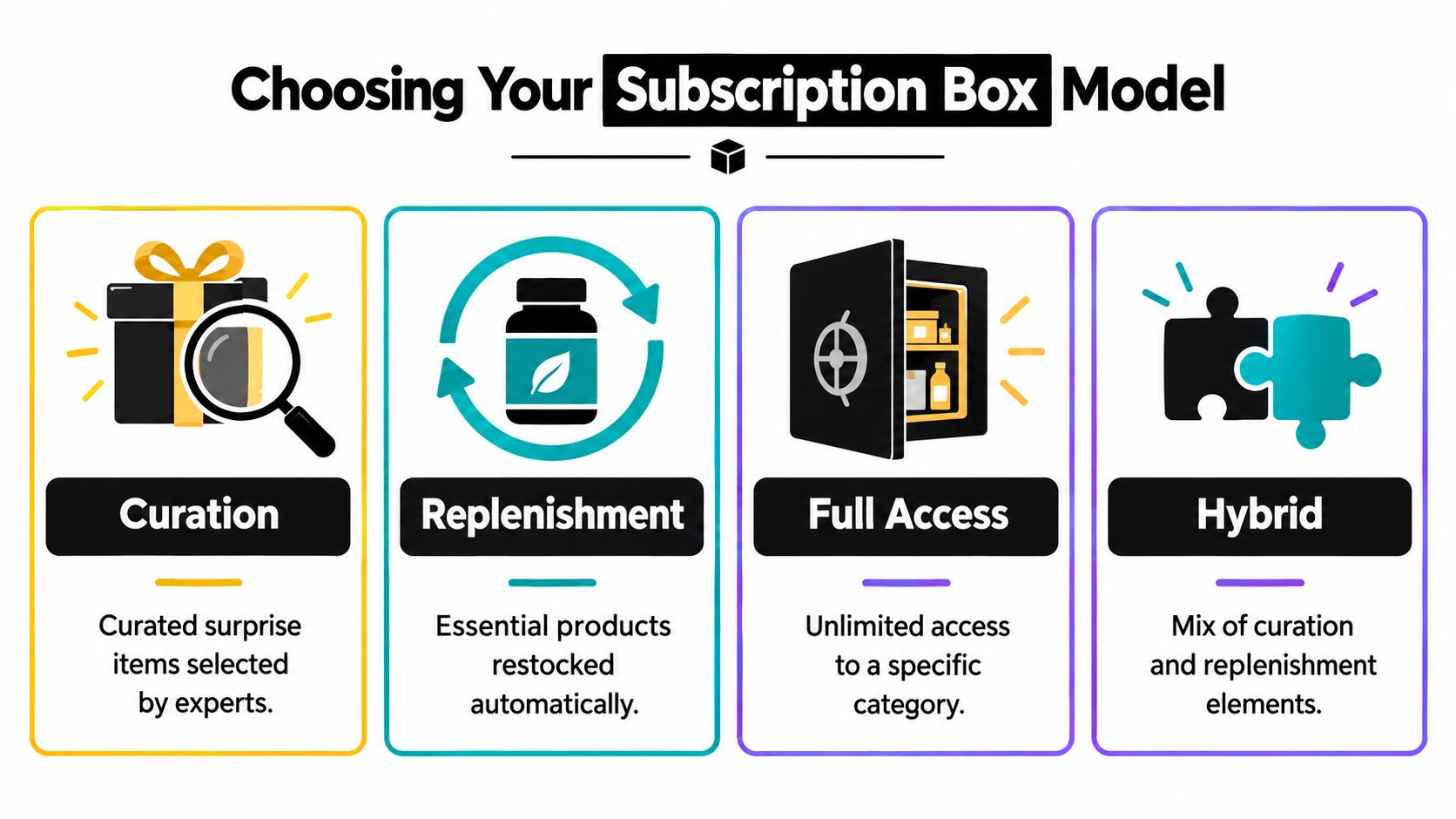
| Model | Customer promise | Operational trade-off |
|---|---|---|
| Curation | Expert-selected products create discovery and surprise | Forecasting and assortment planning are harder |
| Replenishment | Products arrive before the customer runs out | The recurring need must remain credible |
| Full access | Members gain ongoing access to a category or benefit | Value must be visible between shipments |
| Hybrid | A repeatable core combined with curated additions | Personalization can increase assembly complexity |
Curation works when expertise is the product. A wine club, beauty discovery box, or hobby assortment can justify recurring delivery because the customer is paying for selection as well as goods. A useful real-world reference is the Viansa Sonoma wine club, where the recurring proposition is connected to a defined product collection and membership experience.
Replenishment is usually easier to explain and forecast. Coffee, pet consumables, skincare staples, and household essentials have a built-in reason for another order. McKinsey's retention findings support this model's durability, but replenishment still fails when delivery arrives too often, inventory quality slips, or customers can't adjust quantity.
Full access suits membership-led businesses better than a standard surprise box. Customers need to understand what access means, whether the benefit is used regularly, and why recurring billing is preferable to a one-time purchase.
Hybrid models can combine a predictable base product with seasonal or personalized items. They also create more failure points. Every choice adds SKU pressure, pick-and-pack rules, substitutions, and customer-service scenarios. Before offering swaps, map the assembly process for a full billing cycle and price the labor, not just the products.
Use the subscription box versus Subscribe and Save comparison to pressure-test whether your concept is truly a box experience or merely an automated repeat purchase. Start with the simplest model that delivers the promised value, then add control only when customers demonstrate that they need it.
Setting Up Your Shopify Subscription Infrastructure
Your Shopify setup should mirror the customer journey, from the first product-page decision to the renewal after delivery. Avoid building a complicated plan catalog before you know which cadence, price, and assortment customers understand.
Start by defining the plan in operational language:
- Choose the offer. Decide whether the box is pay-as-you-go, prepaid, membership-based, or Build-a-Box.
- Set the cadence. Match billing and fulfillment to how often customers consume the products.
- Define changes. Decide whether subscribers can skip, pause, swap, change frequency, or update payment without contacting support.
- Set the renewal response. Specify what happens after a declined charge, including retries and customer reminders.
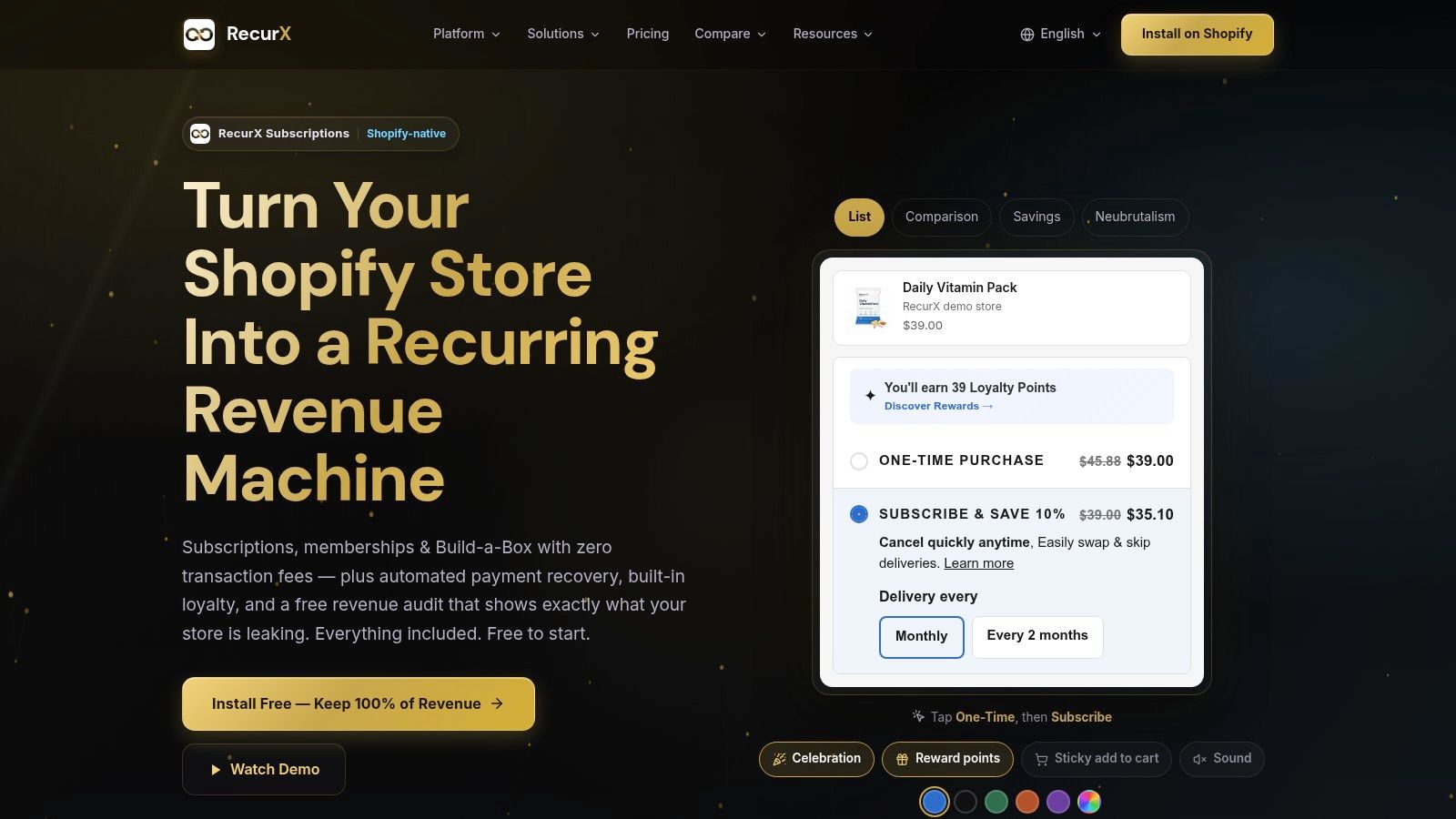
- Install the storefront widget. Place the subscription choice near the purchase control, not buried below unrelated product information.
- Test the account portal. A customer should be able to manage the subscription from the Shopify account experience on your domain.
RecurX can support these Shopify workflows with subscription plans, Build-a-Box configurations, storefront widgets, a self-service portal, payment recovery, loyalty rules, and cohort analytics. Treat those capabilities as infrastructure, not decoration. A widget that converts but creates confusion at renewal is not a successful implementation.
The widget needs to explain the commitment plainly. Show the shipment frequency, price, renewal terms, and available controls before checkout. For a useful example of how a food brand presents a recurring offer, review the Rip Van subscription page, then adapt the clarity to your own product and fulfillment calendar.
The portal is equally important. If customers can pause during travel, skip an unwanted shipment, swap an item, or update a card without opening a support ticket, they retain control over the relationship. That control won't rescue a weak product, but removing unnecessary friction prevents avoidable cancellations.
Use a test order to follow the complete path. Confirm the selected plan, Shopify order, fulfillment instructions, renewal email, portal access, and payment-failure behavior before sending paid traffic.
Pricing Strategy and Discount Structures
Subscription pricing must cover each box's variable cost, create enough value for the first commitment, and leave room for acquisition and retention costs. A low entry price may increase signups while leaving later renewals unable to support the business.
Calculate contribution per shipment before choosing a discount. Include product cost, inbound freight, packaging, assembly labor, payment processing, shipping, expected replacements, and other order-level expenses. Then set the maximum CAC the model can tolerate. The practical launch methodology in this subscription-box guide from BigCommerce recommends tracking CAC, LTV, and churn from day one, with a healthy target of LTV at least 3x CAC.
A useful price model also accounts for when churn occurs. If a customer cancels after the first renewal, a large acquisition discount can erase the contribution from both shipments. Model the offer by renewal cohort, not only by average order value. Shopify subscription reporting and RecurX cohort analytics can show whether a discount attracts durable subscribers or merely delays cancellation.
Build the offer around commitment
Keep the pricing page easy to compare:
- Monthly pay-as-you-go: Lowest commitment and easiest entry, though the customer can leave quickly.
- Prepaid term: Improves upfront cash flow and creates a defined commitment for the customer.
- Membership tier: Adds access or benefits beyond the physical box.
- Build-a-Box tier: Gives customers controlled choice, which can raise basket value without making every order fully bespoke.
Discounts should reward commitment without teaching customers to wait for promotions. A modest prepaid reduction can work when it improves cash flow and production planning. A steep first-order discount becomes risky if the customer only needs to reach one renewal before the margin disappears.
Use ramps instead of permanent concessions
A discount that activates after a defined number of paid orders can reward longevity while protecting early contribution. Test it against product margin, shipping changes, and expected churn. Starting the reward too soon may subsidize customers who would have stayed anyway. A requirement that feels unreachable will not change buying behavior.
Use Shopify's subscription settings to present the billing cadence and commitment clearly, then connect the offer to portal controls and dunning rather than relying on discounts alone. A subscriber who can pause or recover a failed payment may remain active without receiving a new incentive.
Anchor-date billing can reduce renewal surprises. If boxes ship on a predictable production date, state when the first charge occurs and how future renewals align. Free trials require the same clarity: explain when the trial ends, when billing begins, and where the customer can manage the plan.
Use this subscription pricing strategy resource to pressure-test the model. The right price supports repeated delivery and recovers acquisition costs before customers leave.
Building Customer Experience and Retention Tools
Retention infrastructure starts before the first renewal. The product page sets expectations, checkout confirms the commitment, onboarding explains what happens next, and the portal gives customers control when their circumstances change.
A theme-matched storefront widget reduces the gap between your brand and the subscription decision. It should make the recurring option easy to compare with one-time purchase, display cadence and savings clearly, and work on mobile without pushing the buy control out of view.
The customer portal handles the practical reasons people cancel. Give subscribers obvious actions for pause, skip, swap, frequency changes, address updates, and payment updates. A customer who needs a temporary break shouldn't have to choose between receiving an unwanted box and ending the relationship permanently.
Retention principle: Make the healthy alternative easier than contacting support. A pause button can preserve a customer who doesn't need another shipment this month.
Payment recovery needs its own workflow. Separate voluntary cancellation from involuntary churn, send decline-aware reminders, retry at sensible intervals, and include a direct card-update path. RecurX provides dunning sequences through email, SMS, or WhatsApp, along with one-click payment-update links. The point isn't to pressure a customer. It's to help a willing subscriber correct a failed renewal before the account closes.
Use tags to connect behavior with messaging. A new subscriber, a paused subscriber, a customer with a failed payment, and a long-standing member shouldn't receive identical campaigns. Lifecycle tools such as Klaviyo, Mailchimp, Twilio, WhatsApp Business, and Omnisend can support those segments when the events and tags are reliable.
For customer-facing ideas around subscription changes, Pure Paw Labs' subscription management guide offers a useful reference point. Keep cancellation clear, record the reason, and use the answer to improve the box rather than hiding the exit.
Launch Testing and Operational Readiness
A launch isn't ready because the landing page looks polished. It's ready when a real subscriber can purchase, receive the correct box, manage the account, and recover from predictable problems without your team improvising.
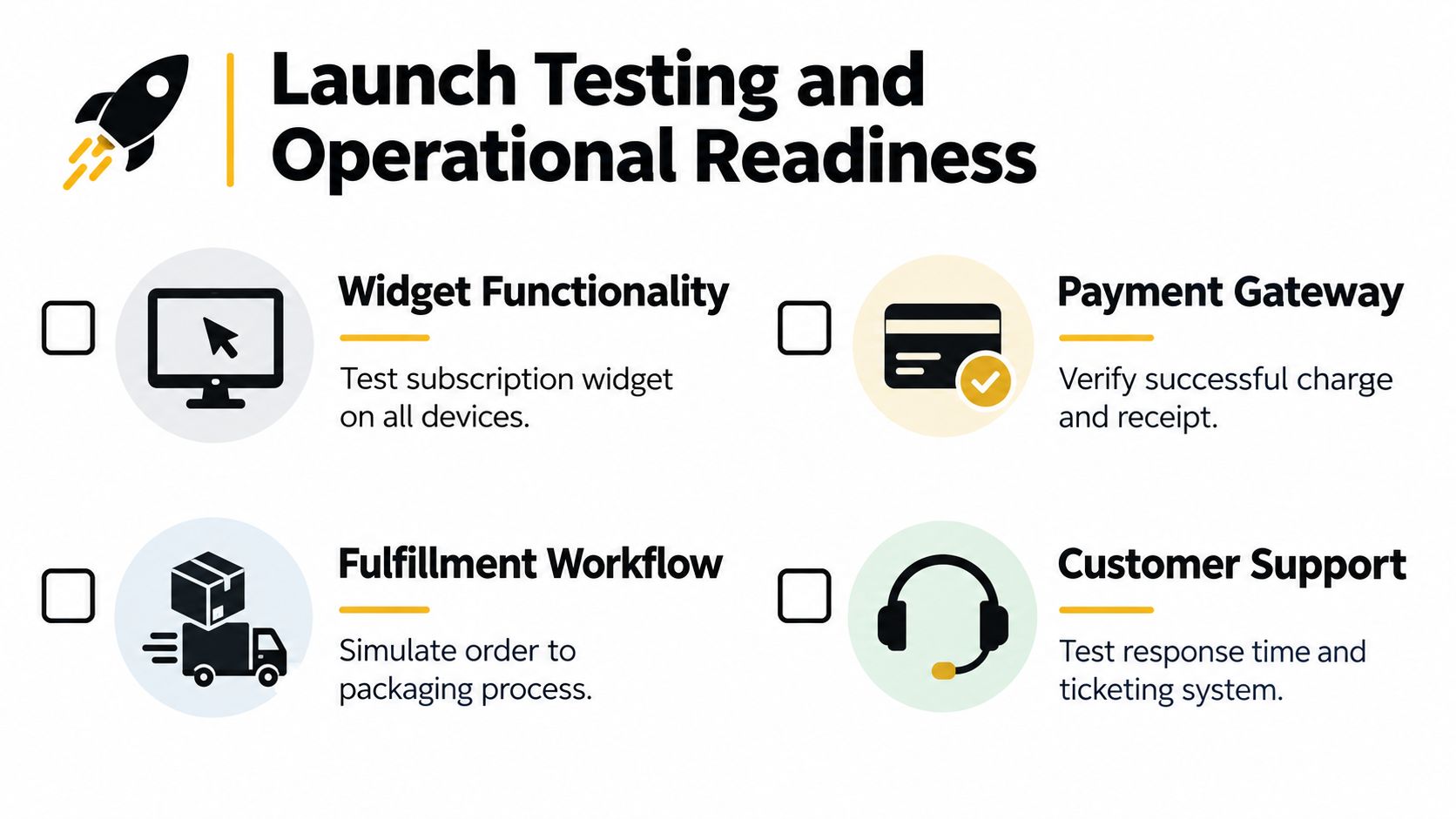
Run the launch as a controlled rehearsal:
- Test every storefront state: Check the subscription widget on mobile and desktop, inspect product variants, and confirm the price changes correctly.
- Place successful orders: Verify payment authorization, receipt language, tax treatment, shipping charge, and renewal terms.
- Simulate a failed renewal: Confirm the retry schedule, dunning messages, card-update link, and account status.
- Walk the fulfillment line: Move an order from Shopify to picking, packing, labeling, shipping, and tracking.
- Use the portal as a customer: Pause, skip, swap, change frequency, update payment, and cancel.
- Ask support to intervene: Give the team common scenarios and check whether replies match the policies shown at checkout.
Don't test only the happy path. An address change after an order is placed, an unavailable product, a failed card, and a skipped shipment reveal more about operational readiness than a successful test purchase.
Inventory and assembly deserve equal scrutiny. Write the box specification, define acceptable substitutions, set a cutoff for changes, and decide who approves exceptions. If personalization is part of the offer, give the warehouse a picking method that prevents similar variants from being mixed.
Your support team should know the shipment calendar, renewal timing, cancellation policy, and recovery process. Customers shouldn't receive different answers depending on who opens the ticket. A smooth first delivery builds trust, but consistent handling of the first problem often determines whether that trust survives.
Moving From Launch to Sustainable Growth
The first useful growth story isn't a spike in orders. It's a cohort that continues renewing after the novelty of the first box fades. Group subscribers by acquisition period, offer, product configuration, or channel, then compare renewal behavior and cancellation reasons across those groups.
Suppose one cohort arrives through a creator partnership and another through paid search. The cheaper acquisition source isn't automatically the better source if its customers cancel quickly. Compare CAC with retention, contribution, and support load so you invest in customers who remain profitable, not merely customers who convert.
Your operating dashboard should connect the full journey:
- Acquisition: source, campaign, and checkout conversion.
- Subscription health: active subscribers, churn reason, renewal status, and plan changes.
- Financial performance: MRR, LTV, ARPU, AOV, and contribution per shipment.
- Experience signals: support contacts, skipped boxes, failed payments, and product feedback.
The Shopify subscription metrics and KPI guide can help organize that measurement layer. Use it to decide what deserves attention, not to create a dashboard nobody checks.
Growth also introduces complexity. Before adding languages, markets, product choices, or new fulfillment partners, confirm that your portal, notifications, inventory rules, and support processes can handle the change. Localization, integrations with email and SMS platforms, tagging, and migration utilities become valuable when they remove operational duplication rather than adding another disconnected system.
A subscription box becomes durable when every renewal has a reason behind it. Acquire carefully, deliver consistently, recover legitimate payment failures, and make temporary changes easy. Then scale the channels and cohorts that prove customers want the next shipment.
RecurX gives Shopify merchants tools for subscription plans, Build-a-Box offers, storefront widgets, customer self-service, dunning, loyalty, and cohort analytics in one subscription workflow. Visit RecurX to evaluate the setup against your box model, fulfillment process, and retention goals before you open the next acquisition campaign.
subscription box · Shopify subscriptions · RecurX · ecommerce guide · DTC brands
Keep reading
- Subscription vs One Time Purchase for ShopifyCompare subscription vs one time purchase models for Shopify. Analyze LTV, churn, and MRR impacts, plus how to implement recurring billing with RecurX.
- How to Sell Subscriptions Online on ShopifyLearn how to sell subscriptions online on Shopify. Build flexible plans, optimize checkout, recover failed payments, and boost retention with RecurX.
- QR Code Checkout System: The Omnichannel Growth PlaybookMaster the QR code checkout system for subscriptions. Learn benefits, Shopify integration, and how to drive recurring revenue with RecurX.
Start growing recurring revenue on Shopify
RecurX has a 14-day free trial and zero transaction fees on every plan. Install in minutes.
Start your free trial →