Subscription Box vs Subscribe and Save: Which Should You Choose?
The two most popular ecommerce subscription models look similar from the outside — both charge a customer on a recurring schedule and ship them something. But subscribe and save and subscription boxes are fundamentally different businesses: different margins, different customer expectations, different reasons customers churn, and different operational complexity. Choosing between them — or knowing when to run both — is one of the most strategic decisions a Shopify subscription merchant makes.
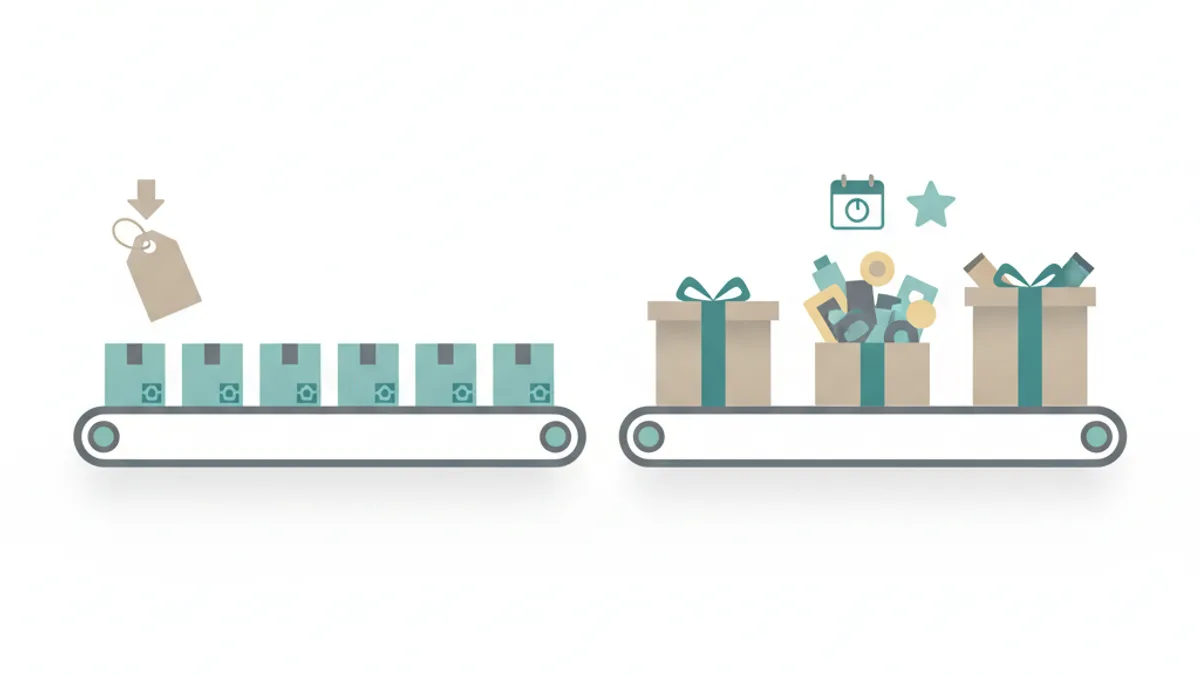
Subscribe and save wins on retention and operational simplicity for consumables — customers keep subscribing because they genuinely need the product. Subscription boxes win on brand-building and higher price points, but churn higher and cost more to run. Pick subscribe and save when customers already know and love your product and just want it reliably. Pick a subscription box when curation, discovery, or variety is the product itself. Many brands run both to serve different segments, but start with one and optimize it first.
The core difference between the two models
The defining difference is what the subscriber is paying for. In a subscribe-and-save model, the subscriber knows exactly what they are getting: the same product at the same price, delivered on a recurring schedule. The value is convenience and savings — never running out of something they already know and love. In a subscription box, the subscriber is paying for curation and discovery: someone else chose what goes in the box, and the contents change every period. The value is surprise, variety, and the feeling of receiving a well-considered selection.
This difference in what the customer is paying for drives everything else: how the economics work, what causes people to cancel, how you have to market each model, and what operations look like behind the scenes. A coffee drinker who subscribes to their favourite roast every two weeks is a completely different kind of customer relationship than a beauty enthusiast who trusts a curator to send five products she has never tried.
| Dimension | Subscribe and save | Subscription box |
|---|---|---|
| What the customer pays for | Convenience and savings on a known product | Curation, discovery, and surprise |
| Product changes per period | No — same product each cycle | Yes — new items or themes each cycle |
| Typical churn driver | Product pile-up or a better price elsewhere | Box disappointment or loss of novelty |
| Operational complexity | Lower — fixed SKUs, predictable inventory | Higher — sourcing and curation every cycle |
| Common categories | Coffee, supplements, pet food, household | Snacks, beauty, books, fashion, hobbies |
| Who needs to love it | The product alone | Both the product and the curation experience |
Subscribe and save: how it works and why retention holds
Subscribe and save is built on one insight: if a customer already knows they want your product, the most convenient version of that product is the one that shows up automatically. The merchant offers a recurring discount — typically 10–15% off the one-time price — in exchange for a commitment to receive the product on a chosen schedule. The customer trades flexibility for savings; the merchant trades some margin for predictable, recurring revenue.
Because the customer controls what they receive and when — they chose the product and the cadence — subscribe-and-save tends to have strong retention when the delivery frequency matches actual consumption. The most common reason customers cancel is product pile-up: a cadence that ships faster than they use the product, leaving them with a drawer of supplements they have not opened. Get the frequency right, and a subscribe-and-save subscription can run for years without the customer actively thinking about it.
The conversion mechanism is simple and immediately quantifiable: the customer can calculate their savings in seconds. This simplicity makes subscribe-and-save easy to merchandise on product pages and easy to explain in ads. It also makes it straightforward to test — change the discount percentage, the default frequency, or the presentation, and the effect on conversion and churn is measurable quickly.
- Best for products that are genuinely consumable and reliably repurchased: coffee, pet food, supplements, cleaning supplies, personal care.
- Operations are simpler: one product per subscriber, predictable inventory, no curation required each cycle.
- The main retention risk is delivery cadence mismatch — offer subscribers the ability to adjust frequency in the customer portal.
- Subscription analytics are cleaner: average order value is predictable, and the main performance variable is churn rate by frequency tier.
Subscription box: the case for curation and where it breaks down
A subscription box sells a different promise: trust us to pick something great for you. Each cycle, the merchant sources, curates, and ships a box of products that the subscriber could not assemble as conveniently on their own. The best subscription boxes deliver genuine discovery — a product the subscriber had never tried but immediately loves. The worst feel like a bag of samples for brands the subscriber does not care about.
That dependence on curation quality is the structural challenge of the model. Retention is closely tied to how each individual box is perceived — and even excellent programs have disappointing periods. A run of great boxes for eight months can produce a spike in cancellations after one weak theme. Subscription boxes therefore typically run higher monthly churn than subscribe-and-save on comparable customer types: commonly 6–12% per month for consumer boxes versus 3–6% for well-run replenishment subscriptions.
The higher churn is not necessarily a reason to avoid the model. Subscription boxes typically command higher price points, build stronger brand identities, and are harder to commoditize than single-product subscriptions. A box business can sustain a higher churn rate if the economics per box are strong and new-subscriber acquisition is efficient. But the math works differently, and the operational investment — sourcing, curation, vendor relationships, packaging design, fulfilment coordination — is meaningfully higher each cycle.
- Best for categories where variety, discovery, or curation are the core value: specialty food, beauty, hobby supplies, books, fashion accessories.
- Requires sourcing, curation, and potentially vendor negotiations every cycle — significantly more complex operations than subscribe-and-save.
- The main conversion driver is the brand promise and the aspiration of what is inside — harder to quantify than a percentage-off discount.
- Customer service load is higher: questions about box contents, requests to swap items, complaints about specific products in a cycle.
Economics side by side
The economic profiles of the two models differ in ways that matter for how you plan and grow the business.
| Metric | Subscribe and save | Subscription box |
|---|---|---|
| Typical price point | $15–$60 / cycle (product-dependent) | $25–$75 / cycle (often higher for full curated boxes) |
| Gross margin profile | Standard product margin minus subscriber discount | More variable; depends on sourcing scale and vendor deals |
| Monthly churn (typical) | 3–6% for consumables at the right cadence | 6–12% for most consumer boxes |
| Operational cost | Low — fixed SKUs and stable inventory | High — new sourcing and curation every cycle |
| Average subscriber LTV | Moderate to high if cadence is right and churn is low | Moderate; shorter average tenure but higher per-box revenue |
| CAC payback period | Shorter when churn is low and the discount is modest | Longer if churn is high; model the unit economics carefully |
Can you run both models at the same time?
Many Shopify merchants successfully run both models, though rarely from day one. The more common path is starting with subscribe-and-save on core products to build a subscriber base and prove the subscription mechanics, then layering a curated box or bundle as a premium tier for subscribers who want variety or a deeper brand experience.
The risk of launching both simultaneously is operational: managing two distinct fulfillment and curation workflows while building acquisition for both stretches a small team. A more pragmatic approach is to launch one, optimize its retention and unit economics, and add the second once the first is running smoothly. The customer segments for the two models are also different — a subscriber who values convenience and savings may have little interest in a curated discovery box, and vice versa.
If you do run both, track their KPIs separately. Churn rates, LTV, ARPU, and NRR will differ substantially between models, and blending them produces a misleading picture of both. Treat subscribe-and-save and subscription box as separate business lines within the same Shopify store and review them independently.
How to choose the right model for your brand
The simplest decision framework: if your customer knows what they want and just wants it reliably and cheaply, subscribe and save wins. If your customer does not know exactly what they want next and values your judgement in choosing for them, a subscription box wins.
- Choose subscribe and save if your product is a consumable that customers already know and love, and the main purchase barrier is simply remembering to reorder.
- Choose a subscription box if your brand value is rooted in discovery, curation, or access to things customers cannot easily find or assemble themselves.
- Choose subscribe and save if you want simpler operations, more predictable margins, and lower baseline churn as your starting point.
- Choose a subscription box if you are building a brand identity around taste, curation, or community, and you are ready to invest in the operational complexity each cycle requires.
- Consider adding the second model later — once the first is profitable and operationally smooth — to capture a different customer segment without splitting early focus.
Setting up either model on Shopify
Both models are well supported on Shopify. A subscription app handles the billing cycle, customer portal, pause and skip flows, and failed payment recovery for both model types. For subscribe-and-save, setup centres on creating subscription plans for your existing products and adding a subscribe-and-save widget to product pages. The core operational work is choosing the right default frequency and giving subscribers the ability to adjust it.
For subscription box businesses, setup centres on the box product itself — typically a single recurring SKU that ships a curated assortment each cycle — plus a curation and fulfilment workflow that can change contents without the subscriber needing to do anything. The customer portal matters for both, but for different reasons: subscribe-and-save subscribers primarily use it to adjust delivery frequency, swap variants, and update payment methods; subscription box subscribers use it to manage their shipping address, pause before a holiday, and review what is coming next.
In both models, the customer portal is one of the most visited pages in your subscription business. A friction-free portal experience reduces support tickets and gives subscribers the flexibility to manage their subscription without cancelling. Make sure it reflects what your subscribers actually need — the requirements differ between models, and a portal built for one does not always serve the other well.
Frequently asked questions
What is the difference between a subscription box and subscribe and save?
In a subscribe-and-save model, the customer receives the same product each cycle at a recurring discount — the value is convenience and savings on something they already know they want. In a subscription box, the customer receives a curated selection of products that changes each period — the value is discovery, variety, and curation. Both bill on a recurring schedule, but the customer experience, operational complexity, and typical churn drivers are fundamentally different.
Which subscription model has better customer retention?
Subscribe and save typically has lower monthly churn — often 3–6% for well-run replenishment subscriptions — because subscribers continue as long as they consume the product and the cadence is right. Subscription boxes tend to run higher churn, commonly 6–12% per month, because retention depends on each box being perceived as valuable. Getting the delivery frequency right is the biggest retention lever for subscribe-and-save; curation quality is the biggest lever for subscription boxes.
Can I offer both a subscription box and subscribe and save on my Shopify store?
Yes — many Shopify merchants run both, often using subscribe-and-save on their core products and a subscription box as a premium or discovery tier. The key consideration is operational: managing two distinct curation and fulfilment workflows adds meaningful complexity. The recommended approach is to launch one model, optimize its retention and unit economics, and add the second once the first is running smoothly. Track the KPIs for each model separately to maintain a clear view of both businesses.
Mo Boumzoud — Founder, RecurX. Mo is the founder of RecurX and writes about subscription commerce, retention, and growth for Shopify merchants. RecurX powers subscriptions for direct-to-consumer brands.
Keep reading
- How to Start a Subscription Business in 2026 (Step-by-Step)Choose a model, validate demand, price it right, launch on Shopify, and grow with retention — the complete playbook for starting a subscription business.
- Subscription Pricing Strategy: 7 Models with ExamplesSeven subscription pricing models explained with examples, plus how to choose the right one and price for value instead of cost.
Start growing recurring revenue on Shopify
RecurX has a 14-day free trial and zero transaction fees on every plan. Install in minutes.
Start your free trial →