10 QR Codes in Advertising Ideas That Convert
Explore 10 practical qr codes in advertising ideas for print, packaging, events, and digital campaigns, with tracking and accessibility best practices.
Explore 10 practical qr codes in advertising ideas for print, packaging, events, and digital campaigns, with tracking and accessibility best practices.
A customer sees your ad on a train platform, notices a QR code on the package arriving at home, opens an order-confirmation email, or receives a payment reminder on their phone. In each case, the scan is only the entry point. The result depends on whether the destination matches the customer's intent, the URL identifies the campaign, the checkout or portal works smoothly on mobile, and people who can't scan still have a clear fallback.
That's why QR codes in advertising need to be planned as complete customer journeys, not decorative squares added at the end of a design. QR codes now support event promotion, print conversion, retail activation, packaging engagement, social campaigns, and other advertising uses. One marketing summary reports that 43% of marketers use QR codes for events, 40% for print ads, and 40% for in-store displays, while a 2025 survey found that more than 90% used QR codes and 94% had increased usage during the previous 12 months (Bitly's QR code statistics summary).
The ten ideas below follow subscription-commerce moments from acquisition and packaging through retention and payment recovery. They also show where campaign-specific links, UTM parameters, fallback paths, and RecurX's subscription checkout links, customer portal, messaging, and analytics can support a Shopify merchant. For a different kind of event use case, see this guide to QR codes for weddings.
Table of Contents
- 1. QR Codes for Direct Subscription Checkout Links
- 2. QR Codes on Subscription Product Packaging
- 3. QR Codes in Email Marketing Campaigns
- 4. QR Codes in Social Media Advertising
- 5. QR Codes on In-Store Signage and Point-of-Sale Displays
- 6. QR Codes in SMS and WhatsApp Marketing
- 7. QR Codes on Influencer and Affiliate Marketing Materials
- 8. QR Codes on Invoices and Order Confirmation Pages
- 9. QR Codes for Payment Recovery and Card Update Campaigns
- 10. QR Codes in Seasonal and Limited-Time Subscription Campaigns
- QR Code Advertising Channels, 10-Point Comparison
- Make the Scan Worthwhile and Easy to Measure
1. QR Codes for Direct Subscription Checkout Links
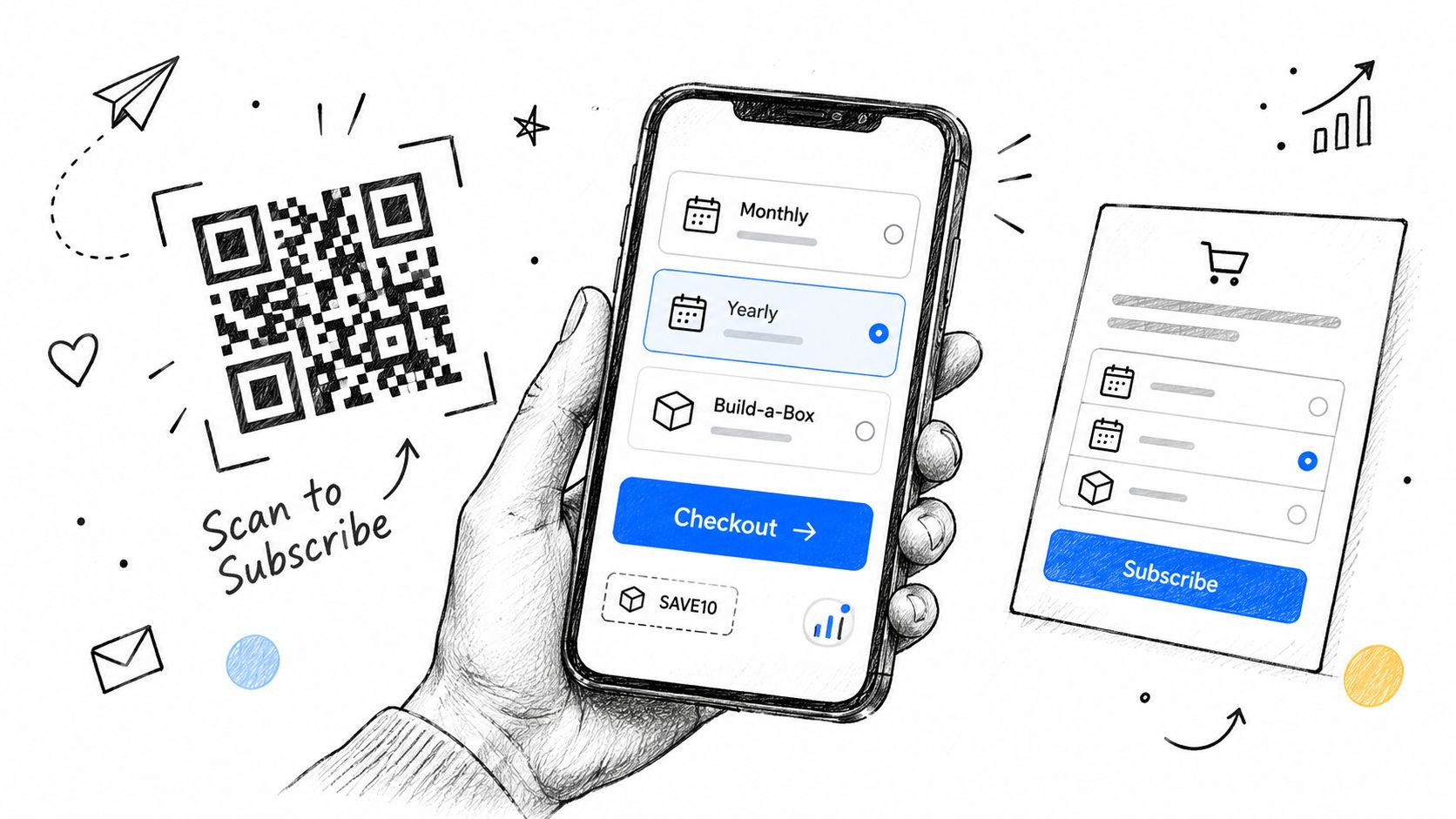
A QR code can take a customer straight to a subscription offer instead of making them search a storefront, open a product page, and find the recurring option. That shortened path works well when the surrounding ad has already explained the product and the scan is the natural next action.
With RecurX quick checkout links, a Shopify merchant can create a destination for a specific plan, such as pay-as-you-go, prepaid, membership, or Build-a-Box. The page should preserve the campaign context, show the relevant price and delivery interval, and make the next step obvious. A print ad for a coffee subscription shouldn't send shoppers to a generic homepage. It should open the coffee offer promised beside the code.
Build the destination before the artwork
Use a campaign-specific URL with parameters such as utm_source=print, utm_medium=offline, and utm_campaign=coffee_subscribe. Keep a readable URL below the code for people who can't scan. The RecurX checkout links guide is the relevant starting point for merchants creating these direct subscription paths.
Practical rule: The code should promise one action, and the destination should deliver exactly that action.
Use a dark pattern on a light background, test the code on current iOS and Android devices, and scan it under the lighting conditions where customers will encounter it. Branded styling can work, but contrast and the quiet space around the code matter more than visual novelty. Test the full path through plan selection, discount application, payment, confirmation, and analytics before printing or launching the ad.
2. QR Codes on Subscription Product Packaging
Packaging gives a subscription brand a second conversation with the customer after the product has arrived. A bottle, box, or label can direct a first-time buyer to a replenishment offer, while an existing subscriber can use the same surface to open a portal for skipping, pausing, swapping, changing frequency, or updating payment.
Placement affects intent. A code beside the ingredient panel may attract a product researcher, while a code inside the box may reach someone who has already used the product. A coffee merchant could place “Never run out of your favorite roast” beside a reorder destination, then use a different campaign parameter for the insert and the outer carton.
Match the message to the customer moment
Don't force every scanner into a new subscription. New buyers may need product education and a first recurring offer. Existing subscribers need account access, not another sales pitch. A dynamic destination lets the merchant update the offer or route traffic without replacing the printed package.
Useful packaging decisions include:
- Make the benefit explicit: Explain whether the scan opens a reorder page, subscription offer, loyalty benefit, or account portal.
- Use product-level tracking: Give coffee, skincare, and supplement packages distinct campaign identifiers so analytics can connect scans with later subscriptions.
- Plan for physical conditions: Test glare, curved bottles, small labels, warehouse handling, and low indoor light.
- Protect the fallback path: Print a short, readable URL and describe what customers will find after scanning.
RecurX's merchant-domain customer portal is useful when the customer already has an account. Keeping management on the brand's domain can make the experience more recognizable and gives subscribers control over their ongoing orders rather than trapping them in a support queue.
3. QR Codes in Email Marketing Campaigns
Email already contains clickable links, so a QR code only earns its space when the recipient is likely to move from a larger screen to a phone, forward the message, or view the campaign in a context where scanning is easier than typing. It can also make a printed version of an email campaign usable without redesigning the entire journey.
Subscription lifecycle messages provide clear destinations. A declined-payment email can show “Scan to update your card.” A win-back message can open a reactivation offer. An upsell sequence can lead to a higher subscription tier. Each message needs its own destination and UTM structure, not one shared QR code across every automated flow.
Give every email reader a non-scan option
Place the code near the primary message, but include descriptive text and a normal link below it. Alt text should explain the action, not merely say “QR code.” Someone using assistive technology or viewing a blocked image should still understand how to update an account or reactivate a plan.
Email rendering also creates practical risks. Gmail, Outlook, Apple Mail, and mobile clients may resize or compress images differently. Test the rendered message, not just the original design file. Make sure the fallback link opens the same mobile-ready RecurX portal or checkout path and that a recipient doesn't need to repeat the entire journey.
For lifecycle teams, the subscription email marketing resource can help connect QR-enabled messages with segmented flows. Keep declined, cancelled, inactive, and active customers separate. The copy, destination, and offer should reflect the customer's status.
4. QR Codes in Social Media Advertising
Social advertising creates a strange QR-code problem. The viewer may already be holding the phone that would scan the code, so the code works best when the ad appears on a larger screen, is shared to another device, or uses a platform-native experience that supports a second-screen action. A social campaign shouldn't assume that placing a code on a tiny mobile creative automatically creates convenience.
For a subscription offer, the destination should open quickly and preserve the platform and creative identity. Create separate campaign URLs for Instagram, TikTok, Pinterest, and Facebook placements. That separation makes it easier to compare scans with checkout starts, completed subscriptions, and later retention instead of treating all social traffic as one pool.
Design for compression and context
Social platforms compress images and videos. A code that scans in the design tool may fail after upload, especially when the creative includes motion, a textured background, or a small code. Use a simple high-contrast treatment, leave clear space around the pattern, and test the final ad preview from another device.
Pair the code with a direct instruction such as “Scan to subscribe” or “Scan for the bundle offer.” The landing page should repeat the offer, identify the product, and avoid sending the visitor through an unnecessary product-page search. If the viewer can't scan, include a short URL or an in-platform button as a fallback.
A subscription brand might use one code for a creator-style video and another for a product-focused carousel. The creative can change, but the measurement plan must stay consistent. Track the source, medium, campaign, creative, and placement, then judge the campaign on completed subscription actions rather than scans alone.
5. QR Codes on In-Store Signage and Point-of-Sale Displays
A retail shelf can introduce a product, but the customer may prefer to subscribe online rather than carry it home repeatedly. A QR code on a shelf talker, counter card, window display, or checkout sign can connect that physical decision with a subscription checkout page.
Context determines whether the code gets scanned. A sign beside a product should answer why the customer should scan now. “Skip the line, subscribe online” is more useful than a code with no explanation. A coffee shop might promote a bean subscription near the tasting area, while a health retailer could place a replenishment message beside a supplement customers purchase regularly.
Make the store part of the tracking model
Give each store, display, or campaign a distinct destination. A location parameter can identify the store without exposing unnecessary customer information. Staff can then explain the offer and answer basic questions about delivery, billing, cancellation, or account management.
Keep the physical execution simple:
- Choose a visible position: Place the code near the featured product and at a comfortable scanning distance.
- Use durable materials: Laminated card or vinyl helps protect codes in busy or outdoor environments.
- Give staff a script: Employees should know what the code opens and what customers can do after scanning.
- Offer a fallback: A short URL or staffed enrollment option prevents the code from becoming the only route.
- Review location results: Compare scans and subscription actions by display, store, and campaign period.
The destination should be a mobile landing page, not a desktop layout squeezed onto a phone. If the merchant uses RecurX, the page can connect the retail offer with a subscription plan and then pass the customer into the Shopify checkout flow. A portal link may be more appropriate for an existing subscriber who wants to change the next order.
6. QR Codes in SMS and WhatsApp Marketing
Messaging channels are usually direct enough that a plain link may beat a QR code. A QR image becomes more useful when the customer opens the message on one device and wants to complete the action on another, or when the image supports a recognizable, brand-controlled route for a sensitive action such as payment recovery.
Keep the message short. “Update your card” or “Reactivate your subscription” should appear before the image, followed by a normal link for customers who can't scan. The destination should be tied to the recipient's authenticated account or secure recovery flow. Don't make customers scan a code and then search for the right order.
Treat image delivery as part of the test
SMS and WhatsApp clients can resize or compress images. Test the actual attachment across iPhone and Android devices, different messaging apps, and common network conditions. Keep the code centered on a clean white background, preserve contrast, and make sure the image remains readable when displayed within the conversation.
RecurX supports messaging connections involving tools such as Twilio and WhatsApp Business, which can help merchants place QR paths inside dunning, reactivation, or subscription-management sequences. Segment the message by customer status. A payment-decline recipient needs a secure card-update destination, while a cancelled customer may need a relevant reactivation offer.
Use time-sensitive copy only when the deadline is real and enforced. A false urgency message damages trust, especially when the customer is being asked to update payment details. The same principle applies to privacy. Explain what the scan does, identify the brand clearly, and avoid an unexplained code that looks like it could lead anywhere.
7. QR Codes on Influencer and Affiliate Marketing Materials
Influencer campaigns need attribution that survives the move from spoken recommendation to physical or visual media. A unique QR code can encode an affiliate's campaign URL, making it useful on event cards, printed inserts, creator mailers, livestream overlays, or content viewed on a second screen.
Create a destination per partner, not a generic code for the whole affiliate program. The URL can carry the partner identifier, campaign name, product, and offer while keeping the customer-facing page clean. If the creator promotes a Build-a-Box subscription, the code should open that flow rather than a general subscription collection.
Give partners assets they can use correctly
Influencers shouldn't have to create their own codes from screenshots. Provide production-ready files, usage instructions, approved surrounding copy, and a fallback URL. An SVG is helpful for print, while PNG assets can suit social compositions. Show the creator where the code should appear in a video and how long it should remain visible.
A partner kit should clarify:
- Attribution rules: Explain whether the code identifies the partner, campaign, placement, or all three.
- Offer details: State the discount, eligibility, and any expiration conditions accurately.
- Design constraints: Specify contrast, clear space, and the smallest tested use case.
- Customer support ownership: Tell the creator where customers should go with subscription or payment questions.
- Reporting cadence: Share scans, checkout starts, completed subscriptions, and retention outcomes through the agreed reporting process.
The merchant should also monitor quality, not only volume. A creator whose audience scans often but rarely completes checkout may need a better landing page or a clearer offer. A strong affiliate code is a measurement instrument and a customer experience, not merely a commission label.
8. QR Codes on Invoices and Order Confirmation Pages
The order-confirmation moment is often overlooked because the customer has already bought. For subscription brands, that purchase can reveal a relevant next action: subscribe to the same product, add a complementary item, join a loyalty program, or open the account portal.
Personalization matters more here than broad promotional language. A customer who bought coffee should see a coffee reorder path. Someone who purchased skincare may need education before a recurring offer. The QR code should sit beside a specific benefit and route to a page that remembers the product context where possible.
Use post-purchase intent without creating pressure
Place the code near the primary confirmation details, but don't make it compete with the order number, delivery information, or support link. “Set up automatic replenishment” is clearer than “Learn more.” Include a standard link and text description underneath so the action remains available to screen-reader users and people viewing an email on desktop.
Digital invoices and confirmation emails also need careful rendering tests. Check desktop and mobile layouts, image blocking, link behavior, and account authentication. A QR code that opens a customer portal should not expose order details to an unauthenticated person who gains access to the image.
RecurX can support the next step through subscription checkout links, loyalty features, and a merchant-domain customer portal. The right outcome isn't always another order. It may be an account created, a loyalty enrollment completed, or a subscriber who can manage future deliveries without contacting support. Track those outcomes separately so the campaign doesn't reduce every post-purchase interaction to immediate revenue.
9. QR Codes for Payment Recovery and Card Update Campaigns
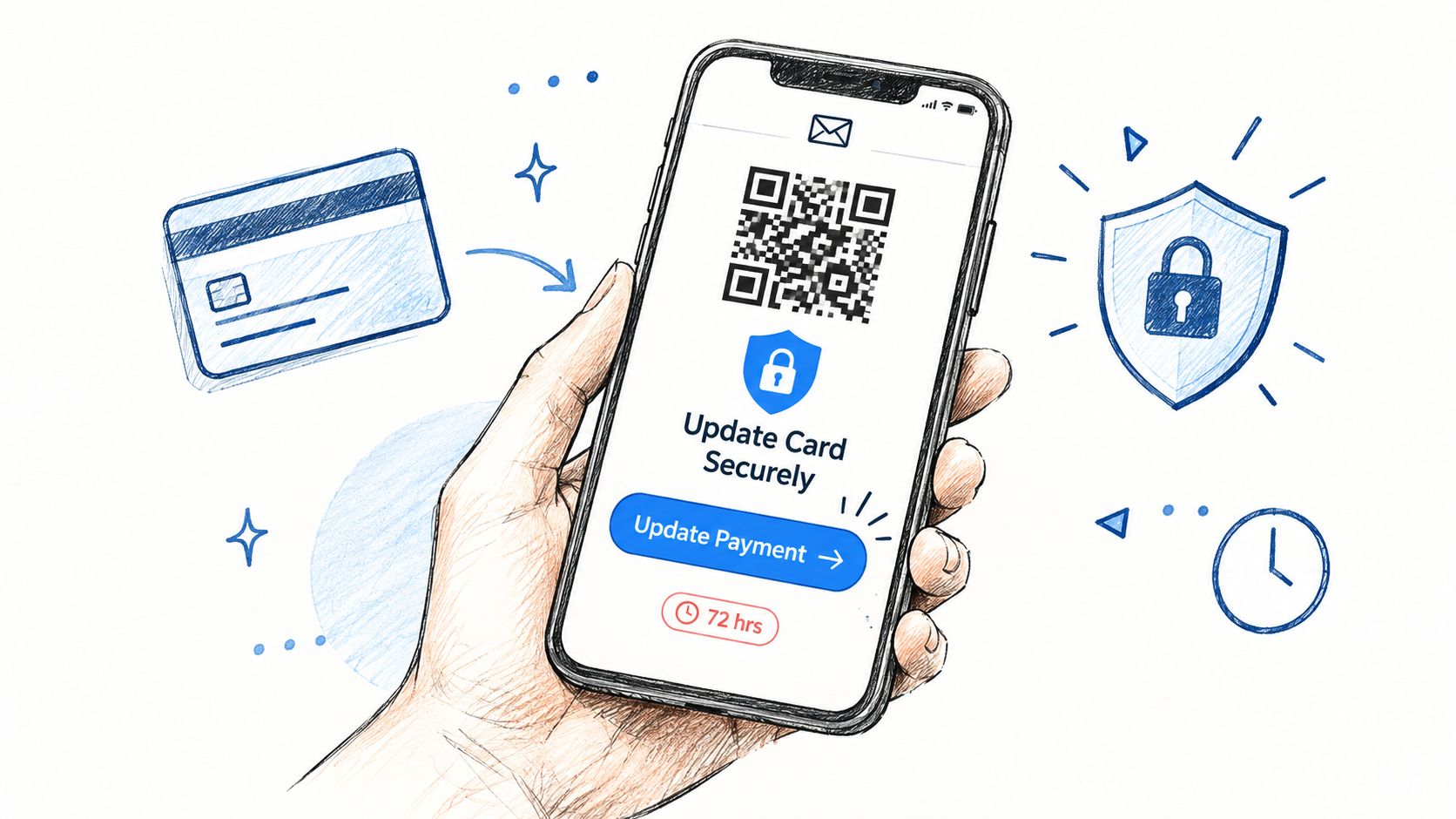
Payment recovery is a high-intent use case because the customer already has an active subscription. The message doesn't need to persuade them to discover the product. It needs to give them a trusted, mobile-friendly way to fix the payment problem and continue the service.
The QR destination should open the correct card-update or payment-retry flow, not the store homepage. Explain the action before the code, use recognizable branding, and include a normal fallback link. Security matters because customers are understandably cautious about scanning an unexplained code in a message about billing. Consumer research cited by Niagara Print Express found that about 60% feel confident QR codes are safe to scan, while 71% find them useful in everyday life, a contrast that points to a trust gap (the QR code trust discussion).
Measure recovery, not just scans
A scan is only an intermediate event. Track the sequence from delivery to portal visit, card-update start, successful payment retry, subscription continuation, and eventual churn. Compare QR-enabled messages with fallback-link activity, but keep the destination and offer consistent enough that the comparison remains meaningful.
RecurX includes decline-aware retry windows, dunning sequences through email, SMS, and WhatsApp, and one-click card-update links. Its payment recovery solutions can be considered alongside a QR route when a merchant wants to provide a second-screen option.
Do not invent deadlines or imply that a payment link is secure without verifying the security design. Test spam placement, expired sessions, mobile loading speed, authentication, and support escalation. A failed recovery flow creates more frustration than a missing QR code.
10. QR Codes in Seasonal and Limited-Time Subscription Campaigns
Seasonal campaigns benefit from dynamic QR codes because the offer, destination, and message may change after the creative has been distributed. A holiday insert can route to a gift subscription before the deadline, then redirect to a standard subscription or evergreen landing page afterward instead of leaving customers with a broken promotion.
Use separate codes for separate channels. A code printed in a direct-mail piece shouldn't be combined with the one used in a social ad if the merchant wants to understand which placement drove the subscription. UTM parameters can identify the source, medium, campaign, creative, and offer while the QR platform or redirect layer records scan activity.
Make urgency specific and honest
A seasonal code should show the actual condition near the code, such as the final redemption date, shipping cutoff, or inventory limitation. The landing page must repeat that information. If the offer has ended, redirecting to a relevant replacement is better than showing an error or removing the promised benefit.
Test alternate copy such as “Scan to save” and “Scan before the offer ends,” but evaluate more than scan volume. A message that attracts curiosity without producing subscriptions, completed checkouts, or retained customers may be weaker than a less dramatic message with clearer intent.
RecurX can support campaign-specific subscription checkout links, free trials, tiered discounts, and bundles or Build-a-Box flows. Keep the seasonal destination mobile-ready and make the subscription terms easy to understand. Customers should know billing frequency, renewal behavior, cancellation options, and what happens when the promotion expires before they complete checkout.
QR Code Advertising Channels, 10-Point Comparison
| Approach | 🔄 Implementation Complexity | 💡 Resource Requirements | 📊 Expected Outcomes | ⚡ Ideal Use Cases | ⭐ Key Advantages |
|---|---|---|---|---|---|
| QR Codes for Direct Subscription Checkout Links | Low–Medium: create quick-checkout URLs and QR assets | Minimal dev + QR generator, RecurX links, analytics | Higher mobile conversions; shortened checkout funnel | Social ads, printed CTAs, campaigns driving instant subscribe | Reduces friction; easy to test; mobile-first |
| QR Codes on Subscription Product Packaging | Medium: packaging redesign & print prep | Packaging design, print runs, dynamic QR option, QA | Increased attach rate at delivery; long-term repeat subscribes | New product launches, replenishment-focused brands | Captures post-purchase momentum; low incremental cost |
| QR Codes in Email Marketing Campaigns | Low: embed QR images into templates | Email platform (Klaviyo/Mailchimp) assets, testing tools | Improved CTR on mobile; better recovery/upsell in emails | Dunning, win-back, post-purchase email sequences | Bridges email→mobile; automatable via RecurX integrations |
| QR Codes in Social Media Advertising | Low: generate campaign-specific QR assets | Creative production, platform ad specs, tracking UTMs | Faster ad-to-checkout conversions on mobile platforms | TikTok/Instagram/Pinterest video & story ads | Reduces app-switch friction; easy A/B per platform |
| QR Codes on In-Store Signage and POS Displays | Medium: print/digital signage and staff alignment | Signage production, durable materials, staff training | Converts foot traffic to online subscriptions; store→online data | Retail displays, shelf talkers, pop-ups | Extends retail reach; low incremental spend |
| QR Codes in SMS and WhatsApp Marketing | Low: attach QR images to messages | Twilio/WhatsApp integration, image optimization, consent | High open/conversion rates; quick recovery actions | Time-sensitive dunning, reactivation, urgent offers | High immediacy and trust in personal channels |
| QR Codes on Influencer & Affiliate Materials | Low–Medium: issue unique codes per partner | Asset pack (PNG/SVG), tracking dashboard, guidelines | Clear attribution; measurable incremental subscriptions | Influencer posts, affiliate campaigns, video content | Simplifies sharing; improves partner tracking |
| QR Codes on Invoices & Order Confirmation Pages | Low: add QR to transactional templates | Email/order template update, RecurX integration | Strong post-purchase conversion; high intent upsells | Post-purchase emails, confirmation pages, receipts | Captures buyers at peak satisfaction; easy to implement |
| QR Codes for Payment Recovery & Card Update Campaigns | Low: generate one-click card-update links | Secure one-click URLs, dunning flow setup, trust messaging | High recovery rates (40–60% on first retry) | Payment decline emails/SMS/WhatsApp dunning | Directly reduces involuntary churn; measurable ROI |
| QR Codes in Seasonal & Limited-Time Campaigns | Medium: campaign coordination & unique codes | Dynamic QR management, creative variants, campaign tracking | Lifted conversion during peaks; urgency-driven spikes | Black Friday, holidays, limited-time promos | Creates urgency; dynamic updates possible mid-campaign |
| QR Codes on Influencer & Affiliate Materials | Low–Medium: issue unique codes per partner | Asset pack (PNG/SVG), tracking dashboard, guidelines | Clear attribution; measurable incremental subscriptions | Influencer posts, affiliate campaigns, video content | Simplifies sharing; improves partner tracking |
Make the Scan Worthwhile and Easy to Measure
The best QR code advertising campaigns begin with a customer moment, not a placement inventory list. A package, confirmation email, shelf card, creator asset, or payment reminder should each have a clear job. The code's job is to open the right next step quickly, while the campaign system's job is to show whether that step led to a valuable outcome.
Start by assigning a distinct code or destination to every meaningful placement. A channel-specific URL makes scans easier to interpret, while consistent UTM parameters keep reporting structured. For example, use the same naming logic across utm_source, utm_medium, and utm_campaign, then add placement or creative identifiers when the campaign needs more detail. Avoid creating so many variations that the team can't maintain them.
Validate the entire mobile journey before launch:
- Destination relevance: Confirm that the scan opens the promised subscription, reorder, portal, or payment action.
- Checkout readiness: Test plan selection, discount handling, account creation, payment, confirmation, and error states.
- Portal access: Confirm that subscribers can pause, skip, swap, change frequency, or update payment without unnecessary support steps.
- Accessibility: Provide descriptive text, a readable fallback URL, strong contrast, and a normal clickable link where the QR code appears.
- Physical reliability: Scan printed materials at their real size, distance, angle, lighting, and surface condition.
- Offer accuracy: Check that dates, eligibility rules, renewal terms, and incentive language match the destination.
Don't optimize for scans alone. Benchmark guidance places print advertising at a typical 2% to 8% scan rate of impressions, event materials at 15% to 35% of attendees, and product packaging at 5% to 15%, showing why context and placement matter (this QR analytics guide). Those figures are planning benchmarks, not promises. The useful question is what happens after the scan.
Measure the funnel from exposure and scan through landing-page engagement, checkout start, completed subscription, first successful renewal, churn, and payment recovery. For QR codes in advertising, the strongest placement may not generate the most scans. It may produce the customers who subscribe, renew, and manage their accounts successfully. Marketers increasingly use QR codes across social media, digital ads, printed materials, and packaging, but execution still determines whether adoption becomes revenue (the 2025 QR code marketing survey summary).
Start with one high-intent placement, such as packaging, a post-purchase confirmation, or payment recovery. Give it one audience, one offer, one destination, and one measurement plan. Expand only after the data shows which audience and customer moment produce the strongest downstream result.
RecurX gives Shopify merchants subscription checkout links, customer portals, payment recovery flows, messaging connections, and subscription analytics that can support QR-based journeys from acquisition through retention. Visit RecurX to connect your next scannable campaign with a mobile checkout or account experience you can measure.
qr codes in advertising · QR code marketing · subscription marketing · campaign tracking · ecommerce advertising
Keep reading
- Strike Through Pricing That Actually ConvertsLearn how to use strike through pricing on Shopify to lift conversions, stay compliant, and run accessible Subscribe & Save offers without losing trust.
- Tiered Discounts ShopifyTiered discounts shopify. Learn how to set up tiered discounts on Shopify, including subscription ramps, anchor billing, and real examples
- Customer Portal Design Principles for Shopify SubscriptionsLearn customer portal design principles for Shopify subscription stores. Covers self-serve UX patterns, accessibility, branding, and localization with examples.
Start growing recurring revenue on Shopify
RecurX has a free-forever plan and zero transaction fees on every tier. Install in minutes.
Install RecurX free →