7 Shopify Subscription Email Tools and Templates
Compare Shopify subscription email tools and workflows for welcome, renewals, dunning, churn prevention, Klaviyo, Mailchimp, and SMS.
Compare Shopify subscription email tools and workflows for welcome, renewals, dunning, churn prevention, Klaviyo, Mailchimp, and SMS.
A customer subscribes to your coffee, supplement, or skincare product. Shopify confirms the order, sends an upcoming-order reminder, and later encounters a failed payment. Weeks afterward, that same customer considers canceling because the product arrived too often, the card expired, or the subscription portal was difficult to use. Each moment needs a different message, trigger, owner, and destination.
Effective Shopify subscription email isn't a collection of attractive templates. It's a message system built around subscription events, clear ownership of native notifications versus ESP-managed campaigns, sensible timing, and a self-serve recovery path. This roundup compares seven options across that stack, from Shopify-native infrastructure and lifecycle automation to payment recovery, migrations, loyalty, Klaviyo and Mailchimp considerations, plus SMS and WhatsApp where shorter channels add urgency. Mailchimp can fit the workflow, but the supplied product information doesn't document a native connector, so merchants should plan deliberate event or tag mapping before relying on it.
Table of Contents
- 1. RecurX
- 2. Klaviyo
- 3. Omnisend
- 4. Recharge
- 5. Loop Subscriptions
- 6. Skio
- 7. Smartrr
- Shopify Subscription Email: 7-Tool Comparison
- Turn the Roundup Into a Send Map
1. RecurX
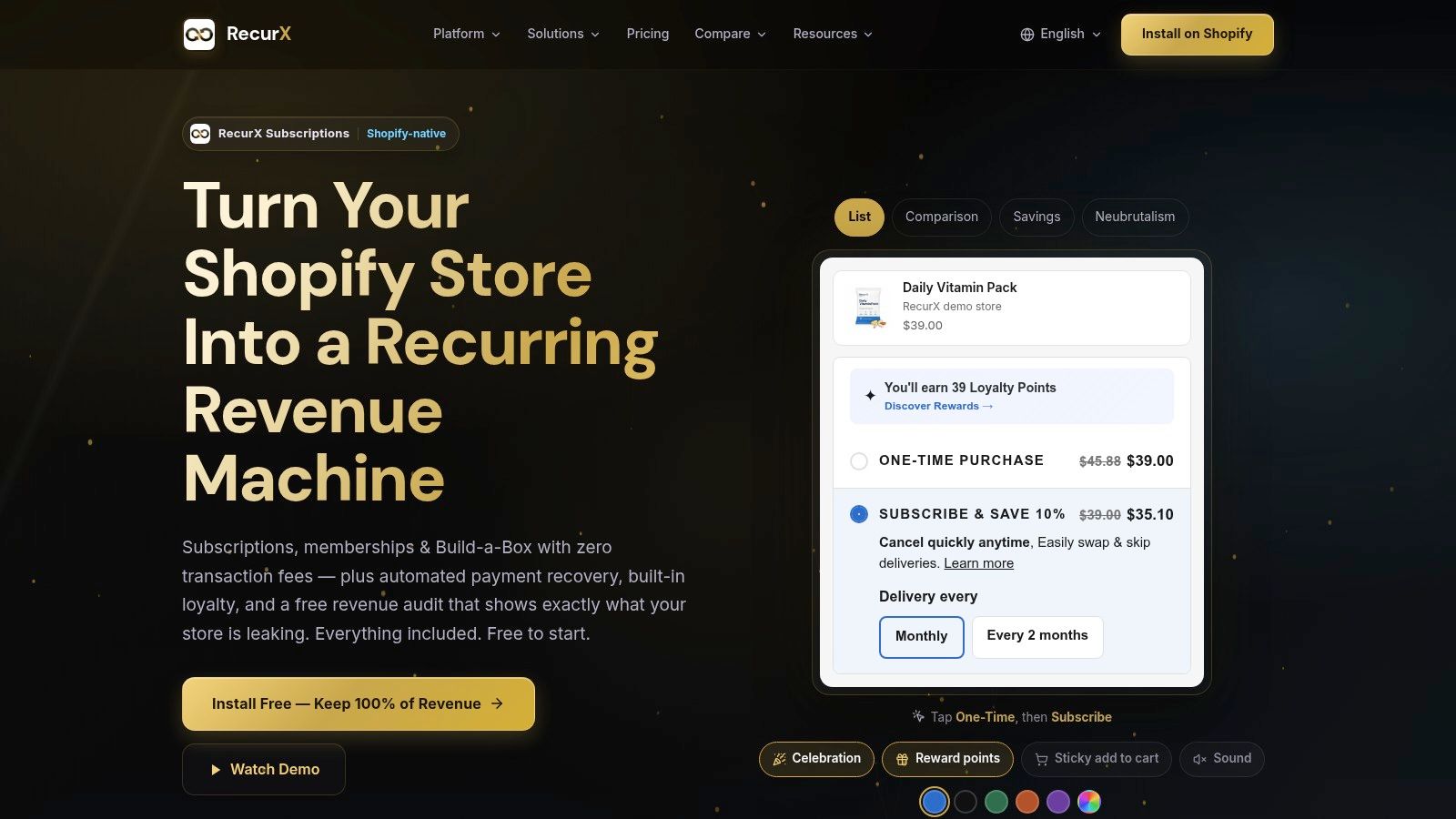
RecurX is the strongest fit when subscription infrastructure and subscriber messaging need to live in the same Shopify-native system. It supports pay-as-you-go, prepaid, memberships, and Build-a-Box models, then connects those plans to a customer portal, loyalty rules, payment recovery, analytics, and notification controls. That matters because the welcome email, renewal reminder, failed-payment message, and cancellation save flow should reflect the customer's actual subscription state rather than a generic purchase tag.
Its storefront widgets are built with Shopify Polaris and App Bridge, without iframes or third-party cookies. Merchants can use 20 WCAG-validated widget templates that match theme colors and fonts, while the customer portal remains on the merchant's domain through native customer-account integration. The portal can let subscribers pause, skip, swap products, change frequency, or update payment details, giving every email a useful destination.
Practical rule: A recovery email works best when its primary button opens the exact account action the customer needs, not a generic homepage.
Why RecurX stands out for messaging
RecurX combines native email templates with email, SMS, and WhatsApp dunning. Decline-aware retry windows, one-click card-update links, loyalty points, VIP tiers, and renewal rewards let the merchant coordinate retention without stitching together separate operational tools. Its automation and tagging can also classify customers by status, plan tier, or behavior for Shopify Flow and segmented marketing.
The analytics layer covers MRR, churn by reason, LTV, ARPU, AOV, cohort retention, and funnel metrics. Migration utilities support Recharge, Bold, Skio, Loop, and Yotpo connections, alongside universal CSV import and token migration where supported. RecurX also positions its supported migration path as targeting about one hour, according to the supplied product information, so it's relevant for agencies and brands leaving legacy platforms.
The trade-off is maturity. RecurX is newer and has a smaller public review footprint and fewer long-term case studies than established incumbents. Some advanced integrations, custom templates, and export capabilities are gated by plan limits. Still, zero transaction fees on every plan, including the free tier, make it attractive for merchants that want to protect recurring-revenue margin while keeping retention features in one admin.
For implementation ideas, use this Shopify subscription email template guide to map welcome, pre-billing, recovery, and cancellation messages to actual subscriber events. Visit RecurX for the product details.
2. Klaviyo
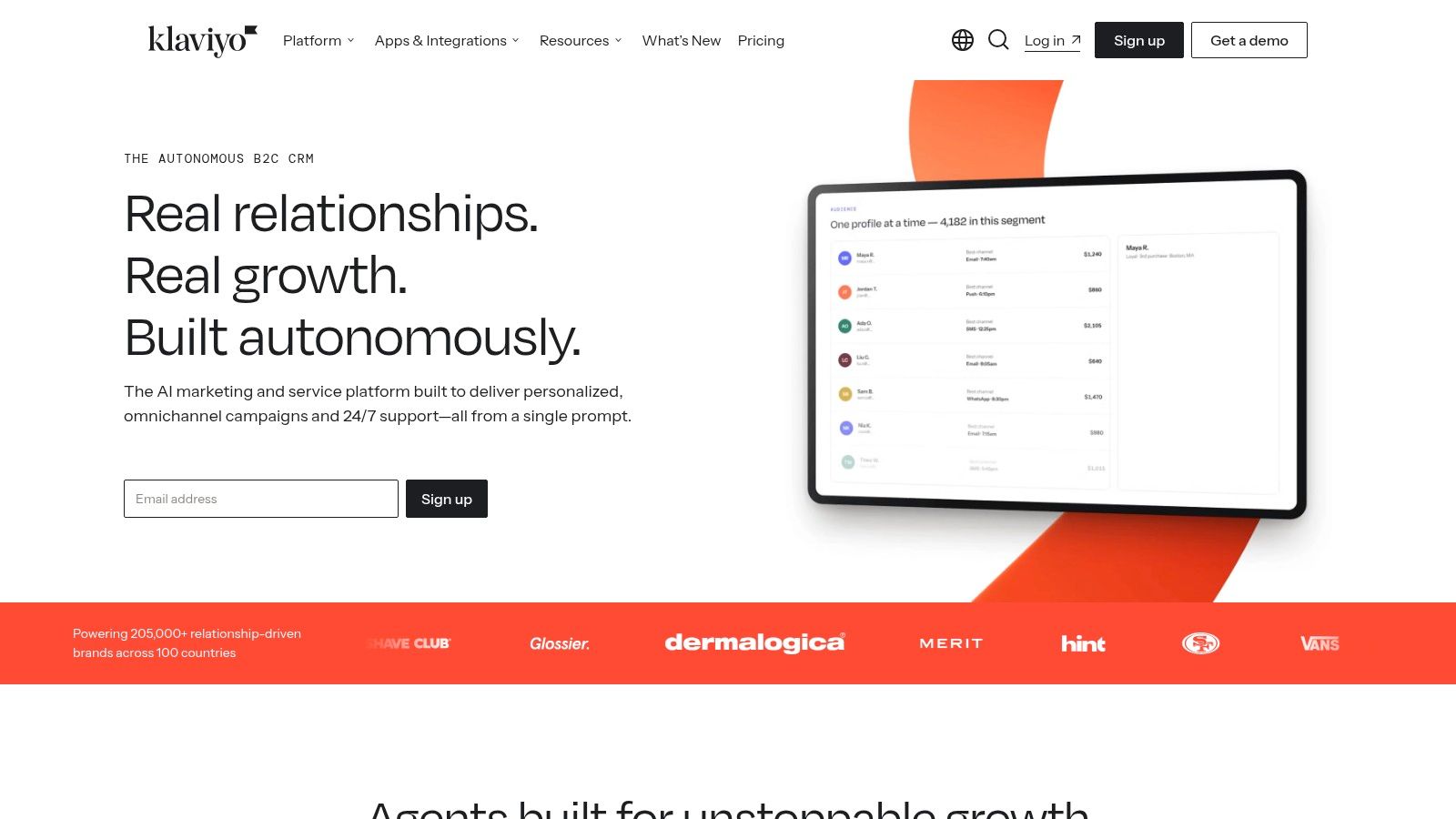
Klaviyo is the lifecycle layer for merchants that already use a dedicated ESP and need detailed segmentation around subscription behavior. It doesn't handle billing. Instead, it receives events from subscription platforms such as Recharge, Skio, Ordergroove, and Loop, then uses those events to trigger personalized email, SMS, and WhatsApp flows.
A useful setup might separate subscription started, upcoming order, payment failed, subscription paused, subscription canceled, and subscription reactivated. Each event can carry product, plan, cadence, and customer properties, allowing the flow to distinguish a first renewal from a long-term subscriber's failed payment. That level of branching is valuable for brands with multiple products or complex save strategies.
Where Klaviyo earns its place
Klaviyo's visual flow builder and segmentation depth are its main advantages. A welcome sequence can educate a new subscriber, a pre-renewal flow can explain how to skip or change a shipment, and a win-back journey can offer different content to customers who paused versus customers who fully canceled. Customer Hub and passwordless OTP can also support a consistent login experience across account and subscription interactions.
The cost and complexity rise with the active profile count. Merchants must map events correctly from the subscription platform, and they must decide which system owns each operational notification. If the subscription app and Klaviyo both send the same upcoming-order or failed-payment email, the customer may receive duplicate messages at the worst possible moment.
Keep billing-state notifications owned by one sender. Use Klaviyo for orchestration only after event names, suppression rules, and portal links are documented.
Klaviyo is a strong choice for teams with a capable lifecycle marketer, an existing data model, and a need for omnichannel branching. Its subscription email marketing workflow guidance is useful when turning subscription states into flow logic. For merchants focused on payment disputes, this resource on stopping chargebacks in Klaviyo adds an adjacent operational consideration.
3. Omnisend
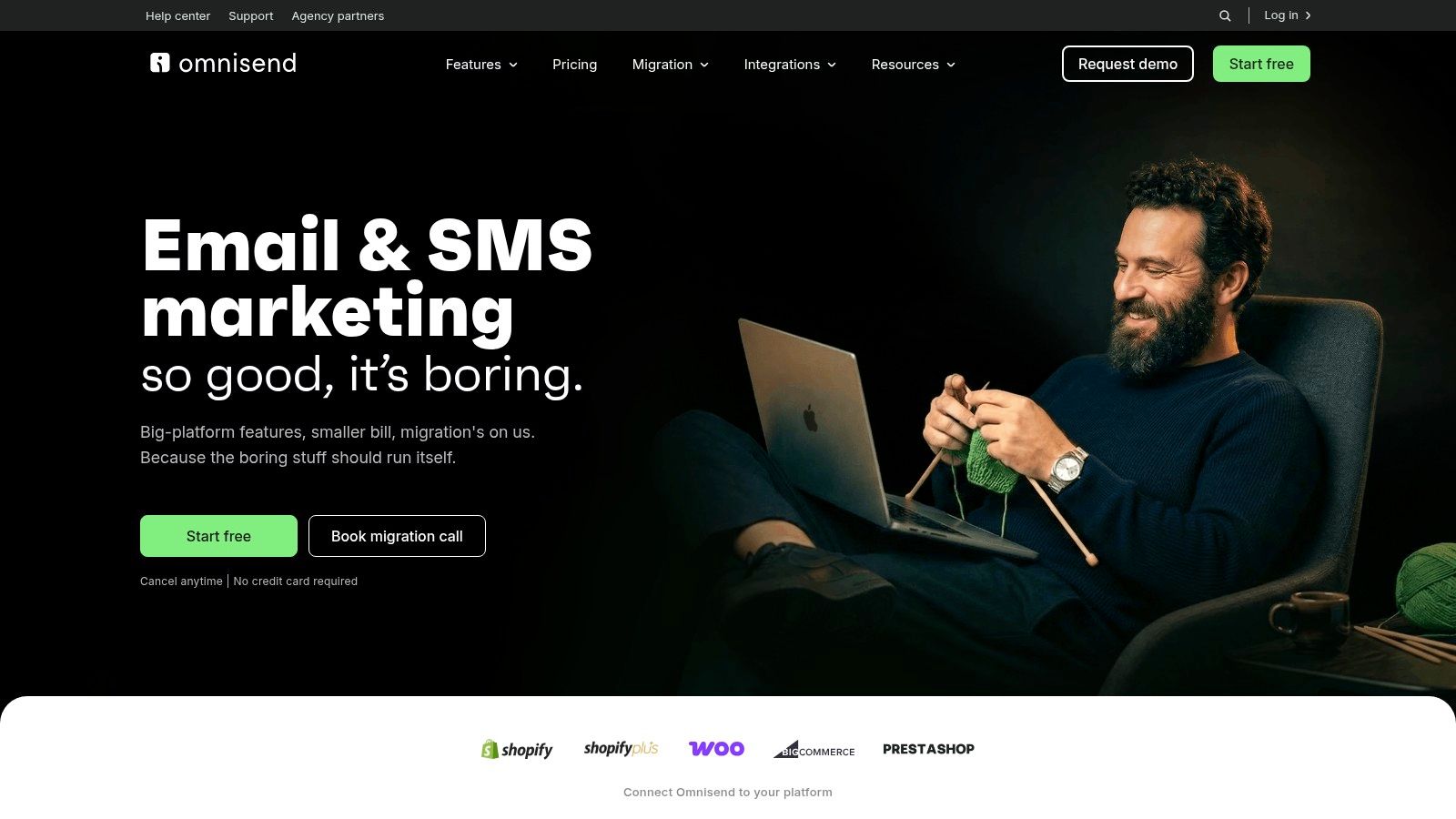
Omnisend suits Shopify merchants that want ecommerce automation without building an especially elaborate customer-data architecture. It connects natively to Shopify and can use subscription states through a Recharge integration or Shopify tags and attributes. That gives teams a practical route to upcoming-order reminders, subscriber education, cancellation win-backs, and basic SMS follow-up.
The platform's visual multi-step flow builder is useful for a straightforward journey. A merchant could trigger an onboarding series after subscription creation, wait for the first delivery, send product-use guidance, then branch based on engagement or subscription status. A canceled subscriber can enter a separate win-back flow, while an active subscriber remains excluded from acquisition promotions that don't fit their current plan.
Best use case and limitation
Omnisend's advantage is clarity. Prebuilt ecommerce automations reduce setup friction, and email and SMS sit under one platform with in-app usage tracking and estimates. That makes it easier for a small retention team to coordinate a renewal email with a time-sensitive SMS without adding another specialist system.
The limitation is data depth. Advanced subscription analytics depend on what the underlying subscription app exposes and how reliably the merchant passes status changes into Shopify. If the program includes multiple brands, intricate plan logic, or extensive customer-level orchestration, Omnisend may require more workarounds than a top-tier ESP or CDP.
Use native subscription notifications for essential account and billing events when the app handles them well. Use Omnisend for marketing-led journeys such as onboarding, product education, replenishment content, and win-back campaigns. Don't make a promotional flow responsible for a payment-recovery event unless the integration clearly passes the failure status and the message links to a working card-update path.
4. Recharge
Recharge combines subscription billing operations with native customer notifications and integrations for dedicated marketing platforms. Its core notification set covers events such as upcoming orders, failed payments, and card updates, while its integration ecosystem supports more advanced lifecycle work in Klaviyo and Omnisend.
That division is practical for a growing subscription business. Recharge can own the operational message that confirms a subscription state or requests payment action, while the ESP handles educational content, segmentation, loyalty messaging, and cancellation prevention. The risk is overlap. Merchants need a written send map showing which platform sends each event, which audiences are suppressed, and which links direct customers to the account portal.
Recovery before promotion
Failed-payment recovery is where Recharge's operational focus matters most. Recovery strategies and timeline logging help teams inspect what happened after a decline rather than treating involuntary churn as a single campaign result. A message can explain the issue in plain language, provide a card-update action, and avoid promotional distractions until the payment problem is resolved.
Shopify's native subscription workflow also demonstrates why timing needs careful ownership. The platform sends a recurring-order reminder three days before each subscription charge, giving customers time to skip, pause, cancel, or update payment details, as documented in Shopify's subscription app information. Merchants using Recharge or another platform should compare its reminder timing and controls with Shopify's native behavior before activating parallel notifications.
Recharge's trade-off is operational complexity and cost structure. Newer plans can include platform and per-transaction components, and smaller teams may need onboarding time to understand the full feature set. For larger programs, its API depth, partner ecosystem, and established recovery tooling can justify that investment.
Use the failed-payment recovery and subscription dunning guide when designing the message sequence, especially around retries, card updates, and suppression.
5. Loop Subscriptions
Loop is a Shopify-native subscription platform with built-in payment recovery, customer notifications, migration support, and a direct Klaviyo integration. Its native emails can cover upcoming orders, payment failures, and expirations, with customizable windows that help merchants align operational communication to their billing schedule.
The direct Klaviyo connection passes subscription events and profile properties into the ESP, which gives lifecycle teams a cleaner route to targeted flows. For example, Klaviyo can distinguish an active subscriber from a churned subscriber, while Loop continues to manage the underlying subscription state and payment process.
A practical migration choice
Loop's migration support is a meaningful advantage for teams moving from another subscription provider. Migration isn't only a data-import problem. It also involves preserving customer expectations, account access, billing dates, payment methods where supported, and the links used in automated messages. A platform that helps coordinate those details can reduce the risk of sending an inaccurate renewal message after launch.
Its advertised $0 per-order fee model is another clear commercial point, but merchants should still evaluate the full plan, required customizations, and integration work. Advanced use cases may require API development, and some brands may prefer to run every customer-facing message through a dedicated ESP rather than use native app emails.
Migration is complete only when a test subscriber can receive the right message, open the right portal, update payment, and see the correct status in every connected system.
Loop works well when the merchant wants strong subscription operations with a relatively direct path into Klaviyo. It's less compelling if the team wants one highly customized messaging system and doesn't want native app notifications active at all.
6. Skio
Skio focuses on subscription speed, customer portal experience, and churn reduction. It provides built-in lifecycle emails for core subscription events and offers SkioSMS for merchants that want a dedicated SMS complement. Its documentation also takes a clear Klaviyo-first position: merchants that prefer Klaviyo for all lifecycle sends should turn off Skio's corresponding emails to prevent duplicate delivery.
That guidance is more important than it sounds. Duplicate renewal reminders create confusion, while duplicate failed-payment messages can make a customer suspect a billing error. Assigning ownership before launch keeps transactional notices, marketing flows, and SMS sequences from competing with one another.
Portal experience versus messaging control
Skio is a good fit for teams that prioritize a fast customer experience and want subscription controls for pricing, shipping, discounts, and recurring price-policy changes. The customer portal should be the destination for most lifecycle CTAs. A renewal reminder can explain the upcoming shipment, but the customer needs a simple path to skip, modify, or update payment without contacting support.
The platform's public pricing and subscription-revenue fee model make evaluation more straightforward, but per-order transaction fees can become a significant consideration as volume grows. Some advanced configurations may also require support-guided setup, which can slow teams that want to own every event and template directly.
Use Skio's native emails when you want the subscription platform to own operational communication. Use Klaviyo instead when segmentation, personalization, and cross-channel orchestration matter more. Don't run both without explicit suppression logic.
7. Smartrr
Smartrr combines subscription management with loyalty and rewards, making it relevant for brands that want retention messaging to reinforce customer value beyond the next shipment. It provides native automated SMS and email notifications across its plans, while a Klaviyo integration supports more advanced ESP-driven flows.
That combination can support a useful retention sequence. An active subscriber might receive a renewal confirmation that highlights points earned, followed by a loyalty message explaining available rewards. A customer considering cancellation could see pause or skip options alongside a reminder of accumulated benefits, provided the message remains clear and doesn't make account management feel manipulative.
Loyalty as a message trigger
Smartrr's strongest distinction is the combined subscription and loyalty stack. Teams can use rewards, milestones, and subscriber benefits as reasons to stay engaged, while the subscription platform continues to handle account operations. This approach works best when the reward has obvious value and the customer can understand how it relates to renewals.
The trade-off is control at the edges. Some advanced settings may require a higher plan or customer-success support, and the platform has fewer third-party tutorials and community resources than longer-established incumbents. Merchants should test every event, especially when Klaviyo is also active, to ensure native SMS and email don't duplicate ESP flows.
Smartrr positions some plans with zero additional transaction fees and offers a 14-day free trial through the Shopify App Store, according to the supplied product information. Confirm current terms before choosing it, since pricing and included features can change.
Shopify Subscription Email: 7-Tool Comparison
| Product | Implementation complexity 🔄 | Resource requirements ⚡ | Expected outcomes 📊 | Ideal use cases 💡 | Key advantages ⭐ |
|---|---|---|---|---|---|
| RecurX | Low, Shopify-native embed; fast migrations (target ~1 hr) 🔄 | Low–Medium, minimal dev work; free tier up to 25 subs ⚡ | ⭐⭐⭐⭐, higher retention; real-time MRR/cohort analytics; ~40–60% first-retry recoveries 📊 | DTC / Shopify Plus teams needing native UX and low-friction migrations 💡 | Zero transaction fees; WCAG-validated widgets; built-in retention stack ⭐ |
| Klaviyo | Medium, requires event mapping from subscription app 🔄 | Medium–High, marketing resources; cost scales with profiles ⚡ | ⭐⭐⭐⭐, best-in-class segmentation and omnichannel engagement 📊 | Brands focused on advanced lifecycle personalization and flows 💡 | Deep segmentation, visual flow builder, large partner ecosystem ⭐ |
| Omnisend | Low–Medium, straightforward Shopify setup; Recharge/tag-based triggers 🔄 | Low–Medium, generally lower TCO vs enterprise ESPs ⚡ | ⭐⭐⭐, effective ecommerce automations (reminders, winbacks) 📊 | SMB ecommerce merchants wanting email+SMS automations at lower cost 💡 | Prebuilt ecommerce flows, unified email+SMS, clear setup guidance ⭐ |
| Recharge | Medium–High, mature feature set; onboarding helpful for complex setups 🔄 | Medium, robust APIs, partner integrations; newer plans may include per-transaction fees ⚡ | ⭐⭐⭐⭐, proven at scale; strong involuntary churn reduction and recovery logs 📊 | Large merchants or teams needing scalable subscription orchestration and integrations 💡 | Battle-tested platform, extensive API/partner ecosystem, robust dunning tools ⭐ |
| Loop Subscriptions | Low–Medium, Shopify-native with migration & admin automation 🔄 | Low–Medium, flat-fee pricing reduces per-order surprises ⚡ | ⭐⭐⭐, reliable recovery and predictable costs; good merchant ratings 📊 | Merchants migrating off legacy apps seeking flat-fee model and simple ops 💡 | Transparent pricing, strong migration support, built-in retries/dunning ⭐ |
| Skio | Low, Klaviyo-first approach; strong portal UX and quick setup 🔄 | Low–Medium, public pricing; per-order fees may apply at scale ⚡ | ⭐⭐⭐, fast time-to-value and polished customer portal; watch per-order costs 📊 | Brands prioritizing customer portal UX and rapid launch 💡 | Clear Klaviyo guidance to avoid double-sends, strong UX, public pricing ⭐ |
| Smartrr | Low–Medium, native notifications plus loyalty features; some setup for advanced configs 🔄 | Low–Medium, multiple plans; some tiers advertise no extra transaction fees ⚡ | ⭐⭐⭐, combined loyalty + subscriptions can lift retention; native SMS/email 📊 | Merchants wanting an integrated subscription + loyalty stack 💡 | Subscription + loyalty in one product, native messaging, flexible plans ⭐ |
Turn the Roundup Into a Send Map
Start with subscription states, not templates. Define what counts as active, paused, skipped, payment-failed, canceled, expired, and reactivated. Then assign ownership for every event. One system should send the essential transactional notice for each billing state, while the ESP can enrich the journey with education, loyalty, personalization, and win-back content.
Shopify's own tooling exposes recipient count, emails sent, open rate, click rate, delivery rate, bounce rate, unsubscribe rate, and spam rate in the admin, as described in its Shopify Email analytics documentation. That makes measurement more useful when teams connect each metric to a job. A failed-payment email needs a working recovery action. A renewal reminder needs engagement and low complaint risk. A win-back flow needs reactivation, not just opens.
Email benchmarks cited in Shopify's marketing guidance include an average campaign open rate of about 31%, a median unsubscribe rate that rose from 0.08% to 0.22% in 2025, and average automated-email revenue of $2.87 per send in 2025, compared with 18 cents for one-off campaigns. Those figures come from Shopify's guidance and should be treated as directional context, not a guarantee for a specific store. Independent benchmark reporting cited for Shopify programs gives campaigns an average open rate of 38.2%, a 3.1% CTR, and campaign revenue per email of about $0.08 to $0.12, while automated flows perform at roughly $0.15 to $0.35 RPE. The sources are not directly interchangeable, so use your own event-level results for decisions.
Build the sequence in operational order
- Choose the transactional owner: Activate native subscription notifications in RecurX, Recharge, Loop, Skio, or Smartrr, or deliberately move those sends into Klaviyo or another ESP. Don't leave both systems active by accident.
- Map the core journeys: Create welcome, first-use education, upcoming-order, failed-payment, cancellation-prevention, and win-back paths. Each message should have one primary action and a destination that reflects the current account state.
- Add the short channels selectively: Use SMS or WhatsApp for urgent payment recovery, imminent renewal context, or a high-value service update. Keep detailed education and preference management in email, where customers have more room to understand the message.
- Test before measuring retention: Send test events for duplicate suppression, card-update links, portal destinations, timing, localization, opt-out handling, and deliverability. Then monitor recovery, churn by reason, subscriber value, and cohort behavior.
For failed payments, avoid treating every decline as a promotional opportunity. Independent retention guidance recommends waiting 2 to 3 days before failed-payment outreach, while the source also emphasizes plain-language messaging and trustworthy account-based management. Coordinate that recovery timing with built-in reminders, retry windows, and customer-service escalation so the customer isn't flooded.
RecurX is especially relevant for Shopify merchants that want built-in email, SMS, WhatsApp dunning, loyalty, analytics, a native customer portal, and zero transaction fees. Klaviyo remains stronger for deep lifecycle orchestration, Omnisend offers accessible ecommerce automation, and Recharge, Loop, Skio, and Smartrr each bring different strengths in billing operations, migration, portal experience, or loyalty. Match the choice to your existing ESP, operational complexity, migration requirements, and willingness to manage integrations.
RecurX brings Shopify-native subscriptions, customer-portal controls, built-in email, SMS and WhatsApp recovery, loyalty features, analytics, and zero transaction fees into one operational stack. If you want to turn subscription events into clearer renewal, dunning, and retention messages without stitching together disconnected tools, visit RecurX and evaluate the setup for your store.
shopify subscription email · subscription email templates · Shopify subscriptions · email dunning · Klaviyo Shopify
Keep reading
- Shopify Subscription API: A Complete Integration Guide 2026Learn how to use the Shopify Subscription API with GraphQL examples, secure authentication, and webhook handling in this 2026 guide.
- Subscription vs One Time Purchase for ShopifyCompare subscription vs one time purchase models for Shopify. Analyze LTV, churn, and MRR impacts, plus how to implement recurring billing with RecurX.
- How to Sell Subscriptions Online on ShopifyLearn how to sell subscriptions online on Shopify. Build flexible plans, optimize checkout, recover failed payments, and boost retention with RecurX.
Start growing recurring revenue on Shopify
RecurX has a 14-day free trial and zero transaction fees on every plan. Install in minutes.
Start your free trial →