Recurring Billing Software Explained for Shopify Growth
Learn how recurring billing software powers Shopify subscriptions, from core features to fees, dunning and analytics. Choose the right fit.
Learn how recurring billing software powers Shopify subscriptions, from core features to fees, dunning and analytics. Choose the right fit.
You launched a Subscribe & Save offer on Shopify. The first customer chose a delivery interval, paid at checkout, and received an order confirmation. It felt like a normal sale, except the next order now has to happen automatically, on the right date, for the right amount, with a valid payment method and a clear path for the customer to pause, skip, or cancel.
That's where the work starts. A subscription creates an ongoing revenue relationship, not just another order. Recurring billing software manages that relationship, from plan rules and invoice creation to payment recovery, churn reporting, and customer self-service. This guide looks at the system through a Shopify merchant's lens, with particular attention to the revenue that disappears when failed payments receive no follow-up. For additional context on the broader operating model, see this guide to ecommerce subscription management.
Table of Contents
- Why Recurring Billing Software Matters for Modern Ecommerce
- How Recurring Billing Software Actually Works
- Core Features Every Recurring Billing Platform Should Include
- How to Evaluate Recurring Billing Software for Shopify
- How Subscriptions Work Inside Shopify From Storefront to Renewal
- Common Misconceptions About Recurring Billing Software
- Your Next Steps to Choosing and Launching Recurring Billing
Why Recurring Billing Software Matters for Modern Ecommerce
A merchant selling coffee might start with one simple offer: deliver a bag every month and give subscribers a discount. Shopify handles the storefront and the initial order. But soon, customers ask to change delivery dates, skip a shipment, swap a roast, or update an expired card. Meanwhile, the operations team needs to know which subscriptions are active, which payments failed, and whether monthly recurring revenue is growing because of new customers or because existing customers are staying longer.
A spreadsheet can record some of those details, but it can't reliably run the subscription lifecycle. Recurring billing software connects the commercial promise to the operational events that fulfill it. It stores the plan, schedules the charge, generates the invoice, communicates with the customer, and determines what happens when the payment doesn't succeed.
The category has expanded well beyond a back-office invoicing tool. One market estimate valued the global subscription and recurring billing management market at USD 10.87 billion in 2025, with a projection of USD 29.72 billion by 2032 and a 15.43% CAGR over the forecast period, as reported in this subscription and recurring billing management market estimate. A separate estimate projected growth from USD 7.15 billion in 2024 to USD 17.95 billion by 2030, at a 16.9% CAGR, in this subscription billing management market report.
The Shopify revenue question
The important question isn't, “Does this app support subscriptions?” Most platforms can create a recurring plan. The stronger question is, how much revenue does the system protect after the first order?
A billing platform affects:
- Cash flow, because successful renewals arrive on a predictable schedule.
- Retention, because customers can manage their plans without contacting support.
- Margin, because transaction fees and recovery costs reduce the value of each renewal.
- Customer trust, because billing dates, prices, receipts, and cancellation terms stay visible.
- Decision quality, because analytics separate active subscriptions, churn, and payment failures.
PayPal's 2020 Small Business Report found that 43% of small businesses worldwide were already using subscriptions, while 71% said subscriptions helped improve retention and 58% said they increased sales. Those figures provide useful historical context, but the operational lesson is current: subscription growth depends on more than persuading a shopper to opt in. The billing system must keep the relationship healthy after checkout.
How Recurring Billing Software Actually Works
Think of recurring billing like a utility service. A customer signs up for water or electricity once, agrees to the terms, and receives charges based on an agreed schedule or measured usage. The provider doesn't recreate the customer relationship from scratch every month. It maintains an account, calculates what is due, sends a bill, collects payment, and follows up when collection fails.
An ecommerce subscription follows the same basic pattern.
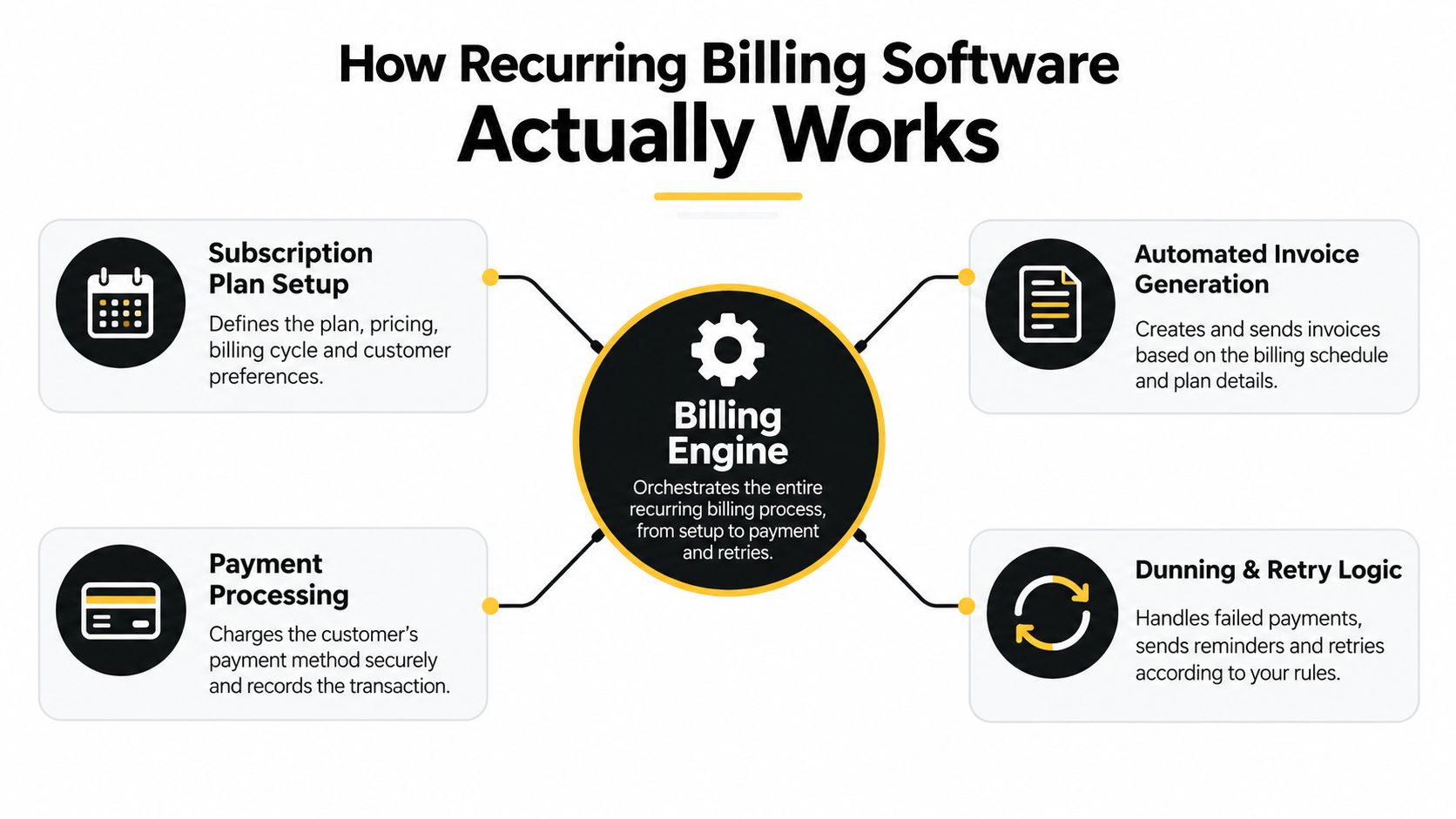
Step one creates the commercial rules
The merchant defines the product, price, billing interval, discount, delivery terms, and eligibility conditions. A plan might charge customers monthly, or it might use a prepaid structure where the customer pays for several future deliveries at once. Some merchants also use an anchor date, such as billing every month on the first business day, rather than counting from each customer's signup date.
The plan needs a lifecycle as well. Customers may upgrade, downgrade, pause, skip an order, swap an item, or cancel. If a change happens between billing dates, the software applies the merchant's proration rules or schedules the change for the next cycle. That prevents the team from manually calculating credits and partial charges.
Step two turns the plan into an order and invoice
At checkout, the customer agrees to the recurring terms and provides payment details. The first order confirms the purchase. The subscription record then stores the schedule and the customer's entitlement, meaning what the customer is allowed to receive or access while the plan remains active.
Before each renewal, the billing engine checks the subscription status, calculates the amount due, creates the invoice or renewal order, and sends the payment request. Tax, discounts, shipping, and product changes must follow the rules attached to that subscription.
Step three handles the payment result
A successful payment keeps the subscription active and triggers the next fulfillment or access event. A failed payment creates a different workflow. The system should identify the decline, decide whether and when to retry, notify the customer, and provide a direct way to update the payment method.
This is why ecommerce recurring payments are only one part of the system. The charge itself is an event. Recurring billing software manages the schedule, invoice, customer communication, recovery process, and reporting around that event.
Practical rule: Treat every renewal as a small operational workflow, not as an isolated card charge.
Step four records revenue performance
A useful analytics layer defines MRR as the monthly-normalized value of active subscriptions, while excluding taxes, free plans, and usage-based products. Stripe's subscription analytics documentation also distinguishes active and past-due subscriptions, identifies churn when a subscription is canceled or marked unpaid, and groups customers into cohorts based on the first month that they generate positive MRR.
That structure matters because a store can lose revenue without losing the same number of subscribers. Subscription churn counts customer relationships that end. Revenue churn shows the value that disappears. Cohort retention helps the team see whether newer customers are behaving differently from older ones.
Core Features Every Recurring Billing Platform Should Include
A feature checklist can make two platforms look identical. A better approach is to map each capability to a merchant problem. A plan builder matters because offers change. A portal matters because customers shouldn't need support to skip a shipment. Dunning matters because a declined card isn't always a decision to leave.
Flexible subscription management
The platform should support more than a fixed monthly charge. Look for pay-as-you-go plans, prepaid subscriptions, memberships, free trials, anchor-date billing, tiered discounts, and Build-a-Box configurations where they fit your catalog.
A supplements brand may want a discounted recurring plan with a different price after several successful orders. A pet food merchant may need customers to change quantity without canceling. A coffee store may sell a curated box and a mix-and-match box. These are different commercial rules, so the platform should represent them directly instead of forcing the team to build manual workarounds.
Storefront presentation also affects adoption. Widgets should match the Shopify theme, display billing terms clearly, and maintain accessible color contrast. A technically strong plan won't help if shoppers can't understand the offer on the product page.
Self-service customer control
The customer portal should let subscribers:
- Pause or skip, when they have enough product.
- Swap products, when preferences change.
- Change frequency, when the delivery cadence no longer fits.
- Update payment details, without contacting support.
- Cancel clearly, with immediate confirmation and no confusing detours.
Self-service protects both sides of the relationship. Customers get control, while support teams avoid handling routine changes manually. The portal should live on the merchant's domain and connect naturally with Shopify customer accounts where possible.
Payment recovery and dunning
Failed payments deserve more attention than many feature pages give them. Independent reporting estimates that 13% of recurring card transactions are declined, and that 60% to 69% of those failures become permanent revenue loss without intervention. The same reporting estimated that subscription businesses lost about USD 129 billion to failed payments in 2025, as described in this failed-payment infrastructure research.
Dunning is the coordinated response: decline-aware retries, customer messages, and a simple card-update path. Industry benchmark reporting places median involuntary churn around 1.5% to 2.5% monthly, compared with about 0.5% to 1.0% when modern retry and dunning automation are used. It also reports smart-retry recovery of roughly 70% to 85% of recoverable failed payments, compared with 40% to 60% for fixed schedules, in this subscription billing benchmark analysis.
Analytics that explain the leak
MRR alone isn't enough. The dashboard should show:
- Churn by reason, separating voluntary cancellation from payment failure.
- Revenue churn, so large-value losses don't disappear inside customer counts.
- Cohort retention, to compare subscriber groups over time.
- LTV, ARPU, and AOV, for customer and order economics.
- Funnel performance, from product-page exposure through post-purchase renewal.
These metrics help the team choose the right intervention. A cancellation survey may address voluntary churn. A card updater and retry workflow address involuntary churn. A bundle or loyalty program may improve order value without changing the billing schedule.
Connected automation
The billing platform should pass subscription status into Shopify Flow and marketing systems. Integrations with tools such as Klaviyo, Mailchimp, Twilio, WhatsApp Business, and Omnisend can coordinate renewal reminders, failed-payment messages, win-back campaigns, and loyalty communication.
For a broader buying framework, merchants can compare capabilities in this guide to subscription billing software options. The key is to evaluate the complete system, not isolated widgets.
How to Evaluate Recurring Billing Software for Shopify
Shopify merchants often compare apps by plan price and visible features. That approach misses the costs that appear after launch, especially per-order fees, support work, payment recovery gaps, and migration friction.
Start with the economics. A platform that charges a transaction fee on every renewal may become more expensive as subscription revenue grows, even if its monthly app price looks modest. Ask for a clear calculation using your own average order value, renewal volume, discounts, refunds, and failed-payment recovery process.
| Evaluation Criteria | What to Look For | Why It Matters |
|---|---|---|
| Fee structure | App fees, transaction fees, gateway costs, add-on charges | Protects contribution margin on every renewal |
| Shopify integration | Native checkout, Shopify admin alignment, customer-account support | Reduces operational gaps between orders and subscriptions |
| Plan flexibility | Prepaid, recurring, bundles, usage components, anchor dates | Lets the offer match how customers actually buy |
| Customer portal | Pause, skip, swap, frequency changes, payment updates, cancellation | Reduces support dependence and frustration |
| Dunning capability | Decline-aware retries, messaging, card-update links, reporting | Recovers eligible revenue instead of ending subscriptions immediately |
| Analytics | MRR, churn reason, revenue churn, cohorts, LTV, funnel data | Shows where retention and margin problems originate |
| Migration | CSV import, platform connectors, token migration where supported | Limits disruption when moving from another provider |
| Localization | Languages, currencies, invoice formats, regional tax workflows | Supports cross-border selling without hiding compliance gaps |
Native Shopify versus standalone infrastructure
A native Shopify app usually keeps the merchant's storefront, checkout, admin, and customer records closer together. That can reduce integration work and make daily operations easier for teams already living inside Shopify.
A standalone billing platform may offer deeper contract, usage, or finance workflows. That can be useful for businesses with negotiated agreements, complex billing entities, or a separate enterprise resource planning stack. The tradeoff is often more implementation effort and more responsibility for keeping customer, order, and subscription data synchronized.
Score the recovery workflow, not the sales demo
Ask the vendor to show a failed renewal from start to finish. You should see the decline reason, retry timing, notification sequence, card-update experience, subscription status, and resulting analytics. If the platform only demonstrates a successful checkout, you haven't tested the part most likely to affect retained revenue.
The strongest evaluation question is not “Can it charge a customer?” It's “What does it do when the charge fails?”
How Subscriptions Work Inside Shopify From Storefront to Renewal
A Shopify subscription begins where the shopper makes a decision, usually the product detail page. The subscription widget needs to explain the price, delivery interval, and renewal terms without making the customer hunt through small text. A theme-matched design helps the offer feel like part of the store rather than an external checkout layer.
The first order establishes the relationship
A shopper selects a one-time purchase or subscription option, chooses any available frequency, and proceeds through Shopify checkout. The initial order creates the first fulfillment event and establishes the subscription terms that guide later renewals.
Some campaigns skip the product page. A merchant can use a quick checkout link in an email, social campaign, or QR code on printed packaging. That route is useful when the audience already understands the product and the offer.
The portal handles everyday changes
After purchase, the customer should have a clear account area. A coffee subscriber may skip the next delivery because they're traveling. A skincare customer may swap a product after trying a different formula. A pet owner may change the frequency when their household needs change.
Those actions should update the subscription record and the next order without requiring a support agent to edit the account manually. The portal is also where customers update a payment method and confirm cancellation.
Renewal triggers payment and fulfillment
At the scheduled renewal, the billing engine calculates the amount, applies the plan's discount and product rules, and submits the payment. Shopify receives the resulting order or fulfillment instruction, while the customer receives the appropriate confirmation.
If the payment fails, the recovery workflow begins. The platform can retry according to the decline context, send an email or message with a card-update link, and keep the merchant's team informed. A subscription should not be labeled voluntary churn when the customer never chose to leave.
Loyalty makes the next renewal more valuable
Loyalty can connect the renewal event to a retention incentive. A merchant might award points for each successful renewal, offer milestone bonuses, or create VIP tiers. The reward should be easy to understand and compatible with the subscription price rather than hidden inside a separate program.
Bundles and Build-a-Box flows add another layer. They let customers select a curated combination while the billing system preserves a single recurring relationship. Integrations with Klaviyo, WhatsApp, or other messaging systems can then personalize reminders and offers based on plan status and behavior.
A short visual walkthrough can help a new operations team understand the sequence:
Common Misconceptions About Recurring Billing Software
Subscription billing isn't just a monthly charge. A subscription can be weekly, annual, prepaid, usage-based, tiered, or hybrid. Cross-border selling may also require localized payment methods, currencies, invoices, and tax workflows. Recent industry coverage highlights hybrid subscription-plus-usage pricing, entitlement visibility, AI-assisted collections, and e-invoicing readiness as important parts of the evolving category, as outlined in this recurring billing management software market coverage.
Any billing tool won't automatically fit Shopify. The platform must connect the storefront offer, Shopify order creation, customer accounts, fulfillment, payment status, and marketing segmentation. A tool can process recurring payments yet still create friction if customers manage subscriptions somewhere unfamiliar or if support agents need to reconcile records manually.
Dunning isn't an optional add-on. A customer whose card fails may still want the product. Immediate cancellation turns a recoverable payment problem into lost revenue. Retry timing, decline classification, customer messaging, and card updates belong in the core operating workflow.
More customization isn't always better. A complex billing engine can add cost and implementation work without improving a simple Subscribe & Save offer. Start with the plan structures, customer controls, recovery rules, analytics, and integrations your team needs now. Add a separate monetization or ERP layer when usage rating, contract logic, multi-entity accounting, or regional compliance exceeds the Shopify application's role.
Your Next Steps to Choosing and Launching Recurring Billing
Treat the purchase as an infrastructure decision, not a widget decision. The right recurring billing software should protect the full revenue loop: a clear subscription offer, a reliable renewal, a recoverable failed payment, a manageable customer account, and analytics that explain the outcome.
Use a short launch checklist:
- Model the economics. Include app charges, transaction fees, payment costs, discounts, refunds, and recovered versus unrecovered renewals.
- Test the customer journey. Subscribe from the product page, complete checkout, open the portal, pause, skip, swap, update payment details, and cancel.
- Test failure paths. Confirm what happens after a declined card, how retries are scheduled, what messages are sent, and when the subscription changes status.
- Validate reporting. Check MRR definitions, churn reasons, cohort views, revenue churn, and data exports.
- Plan migration carefully. If you're moving from Recharge, Bold, Skio, Loop, or Yotpo, confirm how customer records, subscription dates, discounts, and payment tokens will transfer where supported.
- Run a controlled launch. Begin with a focused product group, monitor renewals and support requests, then expand the offer.
RecurX is one Shopify-native option that combines subscription plans, customer-portal controls, payment recovery, analytics, loyalty, bundles, localization, and integrations within Shopify workflows. Evaluate it alongside other platforms by testing the renewal and recovery experience, not just the initial setup.
RecurX helps Shopify merchants create recurring plans, memberships, prepaid offers, and Build-a-Box subscriptions while giving customers tools to pause, skip, swap, or update payment details. Visit RecurX to review its Shopify-native billing, payment recovery, analytics, and loyalty capabilities for your store.
recurring billing software · Shopify subscriptions · subscription billing · ecommerce retention · dunning management
Keep reading
- Strike Through Pricing That Actually ConvertsLearn how to use strike through pricing on Shopify to lift conversions, stay compliant, and run accessible Subscribe & Save offers without losing trust.
- Tiered Discounts ShopifyTiered discounts shopify. Learn how to set up tiered discounts on Shopify, including subscription ramps, anchor billing, and real examples
- Customer Portal Design Principles for Shopify SubscriptionsLearn customer portal design principles for Shopify subscription stores. Covers self-serve UX patterns, accessibility, branding, and localization with examples.
Start growing recurring revenue on Shopify
RecurX has a free-forever plan and zero transaction fees on every tier. Install in minutes.
Install RecurX free →